
Traditional Knowledge is helping Himalayan villages fight climate change, save water, and protect forests. Discover 7 powerful lessons before they vanish.
Forget the weather app on your phone for a second. In parts of Himachal Pradesh and Ladakh, farmers have predicted the length of winter for generations simply by watching how long a Himalayan marmot sleeps since the duration of the marmot’s hibernation was traditionally read as a sign of how long the snowfall and cold would last. No satellites. No apps. Just centuries of careful watching passed down from grandparent to grandchild.
This is Traditional Knowledge. And it is not some dusty museum piece. It is a living toolkit that Himalayan communities are still using today to manage water, protect forests, predict storms, and hold their villages together, even as climate change makes mountain life harder every year.
In this article, we look at 7 powerful examples of this knowledge, why it works, and why we are at risk of losing it faster than we can write it down.
What Do We Actually Mean by “Traditional Knowledge”?
Traditional Knowledge simply means the practical wisdom that local communities build up over generations by living closely with their land. It is not written in textbooks. It lives in the hands of farmers, the memory of elders, and the songs sung at festivals. It covers everything from how to grow crops on a steep slope to how to read the sky before a storm.
For Himalayan communities, this knowledge was never a hobby. It was survival. And as we will see, a lot of it still works better than we give it credit for.
1. Kuhls; The 300-Year-Old Water Hack Engineers Still Study
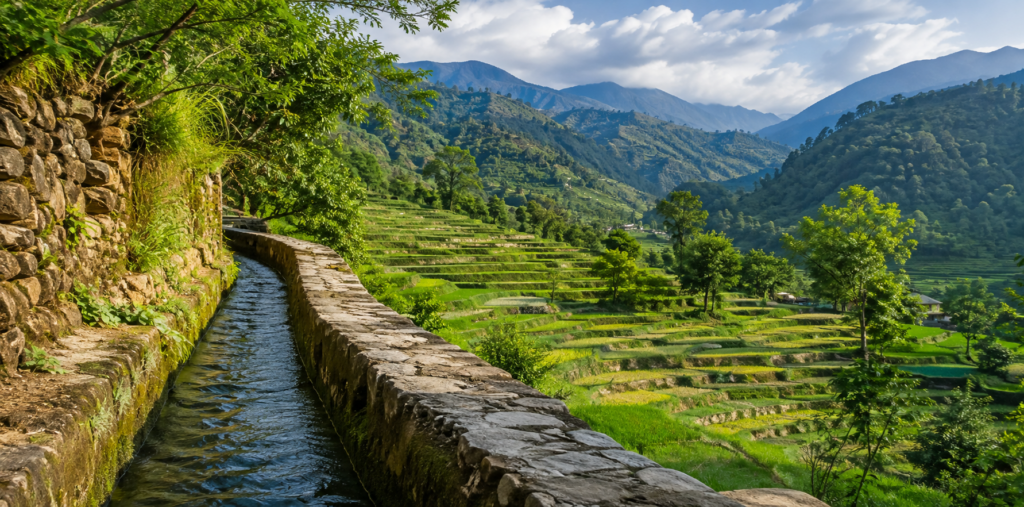
Long before pipelines and pumps, villages in Himachal Pradesh’s Kangra Valley built kuhls, narrow hand-dug channels that use gravity alone to carry glacial meltwater from mountain streams straight to the fields. These community-managed, interconnected gravity-flow systems still irrigate the Kangra Valley below the Dhauladhar range today.
The numbers are genuinely surprising. Kangra valley alone has close to 715 major kuhls and over 2,500 minor ones, together irrigating more than 30,000 hectares of land. Many of these were sponsored by the pre-colonial Katoch rulers of Kangra, which is why several kuhls still carry royal names, like the Kirpal Chand Kuhl that runs through Palampur.
Every kuhl is looked after by a kohli, a traditional water master responsible for fair distribution and settling disputes. As one Kangra farmer put it, kuhls are the lifeline for farmers whose livelihood depends entirely on them, and are passed on to their children as a legacy. That is not sentiment. It is engineering that has outlasted empires.
Want to see it in action? There’s a short documentary called “Kuhl Ki Kahani” that shows how a Palampur village revived its ancient irrigation channel.
2. Sacred Groves; Free Biodiversity Parks With Zero Government Funding
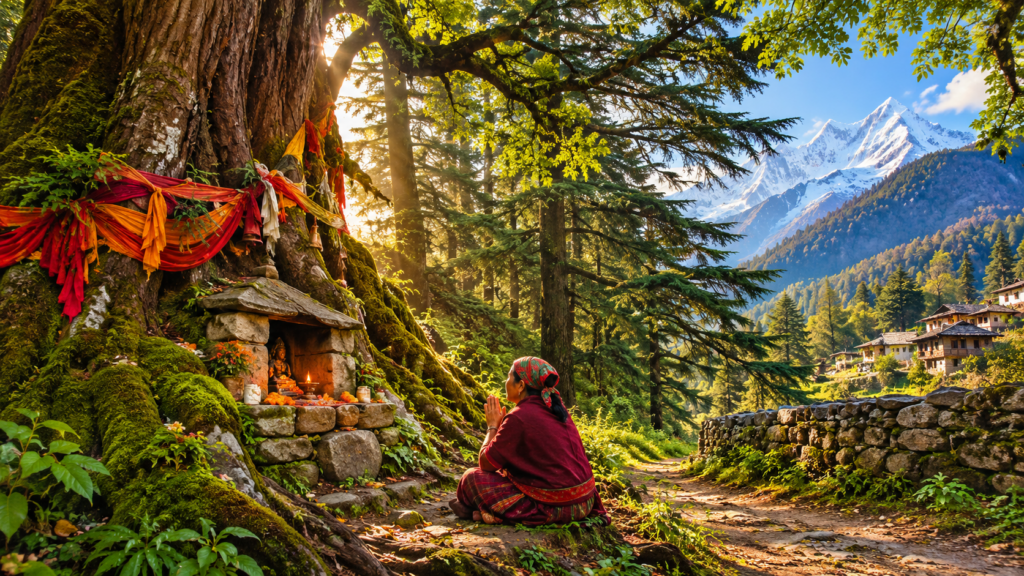
Here’s a fact that should embarrass a few conservation departments: Himachal Pradesh’s forest patches known as Dev Van, or “God’s Forest,” have been protected purely through community belief and taboo, with a total of 514 sacred groves documented across the state.
In Uttarakhand, known locally as Dev Bhumi or the “abode of gods,” sacred groves like Hariyali Devi and Tungnath have survived for the same reason: nobody dares cut a tree there. India as a whole is estimated to have somewhere between 100,000 and 150,000 such groves. That’s more protected forest patches than most national conservation schemes could ever fund or fence.
These groves work because traditional societies are deeply interconnected with nature, depending on it for livelihood, and that bond stretches beyond economics into social, cultural, and spiritual life. No entry fee. No forest guard. Just faith doing the job of policy.
3. Reading the Sky: Traditional Weather Forecasting That Still Works
Before meteorology, Himalayan farmers already had a working forecast system, and parts of it are surprisingly accurate. Bird migration patterns were the oldest and most common indicator for predicting the onset and length of snowfall, while the height and direction at which birds built nests on poplar trees hinted at how hot the coming summer would be.
In parts of rural India, farmers even consulted the village Pandit, who used the traditional Panchangam calendar and star positions to time sowing and predict rain. This wasn’t superstition dressed up. It was generations of pattern recognition, tested one harvest at a time.
The sad part? Farmers themselves say that unpredictable modern weather, combined with fewer elders around to interpret the signs, is making these old indicators less reliable and harder to pass on. Some researchers now want this knowledge formally recognised. One recent paper suggests setting up local “Traditional Knowledge Weather Centers,” staffed by youth trained in both indigenous observation and modern meteorology. That’s not nostalgia. That’s smart hybrid science.
4. The Chipko Movement; When Hugging Trees Changed National Law
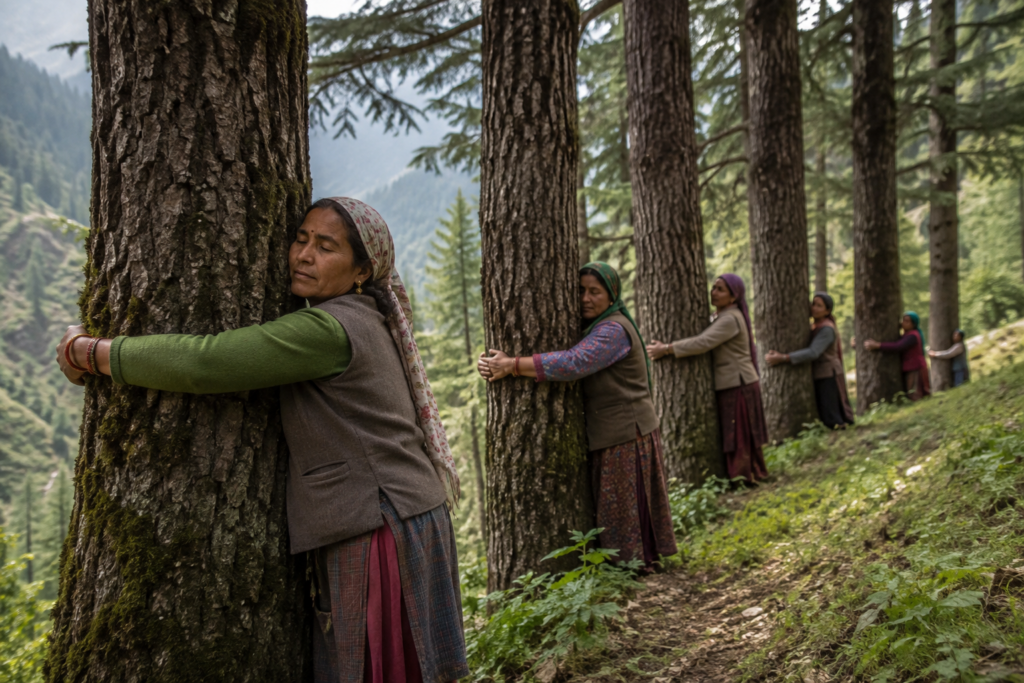
If you want proof that traditional ecological respect can move governments, look at Chipko. In 1974, women from the villages of Reni and Mandal in Uttarakhand physically wrapped their arms around trees to stop loggers, led by a village leader named Gaura Devi.
It worked. The movement led to a 15-year ban on commercial logging in the Himalayan forests of what was then Uttar Pradesh, ordered by Prime Minister Indira Gandhi in 1980. Leaders like Sunderlal Bahuguna and Chandi Prasad Bhatt worked to connect this traditional respect for forests with modern scientific ideas like watershed protection, effectively bridging old wisdom with new science.
Chipko proves something important: Traditional Knowledge isn’t passive. It can organise, protest, and win.
5. Festivals, Panchayats, and the Glue That Holds Villages Together
Himalayan life was never just about survival, it was also about belonging. Community institutions like Van Panchayats, or forest councils, have managed forests sustainably in Uttarakhand for generations, alongside seasonal transhumance patterns that move herds between summer and winter pastures.
Festivals tied to sacred groves and deities weren’t just celebrations either. Communities used these festivals to reaffirm their commitment to protecting both the forest and the local deity, turning conservation into a shared, joyful ritual rather than a rule imposed from outside.
This is collective decision-making at its most practical: no committee meetings, no paperwork, just a shared calendar of duty and celebration.
6. Grandma’s Stories Are a Survival Manual
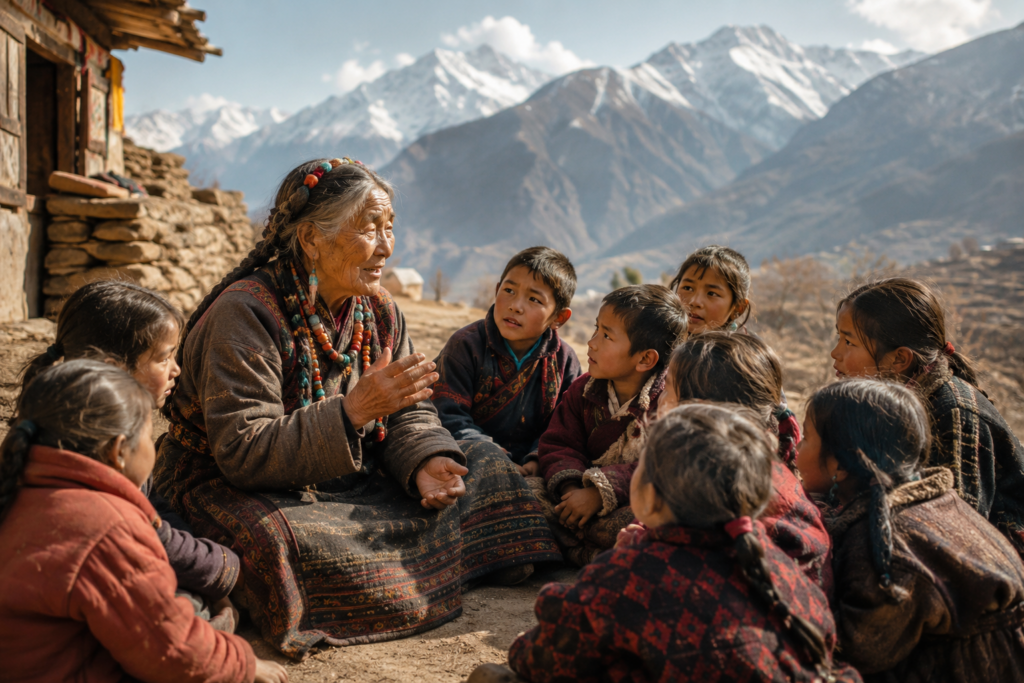
Traditional Ecological Knowledge has one weak point: it lives in people, not in books. It is transmitted orally, from elder to younger generation, within a living community context, and when young people migrate before this transmission happens, the knowledge simply disappears with the generation that held it.
That loss matters more than it sounds. In the age of climate change, this is particularly painful because this kind of localised, adaptive knowledge is exactly what formal climate science struggles to replicate. Folk almanacs, seasonal songs, and stories about which plant cures what altitude sickness aren’t just charming heritage. They’re data, encoded in memory instead of a spreadsheet.
7. The Real Threat: Why Himalayan Villages Are Losing Their Memory
Here’s the uncomfortable part. Across many Himalayan regions, younger generations are abandoning agricultural land for cities, driven by both declining farm viability and the pull of urban opportunity, leaving rural areas ageing and undermining the transfer of traditional knowledge. In some places, abandoned terraced fields are literally reverting to scrubland, raising the risk of erosion.
A recent UN Chronicle piece described it starkly: across valleys in Uttarakhand that were once alive with terraced fields, festivals, and village schools, families are leaving not by choice, but because they have to.
Himalayan Geographic Research Foundation (HGRF) has been tracking this closely too. In their own words on the risk of turning heritage into tourism spectacle: villages in Kinnaur and Lahaul are being promoted as tourist destinations, growing beautiful and photogenic, but increasingly empty, with culture preserved for visitors rather than for the people who created it.
Nikhil Raj Sharma, Founder, Himalayan Geographic Research Foundation
“When we talk about traditional knowledge, we are not talking about the past. We are talking about a working system that has kept these mountains alive for centuries. Every kuhl a farmer maintains, every sacred grove a village protects, every weather sign an elder reads, these are lessons in survival that no textbook can replace. At Himalayan Geographic, our concern is simple: if the youth leave before this knowledge is passed on, we lose more than culture, we lose a proven blueprint for living with these mountains, not against them. That blueprint deserves to be documented, respected, and carried forward.”
“A village without its youth is a library without its books.” — Nikhil Raj Sharma, Founder, Himalayan Geographic Research Foundation
So What Can We Actually Do About It?
The good news is that this fight isn’t being ignored anymore. Even the IPCC’s climate reports now formally recognise that Indigenous, local, and traditional knowledge systems are a major resource for climate adaptation, and that integrating them with modern practices makes adaptation more effective. The problem is that while nearly 70% of national climate adaptation plans across mountain countries acknowledge Indigenous knowledge as valuable, only around 12% of actual planned actions do anything concrete about it.
Here’s what actually helps close that gap:
- Document it now: Record elders on video and audio before the knowledge disappears with them.
- Bring it into schools: Teach kuhl systems, sacred grove ecology, and seasonal wisdom alongside regular science.
- Fund youth-led revival projects: Like the kuhl restoration shown in “Kuhl Ki Kahani.”
- Pair old and new: Combine traditional weather-reading with modern meteorology instead of replacing one with the other.
- Support community tourism done right: Where locals lead and benefit, not where culture becomes a backdrop for someone else’s photos.
Final Thought
Traditional Knowledge isn’t asking to be preserved in a museum. It’s asking to be used, the way it always was: by people living on these mountains, making smart decisions with what their grandparents taught them. The kuhls still flow. The sacred groves still stand. The question is whether we’ll still have anyone left who knows how to read a marmot’s sleep before it’s too late.
Related Reads on HGRF:
- Education Is Emptying the Himalayas
- Vanishing Youth, Warming Peaks: Rethinking Himalayan Community Resilience
Resources:
- Kuhl irrigation (Himachal Pradesh) — Wikipedia
- “Kuhl, kohli and a lost tradition” — India Water Portal
- “Kuhl Ki Kahani” documentary — YouTube
- Sacred Groves of Himachal Pradesh — Bentham Science
- “50 Years On: The Legacy of India’s Chipko Movement” — Earth.Org
- UNESCO — Local and Indigenous Knowledge Systems and Climate Change
- “Migration in the Mountains” — UN Chronicle
- Weather Forecasting: Traditional Knowledge of Uttarakhand Himalaya (ResearchGate)
Disclaimer: The content and images published in this article are provided for general informational and educational purposes only. Some images may be generated or enhanced using artificial intelligence (AI) and are intended solely for illustrative use. The views, interpretations, and information expressed do not necessarily reflect the official position of Himalayan Geographic Research Foundation, nor do they constitute professional, legal, medical, or financial advice.
While efforts are made to ensure accuracy, no guarantees are given regarding completeness or reliability. Readers are encouraged to independently verify information and use their own judgment. By reading this article, you acknowledge that any reliance on the content is at your own risk, and Himalayan Geographic Research Foundation assumes no responsibility or liability for disagreements, interpretations, or outcomes arising from its use. If you do not agree with these terms, you are advised to discontinue reading.