
Education in the Himalayas is failing mountain communities. Discover 7 brutal truths about youth migration, climate change, and the grassroots revolution redefining learning and livelihood in Nepal, Bhutan, and the Indian Himalayan Region.
Every 10 minutes, a young person leaves a Himalayan village; not because they want to, but because their education told them there was nothing left to stay for. That is not a statistic. That is a verdict.
Across the highlands of Nepal and the wider Indian Himalayan Region, a quiet transformation is unfolding. It is not loud like a flood or visible like a melting glacier, yet its consequences may be deeper. It is the shift in how communities think about education, work, and belonging. And it is long overdue.
The Mountain Classroom Has Been Lying to Its Children
Let us be honest. The education system that reached the Himalayas was not designed for the Himalayas. It was designed for factories, offices, and cities. It measured a child’s worth by how far she could travel from her birthplace; not by how deeply she could understand it.
For decades, the logic was simple: study well, leave the village, find opportunity in the plains. Parents sold land to pay for boarding schools. Governments built roads so children could leave faster. And the mountains? They grew quieter.
According to the International Centre for Integrated Mountain Development (ICIMOD), rural-to-urban migration in Nepal’s mountain districts has increased by over 40% in the last two decades. Villages in Mustang, Humla, and Dolpa now have more houses than people. Terraced fields that fed generations are returning to wild grass.
This is not development. This is abandonment; and education pulled the trigger.
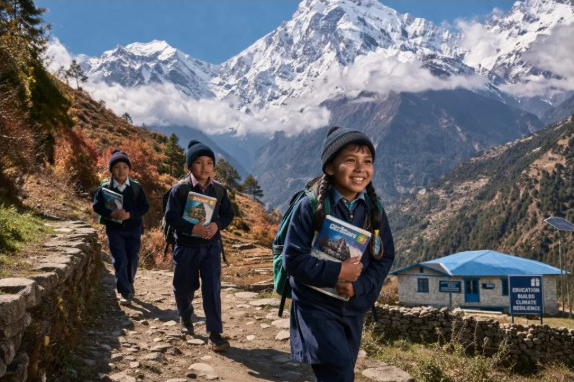
7 Brutal Truths About Education and the Himalayan Crisis
Truth 1; The Curriculum Was Never Written for the Mountains
Schools in high-altitude villages teach the same syllabus as schools in Kathmandu or Delhi. A child in Spiti learns about the water cycle from a textbook; but not about the glacier above her village that feeds her family’s fields. She learns English grammar but not her grandmother’s dialect. She learns history from a national lens but not the oral knowledge her community has preserved for 800 years.
This is not education. This is cultural replacement.
Truth 2; Youth Migration Is Not a Choice. It Is a Manufactured Outcome.
When a school teaches only skills that cities need, migration becomes inevitable. We designed this outcome. We should not be surprised by it.
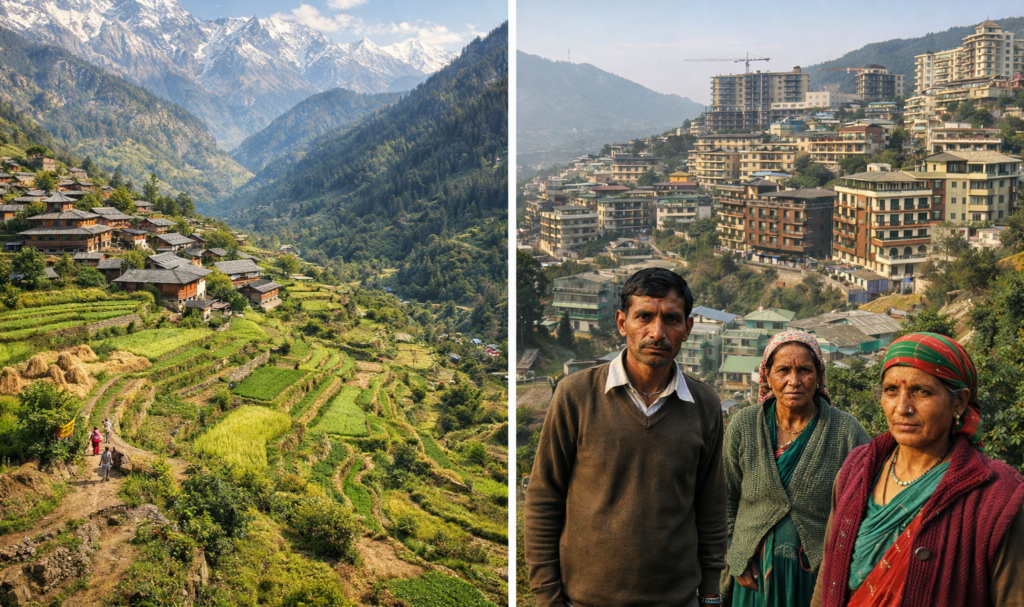
In India’s Himalayan states; Himachal Pradesh, Uttarakhand, Sikkim, and Arunachal Pradesh; the 2011 and 2021 census data both show consistent population decline in high-altitude villages. Young people between 18 and 35 are almost absent in many communities. What remains are the elderly and the very young; a society with no middle generation to carry knowledge forward.
“A village without its youth is a library without its books.”; Nikhil Raj Sharma, Founder, Himalayan Geographic Research Foundation
Truth 3; Traditional Knowledge Is Being Classified as Irrelevant
Himalayan communities hold centuries of ecological intelligence. They know when to plant by reading wind patterns. They know which plants treat altitude sickness. They know how to build homes that survive earthquakes and snow loads simultaneously. None of this appears in a school exam.
By marking this knowledge as “unscientific” or “outdated,” the education system has taught an entire generation to distrust its own inheritance. That is not education. That is humiliation.
Truth 4 Climate Change Is Accelerating the Crisis
Climate change is not just melting glaciers. It is melting the logic of staying.
Agriculture in mountain regions is failing. Spring water sources are drying up. Snowfall patterns; which farmers used for centuries to time their crops; are now unreliable. When a young person sees her family’s farm produce 30% less than it did five years ago, no amount of cultural pride keeps her in the village. She leaves because she must.
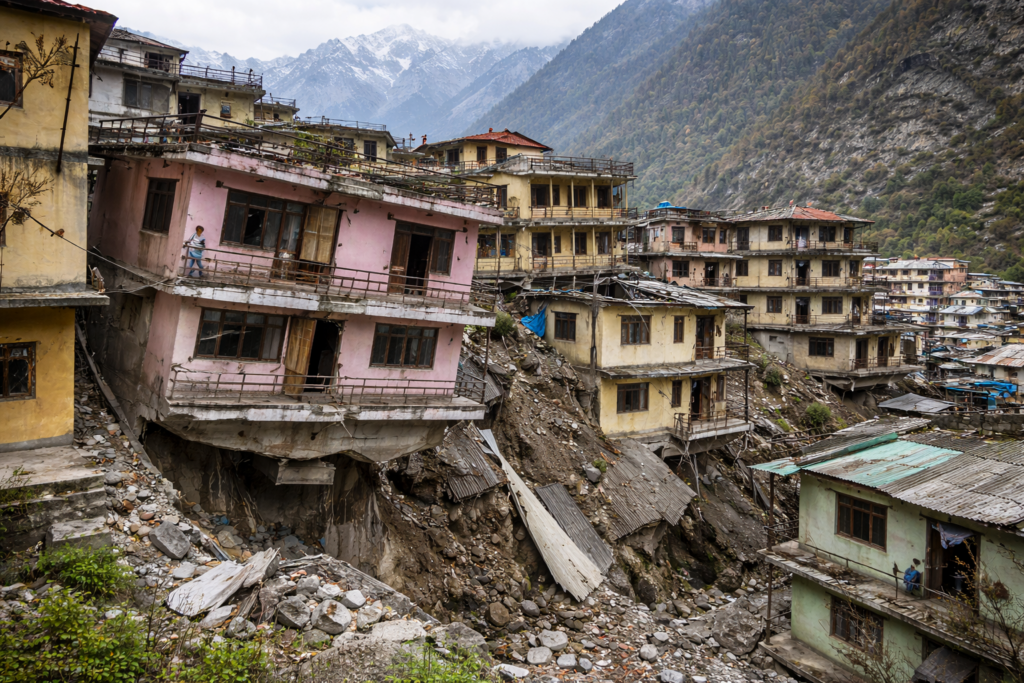
According to a 2023 report by ICIMOD, over 200 glacial lakes in Nepal alone show signs of dangerous expansion due to glacial retreat. Flash floods and landslides now regularly destroy farmland and infrastructure. Communities are being asked to be resilient; but resilience requires tools. Education must provide those tools.
Truth 5; Homestay Tourism Is Working, But No One Is Scaling It Properly
Community-based tourism; especially homestay networks; is one of the most effective economic tools available to Himalayan communities. A family in Upper Mustang can earn more from hosting a trekking group for one week than from farming for a month.
But here is the gap: most homestay operators have no formal training in hospitality, digital marketing, or financial management. The education system that could have provided these skills never arrived. Instead, outside tour operators take the profit, and local families remain at the bottom of the value chain.
In Bhutan, government-supported homestay programmes linked to local schools have shown measurable results; youth retention rates in participating communities are reportedly higher than national averages. India and Nepal have yet to replicate this at scale.
Truth 6; The Communities That Are Winning Did Not Wait for Governments
In Sikkim, community-run schools have begun integrating organic farming knowledge into their curriculum; directly linked to the state’s flagship organic farming policy. In Ladakh, local NGOs have introduced solar energy training in secondary schools. In Dolpo, Nepal, a school funded partly by diaspora contributions now teaches both Tibetan script and digital literacy side by side.
These are not government programmes. These are acts of community defiance against a system that forgot them.
“The real innovation in the Himalayas is not happening in policy meetings in Kathmandu or Delhi. It is happening in classrooms with no electricity, run by teachers who stayed when they could have left.” — Nikhil Raj Sharma
Truth 7; If Nothing Changes, the Mountains Will Become Museums
We are already watching this happen. Villages in Kinnaur and Lahaul in Himachal Pradesh are being promoted as tourist destinations; beautiful, photogenic, increasingly empty. The culture is being preserved for visitors, not for the people who created it.
This is the worst outcome: a Himalayan heritage turned into a theme park, while its living carriers scatter across Indian metros working jobs that have nothing to do with what they knew.
What Is Actually Working; The Community Revolution
Place-Rooted Education Models
Several initiatives across Nepal and India are showing what place-based education looks like in practice:
- Shiksha Sopan (Uttarakhand, India): Integrates environmental education and local agricultural cycles into primary school learning.
- Ringing Bells Foundation: Provides low-cost digital tablets preloaded with local-language content to mountain schools.
- ICIMOD’s Mountain EbA Programme: Trains community members; including school teachers; in ecosystem-based adaptation to climate change.
- Butterflies India: Runs non-formal education programmes for children in migrant communities, keeping cultural threads alive.
The Homestay Economy as a Classroom
The most exciting development is the merging of livelihood and learning. In communities where homestay tourism is growing, young people are discovering that their culture, language, food, and stories have economic value. This realisation is more powerful than any career counselling session.
In Bhutan’s Haa Valley, families involved in the community homestay network report that their children are asking fewer questions about leaving. The reason is simple: they can see a future at home.
This is what I have always argued: learning must be connected to life. When education serves the community it lives in, the community grows stronger. When it serves only external ambitions, the community hollows out.
The 5 Changes That Must Happen Now
- Curriculum reform at state and national level — Himalayan states must demand subject matter relevant to mountain ecology, local languages, and climate adaptation. This is not optional. It is survival.
- Teacher incentives for high-altitude postings — Teachers must be paid more, not less, to work in remote mountain schools. Currently, many such postings are treated as punishment transfers.
- Formal integration of traditional knowledge — Oral histories, medicinal plant knowledge, water management practices, and indigenous weather reading must be documented and included in school curricula.
- Homestay certification programmes linked to schools — Secondary school students in mountain areas should graduate with a basic certificate in tourism, hospitality, and digital marketing; so they can run a business, not just grow crops.
- Community control over school governance — Parents, elders, and local leaders must have real power over what is taught in their schools. Not advisory power. Real power.
What the Mountains Are Telling Us
The Himalayan region holds 10% of the world’s biodiversity and feeds over 1.3 billion people through its river systems. It is not a peripheral concern. It is a civilisational anchor.
And yet we treat its communities as beneficiaries of development, not as architects of it.
“The Himalayas do not need our pity. They need our honesty. And our respect.” — Nikhil Raj Sharma, Himalayan Geographic Research Foundation
The communities living in these mountains have survived ice ages, invasions, and famines. They will survive climate change too; if we stop taking away the tools they need and start listening to the tools they already have.
The question is not whether to modernise. The question is: who gets to decide what modernisation means?
Related Resources Worth Your Time
- ICIMOD’s Mountain Futures Research: https://www.icimod.org
- “Himalayan Voices” Project by UNESCO: https://en.unesco.org/silkroad/knowledge-bank/himalayan-communities
Nikhil Raj Sharma, Founder — Himalayan Geographic Research Foundation:
“We keep talking about saving the Himalayas. But nobody asks who is saving the Himalayan people. Every policy I have seen treats these communities as objects of conservation, not as subjects of their own future. Until education starts from the village and not from the capital, we will keep losing both the culture and the ecology.”
“I have visited over 60 Himalayan villages in the last decade. The ones that are thriving are not the ones with the most government funding. They are the ones where somebody; a teacher, an elder, a young woman who refused to leave; decided that local knowledge matters. That is the revolution. It is quiet. But it is real.”
Simple, as Promised
Education that takes children away from their mountains and gives them nothing to come back to is not education. It is slow erasure. And we are all responsible for it.
The fix is not complicated. Teach children where they live. Respect what their elders know. Pay teachers to stay. Let communities decide. The mountains will do the rest.
We built schools in the mountains that taught children to leave. We called it progress. The mountains are emptying. The glaciers are shrinking. And we are still arguing about syllabus committees.
Disclaimer: The content and images published in this article are provided for general informational and educational purposes only. Some images may be generated or enhanced using artificial intelligence (AI) and are intended solely for illustrative use. The views, interpretations, and information expressed do not necessarily reflect the official position of Himalayan Geographic Research Foundation, nor do they constitute professional, legal, medical, or financial advice.
While efforts are made to ensure accuracy, no guarantees are given regarding completeness or reliability. Readers are encouraged to independently verify information and use their own judgment. By reading this article, you acknowledge that any reliance on the content is at your own risk, and Himalayan Geographic Research Foundation assumes no responsibility or liability for disagreements, interpretations, or outcomes arising from its use. If you do not agree with these terms, you are advised to discontinue reading.