
The Nepal disaster of August 2026 killed over 1,300 people when a Himalayan glacier collapsed with almost no warning. Here is what happened, why these disasters are increasing, and what every mountain town from Himachal to Bhutan must learn right now.
A wall of ice, rock, and mud moving at nearly 120 miles per hour. That is what hit the Nepal-Tibet border on the morning of August 26, 2026. Within days, the Nepal disaster had killed more than 1,300 people and left some 5,500 missing, making it one of the deadliest natural disasters to hit the Himalayas in living memory.
This was not a freak accident. It was a warning that mountain communities across the Himalayas cannot afford to ignore anymore.
If you live anywhere near the mountains, in Himachal, Uttarakhand, Sikkim, or across the border in Bhutan and Tibet, this story is about your home too.
What Actually Happened in the Nepal Disaster
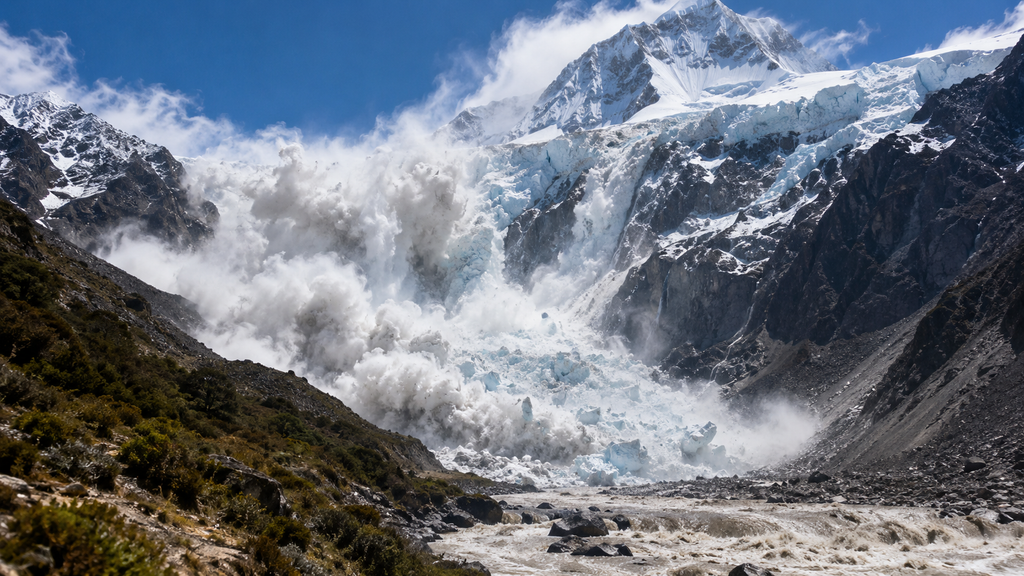
On the morning of August 26, 2026, a huge chunk of the Langtang Lirung glacier broke away high in the mountains. Scientists believe a mass of rock and ice detached from the mountainside and fell, and satellite images show a lot of snow had disappeared in the days before the flood.
That fall triggered an avalanche of ice and rock that crashed down and blocked a river called the Lhende Khola, forming a temporary dam. When that dam gave way, it sent a huge, sudden surge of water crashing downstream with almost no warning.
The flood raced through the Bhote Koshi and Trishuli river valleys, hitting towns like Timure and Syaphrubesi hard. A Red Cross official on the ground described it simply: “There has been a very high demand for body bags.”
The numbers are hard to read, but they need to be read.
- At least 1,355 deaths and nearly 5,000 people missing were confirmed in Nepal, with 43 dead and over 500 missing across the border in Tibet
- The flood was so powerful that it carried some victims’ bodies 240 km away into India
- 32 bridges and nearly 25 miles of road were swept away, cutting off entire communities
- Nepal’s government estimated the economic damage at between $4 billion and $7 billion
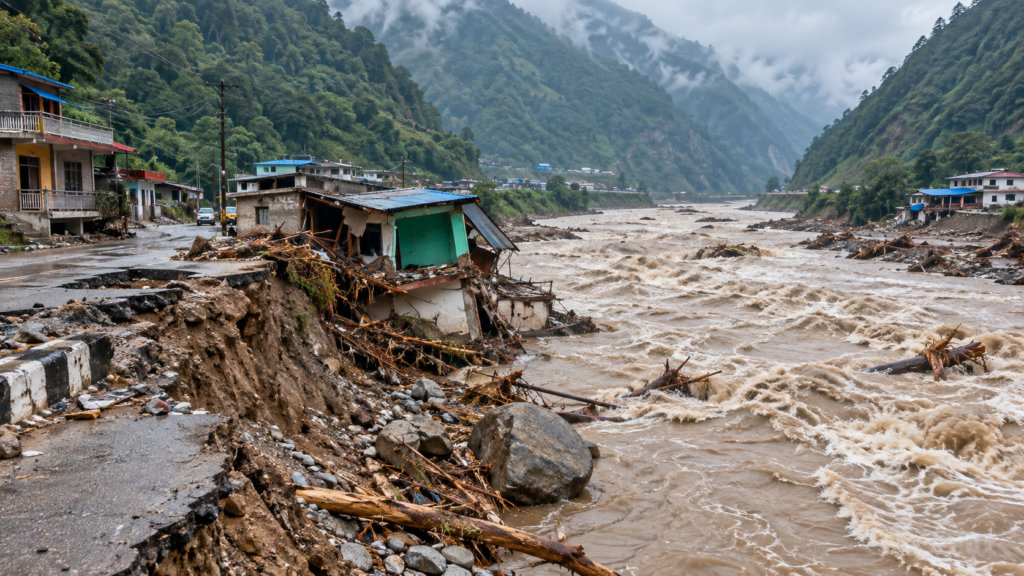
Whole families lost everything in minutes. In Rasuwa district, families who had already rebuilt their lives after the 2015 earthquake lost their homes a second time. One community of around 250 households on the low-lying banks of the Trishuli river was swept away entirely.
This is not a number on a screen. It is somebody’s kitchen, somebody’s school, somebody’s family photo, gone in seconds.
Why Disasters Like This Keep Happening
The Nepal disaster did not come out of nowhere. It came from a mountain range that is heating up faster than most of the planet.
The Himalayas Are Warming, and the Ice Is Failing
Glaciers hold rock and ice together like glue. That glue is melting. A researcher studying the disaster put it plainly: “Permafrost has been the cryospheric glue that’s held the rock and the ice and the glaciers together for millennia, and now we’re getting increasing evidence that it’s being weakened by warming trends.”
Nepal’s own Prime Minister was direct about the cause. He said there was “no doubt” that climate change contributed to the disaster. Nepal’s foreign minister went further, saying his country is bearing a disproportionate share of the consequences of a climate crisis it did little to cause.
This is not just a Nepal problem. A similar collapse buried most of a Swiss village in 2025, and only advance monitoring allowed the village to be evacuated in time. The mountains everywhere are becoming less stable.
Intense Rain and Sudden Cloudbursts
Beyond glacier collapse, the Himalayas are also seeing more sudden, extreme rain events called cloudbursts. The India Meteorological Department defines a cloudburst as very heavy rain, over 100 mm, dumped on a small area within one hour. These events are becoming more common and more intense across Himalayan states.
Building in the Wrong Places
Many mountain towns, including parts of Nepal, sit on old flood paths or unstable riverbanks because flat land is scarce in the mountains. When a flood or landslide hits, there is often nowhere safe nearby to run.
A Fragile Mountain Ecosystem Under Pressure
Deforestation, unplanned construction, and heavy tourism traffic are all adding stress to slopes that are already unstable due to warming. Put together, these factors turn a natural hazard into a human tragedy.
Did the Early Warning System Fail?
This is the most painful question in the whole disaster.
Nepal and China do actually run a flash flood warning system for this exact river valley. Chinese and Nepali scientists have maintained this system for years, and it has been credited with preventing casualties in the past. But this time, it could not keep up. The system proved incapable of detecting the disaster in time because the trigger was not rainfall, it was a sudden glacier collapse.
Here is the part that stings the most. Scientists later found that satellite images had already picked up the danger. Images showed the accelerated movement of the glacier and rock mass in the days just before it collapsed. The information existed. It just did not reach the people who needed it, in time.
Part of the problem is geography itself. The danger zone sits right on the Nepal-Tibet border, so any warning system depends on both countries sharing satellite data quickly with each other. A scientist reviewing the disaster identified the exact gap: there is still no regional satellite system that routinely watches for glacier and rock-slope movement and connects that data directly to flood models downstream.
The eyes in the sky saw it coming. The alarm bell on the ground did not ring in time.
How Mountain Communities Fought Back
Even with the warning system falling short, the human response was remarkable.
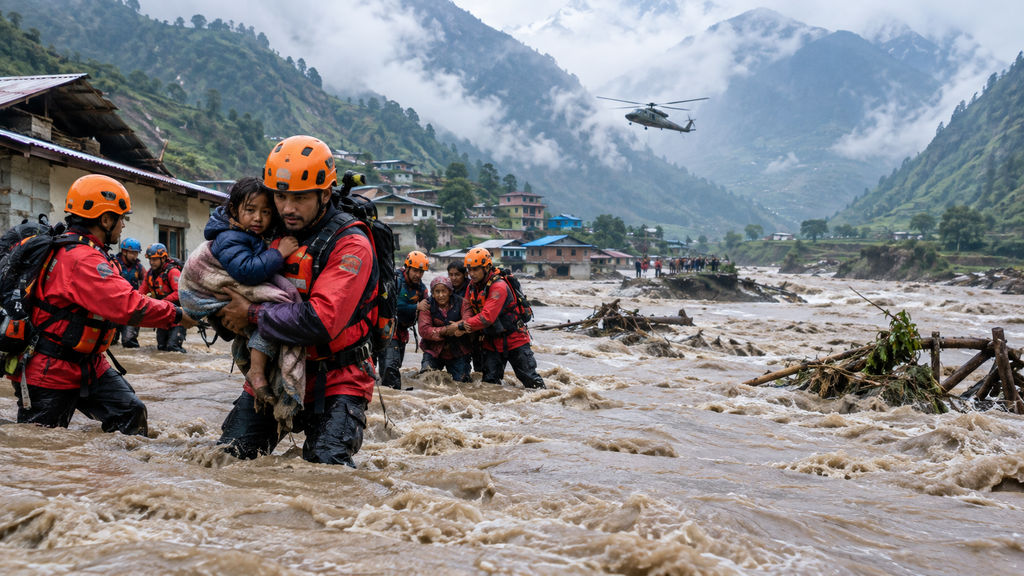
Nepal’s first female helicopter pilot, Priya Adhikari, flew around 100 rescue missions in less than a week, pulling survivors out of areas that roads could no longer reach. Local volunteers, the Nepali Army, and international rescue teams worked around the clock in dangerous, unstable terrain.
Global support arrived fast too:
- China sent 50 tonnes of emergency relief supplies by military aircraft, plus $2 million in emergency flood-relief funding
- Over 9,300 emergency medical personnel were deployed across the flood-hit areas
- Experts from India, Australia, and South Korea joined tunnel rescue and forensic teams
Local groups like Mountain Heart Nepal were often first on the ground, since they already knew the terrain and the people. This is the story that gets missed in the death toll headlines: mountain communities do not wait for outside help. They act first, and the world catches up.
Broken Roads, Broken Power
Mountain infrastructure is built for normal weather, not for disasters of this scale. This flood exposed just how fragile that infrastructure really is.
Thirteen hydropower projects were damaged, wiping out an estimated 431 megawatts of electricity from Nepal’s grid, with total hydropower damage estimated at around 100 billion Nepali rupees. Rescuers spent days trying to reach hundreds of workers trapped inside flooded hydropower tunnels, at one point using controlled explosions and excavators to dig through debris.
The ripple effects reach every household. Energy experts now expect electricity bills in Nepal to rise by at least 10 to 12 percent because of the damage to power plants. Roads and bridges that took years to build were gone within hours, cutting off entire valleys from food, medicine, and rescue teams.
This is the pattern across the Himalayas. Roads, schools, health centres, and power stations are almost always built with normal weather in mind. They are rarely built to survive the kind of extreme event that climate change is now making common.
A Warning Bell for the Entire Himalayas
Here is why this Nepal disaster should worry people far beyond Nepal’s borders. The same danger sits above Himachal Pradesh, Uttarakhand, Sikkim, Arunachal Pradesh, Bhutan, and Tibet too.
Sikkim, 2023: A glacial lake called South Lhonak burst without warning at night. The flood eroded around 270 million cubic metres of sediment and travelled 385 km along the Teesta River, destroying a major dam and killing dozens. After the Nepal disaster, Sikkim reviewed its own risk and found 16 glacial lakes now sitting at the highest risk of bursting.
Uttarakhand, 2025: A sudden flash flood tore through Dharali village in Uttarkashi. At least five people died and more than a hundred went missing, and scientists are still not fully sure if it was a cloudburst or a glacial event.
Himachal Pradesh: This state has a long, painful history with these disasters. In 2023 alone, 19 people were killed in Mandi district and 14 more in Shimla after landslides and a cloudburst. Research on the state’s flood history shows this danger is not new, with major flash flood and cloudburst events recorded across decades in the Kullu and Beas river basins.
Bhutan and Tibet face the same warming glaciers and the same steep, narrow valleys where a small collapse becomes a massive flood downstream.
After the Nepal disaster, India held an emergency review. The Union Home Secretary met with disaster management officials from Uttarakhand, Himachal Pradesh, Sikkim, Arunachal Pradesh, and Jammu and Kashmir specifically to check how ready these states are for glacial lake floods and snow avalanches.
That single meeting says everything. The government itself sees Nepal’s tragedy as a preview of what could happen next door.
What Needs to Change Now
Knowing the risk is not enough. Here is what actually needs to happen across every Himalayan region.
- Build a real regional warning system. Nepal, India, China, and Bhutan need to share satellite and glacier data with each other in real time, not after the fact.
- Map every dangerous glacial lake and slope, the way Sikkim is now doing with its 40 high-hazard lakes, and act on that data before disaster strikes.
- Train local communities, not just city officials, in evacuation drills and hazard recognition, since mountain communities are almost always the first responders.
- Rebuild infrastructure to survive extreme events, not just average weather, especially roads, bridges, and hydropower stations in known flood paths.
- Stop new construction in known hazard zones, including riverbanks and old flood paths, however tempting the flat land looks.
- Fund climate adaptation properly. Mountain nations like Nepal are asking for climate justice, since they contribute the least to global warming but suffer some of its worst effects.
None of this is complicated in theory. It just requires treating mountain safety as a priority before the next disaster, not after it.
Nikhil Raj Sharma, Founder of Himalayan Geographic, shared his thoughts on the disaster:
“Every time the mountains show us their fury, we call it unprecedented. It is not unprecedented anymore. What is missing is not warning, it is the will to act on the warning before people pay with their lives. Our mountains have always demanded respect. Right now, they are demanding it louder than ever.”
Watch and Understand the Disaster
For a clearer picture of how the Nepal disaster unfolded, these reports are worth watching:
- Did a glacier collapse trigger Nepal’s deadly floods? — BBC News
- Nepal-Tibet floods: Climate change risks more glacial collapses in Himalayas — ABC News
A Final Word
The Nepal disaster is not a story about one country’s bad luck. It is a story about what happens when a warming climate meets fragile mountains and communities that are not yet ready.
Himachal, Uttarakhand, Sikkim, Bhutan, and Tibet are not watching from a safe distance. They are standing on the same fault line.
The mountains are not asking us to fear them. They are asking us to prepare.
References
- CNN — Warning signs were visible ahead of Nepal-China floods, report says (Sept 1–2, 2026 live update, death toll and UNDP debris estimate)
- CNN — Deadly flash flood hits Nepal-China border region (Aug 26–27, 2026, Red Cross quote)
- CNN — Mass burials take place as Nepal-China floods death toll tops 1,000 (Aug 31, 2026, rescue pilot Priya Adhikari)
- Britannica — Nepal floods of 2026 (glacier collapse mechanics, casualty and cost figures)
- USGS — 2026 Nepal Debris Avalanche and Flash Flood (official hazard event page)
- Wikipedia — 2026 Nepal floods
- Wikipedia — 2026 Nepal–Tibet floods (hydropower damage figures, international relief details)
- Nature India — Early warning could have saved hundreds of lives in Nepal floods
- Nature — Satellite images before Nepal disaster showed warning signs
- The Conversation — When a mountain falls: how ice and rock triggered Nepal’s catastrophic flood (Swiss Blatten comparison)
- CARE — Nepal flash floods 2026: emergency response (ICIMOD expert quote, bridge/road damage)
- Direct Relief — Nepal Flood Relief 2026 (medical response numbers)
- Mongabay — Nepal’s flood disaster puts its hydropower-first strategy to the test (electricity price impact)
- Down To Earth — The 2023 Sikkim disaster exposes growing risk of GLOFs
- Science — The Sikkim flood of October 2023: Drivers, causes, and impacts (peer-reviewed study)
- The Tribune — After Nepal flash flood, 16 glacial lakes in Sikkim identified at highest risk
- Wikipedia — 2025 Uttarakhand flash flood (Dharali, Uttarkashi)
- Climate Fact Checks — From Cloudburst to Climate Crisis: Understanding the Uttarkashi Flash Floods
- Wikipedia — 2023 Himalayan floods (Himachal Pradesh deaths)
- ETV Bharat — IMD flags flash flood risk for Uttarakhand, Himachal Pradesh
- Wikipedia — 2024 Nepal floods (prior-year comparison)
- UN Nepal — Nepal Floods Response Plan 2024
- ICIMOD — International Centre for Integrated Mountain Development — the main regional research body on Hindu Kush Himalayan glacier and disaster risk, covering Nepal, India, Bhutan, China, Bhutan, Pakistan, Afghanistan, Bangladesh, and Myanmar
- ICIMOD — Who We Are — background on their climate resilience and early-warning work
- BBC News — Did a glacier collapse trigger Nepal’s deadly floods?
- ABC News — Nepal-Tibet floods: Climate change risks more glacial collapses
- ABC News In-depth — Nepal’s glacier time bomb
- Himalayan Geographic — Traditional Knowledge: 7 Powerful Himalayan Secrets Saving Mountains From Climate Change
Disclaimer: The content and images published in this article are provided for general informational and educational purposes only. Some images may be generated or enhanced using artificial intelligence (AI) and are intended solely for illustrative use. The views, interpretations, and information expressed do not necessarily reflect the official position of Himalayan Geographic Research Foundation, nor do they constitute professional, legal, medical, or financial advice.
While efforts are made to ensure accuracy, no guarantees are given regarding completeness or reliability. Readers are encouraged to independently verify information and use their own judgment. By reading this article, you acknowledge that any reliance on the content is at your own risk, and Himalayan Geographic Research Foundation assumes no responsibility or liability for disagreements, interpretations, or outcomes arising from its use. If you do not agree with these terms, you are advised to discontinue reading.
