
The Himalayan monsoon emergency of 2026 is changing shape; less total rain, more sudden killer bursts. Here’s why Himachal, Uttarakhand, Sikkim, and Nepal are at growing risk, and what you can do about it.
On the night of July 18, 2026, rain that had been missing for weeks came down all at once over Jammu and Kashmir’s hill districts. By the next morning, at least 25 people were dead across north and northeast India; 15 of them in Poonch, Rajouri, and Doda alone, with more lost to landslides in Nagaland and floods in Assam. The Army and Air Force were put on standby in Assam for possible evacuations. This wasn’t a one-off. It’s the pattern this monsoon is following almost every week.
Here’s the strange part. Forecasters at ICIMOD, the region’s top mountain research body, had already warned this season would bring below-normal total rainfall because of El Niño. Less rain overall; and yet it’s producing some of the deadliest flash floods in years. That contradiction is the real story of the Himalayan monsoon crisis in 2026, and it’s why this article exists.
If you live in, travel to, or simply worry about the Himalayan belt; Himachal Pradesh, Uttarakhand, Sikkim, Arunachal Pradesh, Ladakh, Jammu & Kashmir, Nepal, or Bhutan; this is what’s actually changing, why it’s happening, and what to do about it.
1. The Monsoon Isn’t Weaker. It’s Just Behaving Differently
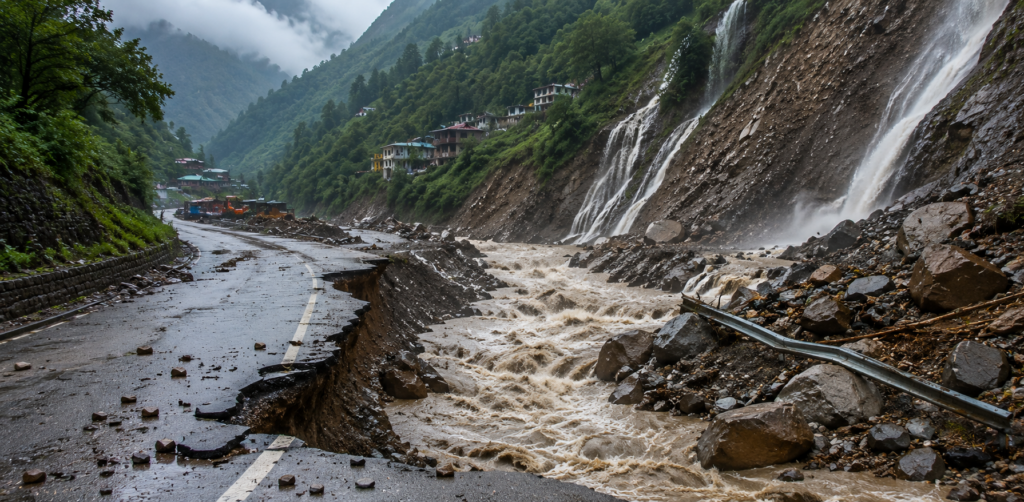
For years, people have judged a monsoon by one number: total rainfall for the season. That number is genuinely going down in parts of the Hindu Kush Himalaya this year. But total rainfall is turning out to be almost the wrong thing to measure.
ICIMOD‘s disaster risk reduction specialist Saswata Sanyal put it plainly, warning that a seasonal rainfall average cannot capture the cloudbursts that cause catastrophic flooding in mountain valleys. In other words: a “dry” year on paper can still deliver a deadly month on the ground, because the rain that does fall arrives in short, violent bursts instead of spread evenly across the season.
This is the core twist of the Himalayan monsoon emergency. Long dry spells build up false confidence. Then one cloudburst undoes it in an hour.
2. Cloudbursts Are Getting More Dangerous at Lower Thresholds
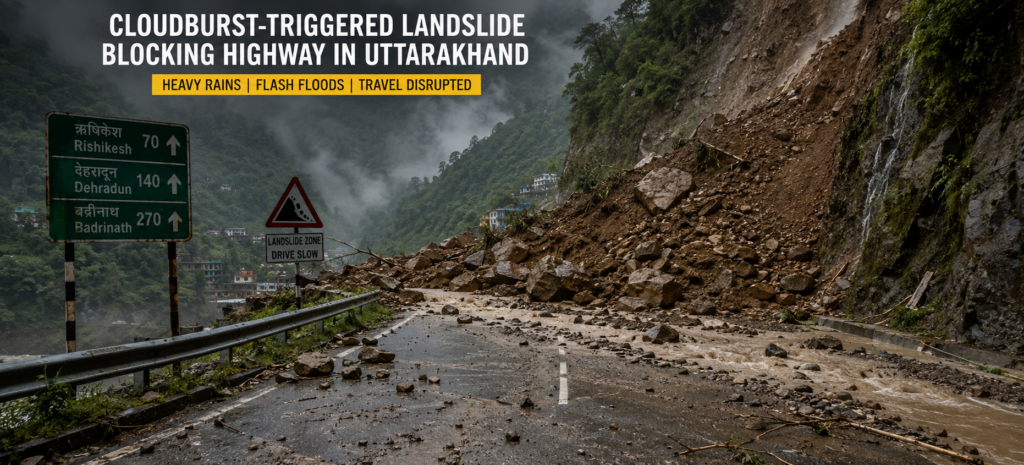
Old textbooks defined a cloudburst as more than 100mm of rain falling in a single hour over a small area; a rare, extreme event. Meteorologists now say that even 30 to 50mm within an hour is enough to trigger a catastrophic flash flood in the steep, narrow valleys of the Himalayas, according to climate researchers writing in Daily Excelsior.
Why does less rain now do more damage? Three reasons, according to hydrology researchers studying the region:
- Steep slopes give water almost no time to soak in; it becomes a fast-moving wall instead of a slow soak
- Roads cut into hillsides using standard blasting techniques (instead of slope-specific methods) leave loose debris that chokes river channels
- Homes, hydropower projects, and highways increasingly sit inside natural floodplains, turning them into accidental dams that fail suddenly under pressure
A recent example: a flash flood in Kishtwar district, Jammu and Kashmir, damaged the 540 MW Kwar hydroelectric project and the national highway connecting Kishtwar to Doda; proof that “engineered” doesn’t mean “flood-proof.”
3. El Niño Is Quietly Rewriting This Year’s Monsoon Script
The 2026 season is being shaped by a strengthening El Niño in the Equatorial Pacific, confirmed by the US National Oceanic and Atmospheric Administration on June 2. The India Meteorological Department has factored this into its June and July forecasts, expecting below-normal seasonal rainfall across large parts of South Asia.
But; and this is the part that catches people off guard; short-lived weather systems can override that broader pattern for a day or two, producing intense localised rainfall capable of causing severe flooding even in a below-normal year, per ICIMOD’s July 2026 assessment. Recent cloudburst-driven flooding in Pakistan’s Gilgit-Baltistan and Arunachal Pradesh are the examples ICIMOD points to.
Add to this that snow cover going into this monsoon is lower than normal, per ICIMOD’s 2026 outlook. Less snow means rivers lose a natural buffer of steady meltwater, so they react more violently when sudden rain does arrive.
4. What’s Already Happened in 2026; the Numbers So Far
Here’s a snapshot of just this monsoon season, before the peak months of August and September have even arrived:
- July 18–19, 2026: At least 25 dead across J&K, Nagaland, and Assam in a single weekend of flooding
- Early-to-mid July 2026: Five more deaths across Himachal Pradesh, Uttarakhand, Uttar Pradesh, Mizoram, and Tripura, with over 4,000 homes damaged in Tripura and roughly 11,000 people moved into relief camps
- Uttar Pradesh recorded 315mm of rain in 24 hours in Mawana, Meerut district; among the highest single-day totals in the country this season
- IMD issued flash-flood guidance for watersheds across Jammu & Kashmir, Ladakh, Himachal Pradesh, Uttarakhand, Punjab, and the Delhi-NCR belt through July 21
And this is only the first half of the season.
5. Recent History Shows This Isn’t a One-Year Blip
Look back just three monsoons and the trend is hard to miss:
- 2023: Floods and landslides on a single day (August 14) killed at least 72 people across Uttarakhand and Himachal Pradesh, with 19 deaths in Mandi district and 14 in Shimla alone after cloudbursts and landslides. Losses were estimated at $1.2 billion.
- 2024: Monsoon flooding and landslides across Assam, Arunachal Pradesh, Sikkim, Manipur, Tripura, Uttar Pradesh, Himachal Pradesh, Kerala, Meghalaya, and Gujarat killed more than 1,878 people and displaced over 351,000, per tracked disaster data.
- 2025: Himachal Pradesh alone recorded 63 deaths and 40 people still missing by early July, with 22 cloudbursts, 31 flash floods, and 17 landslides logged in a single month. A flash flood in Dharamshala’s Khaniyara area swept away labourers living in temporary shelters near a hydro project. In August 2025, a cloudburst; possibly combined with a glacier collapse; sent a wall of water, mud, and boulders through Dharali, a small tourist town near Gangotri in Uttarkashi.
Three years, three record-setting disasters, three different states. That’s not coincidence; that’s a pattern.
6. Nepal and Bhutan Face a Second Threat: Glacial Lakes
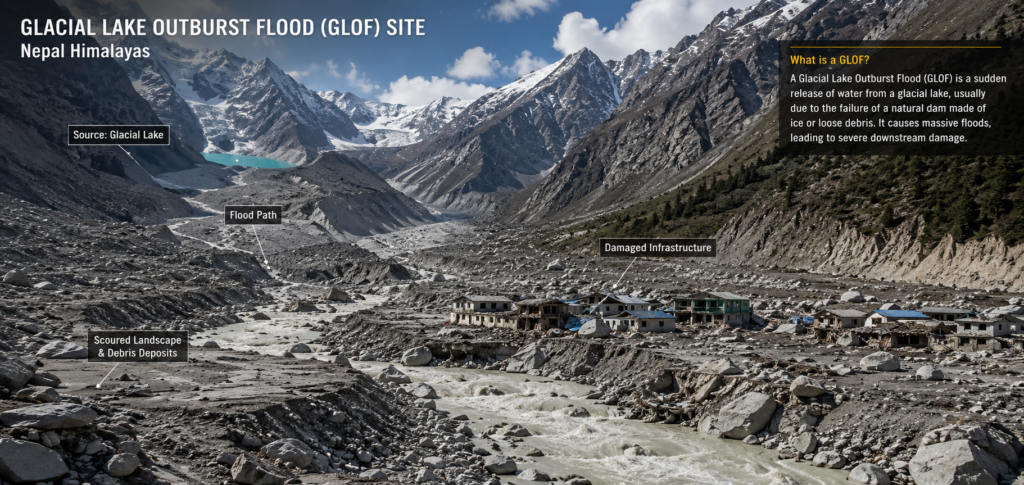
The story isn’t only about rainfall. Nepal’s mountains are dotted with glacial lakes that can burst without any rain falling at all, simply from glacier instability; a hazard called a Glacial Lake Outburst Flood, or GLOF.
In May 2025, two small glacial lakes in Tilgau, Humla district, burst on the same night, sending an ice-and-debris avalanche that destroyed five bridges and displaced around 32 villagers; with no rainfall recorded at the time, according to Wikipedia’s tracked record of 2025 Nepal floods. Weeks later, on July 8, 2025, a flash flood likely caused by monsoon rain combined with a glacial lake outburst swept away the main bridge linking Nepal and China at Rasuwagadhi, a disaster covered by both the Associated Press and the New York Times. Reuters later reported that a Tibetan glacial lake drainage was confirmed as the trigger, according to a regional climate body.
Nepal has faced this risk for decades; the 2008 Koshi flood remains one of the largest ever recorded there, and GLOFs in the Bhote Koshi (1981) and Dudh Koshi (1985) basins show this is a recurring hazard, not a new one.
7. The Himalayas Are Warming Faster Than the Rest of the Planet
Underneath all of this is a simple physical fact: while the global average temperature keeps climbing, the high-altitude Himalayan terrain is warming at roughly 2°C above pre-industrial levels; noticeably faster than the global average, according to climate researchers cited in Daily Excelsior. Warmer air holds more moisture, which is part of why short bursts of rain are getting more intense even as total seasonal rainfall drops in places.
Researchers writing in the journal Frontiers note that changing monsoon dynamics were directly linked to the devastating 2013 Uttarakhand floods, and that the growing gap between long dry periods and sudden intense rain is what’s driving both flood and drought risk in the region at the same time.
What’s Actually Being Done About It
It’s not all bad news. A few concrete steps are underway:
- India’s Ministry of Jal Shakti launched a Unified Inundation Forecasting System in 2025 to give earlier warning of flash floods in Himalayan and other river basins
- A Green Climate Fund project worth roughly $36 million is now working to lower water levels in Nepal’s four most dangerous glacial lakes and install early warning systems
- ICIMOD’s yearly HKH Monsoon Outlook now gives governments across eight countries a shared early-warning tool ahead of each monsoon
Simple Safety Steps If You Live In or Travel To These Regions
- Check IMD or ICIMOD advisories before travelling during monsoon months; not just a general weather app
- Never camp or park overnight right next to a riverbed or dry stream channel, even if it looks completely safe in dry weather
- If you hear a sudden loud rumbling sound at night during heavy rain, move to higher ground immediately; don’t stop to check first
- If you’re on a pilgrimage route like Char Dham or Machail Mata Yatra, know that these roads run directly through flood-prone corridors during peak monsoon
- Follow your local disaster management authority’s social media alerts during your travel dates, not just the news
A Few Places to See This For Yourself
For visual, on-the-ground coverage of this season’s floods, these two recent news reports are worth watching:
- “Northeast Floods Update: Monsoon Fury Batters Northeast”
- “Monsoon Havoc: Heavy Rains Trigger Floods, Landslides and Travel Disruptions Across India”
From Nikhil Raj Sharma, Founder, Himalayan Geographic
“Only when villages understand weather patterns can they protect their crops and water resources,”.
On the broader mindset shift needed in the hills, he has put it simply: “We don’t fight the weather; we learn to work with it.”
And on why outside solutions alone won’t fix this: “To save the mountains, we must first adopt mountain thinking.”
References
- The Watchers — “At least 25 killed as heavy monsoon rain triggers floods and landslides, India” (July 20, 2026)
- The Tribune — “5 dead, highways blocked as monsoon wreaks havoc in Himachal, Uttarakhand, UP, Mizoram and Tripura”
- The Statesman — “IMD warns of heavy rain across 15 states“
- ICIMOD — “Erratic monsoon and rising temperatures heighten flash flood risk across the Hindu Kush Himalaya” (July 7, 2026)
- Down To Earth — “ICIMOD Warns of Enhanced Flash Flood Risks in Hindu Kush Himalaya Amid Erratic 2026 Monsoon“
- Daily Excelsior — “Climate drivers of Himalayan flash floods“
- Wikipedia — “2023 Himalayan floods“
- Wikipedia — “2024 India floods“
- Wikipedia — “2025 Nepal floods“
- AP News — “Monsoon floods sweep away 20 people and the main bridge linking Nepal to China“
- The New York Times — “Deadly Flash Floods Sweep Away Nepal-China Bridge“
- Reuters — “Tibetan glacial lake drainage triggered deadly flood in Nepal, climate body says“
- Frontiers in Environmental Science — “Climate change in the Himalayan region: susceptible impacts on environment and human settlements“
- Scientific Reports (Nature) — “Understanding flash flooding in the Himalayan Region: a case study” / NCBI copy
- Himalayan Geographic — “Dehradun Weather Forecast: How Nikhil Raj Sharma’s 7 Bold Climate Initiatives Are Positively Transforming Himalayan Communities“
Further Reading
- WION Decodes — “Is India’s monsoon changing? What Monsoon 2026 reveals about climate trends”
- Down To Earth — “Hotter, drier Hindu Kush Himalaya monsoon likely in 2026, ICIMOD warns of dual threat of drought and flood“
- ICIMOD’s HKH Monsoon Outlook 2026
- NDTV — “50 Dead In Himachal Landslides, Cloudburst, 7 Swept Away By Flash Floods”
- Himalayan Geographic — “Himalayan Monsoon Crisis: Why Less Rain Is Triggering 5x More Floods and Landslides”
Frequently Asked Questions
Is the Himalayan monsoon actually getting worse, or does it just feel that way because of social media? Both total rainfall patterns and disaster data support this being a real shift, not just more reporting. Total seasonal rainfall in parts of the region is trending lower, but the rain that does fall is arriving in shorter, more intense bursts; which is exactly what’s driving repeated record death tolls across 2023, 2024, and 2025.
Which states and countries are most at risk right now? Himachal Pradesh, Uttarakhand, Jammu & Kashmir, and Ladakh in India; Sikkim and Arunachal Pradesh in the northeast; and Nepal and Bhutan across the wider Hindu Kush Himalaya. Each faces a slightly different mix of flash floods, landslides, and; in Nepal’s case especially; glacial lake outburst floods.
Does less seasonal rainfall mean the flood risk is lower this year? No; this is the single biggest misunderstanding, according to ICIMOD’s own disaster risk reduction specialist. A drier season on paper can still produce a dangerous, even deadly, month if the rain arrives as concentrated cloudbursts.
Disclaimer: The content and images published in this article are provided for general informational and educational purposes only. Some images may be generated or enhanced using artificial intelligence (AI) and are intended solely for illustrative use. The views, interpretations, and information expressed do not necessarily reflect the official position of Himalayan Geographic Research Foundation, nor do they constitute professional, legal, medical, or financial advice.
While efforts are made to ensure accuracy, no guarantees are given regarding completeness or reliability. Readers are encouraged to independently verify information and use their own judgment. By reading this article, you acknowledge that any reliance on the content is at your own risk, and Himalayan Geographic Research Foundation assumes no responsibility or liability for disagreements, interpretations, or outcomes arising from its use. If you do not agree with these terms, you are advised to discontinue reading.