
Forest fires in Himalayas are burning thousands of hectares every year. Himachal Pradesh lost 17,471 hectares in 2024 alone. Here is the real story behind the smoke and why we must stop looking away.
“The mountains are not just geography. They are the lungs of northern India. And right now, they are on fire.”
Here is a number that should keep you up at night. In the year 2024-25 alone, Himachal Pradesh recorded 2,613 forest fire incidents; the highest in recent years with 2,433 of those occurring during the summer window alone. That is not weather. That is a warning.
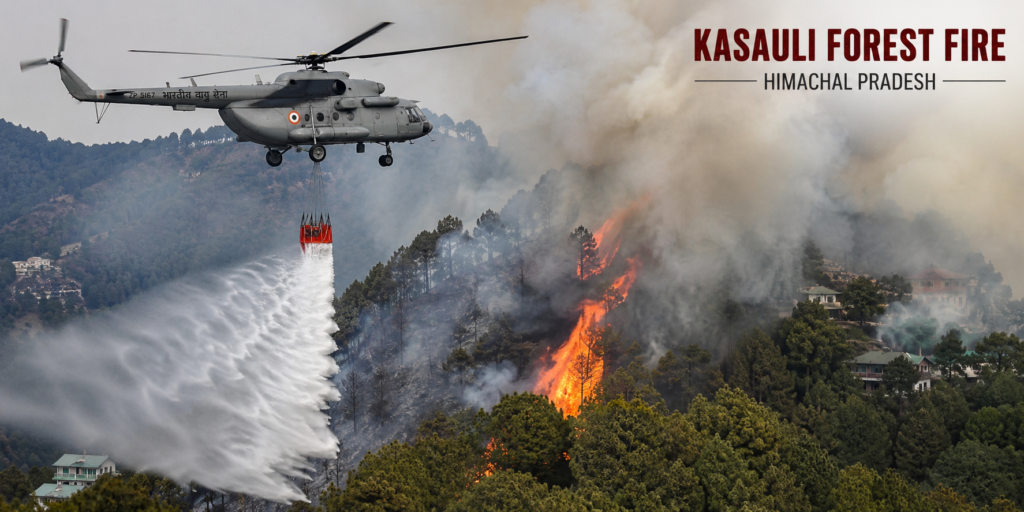
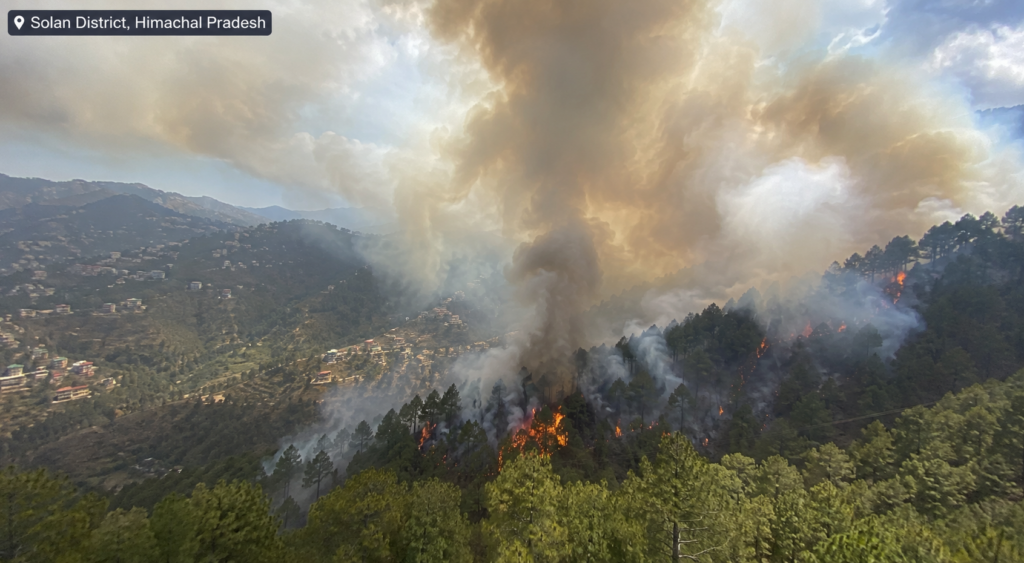
The recent forest fire in Solan, Himachal Pradesh is not just another environmental incident. A major fire broke out in the Kyarighat village area of Kandaghat in Solan district, spreading rapidly across hilly forest toward Kasauli, with thick smoke visible from a great distance as flames consumed large stretches of land. The Indian Air Force had to deploy helicopters. Water was airlifted from Sukhna Lake in Chandigarh just to slow down the burning. Think about that. We needed the Air Force to fight a forest fire.
And then, a few days later, we moved on.
This is the story of forest fires in Himalayas not just the flames, but the forgetting.
The Numbers Are Screaming. Are We Listening?
Let the data speak first, before the opinions.
In 2024 alone, Himachal Pradesh faced 1,684 fire incidents, destroying 17,471 hectares of forest land. On average, 36 percent of forests in Himachal Pradesh are classified as fire-prone.
Experts link these fires to increased heat and black carbon emissions, which negatively affect water systems and air quality.
From November 2021 to June 2022, as many as 5,280 forest fires were reported in Himachal Pradesh; a sharp increase from just 536 fires reported in the state from November 2019 to June 2020. That is a tenfold jump in two years.
During the 2023-24 fire season, the Forest Department reported 686 fire incidents causing damage to 11,032 hectares of forestland and plantation areas, with a financial loss of over Rs 3.24 crore.
And the most damning statistic of all? 95 percent of forest fires in India are caused by human activities.
Not lightning. Not fate. Us.
Solan Is Burning. And It Is Not Alone.
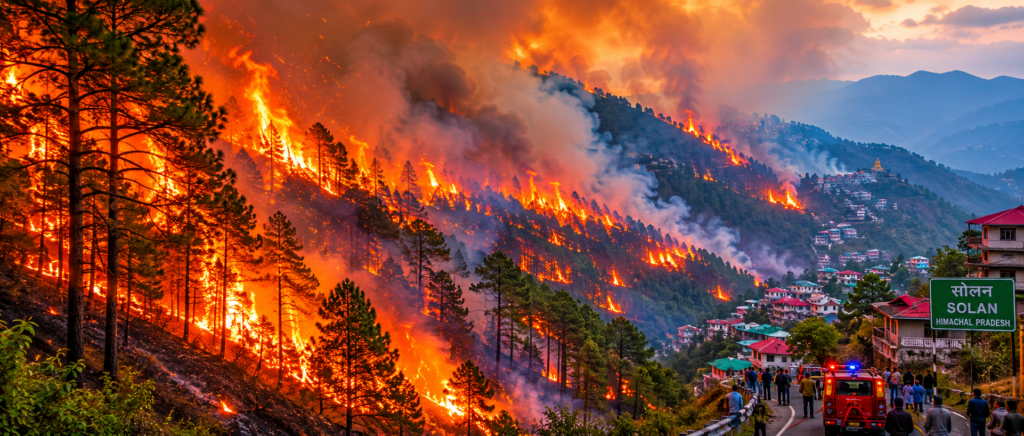
With temperatures in Solan and Kasauli ranging from 34°C to 38°C, forest fires have been at their worst. No stretch of pine-laden forest has been left untouched by flames in recent days.
The Baddi fire station alone received 10 fire emergency calls in a single day. Solan recorded six incidents. Multiple calls were attended by Parwanoo fire station as well. Range Forest Officer Banarsi Das expressed concern over villagers allegedly setting pine needles ablaze despite repeated awareness campaigns.
Schools were shut. Families were evacuated. Defence personnel vacated their residences. A forest fire even halted the Kalka-Shimla heritage train 15 kilometres before its destination when flames reached the railway track.
This is not a seasonal inconvenience. This is a civilisation-level warning.
Why Forest Fires in Himalayas So Easy?
Many people blame the weather. Dry summers, low rainfall; these are real factors. But nature does not suddenly turn violent without human help.
The pine needle problem is real and it is serious.
An estimated two tonnes of pine needles fall per hectare of pine forest every year. As temperatures rise in summer, these highly flammable needles turn the forests into a tinderbox, dramatically increasing the risk of devastating fires.
But here is what most people do not say out loud: the massive presence of chir pine itself; over oak, deodar, and other native trees is a result of decades of poor forest management. In the Himalayas, uncontrolled fires have made the situation less favourable for oaks to grow and more favourable for fire-prone chir pine. One fire creates conditions for the next fire. It is a loop we built.
The human causes are not mysterious. They are embarrassingly ordinary:
- Discarded cigarette butts on mountain roads and trekking paths
- Villagers burning dry grass and pine needles without control
- Tourists lighting bonfires and walking away
- Farmers clearing land with fire
- Illegal activities under cover of smoke
- Construction debris burning near forests
- No accountability, no punishment, no change
While it is hard to determine the triggers of individual fire events, foresters in India and several studies say that 90 percent of fires are started by human beings.
A Forest Fire Is Not Just Burning Trees
This is where people make the biggest mistake. They see smoke, they feel sad, they move on. But a Himalayan forest fire is not just trees burning. It is an entire living world collapsing.
Here is what actually dies in a Himalayan forest fire:
- Soil fertility; topsoil takes decades to form and burns in hours
- Water sources; forests hold water; without them, streams die
- Biodiversity; plants, insects, birds, small mammals, fungi, all gone
- Carbon storage; every burnt tree releases stored carbon back into the air
- Wildlife corridors; animals lose safe paths between habitats
- Landslide protection; forests hold hillsides together; without them, villages below are exposed
Regular forest fires in the western Himalayas are harming the region’s flora and fauna. Research shows that if fires continue, the area occupied by pines, cedars, and rhododendrons in the western Himalayas will shrink considerably. The range of these trees is likely to shift toward the northern and north-eastern parts of the Himalayas.
Forest fire season in the Himalayas coincides with the flowering and breeding months of several vulnerable species. The impact of recurrent fires is therefore not limited to the direct loss of trees and wildlife; fires can meddle with the life cycles of species and push many threatened and endemic ones closer to extinction.
And then there is the glacier problem.
The Fire on the Ground. The Melt at the Top.
Forest fires and glacier retreat are not separate problems. They are the same crisis wearing different faces.
The Himachal Pradesh State Climate Change Centre’s Annual Report 2024-25 shows the state had 805 glacial lakes in 2016, rising to 1,619 by 2022; nearly doubling in six years.
Snow cover in Himachal Pradesh in winter 2023-24 was recorded at 13 percent less than the previous year.
From 1994 to 2021, the glacier area in Himachal Pradesh decreased at approximately 1.678 percent per year. That is a slow death, happening every single year, visible in satellite images, invisible to most of us.
When forests burn, the hills absorb more heat. When hills absorb more heat, glaciers melt faster. When glaciers melt, rivers flood unpredictably in summer, then run dry in winter. When rivers fail, farming fails. When farming fails, people leave. When people leave, the mountains are abandoned and exploited even more.
This is not a conspiracy theory. This is basic ecology.
“We Worship the Mountain But We Do Not Protect It”
Here is the cultural contradiction that nobody likes to admit.
We name our children after rivers. We hold mountains sacred. Himachal Pradesh literally means “Land of Snow” a name that carries reverence in every syllable. Villages have local traditions of forest protection called Van Panchayats and forest god rituals. Older generations walked lightly because they understood the mountain was alive and had limits.
And now? Roads are blasted through wildlife corridors. Hotels sit on ridge lines. Tourists drop plastic at 10,000 feet. And every dry April, the forests burn while we post photos of the scenery.
Traditional irrigation systems like the kuhl in Himachal Pradesh are proven examples of sustainable water use that enhance resilience toward changing precipitation patterns. Our ancestors built systems that worked with the mountain. We are building systems that fight it.
The structure of our relationship with nature has inverted; we once saw ourselves as part of the forest. Now we see the forest as part of our development plan.
The Response: Too Little, Too Slow, Too Political
Every year, the same cycle plays out.
Fire breaks. News spreads. Politicians visit. Photos are taken. A few crore rupees are announced for relief. The forest department posts statistics. And by July, when monsoon rains arrive and put out the remaining flames, everyone breathes a sigh of relief and waits for next year’s fire season.
Forest department officials expressed concern that tackling fires in remote and deep forest areas remains a major challenge, particularly when flames spread rapidly along hilly terrain and roadside stretches.
The Forest Department does what it can. Frontline staff and local communities often fight fires with bare hands, sticks, and green branches. They deserve enormous respect. But they cannot fix a policy failure with physical courage alone.
What is missing is not manpower. It is political will.
What needs to happen not someday, but now:
- Strict anti-fire laws with real enforcement. Not just awareness campaigns. Actual penalties for negligent fire-starting.
- Community forest protection programs that pay and empower local villages to be guardians, not just bystanders.
- Reduce chir pine monoculture. Replant with oak, deodar, and native mixed forest that holds water and resists fire.
- Tourism regulation. No more bonfires on trekking routes. No smoking near forest zones. Accountability for visitors.
- Satellite-based early warning systems at the village level not just in government offices.
- Link forest health to development approvals. No new highway or hotel project should get clearance in fire-prone zones without a fire management plan.
What You Can Do Right Now
You are reading this from a phone or a laptop, probably far from the fires. But you are not unconnected. Here is what ordinary citizens can do:
- Never throw a cigarette in a forest or on a mountain road. Ever.
- Report suspicious fires. Himachal Pradesh Forest Department helpline: 1800-180-8008.
- Support organisations working on Himalayan ecology like Himalayan Geographic, local Van Panchayats, and NGOs working on community forestry.
- Talk about this. Not just with a repost. With your family, your school, your local representative.
- Demand accountability from your elected officials. Forest fires should be an election issue.
- Travel responsibly in the hills. The mountain remembers every bonfire, every cigarette, every shortcut.
The Fire in Real Time
From the Desk of Nikhil Raj Sharma, Founder, Himalayan Geographic
“Every year I travel through these mountains and document what I see. The forests I photographed ten years ago no longer look the same. The fire scars are visible on the hillsides black patches where green once was. People ask me if the Himalayas are in danger. They are not in danger. The Himalayas will survive us. It is we who are in danger of losing everything the Himalayas gave us; water, air, food, stability. And we are losing it quietly, fire by fire, without even noticing.”
“The most painful part is not the fire itself. It is the three-day memory of the public. By the time you read this article next year, Solan will have burnt again. And we will be surprised again. That is not a nature problem. That is a character problem.”
“At Himalayan Geographic, we believe that documentation is the first step toward protection. If you cannot see the destruction clearly, you cannot fight it. These fires must be counted, named, mapped, and remembered; not just in government records, but in public consciousness.”
The Himalayas Are Still Burning
The fire in Solan should not only make us sad. It should make us think about which direction we are going.
Because the Himalayas are not infinite. They are living mountains with real limits. Apart from destroying trees and vegetation, forest fires also result in loss of biodiversity, depletion of soil nutrients, and increased carbon emissions. Fires frequently threaten wildlife habitats and nearby habitations, besides causing severe air pollution in hill districts.
When forests burn repeatedly, glaciers retreat. When glaciers retreat, rivers shrink. When rivers shrink, plains go thirsty. This is not a Himachal Pradesh problem. This is a North India problem. This is a civilisation problem.
The fire season of 2024-25 was the worst on record. The fire season of 2025-26 may be worse. Or it may not be; this year, unseasonal May rains in Himachal offered brief relief. But rain cannot fix negligence. Rain cannot fix policy failure. Rain cannot fix our habit of caring deeply for two days and forgetting for twelve months.
“When forests burn continuously, civilisation eventually burns with them.”
We have been warned. The question is whether we are finally ready to listen.
The Himalayas are burning because we stopped respecting them. 95 out of 100 fires are our fault. We throw cigarettes. We burn pine needles carelessly. We build roads through forests without thinking. We visit mountains like shopping malls. And then we watch the smoke for two days, feel sad, and forget.
The data is clear. The damage is real. The warning is loud. The only question left is whether we are the generation that finally stops looking away; or the generation that watched it all burn and did nothing.
The mountain will survive. The question is: will we deserve it?
Related Articles You Should Read:
- Glaciers of Himachal Pradesh: The Slow Disappearance Nobody Is Talking About
- Pine Needles and Policy Failures: Why Himalayan Forests Keep Burning
- Van Panchayats: The Forgotten Solution to Forest Protection in India
- Tourism’s Hidden Cost: What Every Mountain Traveller Must Know
Disclaimer: The content and images published in this article are provided for general informational and educational purposes only. Some images may be generated or enhanced using artificial intelligence (AI) and are intended solely for illustrative use. The views, interpretations, and information expressed do not necessarily reflect the official position of Himalayan Geographic Research Foundation, nor do they constitute professional, legal, medical, or financial advice.
While efforts are made to ensure accuracy, no guarantees are given regarding completeness or reliability. Readers are encouraged to independently verify information and use their own judgment. By reading this article, you acknowledge that any reliance on the content is at your own risk, and Himalayan Geographic Research Foundation assumes no responsibility or liability for disagreements, interpretations, or outcomes arising from its use. If you do not agree with these terms, you are advised to discontinue reading.