
Himalayan deforestation is turning India’s coolest mountains into heat zones. 352 sq km of forests lost in 2 years. Here’s what’s happening and what we must do before it’s too late.
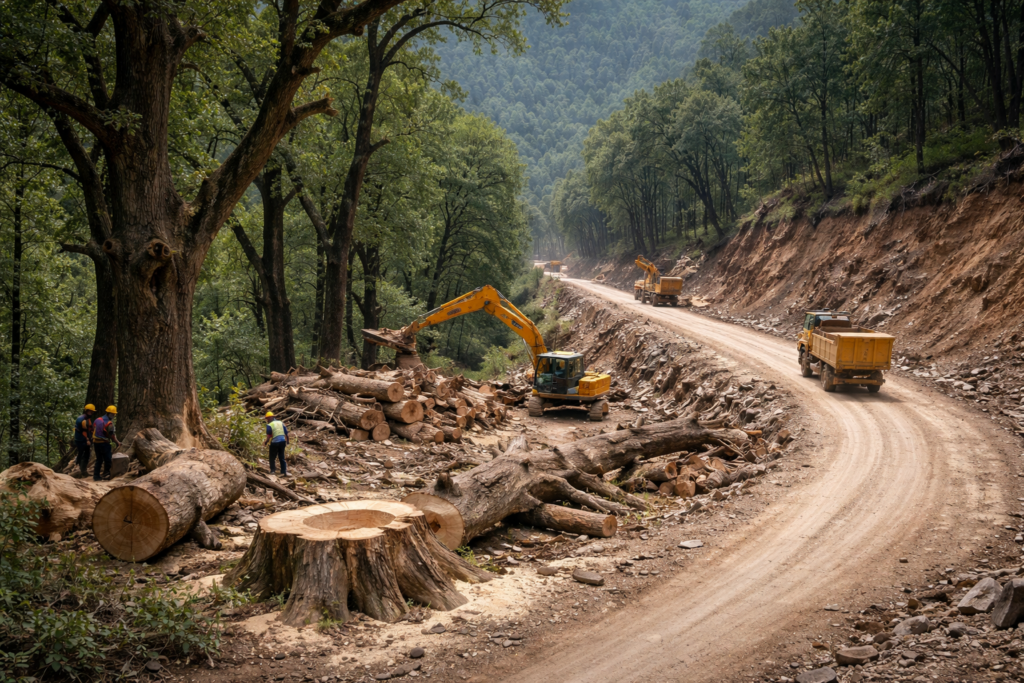
Did you know that India’s Himalayan forests shrank by 352 square kilometres in just two years; that is an area larger than the entire city of Chandigarh, gone? While we were busy building hotels, highways, and resorts in the mountains, the trees that kept those mountains cool, stable, and alive were quietly disappearing. Himalayan deforestation is no longer a distant environmental concern. It is a fire at our doorstep and right now, it is burning.
Stand in Dharamsala, McLeod Ganj, Manali, or Shimla on a May afternoon in 2025, and you will feel something our grandparents never felt in these hills; unbearable, suffocating heat. Ceiling fans are whirring in places that never needed them. Air conditioners are being installed in mountain towns. This is not normal. This is a warning.
The Numbers That Should Shock You
Let us begin with facts, not feelings.
According to the 18th India State of Forest Report 2023, forest cover in the Indian Himalayan Region dropped from 15,427 square kilometres in 2021 to 15,075 square kilometres in 2023. That is a loss of 352 square kilometres in just two years; a 2.27% decline in one of the world’s most ecologically fragile zones. (Source: The Climate Watch, March 2026)
Professor Prakash C. Tiwari, Emeritus Professor at Kumaun University in Uttarakhand, has studied this for decades. His finding is clear: “Over the last 75 years, the Himalaya has experienced a 0.1°C increase in average temperature every decade.” That may sound small, but in a mountain ecosystem, even half a degree changes everything snowmelt patterns, river flows, forest fire frequency, and rainfall timing. (Source: Climate Impact Tracker, March 2024)
If we do nothing, projections say the region will see a 2.5°C to 2.8°C rise by the end of this century, with some models warning of up to 4°C by 2100. That is not a statistic. That is a death sentence for mountain ecosystems.
The Concrete Invasion
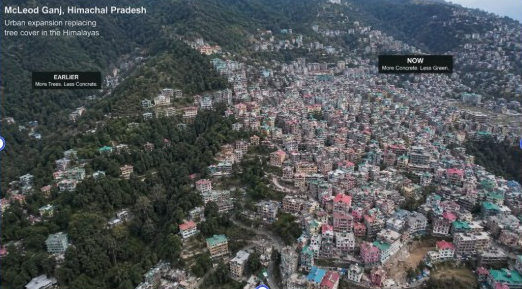
Walk through McLeod Ganj today and you will see construction on every corner. Hotels are built where deodar trees once stood. Parking lots sit on what was forest land. Roads are being widened through slopes that have no business being cut.
A 2021 investigation by Mongabay India found that forest land flanking the main road entering McLeod Ganj from Dharamsala had been diverted first for a parking lot, then for a bus stand under the label of “public purpose.” Ghazala Abdullah, an environment activist based in McLeod Ganj, told Mongabay: “This is just the tip of the iceberg. The nexus between builders and government officials runs deep.” The Supreme Court of India had to step in, upholding a National Green Tribunal order to demolish illegal constructions. (Source: Mongabay India, June 2021)
And it is not just Dharamsala. Across Himachal Pradesh:
- The Gangotri Highway expansion project alone is expected to require the felling of around 7,000 trees in a landslide-prone region.
- The Joshimath subsidence (2023); where houses cracked and sank is directly linked to tunneling for a hydropower project.
- The Silkyara tunnel collapse (2023) trapped 41 workers because mega-projects rushed forward without proper geological surveys.
- Himachal landslides (2023–2025) were worsened by road-widening projects on steep hillsides.
The Supreme Court of India itself has said this clearly: Revenue “cannot be earned at the cost of the environment and ecology.” (Source: ORF Online, August 2025)
The Heat Is Here And It Is Getting Worse
In the summer of 2024, the Indian Meteorological Department (IMD) recorded 14 heatwave days in Himachal Pradesh in a single season; up to June 10 alone. Yellow alerts were issued for Kangra, Dharamsala, Chamba, Kullu, Mandi, and several other districts. Temperatures were expected to rise by another 2–3°C in those zones. (Source: Outlook India, June 2024)
Dr. S.D. Attri, a meteorologist who has studied Himalayan climate patterns, put it simply: “The rapid urbanisation and deforestation in the region reduce the natural cooling effects of forests and increase the urban heat island effect.”
The Urban Heat Island (UHI) effect means that cities and towns in the hills are now significantly hotter than the surrounding forests and fields; sometimes by 2°C to 8°C more. Concrete absorbs heat. Glass reflects it. Tar roads store it. When you replace trees with buildings, you replace a natural cooler with a natural heater. (Source: The Tribune, March 2026)
Why Trees Are Not Just “Nice to Have”
This is where many people make the mistake. They think trees are decorative; a background feature, a source of shade on a hot day. They are not.
Trees in the Himalayas do all of this:
- Regulate rainfall — without forest cover, monsoon patterns become erratic, causing droughts and floods in the same season.
- Hold the soil — tree roots bind mountain slopes. Remove them, and the mountain slides.
- Cool the air — through a process called evapotranspiration, trees release moisture that cools surrounding temperatures.
- Store carbon — forests globally absorb more than 7 billion metric tons of CO₂ per year, more than total annual US emissions. (Source: Statista, 2026)
- Feed rivers — Himalayan forests feed the springs and streams that become India’s great rivers the Ganga, Yamuna, Beas, Ravi, and more.
60% of urban areas in the Indian Himalayan region are located in environmentally unsafe areas, at high risk of landslides. These are not empty mountains. These are towns, schools, hospitals, and families. When trees go, the hills go with them.
The Tourism Boom
Himachal Pradesh saw a record 1.80 crore domestic tourists and 83,000 foreign tourists in 2024. That is extraordinary, and for the local economy, it means livelihoods. But it also means thousands of new hotel rooms being built, thousands of vehicles driving up mountain roads, and a constant demand for more — more roads, more parking, more concrete. (Source: Times of India via Talk Dharti To Me, January 2026)
The Dharamsala–McLeod Ganj road, now a crumbling, sinking stretch of tarmac, is a direct result of this pressure. A senior geologist at Central University of Himachal Pradesh, Dr. A.K. Mahajan, warned: “The water seeping into the geological layers is silently eroding the stability.” (Source: The Tribune, June 2025)
The irony is heartbreaking: people come to the Himalayas for their beauty and peace and in coming, they are slowly destroying both.
Who Suffers Most?
It is never the hotel owner or the road contractor who suffers first. It is the farmer, the shepherd, the woman walking 5 kilometres to find clean water, the child breathing dust from a construction site instead of mountain air.
Research published in Frontiers in Environmental Science (2025) shows clearly that women and indigenous peoples, who depend directly on natural resources for food and livelihoods, bear the harshest impact of ecological collapse in the Himalayas. Biodiversity loss hits their medicine, food, and income first. Landslides destroy their homes first. Erratic rainfall ruins their crops first. (Source: Frontiers, February 2025)
Justice is not separate from ecology. They are the same conversation.
What Can Actually Be Done?
The problem is real, but it is not beyond fixing. Here is what works:
1. Plant Trees
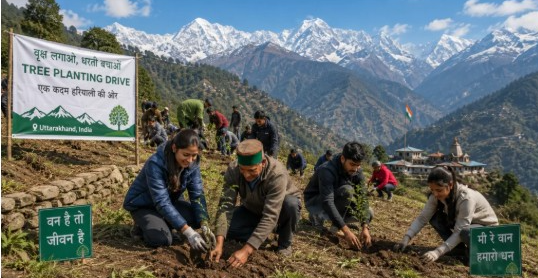
Not just any tree, anywhere. Mountain ecosystems need native species; deodar cedar, Himalayan oak, rhododendron, and silver fir. Planting eucalyptus or other fast-growing monocultures in the Himalayas often does more harm than good. Plantation must be treated as a 15-year commitment, not a one-day event.
2. Enforce Forest Laws; Actually
The Forest Conservation Act, 1980 exists. The National Green Tribunal exists. The Supreme Court has given clear orders. What is missing is enforcement. Forest land must be demarcated clearly so that builders cannot exploit overlap between forest and revenue department jurisdictions.
3. Sustainable Tourism Policy
Carrying capacity limits for Himalayan towns are urgently needed. Dharamsala, Manali, and Shimla cannot handle unlimited tourists without destroying the very thing tourists come to see. Seasonal caps, eco-certification for hotels, and proper waste management are not optional extras; they are survival requirements.
4. Green Building Codes for Mountain Towns
Every new building in Himalayan towns should be required to plant a minimum number of trees, use permeable surfaces, and maintain green buffer zones. Architecture in the mountains must work with the land, not against it.
5. Community-Led Conservation
The most successful forest conservation programmes in India from the Chipko Movement in Uttarakhand to community forests in Himachal; have been led by local people. Top-down government programmes without community ownership fail. Local knowledge must lead.
A Tree Planted Today Is a Gift to 2040
A deodar planted today will provide meaningful shade in 14–15 years. In 30 years, it will be helping hold a hillside together. In 50 years, it will be filtering the water that feeds a spring. This is not a romantic idea. This is basic biology.
We are not fighting for trees. We are fighting for ourselves.
If you live in Dharamsala, Shimla, Manali, Kullu, or any Himalayan town look around you. Count the buildings going up. Now count the trees that came down for them. Ask yourself: what will this town feel like in summer 20 years from now?
Watch this powerful documentary on India’s climate crisis to understand what is at stake: India on Fire: Facing the Climate Crisis | Al Jazeera 101 East
Also read: Himalayan Forest Loss and Rising Temperatures — The Climate Watch
What Nikhil Raj Sharma, Founder of Himalayan Geographic, Says
“Every summer, I see Dharamsala become a little more concrete and a little less green. People who visit say the hills have changed. They are right; the hills have changed because we changed them. If we want the Himalayas to remain the Himalayas, we cannot treat them like a construction site. A building gives you income for 20 years. A tree gives your children oxygen for 200 years. The maths is simple.”
“I have seen forests disappear in places where I played as a child. The Himalayan deforestation crisis is not about statistics; it is about memory, identity, and survival. Every tree that falls takes a piece of our mountain culture with it. We need less concrete and more conscience.”
“We are cutting the trees that cool us, and building the concrete that burns us. The Himalayas are not a construction opportunity; they are a living system that keeps hundreds of millions of people alive. One planted tree today becomes shade, water, and clean air for your grandchildren. One building without green cover becomes a heat trap. The choice is yours. Choose the tree.”
Related Reading and Resources
- Himalayan Deforestation and Forest Loss — India State of Forest Report 2023
- As Dharamsala Grows, the City Eats into the Forest — Mongabay India
- Climate Change in the Himalayan Region — Frontiers in Environmental Science
- Himalayan Heatwaves — Outlook India
- Climate Extremes and the Development Dilemma in the Himalayas — ORF
- Urban Heat Islands in India — The Tribune
Disclaimer: The content and images published in this article are provided for general informational and educational purposes only. Some images may be generated or enhanced using artificial intelligence (AI) and are intended solely for illustrative use. The views, interpretations, and information expressed do not necessarily reflect the official position of Himalayan Geographic Research Foundation, nor do they constitute professional, legal, medical, or financial advice.
While efforts are made to ensure accuracy, no guarantees are given regarding completeness or reliability. Readers are encouraged to independently verify information and use their own judgment. By reading this article, you acknowledge that any reliance on the content is at your own risk, and Himalayan Geographic Research Foundation assumes no responsibility or liability for disagreements, interpretations, or outcomes arising from its use. If you do not agree with these terms, you are advised to discontinue reading.