
Tibetan youth education is the last strong wall protecting a 2,500-year-old culture. Here’s how schools, language, and young leaders are fighting to save it, one classroom at a time.
A Tibetan researcher made a sobering prediction a few years back: by 2030, roughly 70% of Tibetans inside China may not be able to speak their own mother tongue. This projection came after educators warned that Tibetan would be completely removed from school curriculums in the region. Read that number again. Not extinct language, not a forgotten dialect from ancient history; a living language, spoken by millions of people alive today, sliding toward silence within one generation.
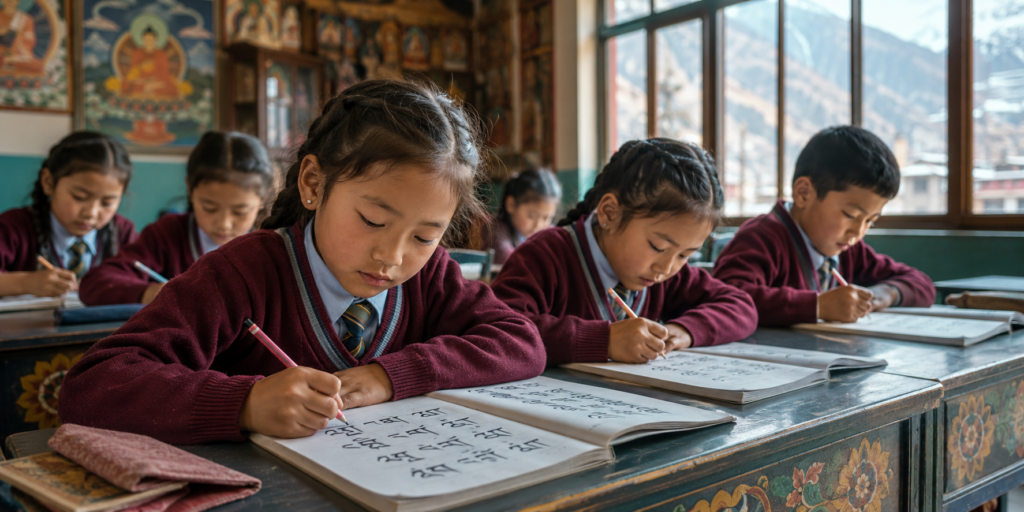
That is the real weight sitting on the shoulders of Tibetan youth right now. Tibetan youth education is no longer just about getting a degree or a job. For thousands of young Tibetans growing up in exile in India, Nepal, and around the world, going to school has become an act of cultural survival. Every Tibetan alphabet a child learns, every folk song a teenager remembers, every monsoon-watching tradition passed down from a grandmother; all of it depends on whether the next generation gets educated in a way that keeps the culture alive, not just the economy running.
This article looks at why education for Tibetan youth matters so much right now, what is actually working in Himalayan schools, what is falling apart, and what an ordinary reader like you can do about it.
Why This Story Matters Right Now
Most people know Tibet through the Dalai Lama, the maroon robes of monks, or a documentary they watched years ago. Very few know that Tibetan civilisation is being fought over in classrooms; some in China, some tucked away in the hills of Himachal Pradesh and Karnataka.
Early in 2025, Tibetan citizens online began publicly demanding that the Tibetan language be restored as a requirement in college entrance exams, showing just how urgent this feels to Tibetans themselves. Meanwhile, in India, Tibetan refugee schools are trying to do the opposite job; not restore a lost requirement, but keep an entire identity alive for children who may never see the Tibetan plateau in their lifetime.
This is not old news dressed up. It is happening in 2025 and 2026, in real schools, with real children.
Tibetan Children’s Village
If you want to understand Tibetan youth education, you have to start with one institution: Tibetan Children’s Village, or TCV.
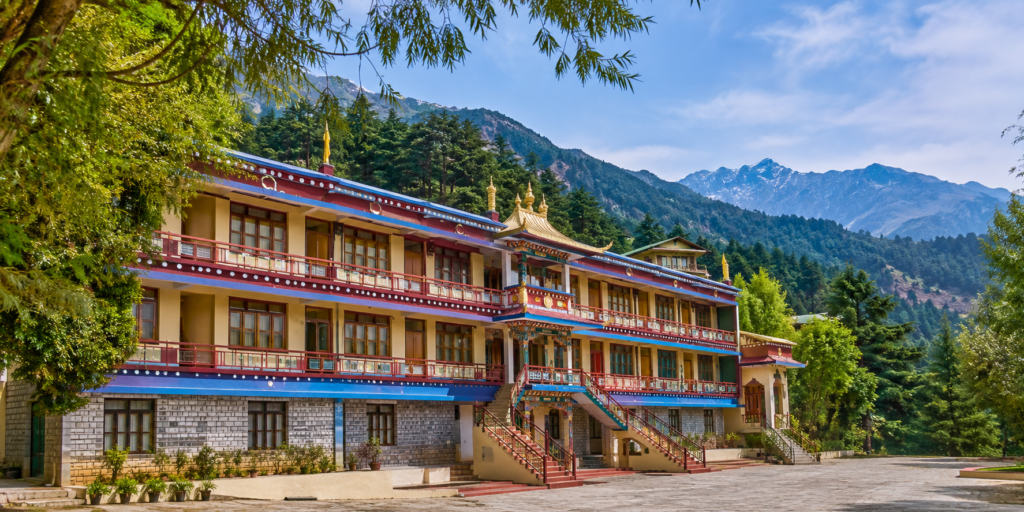
After the Chinese occupation of Tibet in 1950 and the Dalai Lama’s move to India, taking care of orphaned and separated Tibetan refugee children became an urgent priority, and the Dalai Lama proposed setting up a centre for these destitute children in Dharamsala. What started in 1960 with just 51 children has grown into a community of 1,200 residents and 150 day students, spread across 35 homes and four hostels.
TCV did not stay small. It is now a registered non-profit charity headquartered in Dharamsala, Himachal Pradesh, with a network across India caring for more than 12,000 children, and it currently runs centres in Upper Dharamshala, Lower Dharamshala, Bylakuppe, Gopalpur, Chauntra, Suja, Ladakh, and Selakui, along with youth hostels in Delhi and Bengaluru.
Here is a detail that should stop you for a second: over 60% of the staff working across TCV’s branches today are its own alumni. Think about what that means. Children who arrived as refugees, some without parents, grew up, got educated, and came back to run the same schools that raised them. That is not a statistic; that is a full circle.
And the results are showing up on paper too. In 2025, 416 TCV students appeared for the CBSE class 12 board exam and 411 passed; a 99.8% pass rate, with nine students scoring above 90% and the top scorer hitting 95.8%. A refugee school, built out of grief and improvisation sixty-five years ago, is now beating national averages.
The Numbers That Tell the Real Story
Let’s put the key facts together in one place:
- 99.8% — pass rate of TCV students in the 2025 CBSE class 12 exam
- 12,000+ — children currently under TCV’s care across India
- 60%+ — TCV staff who are alumni of the same school system
- 70% — projected share of Tibetans in China who may not speak Tibetan fluently by 2030
- 65 years — how long TCV has been running continuously since 1960
Put these side by side and the picture becomes clear. Inside Tibet, structural pressure is pushing the language toward silence. In exile, schools like TCV are the last strong dam holding the water back.
Losing a Language Is Not Like Losing a Subject
Here is something people outside the Tibetan community often don’t understand. Researchers studying the Tibetan plateau have found that language loss happens because people stop speaking it to their own children; not because of one single law or policy, but because daily life quietly shifts to a different language, generation after generation.
A monk in a Yushu monastery once told journalists plainly that parents believe Chinese matters most for their children’s future, partly because national university entrance exams are conducted only in Chinese. That is a heartbreaking but honest trade-off many parents are forced to make: culture versus career.
This is exactly why the diaspora carries extra weight. A 23-year-old Tibetan American, Tenzin Rabga Chomphel, described it well; many young Tibetans abroad feel real pressure and guilt to learn their mother tongue precisely because they know how repressed the language is back home. It is not a hobby language for them. It feels like a duty.
Even the Dalai Lama has weighed in on this directly, saying that although Tibetan isn’t the most “useful” language professionally, it is the Tibetan people themselves who must be the ones to preserve it since it is their own mother tongue.

It’s Not Just Language; It’s Environmental Wisdom Too
Tibetan elders don’t just carry vocabulary. They carry centuries of high-altitude survival knowledge; how to read glacier melt, when to move herds before a storm, which plants heal a fever at 4,000 metres. None of this is written in a textbook you can Google. It lives in oral tradition, in songs, in grandparents talking to grandchildren while making butter tea.
When a young Tibetan stops speaking the language, this knowledge often stops travelling with it. That is why serious Tibetan youth education programs today try to fold in environmental and cultural learning alongside regular school subjects; not as an extra activity, but as the core of what makes the education “Tibetan” in the first place.

What Nikhil Raj Sharma, Founder of Himalayan Geographic, Has to Say
Nikhil Raj Sharma, Founder of Himalayan Geographic, shared his view on why this issue deserves wider attention: “When we talk about Himalayan conservation, we usually mean rivers, forests, and snow leopards. But a culture is an ecosystem too. Tibetan youth are the last generation that can still learn this heritage first-hand, from people who actually lived it. If we lose them to the pressures of modern life without giving them a proper foundation, we lose something no policy paper can bring back.”
He added a practical note as well: “Real change here does not come from big donations alone. It comes from small, consistent support; sponsoring one child’s school fees, sharing verified information, or simply visiting these schools respectfully and listening to the students themselves.”
What Is Actually Working in Tibetan Schools Today
It is not all struggle. Several things are genuinely working well:
- Alumni-run staffing model; schools like TCV are largely run by people who were once students there themselves, which keeps cultural continuity strong
- Bilingual academic performance; students are proving that studying in Tibetan alongside English/Hindi does not hurt exam results, it can even strengthen them
- International academic partnerships; university programs abroad have started sending graduate student interns to work directly with TCV teachers on classroom management and blending Tibetan cultural teaching with modern instructional methods
- Community identity events; sports days, cultural festivals, and religious ceremonies are used deliberately as informal classrooms for language and tradition
- Global diaspora support networks; vibrant Tibetan community hubs in cities abroad are stepping in to run weekend language schools
What Is Still Breaking Down
Honesty matters more than optimism here, so let’s name the real problems too:
- Enrollment is dropping in some schools as families migrate for work or move abroad entirely
- Career pressure pulls students toward English and Hindi/Chinese, since these languages open more job doors than Tibetan does
- Emotional wellbeing gaps; many students are separated from parents for years, and schools are only recently building structured emotional-support programs for this
- Funding is not guaranteed; most of these institutions run on donations and sponsorships, not government budgets
- Loss of minority Tibetan dialects; even within Tibetan-medium schools, a dozen smaller local languages within Tibetan-speaking regions are already endangered because they are steadily losing younger speakers
So What Can You Actually Do?
You don’t need to move to Dharamsala to help. Real, doable steps include:
- Sponsor a student’s education through verified organisations like Tibetan Children’s Village or The Tibet Fund
- Share accurate information about Tibetan youth education instead of vague sympathy posts
- Support Tibetan-run businesses and cultural centres near you, if you have one in your city
- Encourage schools near you to include Himalayan and Tibetan culture in world-culture curriculums
- Visit respectfully if you travel to Dharamsala, Bylakuppe, or similar communities; buy from local Tibetan markets, attend an open cultural event, listen more than you photograph
A Final Thought
A 12-year-old learning Tibetan grammar today in a hostel classroom in Dharamsala is doing something bigger than homework. She may be one of the last people who will speak this language the way her grandmother did. That is not a small responsibility to hand a child; but it is exactly what history has handed the next generation of Tibetan youth.
Education, in this case, is not just a ladder to a better job. It is the rope holding an entire civilisation together while it crosses a very long, very difficult bridge.
What do you think; should countries hosting Tibetan refugee communities do more to support Tibetan-medium education? Share your thoughts in the comments below.
Related reads:
- Preserving Endangered Himalayan Languages
- Life Inside a Tibetan Refugee Settlement
- How the Dalai Lama Shaped Modern Tibetan Education
Real references used (for further reading):
- Tibetan Children’s Village
- Tibet Post International, “TCV School celebrates 65th founding anniversary,” Oct 2025
- The Tibet Fund
- Wikipedia — Tibetan Children’s Villages
- Radio Free Asia (RFA) Asia Fact Check Lab, 2025
- Central Tibetan Administration, “Tibetans Fight to Keep Their Language Alive”
- International Campaign for Tibet , Dec 2025
- Human Rights Watch, “In Tibet, it’s a crime to even talk about mother-tongue education”
- Smithsonian Magazine, “The Incredible Linguistic Diversity of Tibet Is Disappearing”
- China Digital Times, “Languages in Tibet Struggle for Survival,” Feb 2025
Disclaimer: The content and images published in this article are provided for general informational and educational purposes only. Some images may be generated or enhanced using artificial intelligence (AI) and are intended solely for illustrative use. The views, interpretations, and information expressed do not necessarily reflect the official position of Himalayan Geographic Research Foundation, nor do they constitute professional, legal, medical, or financial advice.
While efforts are made to ensure accuracy, no guarantees are given regarding completeness or reliability. Readers are encouraged to independently verify information and use their own judgment. By reading this article, you acknowledge that any reliance on the content is at your own risk, and Himalayan Geographic Research Foundation assumes no responsibility or liability for disagreements, interpretations, or outcomes arising from its use. If you do not agree with these terms, you are advised to discontinue reading.