
Nepal spends crores on vocational training but most graduates end up jobless or migrating abroad. Here are 7 hard truths about why skills vs degrees is a battle vocational education is losing and what must change now.
Every year, Nepal produces thousands of “trained” youth. And every year, most of them board a plane to Qatar.
That one sentence should disturb every policymaker, educator, and parent in this country. Nepal has over 1,000 vocational training institutes under the Council for Technical Education and Vocational Training (CTEVT). Yet, according to a 2022 World Bank report on South Asian labour markets, fewer than 30% of vocational graduates in Nepal find employment in the field they trained for. Thirty percent. That means 7 out of 10 trained youth are doing something else or going somewhere else entirely.
This is not a skills problem. This is a system problem. And if we keep pretending otherwise, Nepal will keep losing its most productive generation to foreign labour markets while its own industries beg for skilled workers.
What Is Vocational Education and Why Does Nepal Need It So Badly?
Vocational education, or TVET (Technical and Vocational Education and Training), is supposed to give young people job-ready skills; plumbing, electrical work, hospitality, healthcare assistance, IT, construction, and more. In theory, it is the smartest investment a developing country can make. You skip the four-year degree. You train fast. You employ faster.
Nepal has a massive need for this. With a youth unemployment rate hovering around 19.2% (ILO, 2023) and over 500,000 young people entering the labour market every single year, the country cannot afford to keep pushing everyone toward a Bachelor’s degree in something nobody is hiring for.
The logic is sound. The execution is broken.
Watch this short explainer on TVET in South Asia to understand the global picture
Reason 1: The Curriculum Is Living in the Past
Here is the first brutal truth. Most vocational curricula in Nepal were designed years, sometimes decades, ago. They have not kept up with what industries actually need today.
Talk to any hotel manager in Pokhara or Kathmandu. They will tell you that CTEVT hospitality graduates do not know how to use modern property management software. Talk to any electrical contractor in Lalitpur. He will tell you trained electricians cannot read modern circuit diagrams for solar installations. The training is real. The mismatch is realer.
As Peter Drucker said plainly: “Efficiency is doing things right. Effectiveness is doing the right things.” Nepal’s vocational system is efficient at producing certificates. It is not effective at producing employable workers.
A 2021 Asian Development Bank (ADB) report titled “Skilling Nepal” confirmed that curriculum revision cycles in Nepal average 5 to 7 years far too slow for fast-moving industries like IT, construction technology, and green energy.
Reference: ADB, 2021
Reason 2: Training Institutes and Employers Don’t Talk to Each Other
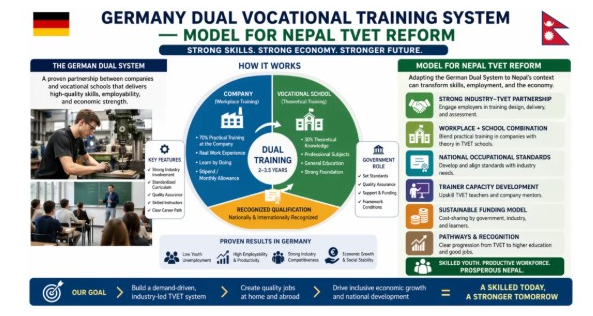
This is perhaps the most damaging failure. In most successful TVET systems; Germany, Singapore, South Korea employers sit inside the training system. They co-design curricula. They offer apprenticeships. They hire from the pipeline directly.
In Nepal, the institute and the employer are strangers.
A garment factory owner in Biratnagar has no formal relationship with the stitching training centre two kilometres away. A construction company in Kathmandu does not know which polytechnic is producing civil assistants. There is no structured, working bridge between training supply and industry demand.
Adam Smith would call this a market failure. When buyers and sellers cannot find each other, the market produces nothing useful. Nepal’s labour market for vocational graduates is exactly that a market where trained youth and employers cannot find each other.
The ILO’s 2022 Nepal Employment Assessment found that only 12% of private sector employers in Nepal had any formal engagement with TVET institutions. Twelve percent.
Reference: ILO Nepal, 2022 Labour Market Assessment
Reason 3: Society Still Looks Down on Vocational Tracks
Let us be honest about something painful. In Nepal, if your child goes to a vocational school instead of a “college,” neighbours ask what went wrong.
This is not unique to Nepal. But it is particularly damaging here, where family honour is tied to degrees and white-collar jobs. A young man who becomes an electrician or a woman who becomes a healthcare assistant is seen as having “settled.” A young person with a BBS degree from a mediocre college even one who cannot find work for five years is seen as having “tried.”
Joy Buolamwini’s work on algorithmic bias reminds us that bias baked into systems produces unfair outcomes. The same is true of social bias baked into education choices. When society systematically devalues vocational work, bright students avoid it. Vocational tracks get the students nobody else wanted. Then the quality drops. Then society devalues it more. It is a cycle that feeds itself.
A 2020 UNICEF Nepal study found that over 67% of parents would prefer their child pursue an academic degree over vocational training, regardless of job prospects.
Reference: UNICEF Nepal Education Report, 2020
Watch this powerful video on changing the narrative around skills
Reason 4: Policy Is Weak, Funding Is Thin, Implementation Is Thinner
Nepal has a national TVET policy. It has a CTEVT Act. It has a Skill Development Fund. On paper, the system looks decent. On the ground, it falls apart.
Max Weber taught us that bureaucracies fail when rules multiply but accountability disappears. That is exactly what has happened here. Nepal’s TVET system has layers of committees, sub-committees, and working groups. But who is actually responsible when a batch of graduates cannot find jobs? Nobody. The accountability chain is broken.
Between 2015 and 2022, Nepal received over USD 150 million in foreign aid for skills development from donors including the World Bank, ADB, SDC, and DFID. Studies from the Ministry of Education, Science and Technology’s own evaluations show mixed results infrastructure improved, but employment outcomes did not significantly change.
Reference: Ministry of Education, Science and Technology, Nepal Annual Report 2022
The money is not the problem. The political will to measure outcomes honestly is the problem.
Reason 5: Training Is Too Theoretical, Not Enough Hands-On
John Dewey, one of the greatest education thinkers who ever lived, said one thing above everything else: children and adults learn by doing, not by listening.
Nepal’s vocational institutes have not learned this lesson. Students spend a large portion of their training in classrooms, watching instructors write on boards. Labs are underfunded. Equipment is old, sometimes non-functional. Industry visits are rare. Internships are short and poorly structured.
A welder who has only watched welding will not weld well on a job site. A nurse’s aide who has only read about patient care will panic in a ward. The gap between what is taught and what is practised is the gap between a certificate and a competent worker.
The ADB’s 2021 “Skilling Nepal” assessment found that the ratio of practical to theoretical instruction in many CTEVT programmes was 40:60 in favour of theory the opposite of what good TVET systems recommend, which is at least 60% practical.
Watch a model vocational training system in action
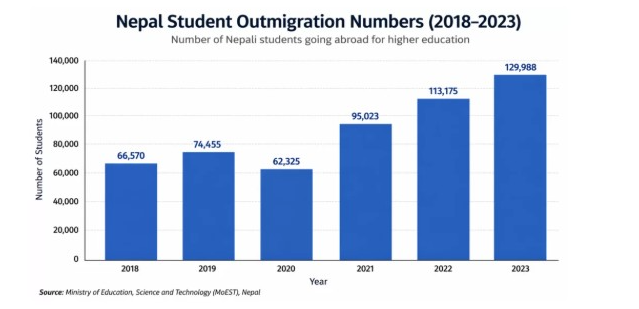
Reason 6: Trained Youth Are Leaving, and We Are Subsidising Their Foreign Employers
Here is the most painful fact in this article. Nepal trains a carpenter. That carpenter goes to Dubai. A Nepali government-funded institute trained that person. A UAE construction company benefits. Nepal loses both the worker and the investment.
According to the Department of Foreign Employment, Nepal, over 550,000 Nepali citizens received labour permits for foreign employment in fiscal year 2022/23 alone. Many of these are young, trained workers. The push factors are obvious wages in Qatar are five to ten times what a similar job pays in Nepal. No amount of patriotism competes with that math.
Adam Smith would not be surprised. Markets are rational. Workers go where wages are better. But the policy failure is that Nepal has not made it economically worth staying. There are no industry clusters that absorb trained workers at competitive wages. There are no apprenticeship pipelines that reward skilled workers. There is no structured return-migration programme that converts foreign experience into domestic enterprise.
Reference: Department of Foreign Employment, Nepal
Reference: World Bank Nepal Migration Report, 2023
Reason 7: No Credible Recognition System for Skills
If you are a trained electrician in Nepal, how does an employer verify your competence? There is a certificate. But certificates from different institutes mean different things. There is no unified, trusted National Qualifications Framework that employers believe in.
Compare this to Australia’s AQF (Australian Qualifications Framework) or the UK’s NVQ system, where a Level 3 certificate means something specific and verifiable to any employer in the country.
Without credible recognition, employers default to degrees. Not because degrees are better, but because they are a known signal. Until Nepal builds a trusted skills credentialing system, the skills vs degrees battle will always favour degrees even when degrees are less useful.
Reference: CTEVT Nepal
What Actually Needs to Change
Here is what a functioning system would look like:
- Curriculum review every 2 years, with industry representatives in the room not just government officials.
- Mandatory employer partnerships for every TVET institute; no partnership, no accreditation renewal.
- A National Skills Passport; a digital, verifiable record of every skill a person has been trained and assessed in.
- Wage incentives for skilled tradespeople government contracts should require certified Nepali tradespeople, creating domestic demand.
- Return-migration programme; Nepalis coming back from Gulf countries with real skills should get fast-tracked certification and enterprise support.
- Change the narrative; national campaigns, celebrity endorsements, school-level exposure to skilled trades. Make being a skilled worker cool, not shameful.
- Outcome-based funding; training institutes should receive funding based on employment rates of graduates, not just enrolment numbers.
The Bottom Line
Skills vs degrees is a false battle in a country that needs both. But right now, Nepal’s vocational education system is failing on every front that matters curriculum relevance, industry linkage, social respect, policy execution, hands-on training, and graduate employment.
The youth of Nepal are not the problem. They are showing up, enrolling, training, and trying. The system that should support them is the problem. And systems can be fixed; if the people in charge decide that employment outcomes matter more than certificate counts.
Nepal trains youth but forgets to connect them to jobs. The system is broken at every level curriculum, attitude, policy, and linkage. Fix the connection, not just the training.
Related Articles You Might Like:
- Why Nepal’s Education System Needs a Complete Reboot
- Foreign Employment: Blessing or Drain for Nepal?
- How Germany’s Dual Training System Could Work in South Asia
- The Real Cost of Brain Drain in Developing Countries
Comments from Nikhil Raj Sharma, Founder, Himalayan Geographic
“This article touches a wound that Nepal has been ignoring for too long. We spend crores on training but zero energy asking whether that training leads to a job. At Himalayan Geographic, we see this on the ground young people with certificates and no confidence to enter the workforce. The system has to connect to reality, not just to classrooms.”
“The migration angle is the one that breaks my heart. We train our best people and then export them to build someone else’s country. That is not development. That is a slow surrender. It is time Nepal treated its skilled workers as the national asset they truly are.”
Disclaimer: The content and images published in this article are provided for general informational and educational purposes only. Some images may be generated or enhanced using artificial intelligence (AI) and are intended solely for illustrative use. The views, interpretations, and information expressed do not necessarily reflect the official position of Himalayan Geographic Research Foundation, nor do they constitute professional, legal, medical, or financial advice.
While efforts are made to ensure accuracy, no guarantees are given regarding completeness or reliability. Readers are encouraged to independently verify information and use their own judgment. By reading this article, you acknowledge that any reliance on the content is at your own risk, and Himalayan Geographic Research Foundation assumes no responsibility or liability for disagreements, interpretations, or outcomes arising from its use. If you do not agree with these terms, you are advised to discontinue reading.