
Parties Over Peace is becoming a growing concern across Himalayan hill towns as late-night parties and DJ nights disrupt local communities, wildlife, and mountain tranquility. Discover why Indian law supports quiet after 10 PM and explore 7 practical ways to balance tourism, entertainment, and peace in the Himalayas.
A Himachal Pradesh village panchayat did something this year that should make every traveller stop and think. In January 2026, the panchayat of Sissu, near the Atal Tunnel, shut down tourism completely for over a month, citing noise pollution, littering, traffic congestion, and a general lack of civic sense among visitors. Parties Over Peace is no longer just a catchy phrase. It is now a real demand from real mountain communities.
The World Health Organization says outdoor night noise should stay under 40 decibels to protect sleep and prevent health problems. Walk through Old Manali or Kasol after 11 PM in season, and you will hear far more than that. This article looks at why Himalayan towns are asking tourists, hotels, and cafés to switch off the speakers after 10 PM and how everyone can get a better night’s sleep without killing the hill economy.
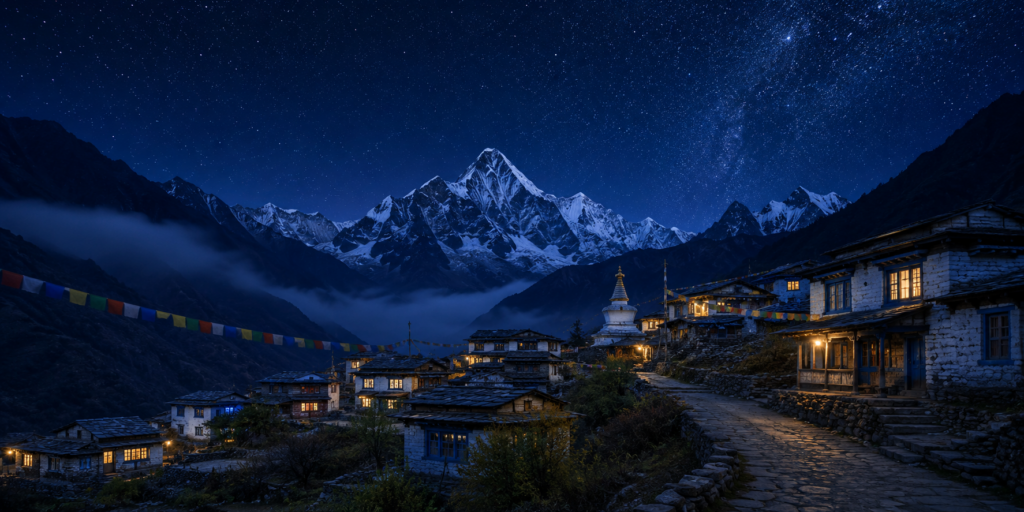
When Mountains Stopped Sleeping; Parties Over Peace
Himalayan hill stations were built around quiet. Apple orchards, wooden homes, slow mornings. That image is changing fast.
In June 2026, a video from a Himalayan trekking trail went viral after a group was filmed playing loud music through portable speakers, sparking an online debate about civic sense and responsible tourism. It was not an isolated case. Long-time visitors to Kasol say parties there now run in a legal grey zone; the sound regulations prohibit them, but they still happen, mostly spreading by word of mouth at cafés.
Even high-altitude camping is not spared. A trekker visiting Chandertal lake, at 4,200 metres, described arriving at a meadow with around 40 tents and 100 people, and DJ music playing as if it were a wedding, breaking the tranquility of one of the most fragile landscapes in the region.
What’s Happening on the Ground
This is not locals being dramatic about a little music. There is hard data behind the complaints.
A 2024 academic study measured noise levels across Shimla and found that Mall Road, the city’s main commercial hub, recorded a daily average of 69.32 dB(A), with peaks touching 88.7 dB. Compare that to the legal residential limit of 55 dB in the day and 45 dB at night, and the gap becomes clear. Add late-night music from hotels and cafés, and many residential pockets in hill towns are running well past what the law and the human ear; can comfortably handle.
A jump of just 10 dB can feel twice as loud to the human ear. So the difference between a quiet mountain evening and a thumping DJ set is not small. It is the difference between rest and noise that follows you into your dreams.

Who Pays the Price? Elderly, Students, and Working Families
Noise pollution does not hit everyone equally. It hits the people who cannot escape it the hardest.
WHO research shows that good-quality sleep needs bedroom noise below 30 dB(A), while sustained noise above 40 dB at night raises the risk of sleep disturbance and long-term health problems. For elderly residents with weaker hearts, broken sleep is not a minor irritation. It raises the risk of high blood pressure and heart trouble over time. Chronically disturbed sleep is linked to obesity, diabetes, high blood pressure, and even memory problems; this is not guesswork, it is the conclusion of decades of sleep research.
For a student preparing for board exams in Shimla or Dharamshala, a DJ set running till 1 AM means a foggy brain the next morning. For a shopkeeper who opens at 7 AM, it means a tired body running on borrowed sleep. For a hotel worker, it often means working the party and then living next to the noise too.
This is exactly why courts in India have taken the issue seriously. Action against noise violations is not rare. Police in Karnal, Haryana, took action against 13 music system vendors in a single week for playing loud music after 10 PM, after residents flooded the police helpline with complaints. If plains towns are cracking down this hard, fragile hill communities deserve the same seriousness.
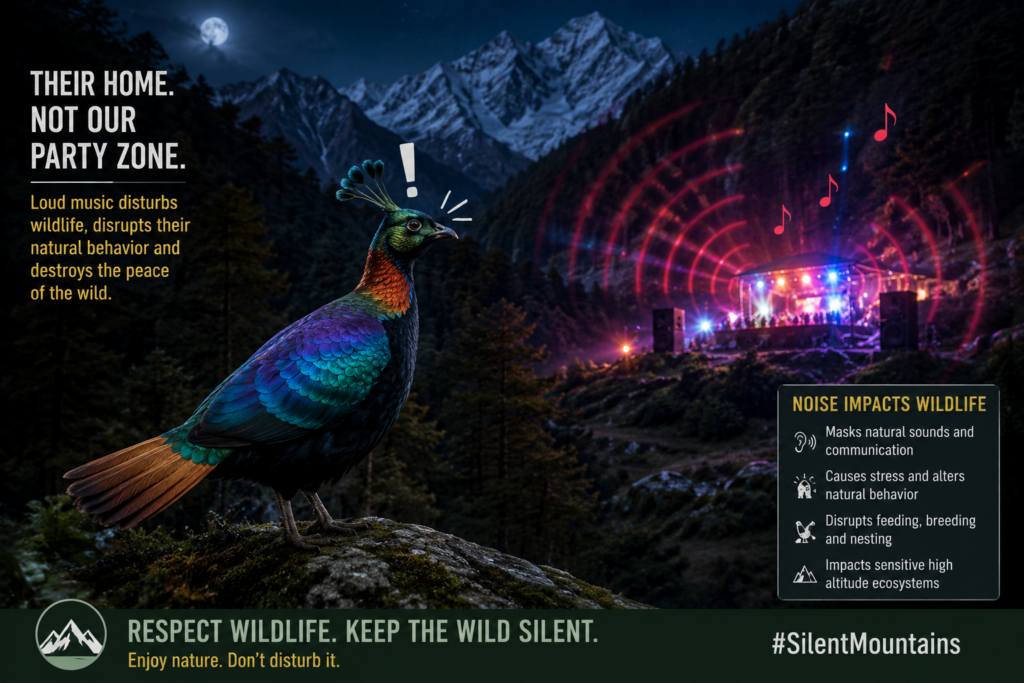
When the Mountains Can’t Sleep Either; Wildlife Under Siege
Here’s a fact that surprises most tourists: noise pollution does not stop at human ears. It quietly reshapes entire ecosystems.
Researchers studying bird communities have found that noise filters out species nonrandomly; birds with low-frequency calls, which get masked most easily by noise, tend to abandon noisy areas, while only higher-pitched callers stay behind. Over time, this changes which birds you even see in a region. Mountain biodiversity, already fragile, gets quietly rearranged by something as simple as a speaker.
It goes deeper than birds leaving an area. Long-term studies link chronic noise to measurable physiological costs in birds, including stress-hormone changes that reduce their breeding fitness across whole bird communities. In the US National Park Service’s own research, sound masking from human noise has been shown to shrink the area in which predators can hear their prey by as much as 70%. Imagine that scale of disruption playing out quietly in the deodar forests around Manali or the meadows above Kasol every single party night.
This is the part that rarely makes it into a travel vlog: a Himalayan monal calling at dusk, a barking deer’s alarm signal at night, a leopard listening for movement; all of this depends on a soundscape that human parties are steadily drowning out.
Silence Is Not Empty
Ask anyone who grew up in a Himalayan village what they remember most about home, and many will not say the view. They will say the sound of wind through pines, the temple bell at dusk, the river at night. Silence in the hills has never meant nothing happening. It has meant a different kind of presence; one built around rest, prayer, farming routines, and respect for the next person’s sleep.
This is also why so many Himalayan towns built their daily rhythm around early nights and early mornings. A hotel blasting music till 2 AM is not just breaking a decibel rule. It is breaking a centuries-old relationship between mountain people and their nights.
That tension; between a backpacker’s idea of a “good time” and a local family’s idea of a peaceful evening; is really the heart of this whole debate.
What the Law Already Says (and Why It Isn’t Working)
India is not short of rules on this. The problem is enforcement.
Under the Noise Pollution (Regulation and Control) Rules, 2000, loudspeakers and public address systems are completely prohibited in public spaces between 10 PM and 6 AM, with permission needed for any daytime use. States can grant a limited exception, allowing loudspeakers until midnight during religious or cultural festivals, for a maximum of fifteen days in a calendar year and even then, designated silence zones near hospitals and schools stay protected.
The Supreme Court has gone further. In its landmark 2005 ruling, the Court declared the right to a noise-free environment a fundamental right under Article 21, and introduced the idea of “aural aggression”; the principle that no one can force their amplified sound on an unwilling listener. In plain words: your right to enjoy music stops where someone else’s right to sleep begins.
Enforcement does happen when communities push hard enough. In Punjab, the National Green Tribunal took up a complaint from villagers against a resort accused of hosting high-decibel events into the early morning hours, and directed the state pollution board to act. In Himachal, the Sissu panchayat went further still, simply shutting the door on tourism for over a month rather than fight a losing battle against noise and litter every season.
Finding the Middle Path: Hospitality Without Harm
None of this means hotels, cafés, and tour operators are the villains. Tourism feeds entire Himalayan economies; homestays, taxi drivers, guides, and small restaurants all depend on visitors choosing to come.
Himachal Pradesh’s own 2025 Eco-Tourism Policy points to one possible direction. It pushes for community-led tourism and registered eco-homestays, alongside basic environmental safeguards for larger hotels. The same thinking can extend to sound. A few practical ideas that hospitality businesses can actually use:
- Move music indoors after 10 PM. A soundproofed lounge can keep the vibe without leaking it into the village.
- Use directional speakers. These send sound where the dance floor is, not across the whole valley.
- Apply for the legal exemption properly. If a festival genuinely needs late music, get the written permission the law already allows; don’t just play and hope nobody complains.
- Mark designated party zones away from residential clusters, the way some hill towns already separate dhaba strips from sleeping neighbourhoods.
7 Simple Fixes That Could Bring the Quiet Back
- Strict 10 PM cutoffs, enforced the same way Karnal police enforced theirs; with real warnings and real fines.
- Mandatory soundproofing checks for any hotel or café licensed to host live music or DJ nights.
- Designated “party zones” physically separated from residential lanes, similar to how cities zone industrial noise away from homes.
- Decibel meters with municipal staff, doing random spot-checks during peak tourist season.
- A “Quiet Hill Town” certification for hotels that voluntarily commit to silence after 10 PM; a badge tourists increasingly look for.
- Community noise-watch WhatsApp groups, linked directly to the local police helpline, the way RWAs already do in many Indian cities.
- Simple signage at town entry points, reminding tourists of the law before they even check in; prevention is cheaper than a midnight argument.
Comment from Nikhil Raj Sharma, Founder, Himalayan Geographic
“Himalayan communities have always welcomed visitors. What we are asking for is simple give us back our nights. A tourist’s holiday should not cost a local family their sleep, or a village its quiet. Responsible tourism has to include responsible sound.”
A Closing Thought
Parties Over Peace was never really about banning music in the mountains. It is about asking a simple question: after 10 PM, whose night matters more; the tourist’s or the local family trying to sleep next door? The Himalayas have room for both joy and quiet. We just have to stop choosing one at the cost of the other.
What do you think; should hill towns enforce a hard 10 PM music cutoff, or is there a better middle path? Tell us in the comments below.
Related reading: Tourist Rush, Local Rage: The Himalayan Overtourism Crisis
Watch: Issue of Noise Pollution in India — NGT and CPCB Action Explained (YouTube)
Sources:
- World Health Organization, Noise fact sheet
- Central Pollution Control Board, Noise Pollution Rules
- The Tribune, “Why ‘shame’ tourists who create nuisance in Himachal mountains”
- The Tribune, “Karnal Police launch drive to curb noise pollution”
- Drishti Judiciary, “Loudspeaker Laws in India”
- Journal of Applied Life Sciences and Environment, “Sound and Silence: Noise Pollution in Shimla”
Disclaimer: The content and images published in this article are provided for general informational and educational purposes only. Some images may be generated or enhanced using artificial intelligence (AI) and are intended solely for illustrative use. The views, interpretations, and information expressed do not necessarily reflect the official position of Himalayan Geographic Research Foundation, nor do they constitute professional, legal, medical, or financial advice.
While efforts are made to ensure accuracy, no guarantees are given regarding completeness or reliability. Readers are encouraged to independently verify information and use their own judgment. By reading this article, you acknowledge that any reliance on the content is at your own risk, and Himalayan Geographic Research Foundation assumes no responsibility or liability for disagreements, interpretations, or outcomes arising from its use. If you do not agree with these terms, you are advised to discontinue reading.