
Nirmal “Nimsdai” Purja, the Nepali mountaineer who turned a decade-long climbing challenge into a six-month sprint, died on July 30, 2026, after an avalanche struck his expedition on Pakistan’s Broad Peak. His company, Elite Exped, confirmed the news on August 1. His close climbing partners and guides, Pur Bahadur “Yukta” Gurung and Nima Sherpa, died in the same avalanche.
The news has shaken the mountaineering world. But grief is not the only thing Nimsdai Purja leaves behind. He leaves behind a completely new idea of what a human being can do at 8,000 metres; and a completely new idea of who gets the credit for doing it.
This article is a look back at the man who refused the word “impossible,” and at the records, the teams, and the causes that will carry his name forward.
A Life That Started With One Trek
Nimsdai Purja was born on July 25, 1983, in Dana village, Myagdi district, Nepal. He did not start out chasing mountains. He served 16 years in the British military; first with the Brigade of Gurkhas, then with the elite Special Boat Service, the Royal Navy’s special forces unit.
His climbing story began almost by accident. In 2012, he trekked to Everest Base Camp on leave. Instead of turning back as planned, he pushed on and summited nearby Lobuche. That single decision changed everything. He climbed his first 8,000-metre peak in 2014, and his first Everest summit followed in 2016, squeezed into a break from a military deployment in Afghanistan.
By 2018, he had left the armed forces to climb full time. He was made a Member of the Order of the British Empire (MBE) that same year, honoured for both his military service and his mountaineering.
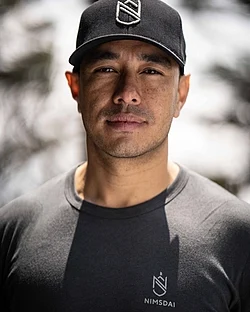
Breaking the Speed Barrier; Project Possible
Before 2019, climbing all 14 of the world’s peaks above 8,000 metres; the “eight-thousanders”; was a career-defining pursuit that stretched across years, sometimes decades. The previous record, set by South Korean climber Kim Chang-ho, stood at 7 years, 10 months and 6 days.
Nimsdai Purja looked at that timeline and decided it did not have to be true. He called his plan Project Possible. The goal: all 14 peaks in seven months.
He did it in 6 months and 6 days; starting on Annapurna on April 23, 2019, and finishing on Shishapangma on October 29, 2019. Guinness World Records logged it as 189 days. It remains one of the most extraordinary feats in the history of the sport.
How did he pull off something that experienced climbers called impossible? Three things stand out:
- Military-grade logistics. His years in the Gurkhas and the SBS trained him to plan complex, fast-moving operations under pressure; skills he applied directly to helicopter transfers, permit runs, and rapid acclimatisation schedules between peaks.
- Back-to-back rotations instead of long rest periods. Where traditional climbers would return home between expeditions, Purja’s team moved straight from one base camp to the next.
- A hand-picked team of elite Sherpa climbers who could match his pace, share the fixing of ropes, and keep the whole operation moving like a single unit rather than one man’s ego trip.
Netflix turned the story into the 2021 documentary “14 Peaks: Nothing Is Impossible,” directed by Torquil Jones and produced with Jimmy Chin and Elizabeth Chai Vasarhelyi of “Free Solo” fame. Legendary climber Reinhold Messner called the feat a unique statement in the history of mountaineering. You can watch the official trailer .
The Winter K2 Victory
If Project Possible was about speed, the winter ascent of K2 was about patience, teamwork, and raw survival.
K2; 8,611 metres, nicknamed the “Savage Mountain”; was the last of the 14 eight-thousanders never climbed in winter. Every attempt before 2021 had failed. The cold, the wind, and the technical difficulty of the Abruzzi Spur route made it mountaineering’s last unsolved problem.
On January 16, 2021, at 5 pm local time, a team of ten Nepali climbers; including Nimsdai Purja, team leader Mingma Gyalje Sherpa, and Sona Sherpa; reached the summit together. Purja was the only member of the group to do it without supplemental oxygen.
What happened in the final ten metres is the part people remember most. Instead of racing each other for the honour of “first,” the entire team stopped short of the top, held hands, and walked the last stretch together while singing the Nepali national anthem. Purja later wrote on social media that they went “brother to brother, shoulder to shoulder” to the top; a line that captures the spirit of the whole climb in seven words.
It was not a solo triumph. It was Team Nepal, a joint force with, in Purja’s own words, no individual agendas and no individual greed.
Reclaiming the Narrative for Sherpa and Nepali Climbers
For decades, Sherpa and Nepali climbers did the hardest, most dangerous work on Himalayan expeditions; fixing ropes, carrying loads, opening trails; while foreign climbers got the magazine covers. Nimsdai Purja spent his career trying to flip that script.
Through Project Possible and the K2 winter ascent, he made sure the world’s cameras were pointed at Nepali climbers, not past them. His own expedition company, Elite Exped, was built and staffed by local high-altitude experts, proving that South Asian-led operations could run at a world-class standard; no different, and often better, than Western-run expedition firms that had long dominated the industry.
His Nimsdai Foundation carried this mission further, off the mountain:
- It funded a Porter House on the Everest route, a rest facility built specifically for the porters and Sherpas who make every expedition possible, most of whom had historically lacked a proper place to rest during their work.
- It has supported education, capacity-building, and emergency aid for mountain communities in Nepal.
- Purja had recently launched the “Hat-Trick Challenge,” aiming to complete the 14 peaks and Seven Summits for a third time; self-funded, with all sponsorship money going to the Foundation.
He had also become the first person in mountaineering history to summit the 14 eight-thousanders and the Seven Summits both with and without supplemental oxygen, a record he set in October 2024. Reports this week noted he had recently completed his 57th oxygen-free ascent of an 8,000-metre peak, on Gasherbrum II, only days before the Broad Peak accident.
The “Nothing Is Impossible” Mindset and Giving Back to the Mountains
“Nothing is Impossible” was more than a film title. It was Purja’s operating philosophy, and it travelled well beyond the climbing world; into boardrooms, gyms, and classrooms, wherever people needed a reason to stop saying “I can’t.”
He was equally direct about the damage mountaineering itself was doing to the mountains. In 2022, the Nimsdai Foundation publicly called out the state of Camp 2 on K2, describing rotting food, human waste, and old ropes frozen into the ice and leaching into the groundwater. Purja said the smell nearly made him sick on his own expedition.
That anger turned into action through the Foundation’s Big Mountain Cleanup project, which has organised full-time, properly paid Sherpa teams to remove waste and dangerous old ropes from K2 and Everest; separate from, but alongside, Nepal’s own army-led Mountain Cleanup Campaign, which has removed well over a hundred tons of waste from Everest since 2019.
A Legacy Carved in Stone
Nimsdai Purja’s life ended in the same mountains that made him famous; struck by an avalanche on Broad Peak on July 30, 2026, alongside his trusted partners Pur Bahadur Gurung and Nima Sherpa. Several other climbers from the same expedition did not survive either. It is a brutal reminder that even the most experienced, best-prepared climber in the world is never bigger than the mountain.
But the record book does not get rewritten by his death. All 14 peaks in 189 days. The first winter summit of K2. The first person to do the 14 peaks and Seven Summits both with and without oxygen. Fifty-seven oxygen-free eight-thousander summits. A foundation that put Sherpa welfare and mountain cleanup on the world’s agenda.
Nimsdai Purja proved that the biggest limits in mountaineering were never really about altitude or oxygen. They were about what people believed was possible. He spent his whole career erasing that word from the mountains; and from the minds of everyone watching from below.
Rest well, Nimsdai. The mountains you climbed will remember your name longer than they remember most who ever stood on top of them.
Disclaimer: The content and images published in this article are provided for general informational and educational purposes only. Some images may be generated or enhanced using artificial intelligence (AI) and are intended solely for illustrative use. The views, interpretations, and information expressed do not necessarily reflect the official position of Himalayan Geographic Research Foundation, nor do they constitute professional, legal, medical, or financial advice.
While efforts are made to ensure accuracy, no guarantees are given regarding completeness or reliability. Readers are encouraged to independently verify information and use their own judgment. By reading this article, you acknowledge that any reliance on the content is at your own risk, and Himalayan Geographic Research Foundation assumes no responsibility or liability for disagreements, interpretations, or outcomes arising from its use. If you do not agree with these terms, you are advised to discontinue reading.