
India’s Education Data Reveals a strange split; 4,791 schools shut in 2025-26, yet enrolment rose. Here’s what it means for hill states like Himachal Pradesh.
Thirteen schools closed somewhere in India today. Thirteen more will close tomorrow. That is not a guess; it is the average from the government’s own school census for 2025-26, and by the time you finish reading this, several classrooms across the country will have gone dark for good.
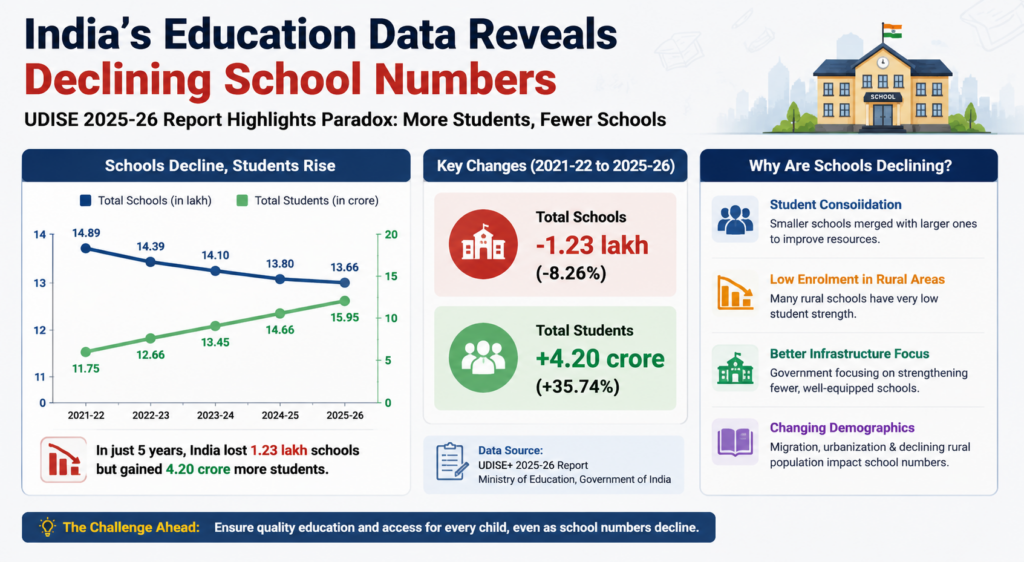
India’s Education Data Reveals a picture that looks contradictory at first glance. The country lost 4,791 schools in a single year, dropping from 14,71,473 to 14,66,682. At the same time, total student enrolment climbed by roughly 30 lakh, touching 24.72 crore. Fewer schools, more students; how do both things happen together? The answer says a lot about where Indian education is heading, and it says even more if you live in a hill state like Himachal Pradesh, where a closed school does not just mean inconvenience. It can mean a ten-year-old walking two extra hours a day.
This piece breaks down the new UDISE+ (Unified District Information System for Education Plus) 2025-26 report from the Ministry of Education, and asks the question that national headlines usually skip: what does this mean for mountain regions, where distance and terrain decide a child’s future far more than any enrolment chart can show?
India’s Education Data Reveals
What the UDISE+ 2025-26 Data Actually Shows
UDISE+ is the government’s own school census. Every recognised school, from a one-room primary school in a Himalayan village to a city’s biggest senior secondary school, reports its numbers here every year. So when this data says schools are disappearing, it is not a rumour; it is the Ministry of Education’s own record.
Here is the plain picture:
- 4,791 schools closed nationally in 2025-26, an average of 13 a day.
- Madhya Pradesh alone accounted for 2,426 closures; more than half the national total.
- Government schools took the biggest hit: 8,077 government schools shut down, against 4,338 the year before; the closure rate nearly doubled.
- Private schools grew by 10,581 in the same period.
- Government school enrolment fell by over 26 lakh children, and state-government schools lost another 27 lakh.
- Private school enrolment rose by about 30 lakh, which is the main reason the national total still went up.
So the “29 lakh more students” in the headline is real, but it hides an uncomfortable truth. Government classrooms are emptying out. Private classrooms are filling up. The net gain in students is basically a transfer, not new children entering school for the first time.
Why Are Small Schools Closing and Merging?
The official reason given is “rationalisation”; a word bureaucrats love and parents rarely understand. In plain language, it means: if a school has very few children, the government prefers to shut it, merge it with a bigger school nearby, or downgrade it, instead of running it half-empty.
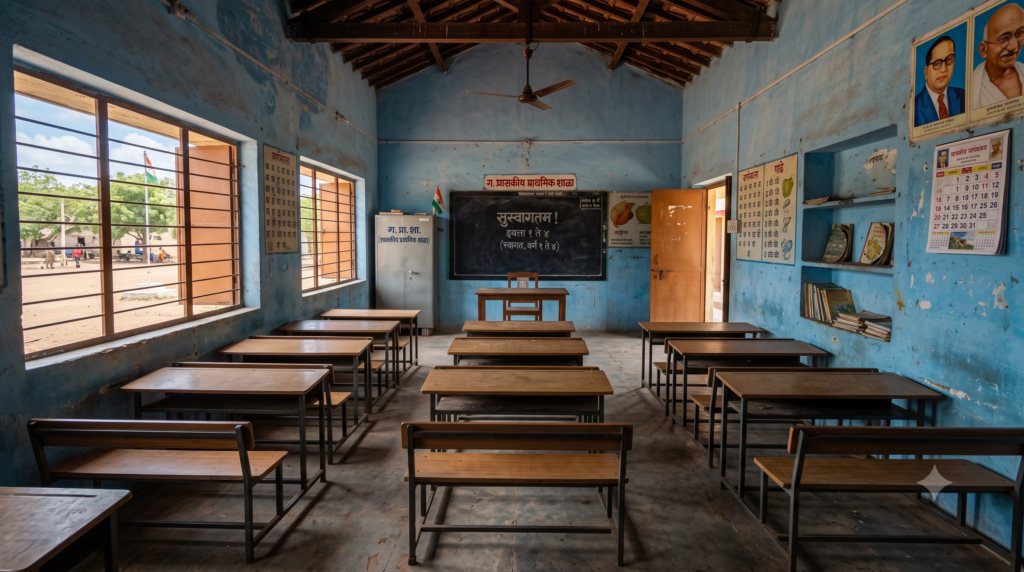
The numbers behind this are striking. Nationally, 1,00,843 schools are still running with just a single teacher for all classes. And 5,663 schools have zero students enrolled; buildings, teachers, and infrastructure, with nobody sitting in the classroom. West Bengal alone has 4,133 such zero-enrolment schools. It is worth asking why a school with no students is still open, and why one with forty students two villages away gets shut and merged instead.
A study tracking the years 2019 to 2025 estimated that around 32,500 schools were closed or merged across the country in that period, affecting close to 5.3 lakh children. Roughly 82 percent of that impact fell on rural India. That single number tells you who this policy really touches; not city families with three schools on their street, but rural families with one school, now gone.
When Distance Matters More Than Numbers
This is where national data stops being useful and local data starts mattering. Himachal Pradesh has an average of just 72 to 83 students per school; less than half the national average of 169. Only Ladakh and Mizoram report lower numbers. On paper, that looks like “too many schools for too few children,” exactly the kind of statistic that invites a merger drive.
But Himachal is also one of the best-performing states on real learning indicators. Its Pupil-Teacher Ratio is 14:1, far better than the national average of 24:1 and well inside the NEP 2020 target of 30:1. The state has around 14 lakh students, 1.03 lakh teachers, and 17,064 schools, and this year’s report flagged Himachal; alongside Ladakh, Mizoram, Sikkim, and Meghalaya; as a state where “students per school are significantly low, indicating a need for optimisation of schools’ infrastructure.”
That single sentence in a government report can mean a lot of school closures in villages across Kullu, Kinnaur, Chamba, or Lahaul-Spiti. In fact, 266 schools were shut in Himachal Pradesh in this reporting year alone, and a separate state directorate exercise had already identified 621 schools for de-notification, merger, or downgrading due to low enrolment.
Here is the problem with applying a flat national formula to a hill state. A school with 15 children in Punjab’s plains might sit two kilometres from the next school, connected by a straight, paved road. A school with 15 children in a Himachal panchayat might be the only school within a mountain pass, with the next nearest school two ridgelines away, cut off for weeks during snowfall. “Low enrolment” looks identical on a spreadsheet, but the human cost of closing it is not identical at all.
The Long Walk to School; Travel Distance After Closures
The Right to Education Act sets a clear rule; a primary school should be within one kilometre of a habitation, and an upper primary school within three kilometres. This is not a suggestion; it is a legal norm. Yet researchers tracking the merger trend admit that once a school is merged or closed, nobody publicly checks whether the RTE distance rule is still being followed. The criteria used to decide which schools get merged are not even available in the public domain.
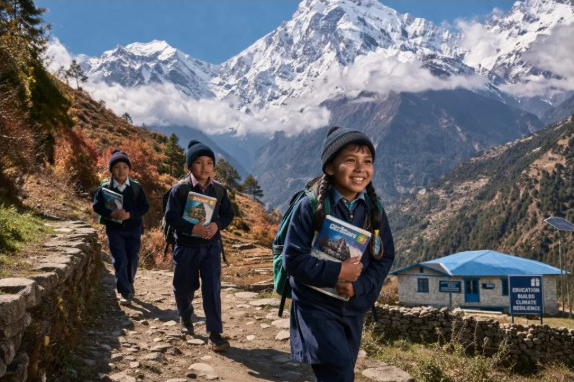
Picture what that means in real terms. A family in a remote Himachal village sends their seven-year-old to the local primary school, a ten-minute walk from home. The school gets merged with one three villages away. Now that same child needs to cross a stream, climb a slope, or wait for a shared jeep that may not run every day. Multiply this by thousands of villages, and you start to see why activists call this a silent access crisis rather than an efficiency reform.
Younger children suffer the most. A twelve-year-old might manage an extra hour of walking. A six-year-old, especially a girl whose parents already worry about safety on a lonely mountain path, often simply stops going. This is one of the quiet ways dropout happens; not because a child refuses to study, but because the school stopped being reachable.
Do Bigger Schools Really Mean Better Learning?
This is the argument the government makes in favour of mergers: consolidate small, thinly staffed schools into fewer, bigger, better-equipped ones, and children get better labs, more teachers per subject, and proper infrastructure instead of a single overworked teacher managing five grades at once.
There is real substance to this argument. Education economists Hanushek and Rivkin, whose work is cited in Indian policy research on this exact question, found that school consolidation can create genuine economies of scale; better facilities, subject specialists, and more efficient use of public money. Nobody seriously disputes that a single-teacher school handling five different grade levels in one room struggles to give any child real, focused attention.
But a separate body of research, including work by Duncombe and Yinger, makes an equally important point: the “optimal school size” depends entirely on local geography, transport costs, and community structure. A merger formula copied from a flat, well-connected district and pasted onto a mountain block ignores exactly the variable that matters most in a state like Himachal Pradesh; distance.
So the honest answer is: bigger schools can improve learning outcomes, but only where the “bigger” school is actually reachable. Merge two schools three kilometres apart on a plain, and you likely gain more than you lose. Merge two schools separated by a mountain pass, and you may simply be trading a rough education for no education.
Teachers Are There, Schools Are Not; Or Is It the Other Way Round?
Here is a genuinely confusing part of this year’s data. The report simultaneously says India added more teachers over 1.02 crore now, an 8.3 percent rise since 2022-23 while it also closed thousands of schools. Teacher numbers are going up even as school numbers go down.
Meanwhile, more than a lakh schools still run with a single teacher covering every subject and every grade. Andhra Pradesh alone has 16,357 such single-teacher schools, followed by Jharkhand with 9,827. So the crisis is not really “not enough teachers in India.” It is teachers concentrated in the wrong places; cities and large schools are well-staffed, while remote single-teacher schools remain stretched thin, right up until the day they get merged away entirely.
This mismatch is the real policy failure hiding inside the UDISE+ numbers. Fixing it does not require closing more schools. It requires posting teachers to where children actually are, especially in hill and border districts where transferring staff is harder and less popular among teachers themselves.
Why Private Schools Are Winning
The clearest trend line in this entire report is the steady shift toward private education. Government schools lost over 26 lakh students. State government schools lost 27 lakh more. Private schools, meanwhile, gained about 30 lakh students and 10,581 new institutions in the same period.
Parents are not choosing private schools purely out of snobbery. Many are choosing them because the local government school shut down, merged into a distant campus, or simply stopped feeling reliable — no regular teacher, patchy infrastructure, uncertain quality. A private school bus that picks the child up from the doorstep starts to look like the more dependable option, even on a tight family budget.
This has a quiet but serious equity angle. Government schools are usually the only free option for poorer families. As they shrink, families with money migrate to private schools, and families without money are left with a longer walk to a merged, more distant government school; or with no functioning school at all in reach.
What This Means for the Future of Educational Equity
Put all of this together and a clear pattern appears. India is not simply “losing schools.” It is consolidating a system built for a different demographic era; one designed for high birth rates and scattered rural populations; into a leaner network built around fewer, larger institutions. That direction is not wrong in itself. Declining birth cohorts in states like Himachal Pradesh genuinely mean fewer children need fewer schools over time.
The risk is in how the consolidation is done. Without a public, transparent distance rule, without protecting RTE norms after every merger, and without redeploying teachers to match where children actually live, this “efficiency” reform can quietly turn into an access crisis for exactly the children who have the least power to complain; rural, tribal, and mountain-community kids whose parents cannot simply enrol them in a private school across town.
For Himachal Pradesh specifically, the road ahead needs a different yardstick than the rest of the country. A school there should not be judged only by how many children sit inside it, but by how many children would lose access to any school at all if it closed. That single question, asked honestly before every merger order, would protect the state’s genuinely strong education record from becoming a case study in good intentions gone wrong.
Nikhil Raj Sharma, founder of Himalayan Geographic, says
The national conversation around school mergers misses what happens on the ground in hill states. ‘On a spreadsheet, a school with fifteen children looks the same whether it sits on flat land or on the other side of a mountain pass,’ he says.
‘In Himachal, distance is not a detail; it decides whether a child keeps studying or drops out. Before any school here is merged, someone needs to actually walk the route a child would have to take.’
References
- UDISE+ 2025-26 Official Dashboard — Ministry of Education
- UDISE+ Official Portal
- “13 Schools Shut Every Day In India; More Than Half In Madhya Pradesh: UDISE Plus Report” — NDTV
- “Himachal schools shine on quality, struggle on numbers” — The Tribune
- “Low enrolment: 621 schools to be closed, merged or downgraded” — The Tribune (Himachal)
- “UDISE Plus 2025-26: SC, OBC enrolment hits 6-year low; over 8,000 govt schools shut” — Careers360
- “School dropout rates reduce across preparatory, secondary levels: UDISE+ report” — The Tribune
- “School Mergers, Closures, and Demergers in India & its Impact on Universal Enrollment” — Education for All in India
- “‘Empty classrooms, overburdened teachers & Right to Education'” — India.com (interview with RTE activist Ashok Agarwal)
Related Reading
- Why Himachal’s Best Pupil-Teacher Ratio Still Isn’t Enough for Its Villages
- Inside a Single-Teacher School: A Day in a Remote Himachal Classroom
- The RTE Act at 15: Has India’s Right to Education Actually Reached the Hills?
- Private vs Government Schools in Himachal: What Parents Are Actually Choosing
- Mapping Himachal’s School Mergers: Which Districts Are Losing the Most Schools?
Disclaimer: The content and images published in this article are provided for general informational and educational purposes only. Some images may be generated or enhanced using artificial intelligence (AI) and are intended solely for illustrative use. The views, interpretations, and information expressed do not necessarily reflect the official position of Himalayan Geographic Research Foundation, nor do they constitute professional, legal, medical, or financial advice.
While efforts are made to ensure accuracy, no guarantees are given regarding completeness or reliability. Readers are encouraged to independently verify information and use their own judgment. By reading this article, you acknowledge that any reliance on the content is at your own risk, and Himalayan Geographic Research Foundation assumes no responsibility or liability for disagreements, interpretations, or outcomes arising from its use. If you do not agree with these terms, you are advised to discontinue reading.