
Himalayan language loss is erasing centuries of knowledge in 2026. Discover 7 urgent truths about why mountain languages are dying; and what communities are doing to fight back.
A language is not just talking. It is memory. When mountain languages die, villages lose their history, their plant medicines, their weather knowledge; things no Google search can recover. Schools must teach local languages. Governments must fund documentation. And every person who still speaks a mountain tongue must use it; loudly, proudly, and often. The Himalayas will not survive only as a postcard. They must survive as a voice.
Somewhere in a Kinnaur village in Himachal Pradesh, an 80-year-old woman knows the name of a medicinal root that no doctor has catalogued. She knows when the rains will shift by watching which bird sits on which tree. She knows this because her language told her so; for generations. Her grandchildren speak Hindi and scroll Instagram. They do not know the word. When she dies, that word dies too.
This is Himalayan language loss. And it is happening right now; quietly, steadily, and almost without protest.
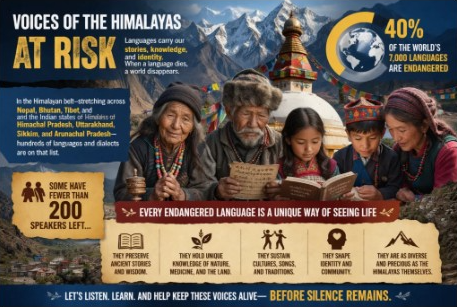
According to UNESCO, at least 40% of the world’s 7,000 languages are endangered. In the Himalayan belt; stretching across Nepal, Bhutan, Tibet, and the Indian states of Himachal Pradesh, Uttarakhand, Sikkim, and Arunachal Pradesh; hundreds of languages and dialects are on that list. Some have fewer than 200 speakers left.
“A language is not just words. It is a way of seeing the world. Destroy the language, you destroy the lens.”
1. The Scale of the Problem Nobody Talks About
The Himalayan region is one of the most linguistically diverse zones on Earth. Linguists estimate over 400 languages and dialects exist across this mountain belt. But diversity on paper means nothing if speakers are disappearing.
In India’s Himalayan region alone:
- Manchati (Himachal Pradesh) has under 3,000 speakers
- Sunam (also HP) is critically endangered
- Milam (Uttarakhand) is nearly extinct
- Nisi, Adi, and Galo in Arunachal Pradesh are under serious pressure
- In Nepal, over 120 indigenous languages exist; at least 20 are in danger
The 2011 Indian Census listed 19,500 mother tongues. The 2021 Census (delayed, still being processed) is expected to show a sharp decline in speakers of minor languages. The numbers do not lie. The Himalayan language loss is not a prediction. It is already a fact.
2. Why Are Young People Leaving Their Languages?
Young people in mountain communities are not villains. They are rational. They look around and see that English gets you a government job. Hindi gets you a bus ticket without embarrassment. Nepali gets you into a Kathmandu college. Their own language? It gets them a pat on the head from a researcher visiting from Delhi.
The structural reasons are clear:
- National education systems teach in dominant languages only
- Textbooks carry no trace of local ecological or cultural knowledge
- Digital platforms YouTube, WhatsApp, Instagram; function almost entirely in Hindi, English, or Mandarin
- Migration to cities breaks the daily practice of speaking the mother tongue
- Social stigma in many schools, children are mocked for speaking “village languages”
When a system consistently rewards one language and ignores another, the outcome is not surprising. It is designed.
“The child who is taught that her language is backward will grow up to believe it. That belief is more dangerous than any government policy.” -Chomsky (paraphrased from Language and Politics, 1988)
3. What Dies With the Language?
This is where people underestimate the damage.
Language is not a container for knowledge. It IS the knowledge structure. Himalayan languages encode:
Ecological knowledge:
- Specific plant names with medicinal properties unknown to modern pharmacology
- Weather-reading systems based on local geography
- Seasonal farming calendars tied to lunar and ecological observation
Spiritual and ritual knowledge:
- Prayers, incantations, and ceremonies that cannot be translated without losing meaning
- Oral epics that carry historical memory going back centuries
Social knowledge:
- Kinship terms that define community roles and responsibilities
- Conflict resolution methods encoded in proverbs
A 2019 study published in PNAS (Proceedings of the National Academy of Sciences) found that indigenous languages contain unique knowledge about local biodiversity that does not exist in scientific literature. When these languages die, science loses data it did not even know it had.
The Himalayan language loss, then, is not a cultural tragedy alone. It is an ecological and scientific loss.
4. The Education Paradox
Here is the cruel irony: the very system meant to lift mountain communities is dismantling their identity.
Modern schools in Himalayan villages; whether in Nepal, India, or Bhutan; are largely modelled on national curricula designed in capitals far from the mountains. A child in Spiti valley learns about the Mughal Empire before she learns the name of the river she drinks from. She memorises Newton’s laws before she hears the oral epic her great-grandfather sang.
This is not education. This is replacement.
John Dewey, the American educationist, argued that learning must connect to the child’s lived environment. In the Himalayas, almost no school does this. The result is a generation that is educated but culturally amputated.
Bilingual education models; where local language is taught alongside the national language; have shown strong results in places like Bhutan and some parts of Sikkim. Children perform better academically and retain cultural knowledge. This is not a new idea. It is simply not funded or prioritised.
5. What Is Actually Being Done
The situation is bad. It is not hopeless. Here is what is working on the ground:
Community-led documentation efforts:
- The People’s Linguistic Survey of India, led by G.N. Devy, has documented over 780 languages across India, including many Himalayan ones. This is the most ambitious language survey in Indian history.
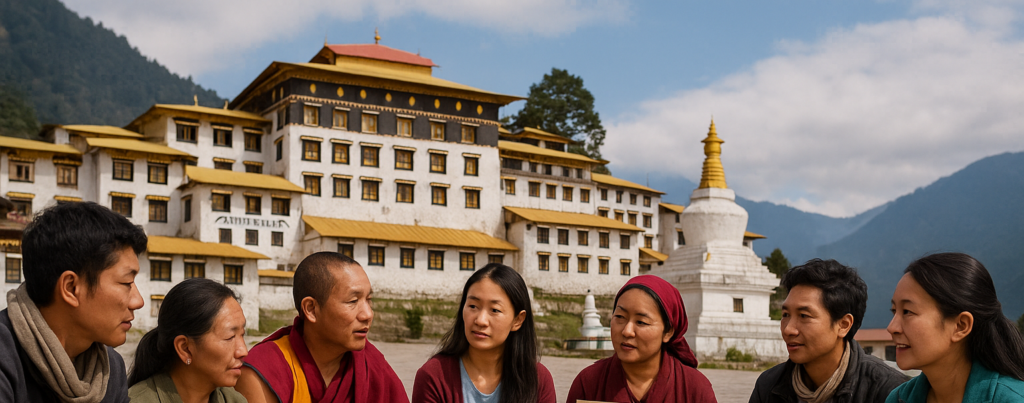
- In Nepal, the Nepal Federation of Indigenous Nationalities (NEFIN) supports mother-tongue education programmes
- In Bhutan, the government has made Dzongkha and local languages mandatory in schools alongside English
Digital preservation:
- The Endangered Languages Project (supported by Google) hosts recordings of dozens of Himalayan languages.
- YouTube channels are being created by young people from communities themselves. One powerful example: Kinnauri Folk Songs and Culture; search YouTube for “Kinnauri language preservation” to find community-run channels documenting music, stories, and speech.
- A recommended watch: “Dying Languages: Race Against Time”; search on YouTube for documentary content on Himalayan endangered languages.
Academic and institutional work:
- Central Institute of Indian Languages (CIIL), Mysore has programmes for documentation
- Sahitya Akademi publishes in tribal and indigenous languages
- In Himachal Pradesh, the HP Academy of Arts, Culture and Languages maintains archives, though funding remains inconsistent
What Nikhil Raj Sharma, Founder of Himalayan Geographic, says:
“We have been documenting villages in the upper Kinnaur and Kullu belt for four years now. The elders we recorded in 2020; several of them are no longer with us. Their voices exist only in our archives now. That is both a responsibility and a warning. We cannot wait for government to act. Community must lead.”
“What surprises outsiders is that young people WANT to preserve their culture; they just don’t know how, and nobody has built tools for them. Give a 22-year-old from Kullu a smartphone app in his language and he will use it. The technology is not the problem. The intention is.”
6. Modernisation as Erasure
In the Tibet Autonomous Region, the situation carries a harder political edge. Tibetan language instruction has been systematically reduced in favour of Mandarin in state schools. Monasteries; the traditional keepers of Tibetan linguistic heritage; face restrictions.
The result: younger urban Tibetans increasingly speak Mandarin as their primary language. Rural communities hold on longer, but with each generation, the gap widens.
This is not only a Chinese government policy issue. It reflects a global pattern: when the state decides one language serves national unity, minority languages pay the price.
The Himalayan language loss in Tibet is an extreme example of what happens when preservation is not just underfunded; but actively discouraged.
7. Practically, Not Romantically
Emotion alone will not save a language. Here is what will:
Policy changes needed:
- Mandatory mother-tongue instruction in primary school (at least as a subject)
- Government grants for community-led language documentation
- Recognition of indigenous languages in official census and administrative processes
Technology actions needed:
- Unicode support and keyboard tools for Himalayan scripts and languages
- AI language models trained on endangered languages (some work is beginning at universities)
- Mobile apps in local languages for agriculture, health, and civic services
Community actions needed:
- Intergenerational language circles; bring elders and youth together weekly
- Record everything: stories, songs, plant names, weather proverbs
- Make language cool; use it on social media, in music, in local art
Individual actions (you, the reader):
- If you speak a mountain language at home, use it. Every conversation is an act of preservation.
- If you do research, journalism, or education in Himalayan areas, use local languages in your work
- Share and support channels, organisations, and individuals doing language documentation
From the Mountains
In 2023, the United Nations declared 2022–2032 the International Decade of Indigenous Languages. Funding, frameworks, and recommendations exist at the global level. But implementation happens in a village in Uttarakhand where a teacher decides whether to spend twenty minutes on Hindi grammar or on a folk story in Garhwali.
That teacher’s choice, made daily, is where the Himalayan language loss is either stopped or continued.
“A language that is not spoken is already a museum exhibit. And no one visits a museum every day.”
The Himalayas are not just a geography. They are a library. Right now, that library is burning; one word at a time, one elder at a time, one generation at a time.
The question is not whether we can afford to save it. The question is whether we can afford to lose it.
Related Articles You May Like:
- Why India’s Tribal Languages Are Disappearing Faster Than We Think
- Bhutan’s Language Policy: What Other Himalayan Nations Can Learn
- The Role of Oral Traditions in Climate Knowledge — What Science Is Missing
Disclaimer: The content and images published in this article are provided for general informational and educational purposes only. Some images may be generated or enhanced using artificial intelligence (AI) and are intended solely for illustrative use. The views, interpretations, and information expressed do not necessarily reflect the official position of Himalayan Geographic Research Foundation, nor do they constitute professional, legal, medical, or financial advice.
While efforts are made to ensure accuracy, no guarantees are given regarding completeness or reliability. Readers are encouraged to independently verify information and use their own judgment. By reading this article, you acknowledge that any reliance on the content is at your own risk, and Himalayan Geographic Research Foundation assumes no responsibility or liability for disagreements, interpretations, or outcomes arising from its use. If you do not agree with these terms, you are advised to discontinue reading.