Himalayan expedition worker safety is in question after the 2026 Himlung avalanche killed 15 Nepali workers. Read the 7 critical gaps in insurance, pay, rescue and rights, and how to fix them.
The foreign climbers had not even arrived. On 27 September 2026, an avalanche buried Himlung Himal base camp in Nepal, and 15 Nepali workers died. They were pitching tents and fixing ropes for the people who would come later. One worker is still missing.
This tragedy puts Himalayan expedition worker safety back in the spotlight. One number shows the problem. Nepal’s minimum accident insurance for a high-altitude guide is Rs 2 million, about $14,400. The royalty a foreign climber pays for a spring Everest permit is $15,000. One permit fee is worth more than a guide’s life cover.
This article uses the Himlung avalanche as a case study. It looks at seven safety gaps faced by Sherpas, guides, porters, kitchen staff and base camp workers. It also lists practical steps that could protect them.
What Happened at Himlung Himal
Himlung Himal is a 7,126-metre peak in the Nar Phu region of Manang district. That the avalanche hit base camp at about 3 am on 27 September. A blizzard had already pushed trekkers and climbers back to town, but a local crew stayed behind to get the camp ready.
Rescue was slow and hard. The Nepal National Mountain Guide Association (NNMGA) coordinated the search. Its president, Tul Singh Gurung, told Reuters that rescuers had recovered 15 bodies. Eight came out on 1 October and seven earlier that week. He said the chances of finding the one missing worker were dim.
Reports differ on who was in the camp. One Himal Press report said the avalanche struck a group of 22 people, eight climbing guides and 14 kitchen staff. ExplorersWeb counted 16 buried, including 14 staff and two Sherpa guides. Reuters and the NNMGA gave 15 dead and one missing. This article uses the Reuters and NNMGA figures.
Why does this matter beyond Nepal? Because these workers carry the risk so that clients can climb with less of it. As Thought Catalog put it, climbers arrive after the risk has been absorbed by someone else.
The 7 Critical Safety Issues
1. Base Camp Is Not a Safe Place
Many people think the real danger starts above base camp. Himlung shows that this is not always true. ExplorersWeb reported that about four metres of fresh snow covered the camp, which is why digging out the workers was so hard.
Himlung is not alone. In November 2025, an avalanche hit Yalung Ri base camp in Dolakha. “Seven climbers died, including five foreigners. Two base camp disasters in under a year should make every operator rethink where tents go.
Climate adds to the risk. Reuters noted that as climate change speeds up the melting of glaciers and ice, mountain work is becoming more dangerous. Old rules about “safe” camp sites may no longer hold.
2. No Clear Rule on Who Decides When to Leave
Both sides of the Himlung story matter here. Mingma G, owner of Imagine Nepal, who led the rescue and lost two staff members, said on social media that his team had urged workers to move to the lower valley since Friday. In his account, the workers did not take the warnings seriously.
The Nepal-based outlet Everest Today asked tougher questions. If workers were told to stay despite bad forecasts, who made that call? What safety check was done? What was the plan to move kitchen staff and guides to safety? It asked for an independent investigation. It also said that if negligence is found, those responsible must be held accountable.
When the risk is high, “the workers chose to stay” is not enough. A worker with a family to feed and a client due soon does not weigh risk like a free person. The duty to order an evacuation should sit with a named person, in writing.
3. Insurance Covers Less Than Families Need
Nepal has improved the rules. Under the 2025 amendment to the mountaineering regulations, expedition teams must buy accident and medical cover for staff. The Tourism Times reports these minimum accident sums:
- Rs 2 million for mountain guides and high-altitude workers
- Rs 1.5 million for liaison officers and base camp workers
- Rs 500,000 for local workers
The Kathmandu Post converted the top figures to about $14,400 for guides and $10,800 for base camp workers. That is real progress. Before the changes, the minimum for a high-altitude worker was only Rs 400,000, according to Seven Summit Treks.
Still, look at what the money must do. It must replace an earner for a whole family, often for decades. After the 2014 Everest icefall disaster, which killed 16 Nepali workers, families received only $10,000 in life insurance. Workers then demanded better payouts and a relief fund.
4. High Risk, Modest Pay
In February 2025, Nepal raised daily wage rates. According to Seven Summit Treks, a guide or high-altitude worker’s rate went from Rs 350 to Rs 1,200 a day. A base camp worker’s rate went from Rs 300 to Rs 1,000. Workers below 3,700 metres have a listed rate of Rs 800.
This is a big jump, and it is good news. But look at the work. As Huck magazine reported in its story on the film Sherpa, Sherpas typically cross the Khumbu Icefall up to 30 times, while climbers cross twice. The workers face the most exposure for the lowest share of the money.
Here is a simple sum. At Rs 1,200 a day, the Rs 2 million insurance equals about 1,667 days of work. That is more than four and a half years of pay. For a high-altitude worker earning a daily rate, that is the full value placed on a life.
5. Rescue and Body Recovery Are Slow and Uneven
At Himlung, the first rescue found four bodies in two days. Then Mingma G stopped the recovery. He said it made no sense to shovel through four metres of fresh snow. A bigger team returned two days later, reportedly at the families‘ request. It dug tunnels and recovered 11 more bodies.
Think about those days from the families’ side. They waited in Kathmandu while the snow held their sons, brothers and fathers. Himal Press reported that the NNMGA coordinated the operation. Its IFMGA-certified guides, Pasang Kaji Sherpa and Bikram Karki, led the field team with five other climbing guides.
The rules do ask for emergency rescue insurance. Nepal’s mountaineering regulations require expedition teams to insure for emergency rescue under the Act, in an amount set by the ministry. But a policy on paper is not a rescue team on site. Remote camps need pre-planned helicopter access, trained rescuers and a clear chain of command before the season starts.
6. The Invisible Workers: Kitchen Staff, Rope-Fixers and Porters
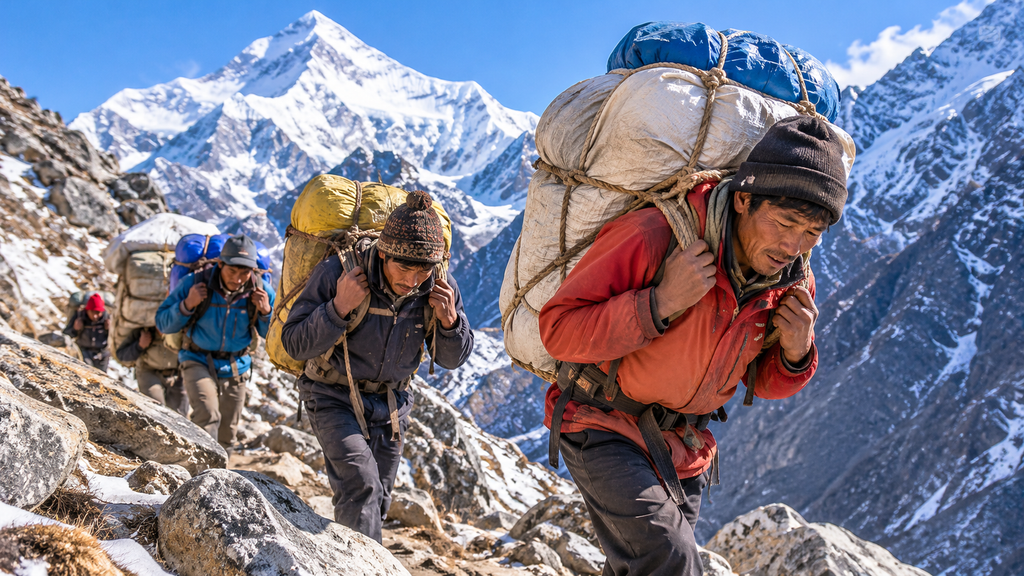
When we say “Sherpa,” we often picture a summit guide in a bright jacket. Many victims at Himlung were not summit guides. Himal Press described 14 kitchen staff in the group. Reuters said the workers were pitching tents and fixing ropes.
These jobs happen early in the season, before clients arrive. Fewer people watch, fewer photos get taken, and fewer names get remembered. Local workers also have the lowest legal insurance minimum, Rs 500,000, and the lowest listed daily rate.
Porters and base camp crews need the same care as guides. They carry loads, cook meals, set tents and keep a camp alive. A camp without them does not run.
7. Accountability and Care After the Tragedy
Within days of the disaster, work was starting up again. ExplorersWeb reported that major outfitters sent teams to repair the trail from Koto to base camp. Nepal’s Department of Tourism showed 34 foreign climbers had applied for Himlung permits.
There is a fair case for this. Tourism pays wages in remote villages, and many workers want the work to continue. But there is also a fair case for pausing. After the 2014 icefall disaster and the 2015 earthquake, ExplorersWeb noted, climbing on Everest’s south side was cancelled for the season. Workers then also pressed for higher insurance and better conditions.
In 2014, the government raised minimum cover by 50 percent and promised a relief fund. According to ThinkProgress, it set aside 5 percent of earnings for that fund, while workers had asked for 30 percent. Change came, but only after a strike threat.
What Would Protect Himalayan Mountain Workers
These are my recommendations, based on the gaps above. Authorities and operators can decide how to adapt them.
- Set a written weather stand-down rule. When forecasts cross a set level, all camp workers move down. A named leader, not the workers, owns that decision.
- Map avalanche risk at every base camp. Use trained snow safety experts, especially for early-season camps. Update the maps each year as glaciers change.
- Raise insurance to match lost income. Link minimum cover to a family’s real needs, and review it every year.
- Publish claim data. Share how many claims were paid, how much and how fast. Tell families their rights in simple Nepali.
- Give every worker a written contract. That includes kitchen staff, porters and local workers. Show wage rates, insurance details and an emergency contact.
- Keep a live list of people at camp. Rescuers should know within minutes who is on the mountain and where.
- Plan rescue before the season. Agree helicopter access, a trained team and a recovery budget in advance. Do not build them while families wait.
- Hold a public inquiry after every mass-casualty accident.
- Report on the relief fund. Publish each year how much royalty money went into worker welfare and who received it.
- Make clients part of the answer. Climbers can ask operators about insurance, pay and weather rules before booking. A good operator will answer clearly.
What Readers and Climbers Can Do
If you plan to climb or trek in Nepal, ask your operator three questions. How much is each staff member insured for? What is the rule for leaving camp in bad weather? Who covers rescue costs for the crew? An operator who answers openly is a good sign.
If you are not a climber, you can still help. Share stories of mountain workers, support welfare groups and ask for open reporting. For a human view of this world, watch the trailer for the documentary Sherpa (2015), about the 2014 icefall disaster: Sherpa official trailer on YouTube. Director Jennifer Peedom set out to film the Sherpa view of Everest and ended up recording a tragedy.
Comments from Nikhil Raj Sharma, Founder, Himalayan Geographic
Every mountain story we celebrate has a worker in it. They set the ropes, cook the food and carry the loads, often before the first client arrives. The Himlung tragedy reminds us that these people are the foundation of Himalayan tourism, not the background. Nepal has improved insurance and wage rules, and that deserves credit. But rules on paper are not enough.
We need clear weather limits for camp workers, fast and transparent insurance payments, and public reports after every major accident. Families should never have to wait in the dark for answers. At Himalayan Geographic, we believe a safer mountain is possible if operators, authorities and climbers share responsibility. When you plan an expedition, ask how the crew is insured and protected. Your questions can change how the industry works. Respect for the mountain must include respect for the people who live and work on it.
The Bottom Line
The Himlung avalanche was a natural event. But much of the damage came from gaps that people can fix: weak evacuation rules, thin insurance, modest pay, slow rescue and little follow-up. Nepal has made real progress since 2014. The 2025 changes raised both insurance and wages. The work is not finished.
Himalayan expedition worker safety should not depend on luck, weather or the goodwill of one operator. It should be a clear, written promise to every person who ties a rope or pitches a tent.
Disclaimer: The content and images published in this article are provided for general informational and educational purposes only. Some images may be generated or enhanced using artificial intelligence (AI) and are intended solely for illustrative use. The views, interpretations, and information expressed do not necessarily reflect the official position of Himalayan Geographic Research Foundation, nor do they constitute professional, legal, medical, or financial advice.
While efforts are made to ensure accuracy, no guarantees are given regarding completeness or reliability. Readers are encouraged to independently verify information and use their own judgment. By reading this article, you acknowledge that any reliance on the content is at your own risk, and Himalayan Geographic Research Foundation assumes no responsibility or liability for disagreements, interpretations, or outcomes arising from its use. If you do not agree with these terms, you are advised to discontinue reading.