
Ghost Villages in the Himalayas are not just empty homes; they are a political failure, an ecological crisis, and a national security threat hiding in plain sight. Here is what must change, now.
Empty land is never truly empty. It is always waiting to be claimed; by nature, by foreign power, or by your own people who finally decided to return. The prince who ignores his borders does not keep them. India must choose: populate its mountains deliberately, or lose them slowly and painfully. There is no third option.
Over 1,700 villages in Uttarakhand alone have been completely abandoned. Not damaged by floods. Not destroyed by war. Just… emptied. People packed their bags, locked their doors, and left; because the state gave them no reason to stay.
We call them Ghost Villages. But let us be honest; they are not haunted by ghosts. They are haunted by policy failure.
And if India does not act fast, the Himalayas will not be a living mountain range. They will be a museum. Empty. Fragile. And dangerously open.
What Are Ghost Villages; And Who Is Really Responsible?
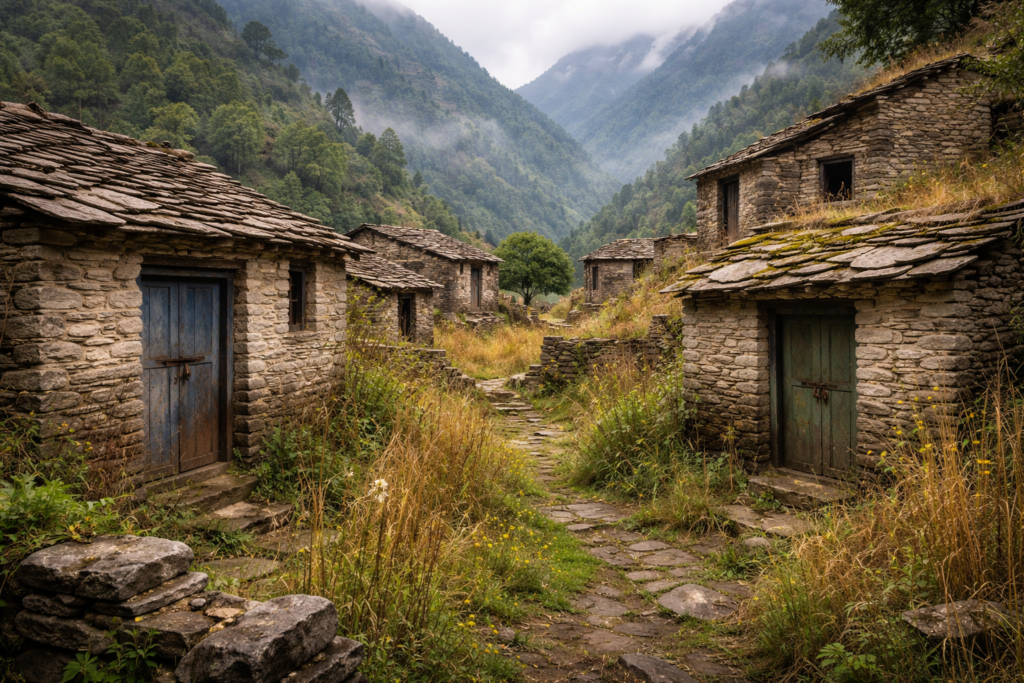
A Ghost Village is a settlement where most or all residents have permanently migrated, leaving behind empty homes, broken temples, and overgrown fields.
India’s Himalayan states; Uttarakhand, Himachal Pradesh, Sikkim, Arunachal Pradesh; are full of them.
According to a 2018 report by the Comptroller and Auditor General (CAG) of India, over 3,946 villages in Uttarakhand had less than 10 households remaining. In some districts of Garhwal and Kumaon, entire panchayats exist only on paper.
But here is what nobody wants to say out loud:
People did not leave the mountains. The state pushed them out.
No roads. No hospitals. No schools. No internet. No market for their crops. No dignity in daily survival. When the nearest doctor is 40 kilometres away on a broken road, you do not stay for the view.
The Numbers That Should Make You Uncomfortable
- Uttarakhand: 734 ghost villages officially recorded; actual number estimated over 1,700 (Uttarakhand Spatial Data Centre, 2022)
- Himachal Pradesh: 47 villages reported fully abandoned in Lahaul-Spiti and Kinnaur districts
- India-China border areas: Over 60% of villages within 50 km of the Line of Actual Control (LAC) have seen severe depopulation since 2000
- Youth migration rate: 75% of young people from hill districts move to plains cities by age 25 (TERI Rural Migration Study, 2021)
These are not statistics. These are choices that were forced on real people.
“But People Want Better Opportunities”; No, They Want Basic Rights
Every time this issue comes up, someone says: “What can you do? People naturally move toward opportunity.”
That argument is lazy. And it is wrong.
People in Ladakh’s remote villages did not abandon their homes because they wanted mall culture. They left because a pregnant woman had to walk 6 hours in snow to reach a health centre. They left because the nearest school stopped after Class 5. They left because their apple crop rotted before a buyer arrived.
This is not nature. This is neglect dressed up as inevitability.
In urban planning conferences, ministers talk about “smart cities” while the smartest ecological knowledge on the planet; stored in the heads of mountain farmers, herders, and forest communities; walks out of the hills forever.
The Strategic Disaster Nobody Is Talking About
Here is where it gets serious.
India shares over 3,488 kilometres of border with China and 3,323 kilometres with Pakistan; almost entirely through Himalayan terrain.
China has been building entire model villages; called Xiaokang villages; right on the Indian side of disputed borders in Arunachal Pradesh. Populated. Permanent. Funded by Beijing.
India’s response? Our side of the border has Ghost Villages.
An empty village is not just a sad story. It is a strategic vulnerability. Populated borders are defended borders. When locals abandon these areas, India loses:
- Human intelligence (locals who know every trail, every change, every stranger)
- Territorial presence (effective occupation requires habitation)
- Ecological stewardship (forests and rivers managed by nobody are destroyed by everyone)
General Bipin Rawat, India’s first Chief of Defence Staff, explicitly warned in 2021 that border depopulation posed a “serious national security challenge.” That warning has largely been ignored.
The Tourism Lie
Open any Himalayan tourism brochure. It will say words like “pristine,” “untouched,” “authentic.”
But authentic for whom?
The tourism economy of Uttarakhand generated over ₹27,000 crore in 2022-23. Yet local communities; the people who lived there for generations; saw almost none of it.
Hotels are owned by investors from Delhi and Mumbai. Tour operators are registered in Dehradun. Porters and guides earn daily wages that do not cover their children’s school fees.
Locals became labourers in their own homeland.
When the season ends, the tourists go home. The money goes to the cities. The villager is left with a dirty river, a broken road, and zero savings.
This is not development. This is extraction with a pretty filter.
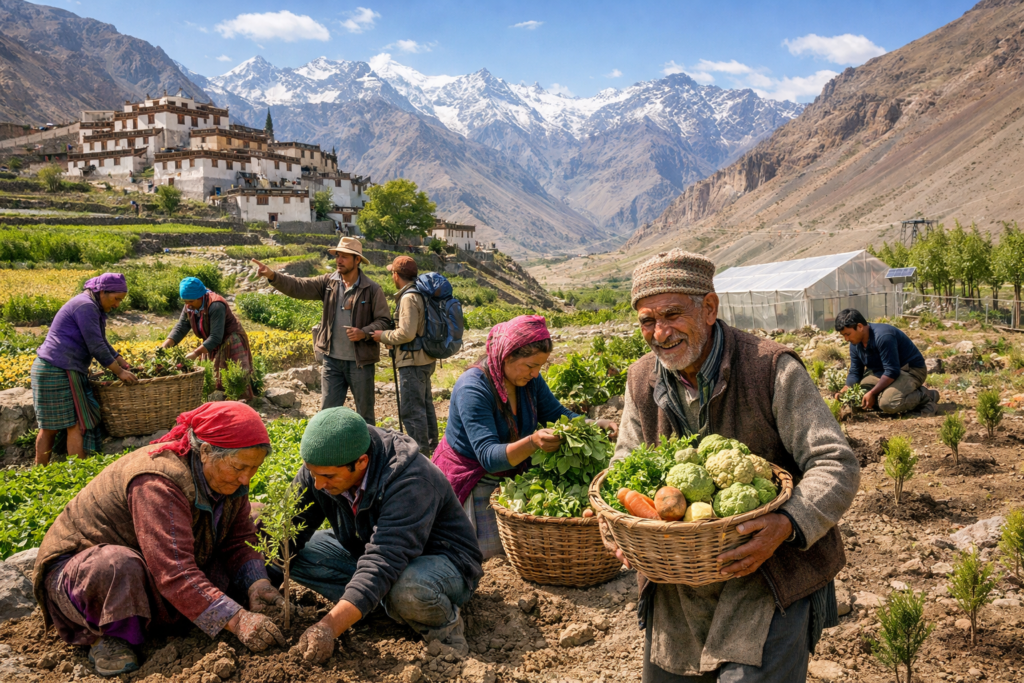
What Eco-Driven Reverse Migration Actually Means
Reverse migration is not a charity programme. It is a strategic investment.
It means creating real, lasting economic reasons for people to return to or stay in their mountain villages; not through sentimental campaigns, but through hard policy and genuine livelihood support.
Here is what it looks like in practice:
1. Land Rights and Return Incentives
Many migrants still own land in their villages but cannot farm it. Clear land-use policies, return subsidies, and legal simplification of property rights would allow families to come back without fear of losing their urban income base during transition.
2. Green Livelihoods That Actually Pay
- Agro-forestry: Pine resin, medicinal herbs, organic produce; Himalayan produce commands premium prices if marketed properly
- Solar micro-enterprises: Mountain villages get 300+ sunny days a year; rooftop solar and micro-grids can power homes and small industries
- Homestay networks: Properly trained and community-owned, not outsourced to tour companies
- Community forest rights: Under the Forest Rights Act 2006, communities can legally manage and profit from forest produce; but implementation remains poor
3. Digital Infrastructure as a Lifeline
Remote work is real. Thousands of Indians now work for Bangalore or Mumbai companies from their laptops.
Why not from a village in Pithoragarh?
BSNL’s 4G rollout in border villages, announced under the Vibrant Villages Programme (2023), is a step. But fibre optic connectivity in every habited Himalayan village must become non-negotiable; not a “scheme,” but an entitlement.
4. Decentralised Governance
Top-down schemes designed in Dehradun or Delhi will not work in Munsiyari or Sangla. Local gram sabhas must have real budgetary power, not just rubber-stamp authority.
The Panchayati Raj system exists. It just needs actual funds and actual respect.
Climate Resilience Lives in These Villages
Here is a fact that climate scientists repeat, and policymakers ignore:
The best ecological managers of Himalayan forests are the people who live in them.
Traditional Himalayan communities practised Van Panchayats (community forest councils) for centuries before India even had a forest department. They knew which trees to cut, when to graze, how to manage water channels called guls and kuhls that fed entire valleys.
When communities leave, forests do not become wild and free. They become dry, fire-prone, and unmanaged.
The 2021 Chamoli disaster. The 2023 Joshimath land subsidence. The recurrent flash floods in Himachal. All of these are worsened by the absence of people who understood the mountain.
Repopulating these villages is not nostalgia. It is climate adaptation.
Real Stories, Real Stakes
Dungri village, Uttarakhand: Once had 85 families. Today, 3 elderly women remain. The school closed in 2009. The hand pump dried up in 2017. The last young man left in 2021.
Kaza, Spiti Valley: A partial success story. Young entrepreneurs have returned to run homestays and cafés, supported by NGOs like Spiti Ecosphere. Internet arrived in 2019. The village now has a small economy again.
Kibithoo, Arunachal Pradesh: India’s easternmost village, on the China border. After the government’s Vibrant Villages Programme invested in roads and connectivity in 2023, some families who had migrated to Tezu began returning.
These are not miracles. They are what happens when policy is serious.
The Vibrant Villages Programme
In February 2023, the Indian government launched the Vibrant Villages Programme (VVP) with a budget of ₹4,800 crore for border villages in Uttarakhand, Himachal Pradesh, Arunachal Pradesh, Sikkim, and Ladakh.
The goals are right: roads, housing, solar power, connectivity, livelihood support.
But implementation is slow. Local communities report that funds are routed through state bureaucracies that have little understanding of ground realities. Contractors from outside the region win tenders. Village residents are consulted last, if at all.
A programme designed to bring people back must be designed by the people it wants to bring back.
What India Can Learn from Bhutan and Nepal
Bhutan has constitutionally mandated that 60% of its land remain forested forever. It pays citizens to act as ecological stewards. Its Gross National Happiness index measures wellbeing, not just GDP. The result: one of the most ecologically intact Himalayan nations on earth.
Nepal’s community forestry programme has successfully handed over 2.4 million hectares of forest to local communities; and forest cover has actually increased as a result.
India has the laws. It has the Constitution. It has the Forest Rights Act, the PESA Act, the Panchayati Raj system.
What it lacks is political will to implement them in mountain areas where votes are few and land is much.
5 Things That Must Happen Right Now
- Declare Ghost Village Restoration a National Priority — not a state subject, not a scheme, a constitutional commitment
- Guarantee 4G/fibre connectivity in every inhabited Himalayan village by 2027
- Fund community-owned eco-tourism — not corporate resorts, not state tourism corporations
- Give Van Panchayats real power and real money to manage local forests and water
- Offer a 10-year tax holiday for any Himalayan migrant who returns and starts a livelihood enterprise in their home district
None of this is impossible. All of it requires political courage.
The Choice Is Simple
Empty villages become occupied land; by erosion, by wildfire, by foreign strategic interest, by corporate extraction.
Populated villages become living shields; ecological, cultural, and territorial.
The Himalayas are not a destination. They are the water tower of South Asia, the carbon sink of the subcontinent, the strategic frontier of the nation, and the cultural memory of over a hundred communities.
You cannot manage a mountain from a mall in Gurgaon.
If India continues to let its mountain villages empty, within two generations the Himalayas will be a museum. Beautiful on postcards. Dead on the ground. And controlled; ecologically, economically, strategically; by forces that do not love this land the way its people do.
The mountains are waiting. The question is whether we have the courage to go back.
Watch and Learn
Here are some powerful video resources on this topic:
- The Ghost Villages of Uttarakhand — Informal documentary by travellers
- Spiti Valley Reverse Migration Stories — Community interviews
- India’s Border Villages and China’s Strategy — Strategic analysis
Comments from Nikhil Raj Sharma, Founder; Himalayan Geographic
“When I first walked through a Ghost Village in Garhwal five years ago, I stood in a courtyard where children’s drawings were still on the wall. The house was locked. The family was in Rishikesh, working in a hotel. That image never left me. This article says what needs to be said; loudly, and without apology.”
“We at Himalayan Geographic have been documenting these villages for three years. What breaks our team every time is not the empty houses; it is the elders who stayed behind. They do not complain. They just say, ‘Nobody came.’ We must go back. For them. For the mountain. For us.”
“Eco-driven reverse migration is not a romantic idea. It is a survival strategy; for the people and for the planet. Share this article. Make someone uncomfortable. That discomfort is the beginning of change.”
Related Articles You Should Read Next
- The Joshimath Crisis: What Sinking Land Tells Us About Development Gone Wrong
- Community Forests of Uttarakhand: The Van Panchayat Story
- Border Tourism: Can India Populate Its Frontiers Through Eco-Travel?
Disclaimer: The content and images published in this article are provided for general informational and educational purposes only. Some images may be generated or enhanced using artificial intelligence (AI) and are intended solely for illustrative use. The views, interpretations, and information expressed do not necessarily reflect the official position of Himalayan Geographic Research Foundation, nor do they constitute professional, legal, medical, or financial advice.
While efforts are made to ensure accuracy, no guarantees are given regarding completeness or reliability. Readers are encouraged to independently verify information and use their own judgment. By reading this article, you acknowledge that any reliance on the content is at your own risk, and Himalayan Geographic Research Foundation assumes no responsibility or liability for disagreements, interpretations, or outcomes arising from its use. If you do not agree with these terms, you are advised to discontinue reading.