
Drug culture is swallowing Himalayan youth whole. Weak borders, absent governance, and a broken economy are the real culprits. This is not a crisis. This is a controlled collapse.
A prince who ignores the corruption eating his border villages is not peaceful. He is stupid. The Himalayan drug crisis is not a poor family’s problem. It is a governance failure at the top. The state knows. Officials know. Politicians know. They choose to act slowly because slow action protects those who profit. If you want this to change, stop asking nicely. Demand it loudly, name the guilty, and vote accordingly. Mountains don’t fall to outsiders. They fall when insiders stop caring.
The mountains do not protect the weak. And right now, the Himalayas are full of weak rulers who have left their youth to wolves. This is not tragedy. This is negligence wearing the mask of geography.
Did you know that Himachal Pradesh alone reported a 300% rise in drug-related cases among youth between 2015 and 2023? In Manipur, over 60% of HIV cases are linked to intravenous drug use. And in Sikkim, the smallest Himalayan state, drug addiction has become the number one reason young men drop out of school. These are not statistics from a distant country. These are our mountains. Our children. Our failure.
Drug culture in the Himalayas is not arriving quietly. It is marching in through broken borders, indifferent officials, and an economy that has nothing to offer a 22-year-old except a tourist’s tip or a dealer’s commission. This article is not written to make you feel sad. It is written to make you feel responsible.
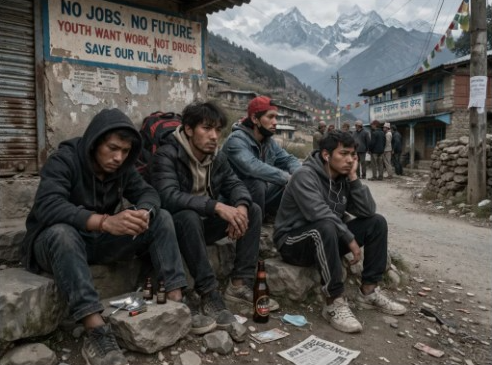
WHY THE MOUNTAINS ARE PERFECT FOR DRUG CORRIDORS
The Himalayas stretch across five Indian states; Jammu and Kashmir, Himachal Pradesh, Uttarakhand, Sikkim, and the northeastern hill states; and share borders with Pakistan, China, Nepal, Bhutan, and Myanmar. Every one of these borders has gaps. Not accidental gaps. Governance gaps.
High altitude means thin air, yes. But it also means thin state presence. Police stations are few. Courts are far. Roads are broken six months a year. The administration in Delhi or Gangtok makes policies for these regions from comfortable offices, but enforcement on a 14,000-feet mountain pass is a different matter entirely.
This is not geography. This is neglect. And drug networks know neglect very well. They set up routes where the state is absent. The Golden Triangle; Myanmar, Laos, Thailand; feeds drugs into India’s northeast. The Golden Crescent; Afghanistan, Pakistan, Iran; pushes heroin and synthetic drugs into Kashmir and Himachal. These routes exist because no one is seriously guarding them.
A young man in Spiti or Tawang does not need to go looking for drugs. The drugs come to him. That is how sophisticated this network is; and how primitive our response has been.
Relevant Watch: — “Drug Menace in Himachal Pradesh” NDTV ground report
THIS IS NOT ACCIDENTAL, IT IS STRATEGIC
Let us be honest about something. When an entire generation loses its discipline, its ambition, and its ability to resist; someone benefits. Whoever supplies the drug benefits financially. Whoever wants a quiet, compliant population benefits politically. This is not conspiracy theory. This is how power has always worked.
Himalayan youth today face three brutal realities.
First, there are no jobs. The traditional economy; farming, herding, small trade; has collapsed under climate change and competition. Tourism has created a cash economy, but it is seasonal, exploitative, and entirely outside the control of local youth. A boy who earns three months of tips and has nine months of nothing is a perfect target for a dealer who offers daily income and a way to kill boredom.
Second, identity is in crisis. Globalisation reached the Himalayas through a mobile phone screen. Young people in Leh or Darjeeling now compare their lives to Instagram reels from Dubai and Mumbai. The gap between what they see and what they have is psychologically devastating. Drugs fill that gap temporarily. That temporary relief becomes permanent dependency.
Third, peer pressure in isolated communities is absolute. In a village of 200 people, if five young men are using drugs, the social pressure on the remaining youth is enormous. There is no anonymous city life here. Everyone knows everything. And in that pressure cooker, saying no is much harder than it looks from outside.
Bold Statement: “In the Himalayas, drugs are not a lifestyle choice. They are the symptom of a society that has been abandoned.”
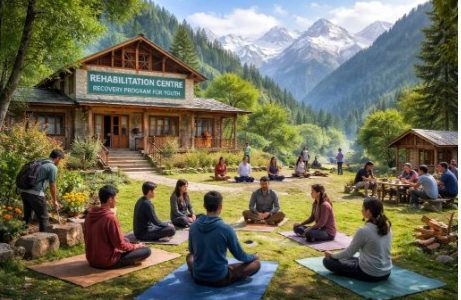
FOLLOW THE MONEY, FIND THE POWER
Small dealers get arrested. That is good. But small dealers are foot soldiers. The real economy of drugs in Himalayan regions runs several layers above them, and those layers are mostly untouched.
Here is what we know. A gram of heroin that crosses the Myanmar border costs less than one hundred rupees at source. By the time it reaches a user in Shillong or Imphal, it costs three thousand rupees or more. That profit margin; three thousand percent; does not go to the boy on the street. It goes up the chain. To transporters, to local protectors, to border officials who look away at the right moment, to political figures who receive cash donations from unknown sources.
The money launders itself through small businesses; hotels, transport companies, pharmacies. In tourist economies like Manali or Kasol, cash is king and questions are few. Drug money blends perfectly into the informal tourism economy. No one tracks it. No one wants to track it.
This is what we must name clearly: the drug economy in the Himalayas is not underground. It is parallel. It runs alongside the official economy with the quiet permission of those who benefit from it.
Relevant Watch: — “Kasol: Paradise or Drug Hub?” — Vice India
THE COLLAPSE OF SOCIAL INSTITUTIONS; WHEN FAMILY AND SCHOOL FAIL
The Himalayas have always had one defence against chaos: strong social institutions. The joint family, the village council, the monastery or church or temple, the school teacher who was also a community elder. These were not formal institutions. They were living authority structures. They held communities together across centuries of hardship.
Addiction is destroying all of them at once.
When a young man becomes addicted, the first casualty is the family. Parents spend savings on treatment. Siblings lose education funds. The home becomes a site of shame, secrecy, and conflict. The family — which should be a support system; becomes overwhelmed and often enables the addiction to avoid social exposure.
Schools in high-altitude regions are already under-resourced. Teachers are underpaid, infrastructure is poor, and dropout rates are high. When a student arrives high or does not arrive at all, most schools have no protocol to respond. There is no counsellor. There is no awareness programme worth the name. There is nothing.
The village elders; who once had authority to shame, guide, or discipline youth; have lost that power. Young people with cash from dealing do not listen to elders with no economic power. Respect has been monetised. And elders cannot compete.
LAWS EXIST, ENFORCEMENT DOES NOT
India has the Narcotic Drugs and Psychotropic Substances Act of 1985. It is a strong law on paper. In the Himalayas, it is mostly paper.
Here is the pattern of enforcement in high-altitude regions. A small-time dealer is arrested. It makes news in the local paper. A senior officer gives a press statement about zero tolerance. The case drags in court for five years. The dealer is out on bail in three months. The network continues. The next arrest happens six months later. Repeat indefinitely.
There are specific reasons enforcement fails:
- Understaffed police units in remote areas with no vehicles or communication
- No dedicated anti-narcotics units in most Himalayan districts
- Courts with backlogs of years, giving bail routinely
- Rehabilitation centres that exist on government paper but not on the ground
- Border check posts that are seasonal, understaffed, and easily bypassed
- No coordination between state police and central agencies like the Narcotics Control Bureau
The NCB itself admitted in 2022 that northeast India’s border management for drug control is critically inadequate. Himachal Pradesh’s own state drug policy has been pending revision since 2019. Uttarakhand has no dedicated drug rehabilitation centre in its hill districts. This is not oversight. This is institutional indifference.
Relevant Watch: — “India’s Drug Crisis in the Northeast” — Al Jazeera English
MILITARISED RESPONSE VS SOCIAL REFORM
There is a comfortable argument made by soft-hearted people: that policing does not solve addiction, that we need awareness and education, not crackdowns. This is half-true and therefore dangerous.
Awareness without supply disruption is useless. You can run a thousand school workshops about the dangers of heroin. But if heroin is cheaper than a meal and available on every second street corner, the workshop changes nothing. Supply must be choked. Networks must be dismantled. Dealers must face consequences that actually sting.
At the same time, a pure policing approach without social investment is equally useless. If you arrest a dealer and his cousin simply replaces him because there are no other economic options in the village, you have achieved nothing. The source of demand; unemployment, identity crisis, boredom, despair; must be addressed aggressively.
What does a real dual strategy look like?
Supply Side:
- Year-round staffed border intelligence units with technology support
- Local anti-narcotics task forces with autonomous authority and accountability
- Fast-track courts for drug trafficking cases above a minimum quantity threshold
- Named, public accountability for officials in areas with high drug flow
Demand Side:
- Mandatory rehabilitation infrastructure in every district, not just state capitals
- Skill development programmes specifically designed for Himalayan livelihoods; eco-tourism, organic farming, cultural economy
- Mental health support in every school, including trained counsellors
- Youth-led community monitoring programmes with real authority and state backing
The mountain cannot be defended by either the soldier or the teacher alone. It needs both, working at the same time, with the same urgency.
WHOEVER HOLDS THE YOUTH HOLDS THE MOUNTAIN
Every strategic mind in history has understood one truth: control the young, and you control the future. The Roman Empire built roads to move armies. The British built schools to produce clerks. Today, drug networks are building dependency to produce compliance.
A generation that is addicted cannot organise. Cannot vote intelligently. Cannot demand rights. Cannot threaten those in power. An addicted youth is a neutralised threat. And in border regions, a neutralised local population is enormously convenient; for traffickers, for corrupt officials, for external actors with interests in keeping India’s border communities weak and distracted.
This is not paranoia. This is political reality. The drug crisis in the Himalayas is not a side effect of poverty. It is a mechanism of control. And until we treat it as such; with the full force of political will, administrative accountability, and public anger; it will continue.
DEMAND MORE THAN SYMPATHY
This is not the moment for candle marches. This is the moment for demands.
- Every Himalayan district must have a functional, staffed rehabilitation centre by 2026
- Border management in drug-vulnerable corridors must be upgraded with technology, personnel, and year-round presence
- State governments must publish annual drug enforcement reports with district-wise data, open to public scrutiny
- The Narcotics Control Bureau must establish permanent regional offices in Shimla, Srinagar, Gangtok, and Imphal
- Youth employment programmes in Himalayan states must be allocated a minimum of 15% of state budgets
- School curricula in hill states must include mandatory life-skills and drug-awareness education from Class 6 onwards
- Local journalists and NGOs who expose drug networks must receive legal protection, not harassment
The mountains are not silent. The youth are screaming. The question is whether those in power choose to hear it or prefer the convenience of deaf ears.
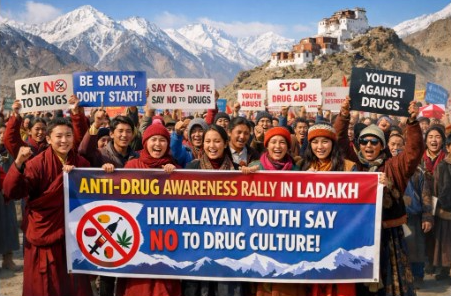
COMMENTS FROM NIKHIL RAJ SHARMA, FOUNDER, HIMALAYAN GEOGRAPHIC
“I have walked through villages in Kullu where three out of five young men are regular users. These are not bad people. These are people whom the system left alone at 4,000 meters and then was surprised when they fell. We keep talking about the beauty of the Himalayas. We never talk about the crisis living inside that beauty.”
“The saddest part is not the addiction itself. It is the silence around it. Families hide it. Officials deny it. And the networks grow stronger in that silence. Himalayan Geographic has been pushing for ground-level data collection and community intervention for three years now. The government has listened politely and done almost nothing.”
“This article needed to be written. We have been documenting the Himalayas for years; the beauty, the culture, the resilience. But we cannot keep showing only the postcards while the people in those postcards are suffering. High altitude should mean high aspiration, not high on substances. Himalayan Geographic will continue to hold a mirror to this crisis until someone in power blinks.”
“The mountains do not belong to trekkers or governments or drug networks. They belong to the youth who were born there. And right now, we are losing that youth. That is the story we must tell; loudly, repeatedly, without apology.”
WHAT YOU CAN DO RIGHT NOW
- Write to your local MP or MLA demanding a district-level drug rehabilitation centre
- Support organisations working on Himalayan youth welfare; Himalayan Geographic Research Foundation, iCall, and local NGOs in Himachal and the northeast
- If you see suspicious activity in your community, report to the NCB helpline: 1800-11-0031
RELATED ARTICLES TO READ:
- “The Golden Triangle and India’s Northeast: How Drugs Cross Our Borders“
- “Youth Unemployment in Hill States: The Invisible Crisis“
- “Kasol, Manali, and the Dark Side of Himalayan Tourism“
Disclaimer: The content and images published in this article are provided for general informational and educational purposes only. Some images may be generated or enhanced using artificial intelligence (AI) and are intended solely for illustrative use. The views, interpretations, and information expressed do not necessarily reflect the official position of Himalayan Geographic Research Foundation, nor do they constitute professional, legal, medical, or financial advice.
While efforts are made to ensure accuracy, no guarantees are given regarding completeness or reliability. Readers are encouraged to independently verify information and use their own judgment. By reading this article, you acknowledge that any reliance on the content is at your own risk, and Himalayan Geographic Research Foundation assumes no responsibility or liability for disagreements, interpretations, or outcomes arising from its use. If you do not agree with these terms, you are advised to discontinue reading.