
Diwali pollution harms more than air. See how fireworks, noise, traffic and waste affect birds, dogs and urban wildlife, and how to celebrate Diwali with care.
On the morning after Diwali 2025, Delhi’s air held an average of 488 micrograms of fine dust in every cubic metre. That was more than three times the 156.6 recorded before the festival, according to an analysis of CPCB data by Climate Trends. Many of us woke up to a grey sky and shrugged. This yearly smog is what most people now call Diwali pollution.
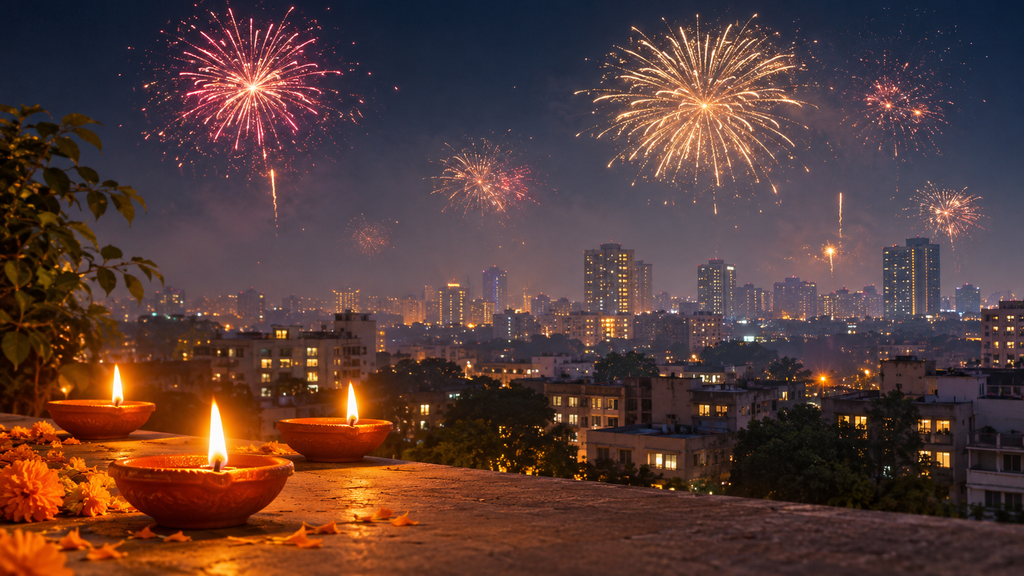
Think about the night itself. Diyas glow in every window. Families share sweets, children wave sparklers, and the whole street sounds like one big drum. For many of us, it is the warmest night of the year.
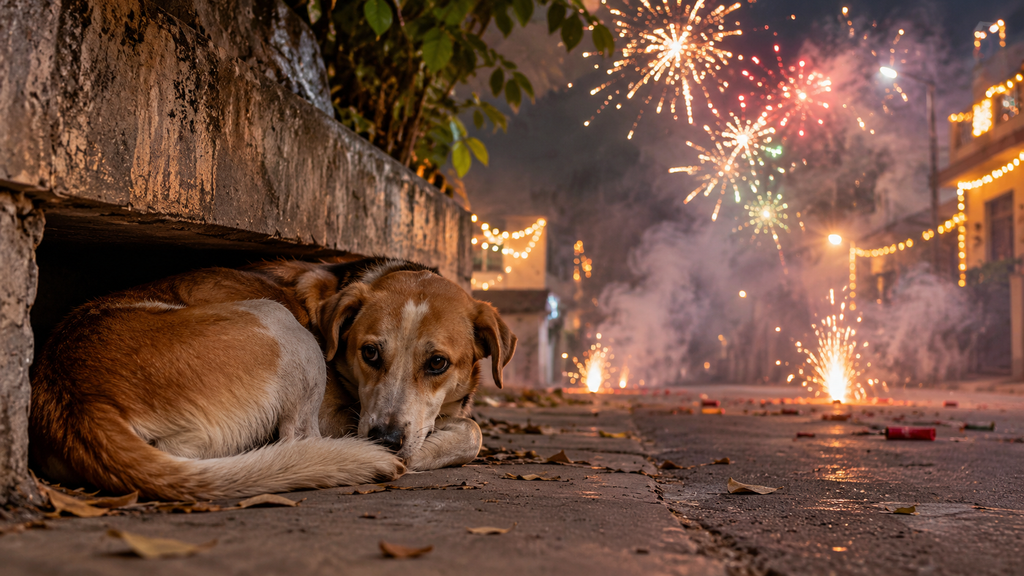
Now picture the same night from a tree. A crow is asleep in the dark. A blast like a gunshot goes off nearby, then another, then fifty more. There is flash, bang and smoke, and nowhere to go. A street dog squeezes under a parked car. This is not just imagination. The sections below show what research tells us.
This year, Diwali falls on 8 November 2026. For Delhi-NCR, the Supreme Court allowed certified green crackers only on 7 and 8 November, from 6 to 7 am and 8 to 10 pm. A full ban returns from 9 November. Reports on the eve of the festival placed the region’s AQI above 500. Rules differ from state to state, but the question stays the same everywhere.
This article is not against Diwali. The festival is part of India’s heritage, and its message of light over darkness is worth celebrating. The focus is on five pressures that come with careless celebration: smoke, sudden blasts, constant noise, traffic and leftover waste. We also look at Himalayan towns, where very little is measured.
“Light should never be the reason someone else cannot sleep.”
Diwali Pollution and the Air We Leave Behind
Fireworks burn chemicals and throw fine particles into the air. Scientists measure these as PM2.5 (specks smaller than 2.5 microns, far thinner than a hair) and PM10. A 2023 review in Pacific Conservation Biology lists what fireworks release: sulphur dioxide, carbon monoxide, particles, and metals such as aluminium and manganese. The same review says particle levels can reach five times the background after a display and then fall within about 24 hours. Lab tests on mice and human cells showed strong inflammation from firework particles.
Delhi’s numbers show the pattern clearly. CPCB data analysed by Climate Trends showed the average PM2.5 rising from 156.6 before Diwali 2025 to 233.5 on Diwali day, and to 488 after it. That was the highest of the five years studied. The peak reading was 675.1. The WHO 24-hour guideline is 15 and India’s national standard is 60. By simple division, 488 is about 32 times the WHO figure and about eight times the Indian standard.
This is not a one-year story. The post-Diwali average was 454.5 in 2021, then 168 in 2022 and 319.7 in 2023. PTI’s report on the same data noted that Delhi’s air has fallen into the “severe” category after Diwali for most of the past decade, despite court bans. Weather matters too. In 2025, the average temperature dropped to 20°C after Diwali from 27°C before. Cold air can trap pollution near the ground. The Delhi government disputed the framing of the year as a worst case. Even so, the CPCB-based hourly analysis showed the highest post-Diwali average in five years.
Why do fireworks hurt more in cities that are already polluted? Because there is no room left. Delhi’s average before the festival was 156.6, already far above the 60 allowed for a full day. Fireworks pile a sharp spike on top of a bad baseline. Birds are in that air too, and nobody measures what they breathe.
The hills are not safe from this. In Dehradun, researchers measured the air during Diwali 2017 and 2018. Fine and coarse particle levels were 1.8 to 2.1 times higher than before the festival. Tracking of air movement found no long-distance source, so the authors blamed local fireworks, wood burning and vehicles.
Birds and Urban Wildlife
What a radar over Birmingham saw
In 2021, scientists at the University of Birmingham aimed a radar at the city sky. They compared bird flight tracks on ordinary nights with nights when fireworks are common. These were Diwali, Bonfire Night and New Year’s Eve. The study was published in Scientific Reports in 2023.
The result was clear. On all three occasions, birds flew higher and in larger numbers. For Diwali, the standardised effect sizes were 17.11 for flight height and 23.41 for numbers. The Diwali effect on numbers was the largest of the three events. The authors noted that bird activity was raised at a time of night when many birds would normally be roosting. They added that colder months mean higher energy costs for staying warm.
Now the limits. A radar sees flight tracks. It does not tell us the species, or whether any bird was hurt, starved or failed to breed. The study was in a UK city. So the findings show real disturbance, but they do not prove lasting harm.
A wider pattern across the world
Other research points the same way. Weather radar in the Netherlands showed thousands of birds taking off soon after midnight on New Year’s Eve. At Lake Constance in 2010, more than 4,000 waterbirds fled a display, and some stayed away for over two days. Many were moulting and could barely fly. The display was banned afterwards. On Lake Zurich, New Year fireworks caused a 26 to 35 per cent overnight drop in swans, geese and ducks, and numbers took 3 to 10 days to recover.
Some cases are worse. In Beebe, Arkansas, two New Year displays in 2011 and 2012 were linked to the deaths of thousands of red-winged blackbirds. They were driven from their roosts at night and collided in flight. In Valencia, house sparrows bred less successfully in towns with spring festivals and fireworks. After the 2020 festivals were cancelled, the difference vanished. A captive griffon vulture’s heart rate jumped from 50 to 170 beats a minute during a display. A German review found birds in open country and in colonies reacted more than birds in woods, and noise caused more reaction than light.
What we know about India
We found no Indian radar study of birds during Diwali. The 2023 review itself says Diwali falls in the winter migration season, but no reports on impacts on migrants are available. What India has are rescue reports. In 2017, a Delhi wildlife rescue team said bird injury cases rise by about 60 per cent around Diwali. The team admitted it had no exact data. That is a useful signal, not proof.
There is also a hopeful story. Villagers near Vettangudi Bird Sanctuary in Tamil Nadu have long avoided crackers so migratory birds can roost in peace. The sanctuary draws about 15,000 birds a year, and the Forest Department gives the villagers sweets every Diwali as thanks.
Street dogs, cats and other animals
Dogs are the best studied. An online survey of 1,225 dogs found that 52 per cent were at least partly affected by firework fears. Most dogs developed the fear in the first year of life. A 2020 study filmed dogs on New Year’s Eve and compared them with a quiet evening to measure fear behaviour. In a New Zealand survey, owners said 74.4 per cent of companion animals showed fear of fireworks. Horse owners reported more running, broken fences and injuries.
Street animals are a gap. We found no peer-reviewed Indian study on free-living dogs or cats at Diwali. Pet research suggests they feel the same fear, but they cannot go indoors. Wildlife SOS has described birds forced out of night roosts, bats disturbed in their shelters, and animals hit by sudden loud sounds.
What is proven and what is only possible
- Well supported: fireworks make birds fly up, in greater numbers, at night. Fireworks frighten many dogs.
- Possible but not proven for India: effects on migrating birds, nesting and breeding success in Indian cities.
- Unknown: how street dogs, cats, bats and mountain wildlife respond. This needs field research.
The Noise We Have Normalised
Imagine your phone’s loudest alarm ringing outside your window at 11 pm, again and again, for hours. For wildlife, a festival night can feel something like that. Noise adds to the problem even before the first cracker. Honking in jams, loudspeakers and crowds all stack up.
India has rules for this. Under the Noise Pollution (Regulation and Control) Rules, 2000, residential areas are limited to 55 decibels by day and 45 at night. Commercial areas get 65 and 55, and industrial areas 75 and 70. Silence zones get 50 and 40. “Day” means 6 am to 10 pm [13]. Silence zones surround places like hospitals, courts and schools, within about 100 metres. The same rules cover loudspeaker.
Firecrackers have their own limit. A cracker must not exceed 125 dB(AI) or 145 dB(C)pk at 4 metres from the point of bursting. This is a separate standard from the ambient limits. Noise can exceed 85 dB, the level at which harm to human eardrums can occur. So even a legal firecracker is far above that level at close range.
Noise also stresses animals. The 2023 review notes that noise can raise stress hormones even in city animals. It also cites lower body condition in urban chicks and mice exposed to noise and light. The Valencia sparrow result suggests festival noise may even reduce breeding success.
Do we follow our own rules? Himachal Pradesh gives a mixed picture. The state’s pollution board monitors Diwali noise each year. In 2024, noise was reported down by about 20 per cent from the year before. But in 2025, a report on the board’s data said noise exceeded limits in Chamba, Una, Rampur Bushahr, Kinnaur, Baddi and Kullu. The rules are good. Enforcement is the weak link.
Traffic, Congestion and the Extra Pollution Burden
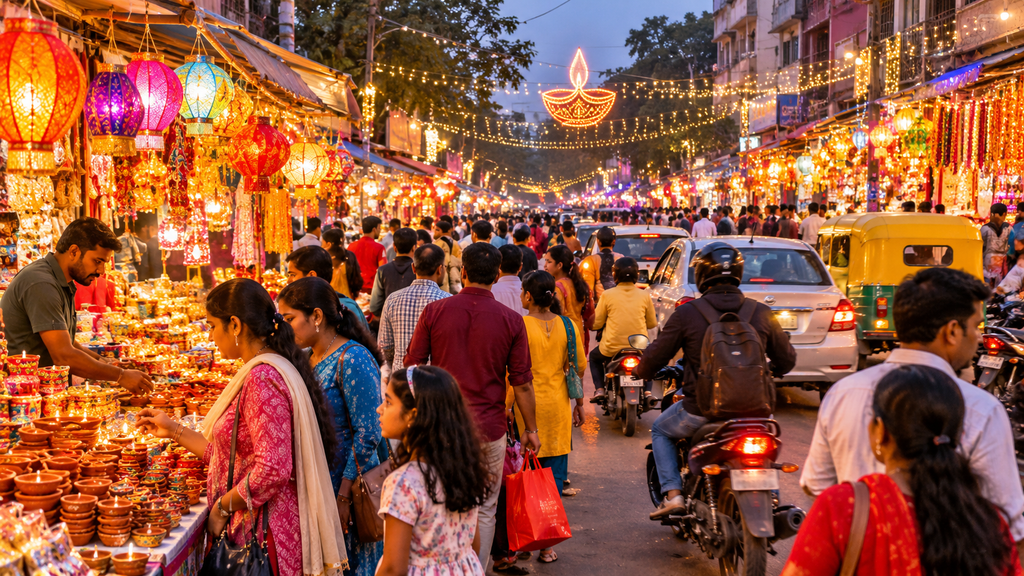
Diwali is also a shopping season, and shopping means vehicles. The Centre for Science and Environment studied Delhi in Diwali week 2022. It found vehicles were the largest local source of PM2.5, with about half of Delhi’s own contribution. Congestion stretched from noon to 8 pm instead of the usual two peaks. The worst pre-Diwali days had average speeds near 24 kmph. On Diwali day itself, traffic eased and speeds rose to about 33 kmph.
Traffic and fireworks leave different fingerprints. Nitrogen dioxide (NO2) follows traffic, and it rose when speeds fell. PM2.5 jumps late at night when crackers are burst. CSE’s 2024 note found NO2 higher on Diwali night and the nights before, for three years running. ITO, a traffic hotspot, averaged 182 micrograms of NO2 at night, while quiet Lodhi Road averaged 2. The 12-hour PM2.5 average on Diwali night 2024 was 386, against 289 in 2022. The two problems peak at different hours, and they need different fixes: fewer crackers for one, and calmer traffic for the other.
Hill towns face the same split. A state board scientist said in 2019 that vehicle movement in Shimla and Manali affects air quality, not only firecrackers.
The Environmental Footprint After Diwali
The celebration ends, but the material stays. Bhopal collected over 1,100 tonnes of waste after Diwali 2025, around 300 tonnes more than usual. About 20 tonnes was cracker waste: gunpowder residue, dust, plastic covers and cardboard. Roughly 5 tonnes could be recycled, and the remaining 15 tonnes was stored as hazardous waste. Chennai removed 60 tonnes of cracker waste on Diwali day alone. Mumbai’s civic body cleared over 3,000 tonnes of extra garbage in four days [30].
Smaller cities struggle more. Patiala generates about 220 tonnes a day, which rose to 225 in the festive season. Its processing capacity is only 195 tonnes a day. Waste left in streets can reach drains, and burnt waste adds smoke to the air.
Chemical residue is the less visible part. Perchlorate is a chemical used in fireworks, and it can affect the thyroid at high levels in drinking water. At Mount Rushmore in the USA, a US Geological Survey study linked past fireworks to perchlorate in water. The highest stream sample was 54 micrograms per litre, and sites outside the memorial were under 0.2 . The drinking water there was still reported safe. A study of firework sites in Kerala found perchlorate in soil up to about 20,451 parts per billion, and in water up to 7.23. The soil level peaked on the third day after the display.
These are single sites, not Diwali across India. Good data on Indian soil and streams after Diwali is thin. That is itself a finding. After-festival waste handling should be planned as carefully as the festival. Bhopal’s 2026 plan is a good model. It collects cracker waste separately in dedicated bags, sends it to a hazardous waste facility, and bans open burning.
Is the Mountain Environment Being Overlooked?
Most Diwali studies come from big plains cities. Mountain towns get little attention, and they are not copies of Delhi. Their roads are narrow, their slopes are steep, and their waste systems are small. One town cannot speak for another, so we must look at local evidence.
The Uttarakhand pollution board recorded an AQI of 269 in both Dehradun and Kashipur on Diwali 2024, and 175 in Rishikesh. In 2025, it reported most cities in the moderate or satisfactory range. It used water-spraying drones and mechanical sweepers. Weather and rules both matter, so one clean year does not settle the matter.
Himachal Pradesh shows how mixed the picture is. The state’s pollution board monitors air and noise before, on and after Diwali at 11 or 12 towns under CPCB protocol. In 2024, the state’s average AQI was 140 against 92 the year before, and Baddi hit 392. Shimla scored 66 against 78, after the district allowed bursting only from 8 to 10 pm. That is encouraging, but one year is not proof.
In 2025, reports on the board’s data said none of the 12 monitored sites fell in the poor or severe categories.
Baddi is the only Himachal town with a real-time CPCB air station, according to the Tribune. For tourist hubs like Shimla, Manali and Dharamshala, we depend on short-term readings.
Why it matters: mountain streams feed rivers for millions of people downstream. Waste thrown on a slope can end up in a stream. This is a reasonable concern, but it is not yet measured. The sensible step is local monitoring of noise, waste and wildlife, before any problem grows.
COMMENT FROM NIKHIL RAJ SHARMA FOUNDER OF HGRF
“At HGRF, we see the Himalayas as a living home, not a backdrop. Festivals are part of that home, and we respect them deeply. But a festival should not cost our neighbours their rest, and by neighbours I mean birds, dogs and every other creature near us.
This article asks a simple question: what happens to the living world while we celebrate? The honest answer is that we do not know enough, especially in mountain towns. We need more measurement, more local research and more care.
I would invite every reader to try one change this Diwali. Light more diyas. Burst fewer crackers. Keep your pets safe indoors. Pick up the waste the next morning.
Tradition and nature were never meant to compete. The best celebrations make room for both. Tell us in the comments how you are celebrating.”
Can We Celebrate Diwali More Responsibly?
Individual choices
- Cut crackers, or skip the loudest ones. Noise causes the strongest reaction in birds, more than light. Quiet options remove the main trigger.
- Do not assume sparklers are harmless. A New Zealand study found a steep rise in particles after fireworks, much of it from hand-held sparklers. Perchlorate-free fireworks exist, but they cost more.
- Light diyas, string lights and rangoli instead. They give the festival’s glow without the blast.
- Protect pets. Bring dogs indoors and add background sound to mask the noise. Fear signs include panting, trembling, hiding and fleeing.
- Bag cracker debris separately. Do not burn it or mix it with kitchen waste.
Community action
- Agree on quiet hours and a short bursting window. Shimla’s 8 to 10 pm rule is one example. Short windows give birds long stretches of calm.
- Keep fireworks away from lakes, large roost trees and sanctuaries. Open-water birds and colonies reacted most strongly in the studies. The Lake Constance display was banned once 4,000 birds fled it.
- Ease market traffic. Pedestrian evenings, parking limits and shared rides cut idling, which raises NO2.
- Run awareness drives in schools and housing societies. Simple bird counts before and after Diwali would give local data that does not exist today.
Institutional steps
- Measure more, especially in the hills. A single real-time station for a whole state is not enough. Noise monitors near hospitals, schools and bird habitats would show where rules are broken.
- Enforce the rules already written. The firecracker noise standard and zone limits exist. Enforcement is what turns them into protection.
- Strengthen waste systems. Separate cracker waste, treat it as hazardous, and plan extra staff and capacity.
- Fund wildlife research. Radar, camera traps and bird counts could show how Indian birds respond. Diwali coincides with migration, which makes this urgent.
- Try quiet alternatives. Drone and laser shows are quiet and reusable, though drones can disturb wildlife too.
A Festival of Lights Should Not Leave Nature in Darkness
Diwali pollution is not only about smog. It is about who pays for our joy. Birds lose their sleep and their safe roosts. Dogs shake under beds, and street animals have nowhere to hide. Mountain towns, with little monitoring, may be carrying a burden nobody has measured.
None of this asks us to give up Diwali. It asks us to keep what makes it special, which is light, family, food and goodwill. We can drop what harms others. Villages like those near Vettangudi show that a quiet Diwali can still be a proud one.
Diwali is good. Diwali pollution is the problem, and it is a problem we can fix. Fireworks make the air dirty, and they frighten birds and animals who cannot understand what is happening. We do not have enough Indian studies, especially in the hills, so we should start measuring. Light your diyas, burst fewer crackers, keep your pets safe, and clean up after the festival. A celebration is better when everyone nearby can sleep in peace.
“The true spirit of a festival is not measured by the brightness of its fireworks, but by the care we show for the living world around us.”
SOURCES AND RESEARCH REFERENCES
- The Statesman (2025). “Delhi’s PM2.5 pollution peaks post-Diwali, worst in five years: report.”
- The Wire (2025). “A Diwali of epic proportions: Delhi pollution this year was highest compared to last four years.”
- ThePrint/PTI (2025). “Delhi’s post-Diwali air quality plunges to 5-year low, CPCB data shows.”
- Telangana Today/PTI (2 Nov 2026). “Green crackers allowed in Delhi-NCR from 6–7 am, 8–10 pm on Nov 7–8.” . Also LiveLaw (2026)
- OneIndia (2026). “What are green crackers? Supreme Court allows 2-day firecracker window amid Delhi’s AQI crosses 500.”
- Down To Earth (2025). “Floods cut farm fires, but Delhi’s air still suffocates post Diwali.”
- Down To Earth (2021). “WHO raises the bar on clean air.”
- Prabhu V. et al. (2019). “Atmospheric aerosols and inhalable particle number count during Diwali in Dehradun.” City and Environment Interactions.
- Wayman J.P. et al. (2023). “L-band radar quantifies major disturbance of birds by fireworks in an urban area.” Scientific Reports 13:12085. h (DOI: 10.1038/s41598-023-39223-1)
- Bateman P.W., Gilson L.N. and Bradshaw P. (2023). “Not just a flash in the pan: short and long term impacts of fireworks on the environment.” Pacific Conservation Biology 29:396–401.
- Riemer S. (2019). “Not a one-way road: severity, progression and prevention of firework fears in dogs.” PLoS ONE 14(9).
- Gähwiler S. et al. (2020). “Fear expressions of dogs during New Year fireworks: a video analysis.” Scientific Reports 10:16035.
- Ministry of Environment and Forests (2000). Noise Pollution (Regulation and Control) Rules, 2000 (mirror copy).
- MoEF (2006). Noise standards for firecrackers, G.S.R. 640(E).
- India Environment Portal (news clipping). “Centre against total ban on firecrackers in Delhi.”
- Free Press Journal (2025). “Mumbai firecracker tests reveal undisclosed chemicals…”
- The News Himachal (2025). Report on HPSPCB “Ambient Air Quality Monitoring during Diwali 2025.”
- The Tribune (2025). “Baddi breathes easier this Diwali.”
- Business Standard/PTI (2024). “AQI deteriorates to poor, very poor in parts of Himachal post-Diwali.”
- Madhyamam (2024). “Post-Diwali spike in air pollution hits Himachal Pradesh.”
- The News Himachal (2019). “Air in Sundernagar, Baddi and Manali was bad enough for causing breathing discomfort.”
- Govt. of Himachal Pradesh, Environment Dept. (2023). Report to NGT in OA No. 687 of 2023. REPORT BY ENVIRONMENT DEPARTMENT, GOVT. OF HP IN OA NO.687 of 2023 AIR QUALITY INDEX IN VARIOUS CITIES.pdf (URL contains spaces)
- Centre for Science and Environment (2022). “Vehicles top polluters in Delhi during Diwali week.”
- CSE (2024). “Diwali 2024: What is the first smog event of the season like?”
- Down To Earth/CSE (2024). “CSE-DTE’s post-Diwali 2024 analysis.”
- Free Press Journal (2025). “Bhopal: Municipal Corporation collects over 1100 tonnes of post-Diwali waste.”
- Free Press Journal (2026). “Bhopal to send over 1 tonne of firecracker waste to Pithampur for scientific disposal.”
- The Tribune (2025). “Patiala struggles with post-Diwali waste.”
- ETV Bharat (2025). “60 metric tonnes of firecracker waste removed from Chennai streets.”
- Free Press Journal (2025). “BMC clears over 3,000 MT of extra garbage during Diwali 2025.”
- Hoogestraat G.K. and Rowe B.L. (2016). USGS Scientific Investigations Report 2016-5030. Supports: perchlorate near past fireworks at Mount Rushmore. Peak stream sample (54 µg/L) and sites outside the memorial (<0.2 µg/L) come from a USGS-based news summary:
- Sijimol M.R. et al. (2023). “Perchlorate and chlorate contamination associated with fireworks in Kerala, India.” Environmental Forensics 24(3–4).
- Millennium Post (2017). “60 per cent rise in bird injuries during Diwali: Veterinarians.”
- ThePrint/ANI. “Vettangudi birds sanctuary doesn’t burst crackers on Diwali.”
- The Tribune. “Firecrackers endanger wildlife, experts urge mindful celebrations this Diwali” (Wildlife SOS).
- Free Press Journal (2025). “Uttarakhand records remarkable improvement in air quality during Diwali 2025.”
- Down To Earth. “Firecracker bursting new in Kedarnath…“
- Psychology Today. “How common is the fear of loud noises in dogs?” (summarises Blackwell et al., 2013). Supports: bringing dogs indoors and adding background noise.
- The Quint (2025). Delhi post-Diwali coverage with Sunil Dahiya.
- Uttarakhand Pollution Control Board. Diwali AQI monitoring, 13–27 Oct 2025.
- Animal Ethics (YouTube channel). A channel linked from an Animal Ethics article on how fireworks harm animals.
- Systematic review on fireworks noise and dogs (IIETA). Supports: fear signs in dogs.
Disclaimer: The content and images published in this article are provided for general informational and educational purposes only. Some images may be generated or enhanced using artificial intelligence (AI) and are intended solely for illustrative use. The views, interpretations, and information expressed do not necessarily reflect the official position of Himalayan Geographic Research Foundation, nor do they constitute professional, legal, medical, or financial advice.
While efforts are made to ensure accuracy, no guarantees are given regarding completeness or reliability. Readers are encouraged to independently verify information and use their own judgment. By reading this article, you acknowledge that any reliance on the content is at your own risk, and Himalayan Geographic Research Foundation assumes no responsibility or liability for disagreements, interpretations, or outcomes arising from its use. If you do not agree with these terms, you are advised to discontinue reading.