
Cost of Growth; see 7 warning signs that unchecked roads, dams and tunnels are breaking the Himalayas, and how science-based development can still save our mountains.
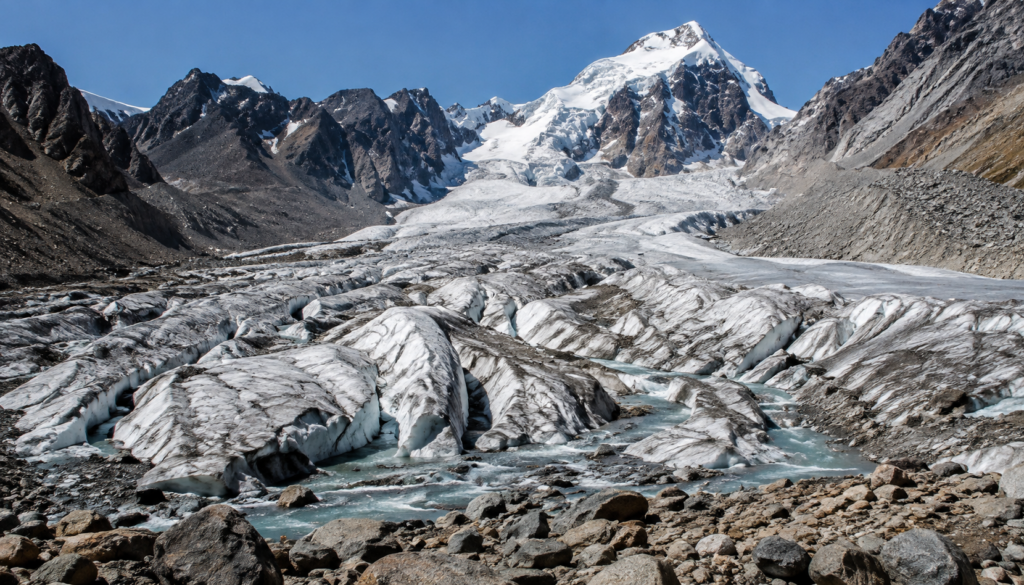
The Himalayan glaciers melted 65% faster in the 2010s than in the decade before. That is what the International Centre for Integrated Mountain Development (ICIMOD) found in its 2023 report. Now add blasting, road cutting and tunnel digging on top of that melting. The mountains are taking a hit from both sides.
This is the real cost of growth in the Himalayas. A new road looks like progress on the day it opens. The bill comes later, in the form of a landslide, a sinking town or a flooded valley. Someone always pays that bill, and it is rarely the person who signed the file.
Why the Himalayas Are Not Like Other Places
The Himalayas are young mountains, geologically speaking. They are still rising, and the rock is often loose, cracked and full of old landslide debris. A hill in the Himalayas is not like a solid wall. It is more like a pile of stones held together by roots, soil and water balance.
About 240 million people live in these mountains, and another 1.65 billion live downstream. The snow and ice feed 12 rivers across 16 countries. So when the mountains weaken, the effect reaches the plains of India, Nepal, Pakistan, Bangladesh and beyond.
This is why the Himalayas need their own development rules. A highway design that works in Rajasthan can fail on a steep slope in Uttarakhand. Copy-paste planning is the first mistake.
Cost of Growth; 7 Warnings
Warning Sign 1: Roads Cut Into Weak Slopes
Roads bring hospitals, schools and markets to remote villages. No one should deny that. People in the hills deserve good roads as much as people in Delhi or Mumbai.
The problem starts when we cut a slope too steeply or too fast. The cut removes the “toe” of the hill, which is the part that holds everything above it. Rain then loosens the soil, and the slope slides. The broken rock and mud often get dumped straight into the river below.
The Supreme Court of India has looked at this in Himachal Pradesh. In 2025, it said disasters there cannot be blamed on nature alone. It named unchecked construction, highway expansion, hydropower projects, tunnels and heavy deforestation as concerns.
The court also noted that tree felling and habitat loss weaken the soil and raise the risk of landslides and erosion. That is a plain, practical point. Fewer roots mean less grip on the hill.
Warning Sign 2: Hydropower and Tunnels in Risky Valleys
Hydropower is clean energy, and India and Nepal need power. But a dam and its tunnels are heavy machines placed inside a moving landscape. When the landscape moves faster than expected, the machine breaks.
Take the news from August 2026. A flood in Nepal knocked out hydropower projects that together made about 700 megawatts, close to 10% of the country’s power capacity. The Associated Press also reported that tens of kilometres of roads and several bridges were destroyed.
CNN reported that the trigger was part of a glacier breaking off, causing a landslide and a flood. The same report said countries are building in the Himalayas like never before. It also noted that rising power demand could push even more projects into the region.
India has seen similar events. In February 2021, a flood in Chamoli hit two power projects on the Rishiganga and Dhauliganga rivers, and more than 200 people were reported dead or missing. In October 2023, a glacial lake burst in Sikkim and damaged the Teesta III dam at Chungthang. These events were widely reported by national and international media.
Experts do not say “never build”. They say: study the risk first, build smaller where needed, and keep debris and floodwater away from tunnels. Even the disaster experts quoted by the AP said rebuilding should avoid repeating old weaknesses.
Warning Sign 3: Joshimath, the Town That Was Warned in 1976
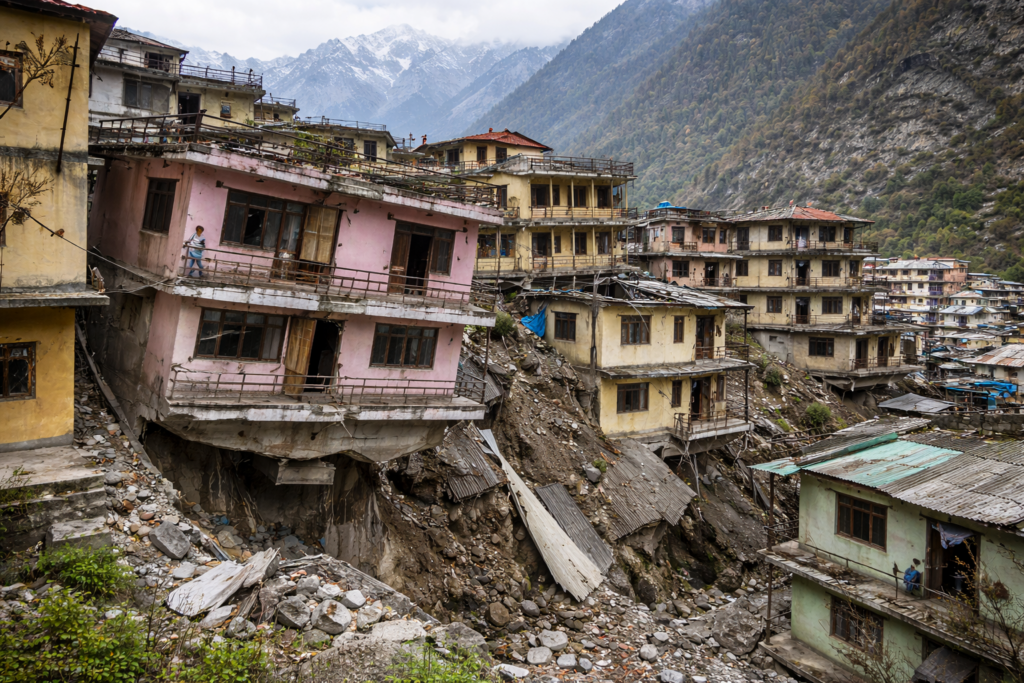
Joshimath is the best-known example. In early January 2023, cracks opened in houses and roads across the town in Chamoli district, and many families had to leave.
Here is the part that stings. A government committee had already looked at this town in 1976. It was headed by M.C. Mishra, then Commissioner of Garhwal. Its report said Joshimath does not sit on solid, in-place rock. The warning is nearly 50 years old.
The Indian Space Research Organisation’s remote sensing centre studied the sinking later. It found the ground dropped 8.9 cm between April and November 2022. Then it dropped 5.4 cm in just 13 days, from late December 2022 to early January 2023. That is a sharp jump.
To be fair, scientists have not agreed on one single cause. Joshimath sits on old landslide debris, and water, slope and rain all play a role. Some experts also point to tunnelling and unplanned building. The honest answer is that many pressures acted together, and a fragile town had very little room for error.
The lesson is simple. When a warning is written down and then ignored for decades, the failure belongs to planning, not to luck.
Warning Sign 4: Too Many Buildings, Too Little Planning
Tourism is the lifeline of many mountain towns. Hotels, homestays and cafés give jobs to young people who might otherwise leave for the cities. That matters a lot.
But many hill towns have grown with weak drainage, no clear zoning and buildings packed onto steep ground. Think of a Jenga tower. You can pull out one block, then another, and it still stands. Then one more block comes out and everything falls.
The Supreme Court mentioned this in the Himachal case. It listed tourism, multi-storey buildings, zoning, forest cover, roads, hydroelectric projects, mining and heavy machinery among the issues the state must answer. In plain words, the court asked the state to look at the whole picture, not one project at a time.
A year later, the case was handed to the Central Empowered Committee, a body that can ask for records, maps and satellite images, and do field visits. Good planning starts with good data, and the court seems to agree.
Warning Sign 5: Springs and Forests Are Quietly Disappearing
Not every damage makes headlines. Some of it is slow and silent. Hill villages depend on natural springs for drinking water, and many of those springs are drying up.
NITI Aayog, the government’s policy body, reported that about 30% of springs in the Indian Himalaya have dried up. The Wire reported this, linking it to land use change and soil erosion. When roads and buildings cover the ground, rain runs off quickly instead of seeping in and refilling the springs.
Forests work in the same way. Roots hold soil, leaves slow the rain, and the forest floor acts like a sponge. Cut the forest and you lose all three jobs at once.
“A mountain without its forest is a slope waiting for a monsoon.”
Warning Sign 6: The Courts Are Now Sounding the Alarm
When a country’s highest court uses the word “vanish”, it is time to listen. On 28 July 2025, the Supreme Court said that if things continue as they are, Himachal Pradesh may vanish in thin air from the map.
The court also said something every policymaker should note: revenue cannot be earned at the cost of environment and ecology. That is a direct message to every state that treats mountains only as a source of income.
In its response, the Himachal government admitted there were shortcomings in existing measures and asked for six months to prepare a roadmap. A minister also called the order a wake-up call and said development strategies must change.
Admitting a problem is the first step. The next steps are rules that are actually followed on the ground. Court orders, expert committees and state plans only matter if they change what gets built, where and how.
Warning Sign 7: Climate Change Makes Every Mistake Bigger
Here is the hardest truth. Even perfect planning would not make the Himalayas safe from climate change. But poor planning makes climate risk much worse.
The ICIMOD report says glaciers in this region could lose up to 80% of their ice by 2100 if temperatures keep rising. The same report calls the changes to snow, ice and permafrost unprecedented and largely irreversible. As ice melts, glacial lakes grow, and some can burst.
ICIMOD also warns that melting glaciers, loose slopes, unstable permafrost and erratic rain are raising the risks of floods, landslides and debris flows. A road or dam built without checking these risks is like a house built in a riverbed.
So the question changes. We cannot ask only, “Will this project work today?” We must ask, “Will it still be safe in 2050, in a hotter, wetter and more unstable mountain?”
The Money Question: What Does Growth Really Cost?
Today, the cost of a hill road is counted in rupees per kilometre. But the full bill also includes the landslide cleanup, the broken bridge, the lost crop, the rebuilt school and the displaced family. Those costs often fall on the public, years later.
Good management asks three questions. Is this project needed? Is this the right place? Have we counted the full cost? If any answer is “no” or “not sure”, the project needs another look.
What Real Mountain Communities Face
Picture a family in a hill village. The new road brought a bus, a clinic and a mobile tower. They are grateful for it. Then one monsoon night, the slope above the road gives way. The road is blocked for days, and the clinic cannot be reached.
This is an illustration, not one real family. But variations of it happen every monsoon across Uttarakhand, Himachal, Sikkim and Nepal. The people who suffer most are not the planners. They are farmers, drivers, shopkeepers, children and elders.
Mountain people are not against development. They want roads, power and jobs. What they ask for is development that does not put their homes at risk. That is a fair demand, and it deserves a fair hearing.
7 Fixes: What Science Based Development Looks Like
The good news is that solutions exist. Here is a practical checklist that planners, officials and citizens can use.
- Map the risk before drawing the road. Use geological surveys, satellite data and landslide maps first. Choose the route after that, not before.
- Respect carrying capacity. Every hill town can only hold so many buildings and vehicles. Set limits and enforce them.
- Cut slopes safely. Use proper slope angles, retaining walls and drainage. Never dump debris into rivers.
- Build smaller, smarter hydropower. Check glacial lake and flood risk. Keep tunnels and powerhouses away from debris paths.
- Protect forests and springs. Plant native trees. Revive springs. Treat them as water infrastructure.
- Listen to local people. Villagers know where water flows and where the ground moves. Their knowledge is free data.
- Be open with data. Publish environmental reports, monitoring results and monitoring gaps so that citizens can check the claims.
None of this is anti-growth. It is growth that lasts.
Comments from Nikhil Raj Sharma, Founder, Himalayan Geographic
The Himalayas do not need less development. They need smarter development. When I read the court’s warning and the new reports from Nepal, I see the same message: the mountain is telling us its limits. Roads, power and tourism matter for our people.
But they must be planned with geology, water and local knowledge in front of us, not behind us. Every hill family I know wants safety first. They want a road that stays open in the monsoon and a home that stays standing. Science already gives us tools to do this: risk maps, slope studies, early warning systems.
What we need now is the will to use them before the project, not after the disaster. At Himalayan Geographic, we will keep asking for open data, honest planning and the voice of mountain communities in every decision.
Final Say:
The Himalayas are not a limitless resource. They are a living system that supports crores of people, rivers, forests and farms. Every project changes that system a little. A hundred projects without planning can change it a lot.
The cost of growth is not a reason to stop building. It is a reason to build wisely, with science, local knowledge and honest accounting. The court’s warning, the Joshimath data and the 2026 Nepal floods all point the same way. We can still choose a better path, but the time to do it is now.
References and further reading:
- ICIMOD, HI-WISE report summary
- CNN on the 2023 ICIMOD report
- Associated Press, Nepal floods and hydropower (31 Aug 2026)
- CNN, “The Himalayas are unpredictable. But countries are building there like never before” (28 Aug 2026)
- Tribune India, Supreme Court on Himachal
- Bar & Bench via Moneylife
- SC Observer
- ORF Issue Brief, “Lessons from Joshimath”
- The Wire on the HKH Assessment and the NITI Aayog spring data
Disclaimer: The content and images published in this article are provided for general informational and educational purposes only. Some images may be generated or enhanced using artificial intelligence (AI) and are intended solely for illustrative use. The views, interpretations, and information expressed do not necessarily reflect the official position of Himachal Geographic Research Foundation, nor do they constitute professional, legal, medical, or financial advice.
While efforts are made to ensure accuracy, no guarantees are given regarding completeness or reliability. Readers are encouraged to independently verify information and use their own judgment. By reading this article, you acknowledge that any reliance on the content is at your own risk, and Himalayan Geographic Research Foundation assumes no responsibility or liability for disagreements, interpretations, or outcomes arising from its use. If you do not agree with these terms, you are advised to discontinue reading.