
Bhutan adventure tourism is booming in 2026, up 44% in a single year. See how trekking, mountain biking, and village homestays are funding forests, healthcare, and culture.
Bhutan adventure tourism just did something almost no other destination managed after the pandemic. In 2025, this tiny Himalayan kingdom welcomed 209,376 visitors, a jump of over 44% in a single year, while most countries in the world grew by only 4% to 12%Bhutan welcomed nearly 210,000 tourists in a year that saw an increase of over 44 percent compared to the previous year, with steady growth represented by visitors from 157 countries. It did this while charging tourists a mandatory $100-a-night government fee, banning solo backpacking, and refusing to build a single big airport.
That sounds like the opposite of a tourism strategy. It is actually the whole point.
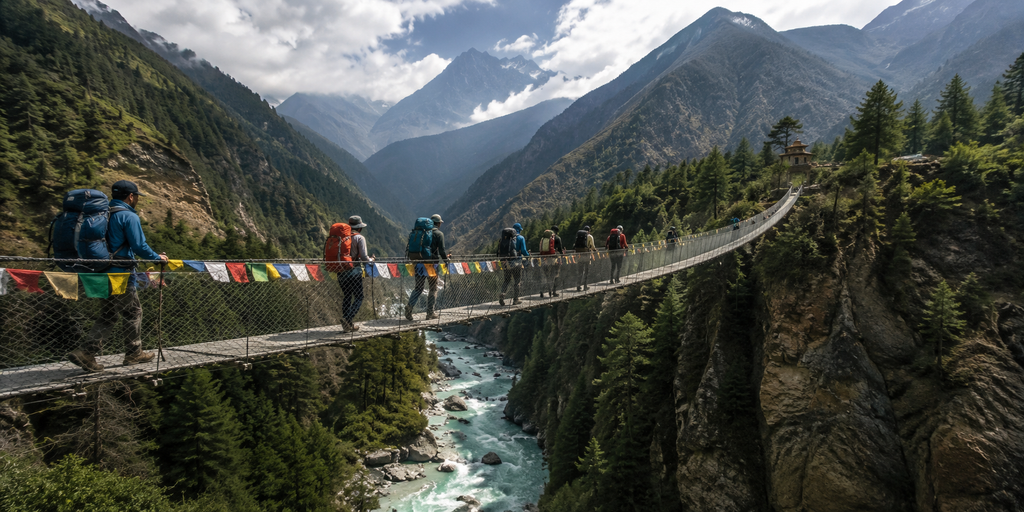
Bhutan is the only country on Earth that absorbs more carbon than it produces, and it has decided that tourism must earn its place inside that promise, not threaten itBhutan is already carbon negative, absorbing more carbon dioxide than it produces, and cleaning squads patrol its forests and mountain trails looking for litter left behind by tourists.
So instead of chasing crowds like Nepal or Thailand, it built an adventure model around one ancient trail, a growing mountain bike scene, and villages that would rather host you for a night than sell you a souvenir. If you have ever wondered what tourism looks like when a country treats its forests as more valuable than foreign exchange, Bhutan is the answer. Here is exactly how it works, and how you can be part of it responsibly.
Bhutan Adventure Tourism By The Numbers; A Quiet Boom Nobody Saw Coming
Before 2019, Bhutan was edging toward 300,000 annual visitors. COVID-19 nearly wiped that out overnight, and a steep fee hike afterward slowed the recovery further. But 2025 changed the story completely, with tourist numbers rising 44.33% year on year and government revenue from the Sustainable Development Fee climbing to $43.31 million, up 49% from the year beforeBhutan recorded a 44.3 percent rise in foreign tourist arrivals in 2025 and its sustainable development fee rose by over 49 percent, according to a review published by Bhutan Tourism.
What is even more telling is who is coming. Visitors from countries other than India now make up about 40% of all arrivals, up from just 27% before the pandemicVisitors from countries other than India accounted for around 40 percent of total arrivals, up from 27 percent in 2019. That shift matters. It means Bhutan’s slow, expensive, guide-only model is not scaring off the modern adventure traveller. It is attracting exactly the kind of visitor who wants fewer crowds, better trails, and a real connection to the place they are walking through.
- 209,376 tourist arrivals in 2025, a 44.33% jump over 2024
- $43.31 million collected through the Sustainable Development Fee alone
- Visitors now arrive from 157 different countries
- Roughly 40% of all tourists now come from outside India
The High-Value, Low-Volume Model
Every other country trying to fix overtourism is now studying Bhutan’s playbook, because Bhutan built it decades before overtourism was even a word people used. The policy is called “High Value, Low Volume,” and it rests on one simple idea: fewer tourists paying more is better for a fragile mountain ecosystem than millions of tourists paying less.
The tool that makes it work is the Sustainable Development Fee, a nightly government charge that every international tourist pays on top of hotels, food, and guides. It currently sits at $100 per person per night, locked in until 31 August 2027, after being cut in half from an earlier $200 rate to help the industry recoverThe Bhutan SDF Fee was raised to $200 per night in September 2022, but a 50% discount introduced in 2023 brought it down to $100 per night, a rate that remains in effect until 2027. Indian, Bangladeshi, and Maldivian nationals pay a much smaller regional rate.
This is not a hidden tax. Roughly a third of it funds free healthcare, free education, and environmental protection for Bhutanese citizens directlyAround 30% to 40% of the Sustainable Development Fee supports health, education, environmental protection, and cultural preservation in Bhutan. Every tourist who treks the hills above Thimphu or bikes down the Punakha valley is, quite literally, paying for a Bhutanese child’s school books.
The rule that makes this enforceable is simple: no licensed tour operator, no visa, no trek. Independent backpacking is not allowed for most nationalities, and every visitor needs a Bhutanese guide for their entire trip, including on the trekking trails themselvesBhutan requires all international tourists to book through a Tourism Council of Bhutan-licensed operator before a visa can be issued. It feels restrictive to first-time visitors, and it is exactly why Bhutan’s forests, trails, and villages have not been trampled the way so many other Himalayan destinations have.
Trans Bhutan Trail; 403 Kilometres Of Living History You Can Walk
If Bhutan’s adventure revolution has one flagship product, it is the Trans Bhutan Trail. This 403-kilometre footpath runs from Haa in the west to Trashigang in the east, crossing nine districts and 27 local villages along the wayThe Trans Bhutan Trail is a 403-kilometre east-west trail stretching from Haa to Trashigang, crossing 27 gewogs across nine dzongkhags. It dates back to the 16th century, when it was Bhutan’s only route for monks, traders, royal messengers, and pilgrims moving across the kingdom.
The trail fell apart after Bhutan built its first national highway in 1962, and it sat unused for almost sixty years. Then, starting in 2018, the government and the Bhutan Canada Foundation rebuilt it from scratch, restoring 18 major bridges and more than 10,000 stone steps, with nearly 900 workers furloughed during COVID-19 taking on the physical labour.
The project to restore the trail began in 2018, involving the restoration of 18 major bridges and more than 10,000 steps, with about 900 workers furloughed during the COVID-19 pandemic helping with the project. Prince Jigyel Ugyen Wangchuck formally reopened it to tourists on 28 September 2022, the same day Bhutan’s borders reopened after the pandemic.
Walking it in full takes about a month, but the trail is split into 28 manageable sections, so you can walk anything from a half-day loop near Thimphu to a two-week traverse through Punakha and the Phobjikha valley. Since 2025, a licensed local guide is compulsory on every section, which keeps the trail safe and keeps tourism money flowing directly into the communities it passes throughBhutan mandates hikers to have a guide as of 2025.
Trans Bhutan Trail: Quick Facts
- Length: 403 kilometres, from Haa in the west to Trashigang in the east
- History: dates to the 16th century as a royal, trade, and pilgrimage route
- Restoration: 18 bridges and 10,000+ steps rebuilt starting in 2018
- Sections: split into 28 walkable segments for flexible trip planning
- Wildlife: passes through habitats for red pandas, golden langurs, and the takin
- Guide rule: a licensed local guide is mandatory on every stretch
Trekking companies also run mountain bike descents on sections of this same trail, so you do not need to choose between walking history and riding it.
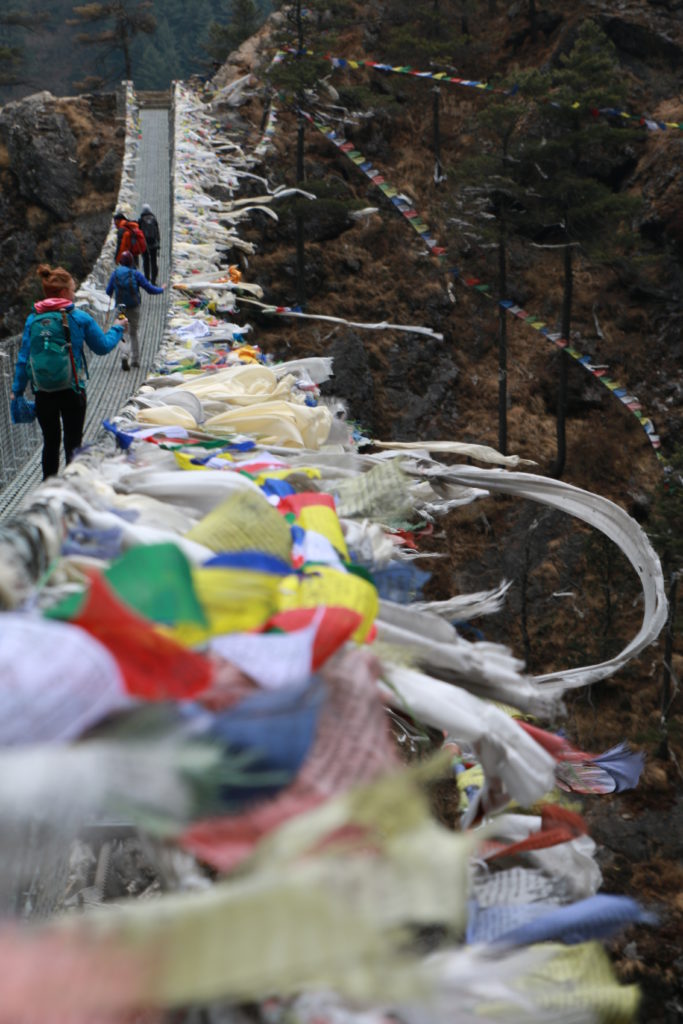
Mountain Biking Bhutan
Bhutan’s mountain biking scene has grown from a royal hobby into a genuine adventure sport industry in under a decade. The Tourism Council of Bhutan built three dedicated mountain bike trails in the hills above Thimphu between 2020 and 2021, giving both locals and visitors a formal riding network for the first timeIn 2020-21, the Tourism Council of Bhutan initiated the development of three mountain-biking trails in the hills above Thimphu city. Since then, trail-building communities have added routes around Punakha, Talo, and Limbukha, many of them descending straight off sections of the Trans Bhutan Trail itself.
The centrepiece event is the Tour of the Dragon, an ultra-marathon mountain bike race that starts in central Bhutan’s Bumthang valley and covers 268 kilometres over four mountain passes before finishing in Thimphu, usually held in early SeptemberHeld in early September, the annual “Tour of the Dragon” is categorised as an ultra-marathon mountain bike race, starting in Bumthang and travelling 268 km over four mountain passes before finishing in the capital Thimphu.
It is one of the toughest one-day mountain bike races anywhere in the world, and it has become a genuine point of national pride, with members of Bhutan’s royal family known to ride recreationally in the hills around the capital.
What makes Bhutan’s mountain biking scene stand out is who runs it. Most outfitters are small, rider-owned companies built by Bhutanese guides who also run local bike libraries to get young Bhutanese women and children onto trails for the first time. Riders end most days at a village homestay, not a hotel, sharing a meal with a family instead of a buffet line.
You can watch how these ancient trails now double as adventure sport terrain in this short BBC documentary on the Trans Bhutan Trail.
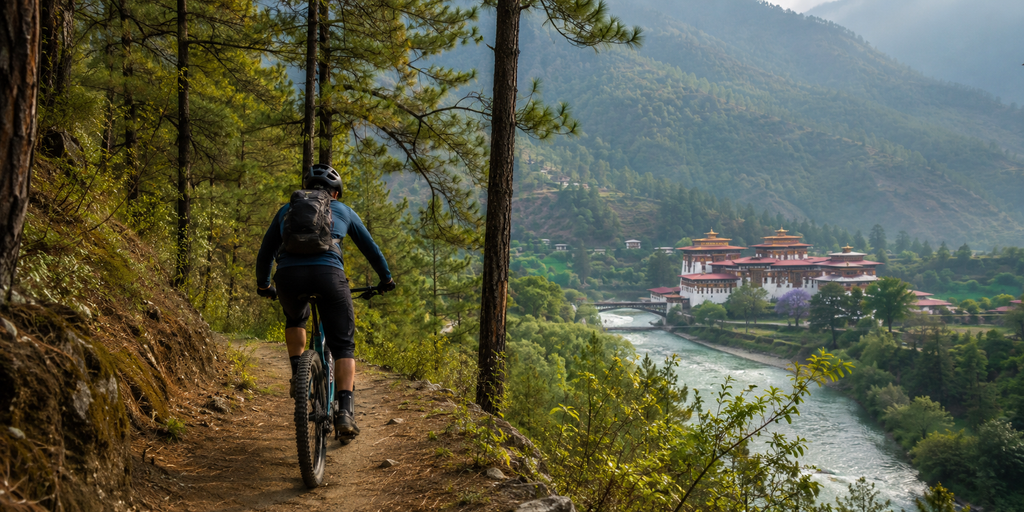
Community-Based Tourism; Sleeping In A Farmhouse, Not A Franchise
This is the part of Bhutan’s adventure story that rarely makes it into glossy brochures, and it is arguably the most important one. Bhutan has built an entire layer of tourism around homestays, where your nightly rate goes straight into a Bhutanese family’s pocket instead of a hotel chain’s balance sheet.
In the Phobjikha valley, home to the rare black-necked crane, the Royal Society for the Protection of Nature runs a community-based tourism project where visitors can hire bikes, join a hot stone bath, take a craft workshop, or simply stay the night in a village homeCommunity-Based Sustainable Tourism in Phobjika, run by the Royal Society for the Protection of Nature, offers a range of community-run activities including bike hire, hot stone baths, craft workshops, and overnight stays in village homes.
Further east, inside the Wangchuck Centennial National Park, twenty Alpine Organic Homestays now operate with support from park authorities and WWF, giving remote highland families a real alternative to herding alone for incomeThere are twenty homestays inside the Wangchuck Centennial National Park, where park authorities, WWF, and several organisations have worked together to support homestay hosts and attract visitors.
One Bhutanese host explains the philosophy behind it simply: guests are treated as strangers for the first day or two, then folded in as family for the rest of their stay, reviving an old Bhutanese custom of sheltering travellers on long journeys before hotels ever existedPeople used to travel long distances on foot, and since Bhutan had no inns or hotels, travellers would stay with other families on the way to their destination. That is not a marketing line. It is literally how Bhutanese villages functioned for centuries before the tourism industry existed at all.
Think of it as the opposite of an Airbnb “experience” add-on. There is no algorithm matching you to a host. There is a village, a family, and a guide who has known them for years.
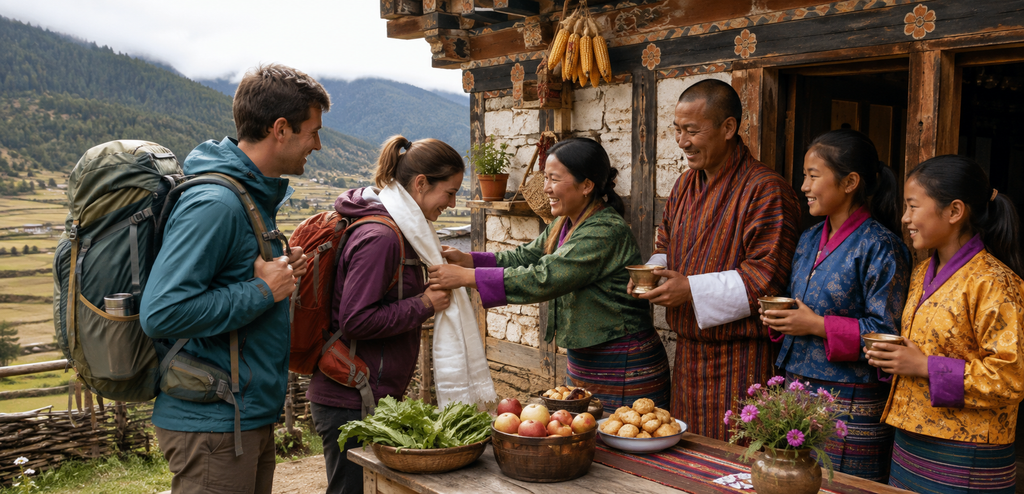
Trail Conservation And The World’s Only Carbon-Negative Adventure Playground
Bhutan’s constitution does something almost no other country’s founding law does: it locks in a minimum forest cover of 60% forever, and the country currently sits well above that, at roughly 70 to 72% forest coverBhutan today has a forest cover of 72 percent, of which over half falls under protected areas comprising 10 national parks and sanctuaries, and the Constitution of Bhutan mandates that 60 percent forest cover be maintained for all time.
That single legal clause is why hiking or biking through Bhutan feels genuinely different from doing the same activity almost anywhere else in the Himalayas. You are not walking through leftover wilderness. You are walking through land that is protected by law before it is ever protected by a park sign.
The country’s forests absorb far more carbon than Bhutan’s economy produces, roughly four to six times more by some estimates, making it the world’s only verified carbon-negative nationWhile the country emits around 1.5 million tons of carbon annually, its forests absorb over 6 million tonnes. Bhutan’s then-prime minister explained this commitment on the world stage in a widely watched talk, which you can watch here for the full national story.
Trail conservation is not left to chance either. Teams known as De-suups, or Guardians of Peace, patrol the Trans Bhutan Trail and forest areas, clearing litter, cutting fallen trees, and maintaining bridges as part of the same national programs that fund reforestation and clean-up drives across the country. This is what your Sustainable Development Fee is actually paying for on the ground.
The Snowman Trek
If the Trans Bhutan Trail is Bhutan’s welcome mat, the Snowman Trek is its final exam. Widely called the toughest trek on the planet, it crosses eleven Himalayan passes above 4,500 metres, spends most of its length above 4,000 metres, and takes 25 to 30 days to completeThe Snowman Trek in Bhutan is billed as the toughest trek in the world, crossing eleven mountain passes at altitudes of over 4,500 metres, with trekkers staying above 4,000 metres for most of the trek.
Its difficulty is not exaggerated for marketing. The trekking window is barely a few weeks each year, squeezed between melting monsoon snow and the first winter storms, and even fit, well-prepared trekkers have a completion rate of only around 50%The trek has a success rate of just fifty percent, and only a handful of trekkers attempt this challenging route each year. It was originally carved out by yak herders moving through the remote Lunana region, not by trekking companiesThe Snowman Trek is the longest hiking trail of Bhutan, extending through the high Bhutanese Himalayas and covering the northern part of the kingdom, and it was created by the yak herders of the country.
It is not a trek for a first Himalaya trip. But for experienced high-altitude trekkers, it represents the purest form of Bhutan’s adventure tourism model: remote, guided, low-impact, and completely unforgettable.
Comment From Nikhil Raj Sharma, Founder of Himalayan Geographic
Himalayan Geographic Research Foundation (HGRF) works across Nepal, Bhutan, and the Indian Himalayan region on community-led conservation and education, which makes it a natural voice on this topic. Their broader writing consistently pushes for tourism models that keep decision-making inside local communities rather than outside investors, which is very close to what Bhutan’s homestay and guide-mandatory system already does in practice.
Tourism in the Himalayas often forgets the people who live there year-round. Bhutan’s model flips that. When a trekking fee funds a village school or a homestay keeps a family from migrating to the city, that is conservation and community development working together, not tourism happening to a place.
Other Himalayan regions; parts of Nepal, Himachal, and Uttarakhand; are watching closely. The real test isn’t whether a destination looks unspoiled in photos. It’s whether the people who’ve lived there for generations still have a say in what happens next, and still see the benefit in their own hands.
Planning Your Bhutan Adventure Trip in 2026
Here is what you actually need to know before you book, based on the current 2026 rules.
- Sustainable Development Fee: $100 per adult per night, locked until 31 August 2027; children aged 6 to 12 pay half, under-6s go free
- Regional rate: Indian, Bangladeshi, and Maldivian nationals pay a much lower fee, currently around ₹1,200 per night for Indians
- Visa fee: a separate, one-time $40 charge for most other nationalities
- New GST: a 5% Goods and Services Tax now applies to hotels, guides, and transport, added from January 2026Effective January 1, 2026, Bhutan introduced a mandatory 5% Goods and Services Tax on all tourism-related services, including hotels, private guides, and transport
- Booking rule: you must book through a licensed Bhutanese tour operator; independent solo travel is not permitted for most nationalities
- Best season: March to May and September to November for clear skies and stable mountain passes
- Entry points: Paro International Airport for flights, or Phuentsholing for overland entry from India
If you are trekking the Trans Bhutan Trail, a 4 to 7 day western section is the easiest starting point. If you want the full mountain biking experience, base yourself around Thimphu and Punakha, where the trail network is most developed.
Why This Matters Beyond Bhutan
Everest Base Camp trekkers have spent years posting photos of queues on the summit ridge, and destinations from Venice to Bali are now openly fighting overtourism with entry caps and daily fees copied straight from Bhutan’s own playbook. Bhutan got there first, and it did it by accident of geography as much as policy, being small, mountainous, and late to build roads in the first place.
The lesson for the rest of the adventure travel world is uncomfortable but simple: sustainable tourism does not mean cheaper tourism. It often means fewer people paying more, staying longer, and putting real money into the hands of the communities they are walking through. Bhutan adventure tourism proves that model can actually grow, not shrink, once travellers understand what their money is funding.
Have you trekked in Bhutan, or are you planning your first trip in 2026? Share your experience in the comments below, we would love to hear which trail or valley stole your heart.
Disclaimer: The content and images published in this article are provided for general informational and educational purposes only. Some images may be generated or enhanced using artificial intelligence (AI) and are intended solely for illustrative use. The views, interpretations, and information expressed do not necessarily reflect the official position of Himalayan Geographic Research Foundation, nor do they constitute professional, legal, medical, or financial advice.
While efforts are made to ensure accuracy, no guarantees are given regarding completeness or reliability. Readers are encouraged to independently verify information and use their own judgment. By reading this article, you acknowledge that any reliance on the content is at your own risk, and Himalayan Geographic Research Foundation assumes no responsibility or liability for disagreements, interpretations, or outcomes arising from its use. If you do not agree with these terms, you are advised to discontinue reading.