
Himalayan education is failing mountain children. Here’s how schools in Himachal Pradesh, Uttarakhand, Sikkim, and Arunachal Pradesh must adapt to climate change, migration, and real mountain life.
Here is a fact that should stop you cold. Over 1,700 villages in Uttarakhand have been fully or partially abandoned in the last two decades. Young people left. Elders stayed behind. And in most cases, the schools those children attended never once taught them how to stay and thrive in the mountains they came from.
This is the quiet crisis of Himalayan education.
Across Himachal Pradesh, Uttarakhand, Sikkim, and Arunachal Pradesh, schools are facing a moment they cannot ignore. The old problems; distance, roads, buildings are still there. But newer, harder problems have arrived. Climate change is rewriting weather patterns. Springs are drying. Landslides are increasing. And the education system is still teaching children the same syllabus designed for a city child on the plains.
A mountain child deserves better. And honestly, so does the mountain.
THE PROBLEM NO ONE WANTS TO NAME
Let us say it plainly. The education model that runs in Himalayan schools was not built for Himalayan children. It was built for a standardised, urban, plains-based society. Children in Kinnaur or Tawang or Lachung open textbooks that talk about factories, metro cities, and coastal ecosystems. They rarely read about alpine meadows, glacial rivers, traditional water harvesting, or forest rights.
This is not just a curriculum problem. This is an identity problem.
When every lesson quietly tells a child that success lives far away from home, that child begins to believe it. Education, which should expand possibility, instead narrows it to a single direction out of the mountains, into the city. The Azim Premji Foundation, which has worked closely with mountain schools in Uttarakhand, has noted this gap repeatedly in its field reports. Children are learning to pass exams, not to understand the world they actually live in.
According to the ASER Report 2023, rural learning outcomes in hill states remain below national targets in foundational literacy and numeracy. Infrastructure and teacher shortages are real. But so is the deeper problem of relevance.
WHAT CLIMATE CHANGE IS DOING TO HIMALAYAN CLASSROOMS
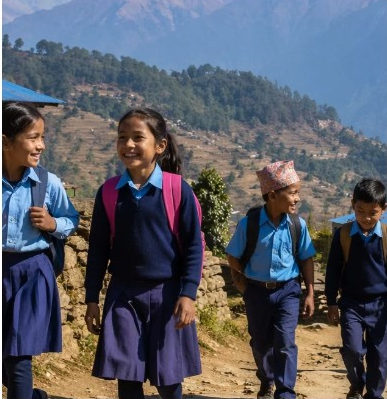
Here is something teachers on the ground already know. When a landslide blocks the road to school, children miss weeks of class. When a spring dries up, a family moves. When an erratic monsoon destroys a farm, a father migrates to Delhi for labour work, and a child’s stability disappears with him.
Climate change is not a future problem in the Himalayas. It is a present classroom reality.
The People’s Science Institute in Dehradun has been tracking the alarming decline of mountain springs through its Springs Atlas project. Their research shows that thousands of springs across Himachal Pradesh and Uttarakhand are drying up or becoming seasonal. These springs are the lifelines of villages. Yet most Himalayan school syllabi do not include a single lesson on watershed management or spring revival.
The ICIMOD (International Centre for Integrated Mountain Development), based in Kathmandu, has published extensive research linking education, climate resilience, and mountain livelihoods. Their findings are consistent: communities with stronger environmental literacy adapt better. Schools that teach local ecology produce young people who can contribute to local climate solutions.
This is not about making every student a forest ranger. It is about basic survival knowledge becoming part of basic education.
What Schools Could Teach Right Now
- How local rivers and springs work, and why they are shrinking
- Reading weather patterns using both science and traditional signs
- Landslide-prone zones and basic disaster preparedness
- Seed saving, organic farming, and soil health
- Community forest rights under the Forest Rights Act, 2006
- Watershed management and water conservation techniques
None of these require massive funding. Many of these can be taught using local experts, community elders, and the landscape itself.
SIKKIM’S QUIET EXAMPLE THAT EVERYONE SHOULD SEE
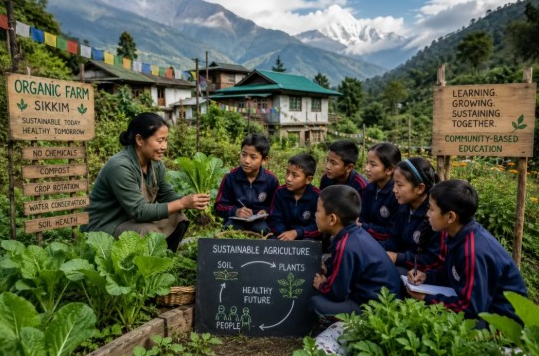
In 2016, Sikkim became India’s first fully organic state. This was not an accident. It was the result of years of policy, community effort, and a decision to treat the local environment as an asset rather than an obstacle.
What Sikkim shows is that mountain economies can innovate on their own terms. And education has begun catching up. Schools in Sikkim are increasingly incorporating discussions around biodiversity, sustainable agriculture, and ecological balance. The state’s relatively small size and strong government focus on sustainability have made this easier. But the lesson is scalable.
When children see that organic farming feeds families and earns market premiums, when they see that their forests have economic and ecological value, education starts connecting to real life. That connection is exactly what most Himalayan schools are missing.
ARUNACHAL PRADESH; WHERE INDIGENOUS KNOWLEDGE IS STILL WAITING AT THE SCHOOL GATE
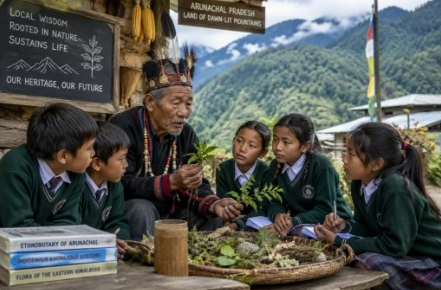
Arunachal Pradesh has over 26 major tribes and more than 100 dialects. It holds some of the most ecologically rich and culturally layered landscapes in all of Asia. Traditional knowledge systems among communities like the Adi, Nyishi, Galo, and Monpa carry centuries of understanding about forests, rivers, weather, and seasonal cycles.
This knowledge does not appear in the NCERT textbook.
Noam Chomsky has argued for decades that what gets excluded from formal education is always a political decision. Indigenous communities in Arunachal Pradesh are not lacking in wisdom. They are lacking in institutional recognition. Their elders can read a forest the way a meteorologist reads a satellite map. Yet schools treat that knowledge as irrelevant.
The National Education Policy 2020 does mention the importance of local languages and culture in early education. Implementation, however, remains uneven. In remote districts of Arunachal Pradesh, teacher vacancies, poor digital access, and language barriers continue to affect quality of learning. A 2022 report by the Ministry of Education noted that Arunachal Pradesh had some of the highest single-teacher school rates in the northeast.
The irony is painful. The children who most need contextualised, relevant education are the ones most underserved by the current system.
MIGRATION; THE PROBLEM THAT EDUCATION KEEPS FEEDING
“Padhai karo, shahar jao.” Study hard, go to the city. This is the advice most mountain children receive from their families. And who can blame the families? They have watched agriculture become harder. They have seen government jobs dry up. They have felt the economic pull of the plains.
But here is the uncomfortable truth. When education only produces outward migration, villages collapse. Schools close because there are no students. Temples fall apart because there are no caretakers. Traditional crafts disappear because no young hands learn them. The village becomes what Uttarakhand now tragically calls a “bhoot gaon”; a ghost village.
Max Weber would recognise this as a systemic failure of bureaucratic education. The system optimises for a measurable output pass rates, literacy numbers, employment data and ignores what it destroys in the process. Education is measured by how many children leave, not by how many communities survive.
The fix is not to tell children not to leave. The fix is to give them a reason and a skill set to stay if they choose to. Mountain-based livelihoods; eco-tourism, sustainable agriculture, traditional textile enterprise, digital work are viable. But they require education that prepares students for those paths, not only for call centres in Bengaluru.
TECHNOLOGY IS AN ANSWER, BUT NOT THE ONLY ONE
India’s DIKSHA platform (Digital Infrastructure for Knowledge Sharing) has provided digital learning content in multiple languages, including some regional languages of the northeast. E-Vidya, PM eVIDYA, and state-level digital initiatives have expanded in post-pandemic years.
But here is the honest limitation. A tablet with no internet signal is a paperweight. Many mountain schools still face 2G connectivity at best. Power cuts are common. Teacher training for digital tools is inconsistent. Technology helps when the basics are in place. Without the basics, it adds another layer of inequality.
The answer is investment, not just innovation. Mountain schools need dedicated budget lines, local hiring policies for teachers, solar power for uninterrupted electricity, and satellite internet where fibre is impossible.
WHAT A TRULY MOUNTAIN-SHAPED EDUCATION LOOKS LIKE
A mountain classroom that does learning by doing would look something like this:
- Students measure local spring water levels each month and map seasonal changes
- A school garden grows indigenous crops and students learn why those varieties matter
- Disaster preparedness drills are as regular as mathematics tests
- Community elders are invited as subject experts, not just as guests
- Students learn the economic logic of sustainable tourism, forest produce, and handloom
- Older students mentor younger ones in local language and folklore documentation
This is not replacing standard education. This is completing it.
Schools Already Moving in This Direction
Several schools under the Uttarakhand Board have begun incorporating climate and environment modules under the Green School Programme initiative. The Himalayan Environmental Studies and Conservation Organisation (HESCO), founded by Anil Prakash Joshi (Padma Bhushan 2021), has worked with mountain schools on environment integration for decades. His work is proof that change is possible, and it is happening.
In Himachal Pradesh, the State Council of Educational Research and Training (SCERT) has piloted activity-based learning modules in some tribal districts. These remain limited in scale but show early results.
Reference:
National Education Policy 2020, Government of India
ICIMOD Knowledge Portal; mountain education research
People’s Science Institute Springs Atlas
HESCO Dehradun
THE MOUNTAIN CHILD IS NOT A PROBLEM TO BE SOLVED
Let us end with this. A child growing up in Sangla Valley or Mon or Lachung or Ziro is not disadvantaged because they live in the mountains. They are sitting on one of the most resource-rich, culturally deep, ecologically vital landscapes on earth. Their disadvantage is the system that ignores all of that and hands them a textbook designed for a Mumbai suburb.
Education should build on what is already there. Mountains are not a problem. The curriculum is.
A mountain child should not have to abandon their mountains to succeed. The strongest Himalayan education system will be the one that teaches students how to protect, improve, and lead the communities they come from.
That is not a radical idea. That is just common sense. And high time it became common policy.
RELATED ARTICLES:
- “How Indigenous Knowledge Can Save the Himalayas“
- “Uttarakhand’s Ghost Villages: Who Is Responsible?“
- “NEP 2020 and Mountain Communities: Promise vs Reality“
- “Sikkim’s Organic Revolution: Lessons for India’s Hill States“
COMMENTS FROM NIKHIL RAJ SHARMA, FOUNDER, HIMALAYAN GEOGRAPHIC:
“Our children know the name of every planet in the solar system but cannot name the three rivers that flow through their own valley. That is not education. That is displacement in textbook form. Himalayan education must come home.”
“At Himalayan Geographic, we believe that documenting mountain ecosystems is not just scientific work; it is educational work. When a child sees their own landscape in a research report, something shifts inside them. They start to see themselves as protectors, not refugees. That is the shift our schools must create.”
Disclaimer: The content and images published in this article are provided for general informational and educational purposes only. Some images may be generated or enhanced using artificial intelligence (AI) and are intended solely for illustrative use. The views, interpretations, and information expressed do not necessarily reflect the official position of Himalayan Geographic Research Foundation, nor do they constitute professional, legal, medical, or financial advice.
While efforts are made to ensure accuracy, no guarantees are given regarding completeness or reliability. Readers are encouraged to independently verify information and use their own judgment. By reading this article, you acknowledge that any reliance on the content is at your own risk, and Himalayan Geographic Research Foundation assumes no responsibility or liability for disagreements, interpretations, or outcomes arising from its use. If you do not agree with these terms, you are advised to discontinue reading.