
How Pragya Dixit’s revolutionary sanitary waste management initiative is transforming women’s health and environmental protection across Uttarakhand’s Himalayan communities with 49 modified vehicles collecting 50kg daily.
In a municipal hall in Roorkee, officials and waste management professionals gathered with an urgent message. Sanitary waste cannot mix with regular garbage. But this conversation carries implications far beyond city walls, reaching into the heart of the Himalayas where one woman’s vision is rewriting the rules of waste management and women’s dignity.
The Mountain Crisis That Nobody Talks About
Twelve billion disposable sanitary napkins are generated every year in India, but in the Himalayas, every single one becomes a potential environmental disaster. Picture this: steep slopes where nothing stays hidden, crystal streams that carry everything downstream, and valleys so enclosed that burning plastic fills homes with toxic fumes for hours.
Over 6,200 kilograms of menstrual waste has been collected across Tehri district alone in just one year. That number tells only part of the story. Behind it lies a quiet revolution led by Pragya Dixit, an artist turned social activist who saw a problem everyone else ignored.
When Waste Becomes a Women’s Issue
Most commercial sanitary pads contain plastic materials that can take up to 800 years to break down into microplastics. In mountain communities, women face an impossible choice. Burn them and breathe toxic fumes. Mix them with household trash and contaminate water sources. Or wrap them in shame and hide them.
In Himachal Pradesh, women received instructions from landladies to burn sanitary pads in backyard pits because waste collectors refused to take them. The practice became routine. Dangerous. Humiliating.
One Foundation’s Bold Solution
Pragya Dixit didn’t start with grand plans. In 2020, during COVID-19 lockdowns, she began distributing sanitary pads in Uttarkashi. But access without disposal only moved the problem downstream. So she did something unprecedented.
Forty-nine municipal waste collection vehicles in Tehri district now carry separate compartments specifically designed for menstrual waste. This simple modification acknowledges a truth: in mountains where every stream becomes someone’s drinking water, waste segregation isn’t just policy. It’s survival.
The Numbers That Matter
Her foundation’s impact spreads across three districts: Uttarkashi, Rudraprayag, and Tehri Garhwal. Consider these milestones:
50 kilograms of menstrual waste collected daily across the region, preventing contamination of local water bodies and reducing pressure on already limited landfill space.
More than 30,000 women now have access to sanitary products, awareness sessions, and income opportunities through waste collection and community work.
Zero mixing of sanitary waste with household garbage in covered areas, protecting sanitation workers from unnecessary health risks.

Why Mountains Demand Different Solutions
The Roorkee workshop introduced four-way segregation at source: wet waste, dry waste, sanitary waste, and hazardous waste. In plains, this framework sounds technical. In mountains, it becomes essential.
Himalayan geography magnifies every mistake. Steep slopes mean contaminated water travels fast. Fragile soils absorb toxins deeply. Materials like polypropylene used in pads contaminate soil and water, breaking into microplastics that enter plants, animals, and humans.
When sanitary waste mixes with regular garbage in mountain communities, there’s no safe place for it to go. No distant landfill. No treatment plant. Just valleys, streams, and people.
Seven Innovations
Pragya Dixit’s work demonstrates practical wisdom. Here’s how her foundation bridges the gap between municipal policy and mountain reality:
Redesigned Collection Systems: Modified vehicles with dedicated compartments ensure separation from point of collection, protecting both workers and communities.
Economic Empowerment: Women’s self-help groups manage cloth pad production units, creating income while reducing waste generation.
Biodegradable Distribution: The foundation now provides biodegradable pads, addressing both access and disposal challenges simultaneously.
Community Training: Regular awareness sessions transform menstrual waste from a hidden shame to a managed public health concern.
Source Segregation: Color-coded bins and clear instructions help households separate waste before collection.
Livelihood Links: Waste collection creates dignified employment opportunities within communities that need them most.
Scalable Models: Solutions designed for mountain constraints can be adapted across similar geographies.
The Hidden Cost of Ignorance
Burning sanitary pads releases fine particulate matter carrying serious environmental and health risks. In enclosed valleys, these particles linger. Women and children inhale them daily. The practice causes respiratory problems, but alternatives remained unavailable until recently.
Remote Himalayan regions lack centralized waste systems, leaving women to manage disposal through whatever unsafe methods seem available. As one researcher noted, women transitioned from reusable cloth to disposable products without anyone planning for the waste burden.
When Cities Shape Mountain Solutions
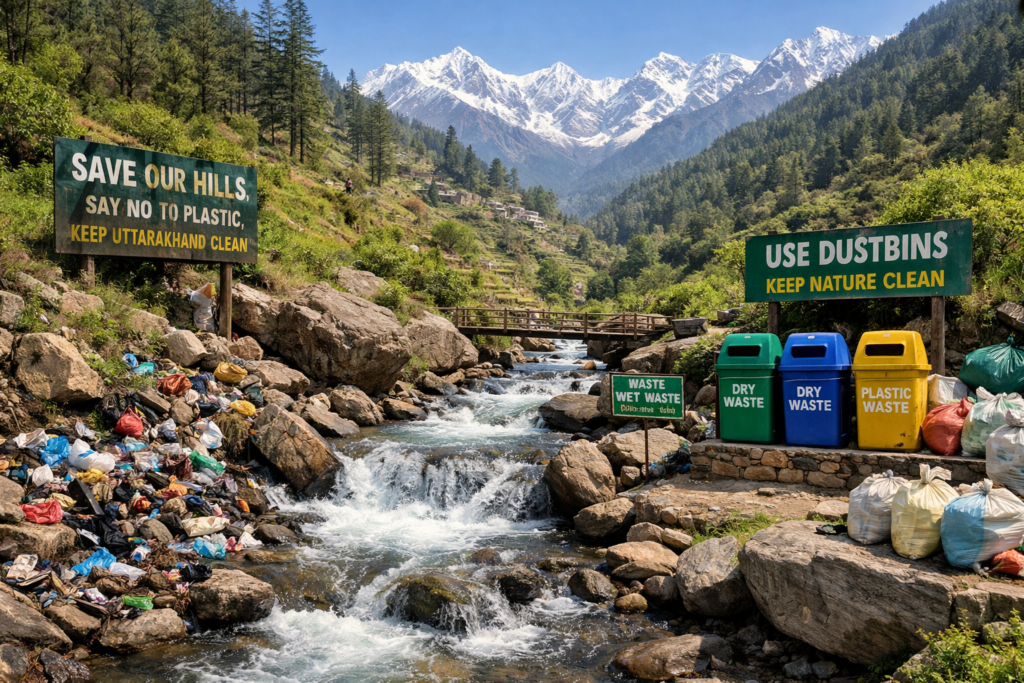
The Roorkee workshop matters because municipal thinking shapes policy and funding for hill towns. When a city acknowledges sanitary waste as a distinct category requiring dedicated handling, it strengthens the case for specialized systems in fragile regions.
Pragya Dixit’s mountain experiments now inform urban planning. Ideas travel both directions. Around 113,000 tonnes of menstrual waste ends up in Indian landfills annually, affecting urban and rural areas alike. Mountain solutions show what’s possible when geography demands innovation.
The Broader Implications
This work connects to fundamental rights. Access to menstrual products without safe disposal creates new problems. Poor menstrual hygiene management remains a stumbling block in fulfilling the right to education for girls.
Pragya Foundation officially established as a trust in January 2024, but its roots reach deeper into the pandemic’s lessons about systems failing women first. Founder Pragya Dixit brings unique perspective as both artist and activist, seeing waste management as part of cultural transformation.
Building Beyond Bins
The Pragya foundation’s expansion plans include production units where women manufacture reusable cloth pads. This approach recognizes that sustainable waste management must create local economic value, especially in regions where commercial products travel long distances and cost remains prohibitive.
In Ladakh’s extreme climate, menstrual cups offer solutions where cloth pads prove impractical due to water shortage. Different mountain contexts require different approaches. Pragya Dixit’s model adapts to local conditions rather than imposing one-size-fits-all solutions.
What Makes This Different
Traditional approaches treated menstrual waste management as either a municipal problem or a women’s health issue. Pragya Dixit’s innovation lies in recognizing it as both, plus an environmental concern, an economic opportunity, and a dignity issue.
Her vehicles don’t just collect waste. They carry a message: your health matters, your environment matters, your dignity matters. In communities where women historically managed menstruation in silence and shame, this visibility creates cultural shift.
Learning from Mountain Wisdom
Mountains teach constraint. Limited infrastructure. Difficult terrain. Fragile ecosystems. These challenges force precision in solutions. Himalayan communities cannot afford waste mixing because consequences appear immediately in contaminated springs and polluted streams.
Zero-waste initiatives in Darjeeling promote eco-friendly menstrual products, showing broader regional momentum toward sustainable practices. Multiple Himalayan regions now experiment with decentralized, community-driven approaches.

The Path Forward
Pragya Dixit speaks with quiet confidence about expansion. Biodegradable product distribution. More production units. Geographic reach into new districts. But she measures success differently: every woman who gains dignity, every stream remaining clean, every forest protected from avoidable contamination.
The foundation’s work demonstrates that transformative change often begins with addressing challenges others overlook. From Roorkee’s municipal discussions to modified waste vehicles climbing mountain roads, the message spreads: sanitary waste management isn’t an afterthought. It’s fundamental to environmental protection and women’s dignity.
Why This Matters Now
Disposable diapers and pads take hundreds of years to decompose because they contain plastics and synthetic polymers. New biodegradable alternatives emerge, but distribution and education remain critical. Mountain communities cannot wait for perfect solutions. They need practical systems that work today.
The Roorkee workshop, Pragya Dixit’s field work, and growing regional awareness create momentum. Municipal thinking aligns with mountain necessity. Policy frameworks support specialized handling. Women’s groups build economic independence through waste management.
Small Choices, Large Impact
In the Himalayas, sustainability begins with deliberate choices. Separating sanitary waste appears modest but carries profound implications. It acknowledges women’s needs. Protects environmental health. Creates dignified livelihoods. Preserves water quality for downstream communities.
This quiet transformation deserves documentation and replication. Not as charity or activism alone, but as intelligent adaptation to geographic reality. Mountains demand precision. Pragya Dixit delivers it, one modified vehicle at a time, one awareness session at a time, one woman’s dignity at a time.
The story from municipal hall to mountain village traces how ideas travel, adapt, and transform. Roorkee’s technical discussions find practical expression in Tehri’s waste collection systems. Urban policy supports mountain innovation. And at the center stands recognition that sanitary waste management protects both people and places.
What steps does your community take to manage sanitary waste? Share your experiences and ideas in the comments below.
Watch Related Content:
Read More:
- Pragya Foundation’s Complete Story
- The Hidden Menstrual Waste Crisis in the Hills
- Sanitary Waste Management Challenges
Comments from Nikhil Raj Sharma, Founder, Himalayan Geographic
“Pragya Dixit’s work represents the kind of grassroots innovation that truly transforms mountain communities. What strikes me most is how she’s turned a taboo subject into a practical environmental solution. The Himalayas have always taught us that sustainability isn’t about grand gestures but about understanding local constraints and working with them intelligently.
“The modified waste collection vehicles are brilliant in their simplicity. This is exactly what we need: solutions that acknowledge both women’s dignity and environmental fragility. Her integration of menstrual health, waste management, and livelihood creation shows how interconnected these issues are in mountain contexts.
“At Himalayan Geographic, we’re committed to documenting these quiet revolutions. Pragya’s story deserves attention not just as social work, but as a model for climate-adapted development in fragile ecosystems. When other regions face similar challenges, they’ll look to these mountain experiments for answers.”
Disclaimer: The content and images published in this article are provided for general informational and educational purposes only. Some images may be generated or enhanced using artificial intelligence (AI) and are intended solely for illustrative use. The views, interpretations, and information expressed do not necessarily reflect the official position of Himalayan Geographic Research Foundation, nor do they constitute professional, legal, medical, or financial advice.
While efforts are made to ensure accuracy, no guarantees are given regarding completeness or reliability. Readers are encouraged to independently verify information and use their own judgment. By reading this article, you acknowledge that any reliance on the content is at your own risk, and Himalayan Geographic Research Foundation assumes no responsibility or liability for disagreements, interpretations, or outcomes arising from its use. If you do not agree with these terms, you are advised to discontinue reading.
