
She was five years old when the Himalayas broke.
Not in the poetic sense; but literally, catastrophically, in the way that only mountains can: with roaring floodwaters, cascading boulders, and a fury that swallowed entire villages whole. It was June 2013, and the Kedarnath flash floods had descended on Uttarakhand like a sentence long overdue. More than a thousand people perished. Nearly one hundred thousand were evacuated. Temples that had stood for centuries vanished beneath silt and stone.
Little Ridhima Pandey sat in her home in Haldwani, about 330 kilometres from Kedarnath, watching it all unfold on television. She remembers the faces; the helplessness, the grief, the chaos. She remembers going to bed that night and dreaming of losing her own parents to the floods. Those nightmares would return, again and again, for years.
But somewhere between the fear and the silence, a question was forming in the mind of this Himalayan child: Why isn’t anyone stopping this?
A Valley That Teaches You Everything
To understand Ridhima, you first need to understand the land she comes from.
Uttarakhand; called Devbhoomi, the land of the gods; is a place where the sacred and the precarious coexist in breathtaking proximity. The Ganges begins her journey here, threading through gorges carved over millennia. Dense sal forests climb the foothills. Rhododendrons bloom crimson in spring. And yet, this same land has become one of the most climate-vulnerable regions in India; battered by erratic rainfall, accelerating glacial melt, cloudbursts, and landslides that seem to grow more frequent with every passing monsoon.
Ridhima was born on October 21, 2007, in Haridwar; the very city where the Ganges meets the plains, where pilgrims gather in their millions to seek purification from the river’s sacred waters. Her father, Dinesh Chandra Pandey, is a lawyer and wildlife conservationist who has spent sixteen years working to protect the natural heritage of this fragile state. Her mother, Vinita Pandey, works with the Uttarakhand Forest Department. The dinner table in the Pandey household was, in many ways, a classroom; one where children learned not just about ecosystems and endangered species, but about the moral weight of living in a place of such beauty and such vulnerability.
When the 2013 floods struck, Ridhima’s parents sat with her and explained, patiently, what was really happening — how decades of deforestation, unregulated construction in riverbeds, and unchecked carbon emissions were destabilising the very ground beneath their feet. The conversation that most parents would have shielded their child from became, for Ridhima, the seed of a life’s mission.
She began reading. Then researching. Then, at nine years old, she decided she had heard enough empty promises from the adults in charge.
The Nine-Year-Old Who Took the Government to Court
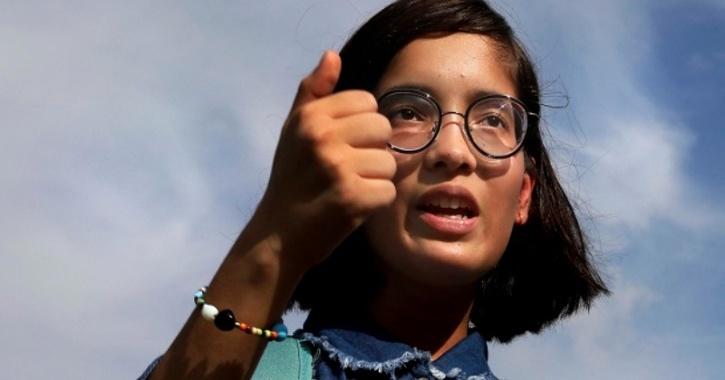
In March 2017, Ridhima Pandey walked into the National Green Tribunal of India and filed a petition against the Government of India. She was in the third grade.
The petition argued that the government’s failure to implement environmental laws and meaningfully address climate change was a direct violation of the constitutional right to life under Article 21 of the Indian Constitution. She wasn’t asking for sympathy. She was asking for accountability.
The petition was eventually dismissed on procedural grounds; but not before it sent shockwaves through India’s environmental legal community and thrust a nine-year-old girl from the Himalayan foothills onto the national stage. Critics scoffed. Supporters marvelled. And Ridhima, undeterred, prepared her next move.
Two years later, in 2019, she joined sixteen young climate activists from around the world; including Swedish activist Greta Thunberg; to file a complaint at the United Nations Committee on the Rights of the Child. The complaint named five of the world’s largest economies; Argentina, Brazil, France, Germany, and Turkey; for violating children’s rights through their inaction on the climate crisis. The message was simple and devastating: You are gambling with our future, and we are holding you responsible.
The international press took notice. The Christian Science Monitor profiled her as India’s answer to Greta Thunberg. The New York Times, The Guardian, NBC News, and Vogue featured her story. And in November 2020, the BBC named her among its 100 most inspiring and influential women in the world; making her, at thirteen, one of the youngest women ever to appear on the list.
Fighting for the Forests of Home
Global recognition can sometimes pull activists away from the ground beneath their feet. Not Ridhima.
Even as she addressed international forums in Paris, Madrid, and Oslo; even as she served on the Civil Society and Youth Advisory Council for COP26; she remained tethered to Uttarakhand with a fierce, almost territorial love. She had seen what happened when the mountains were taken for granted, and she was not about to let it happen quietly.
When the Uttarakhand government announced plans to fell over ten thousand trees in the Thano forest reserve near Dehradun to expand the city’s airport, Ridhima was among the voices who rose in protest. The Save Thano Forest movement became a rallying cry; not just for environmentalists, but for ordinary citizens who had grown tired of watching their green cover shrink in the name of development. For Ridhima, this wasn’t abstract. These were the trees that filtered the air over her city, anchored the soil on those steep hillsides, and sheltered the biodiversity that made Uttarakhand what it was.
She has also spoken out relentlessly about the pollution of the Ganges; a river that is not merely ecological infrastructure, but the spiritual lifeblood of millions who live along her banks. She wrote directly to Prime Minister Narendra Modi in September 2020, urging the government to take immediate and meaningful action on air pollution. She launched the “Clean Air for All” campaign on Earth Day 2020, inspired by the brief, haunting glimpse of clear skies over Delhi during the COVID-19 lockdown; proof, she argued, that clean air was not a luxury but a possibility being denied to millions.
After seven years of relentless legal effort, a milestone arrived: on her petition, the Supreme Court of India directed six ministries; including the Ministries of Power, Transport, and Renewable Energy; to address carbon emission challenges in a coordinated manner. It was a moment that Ridhima marked not with celebration, but with renewed resolve.
“After seven years of relentless efforts, my work is finally paying off,” she wrote. “This coordinated approach is vital for meaningful environmental progress.”
The Spark in Every Young Mind
Walk into any school in Uttarakhand where Ridhima has spoken, and you will find something hard to quantify but impossible to miss; a change in the air. Students who once thought climate change was something that happened somewhere else, to someone else, leave these sessions with a different understanding: that the floods that displace their neighbours, the forests that thin with every passing year, the rivers that run warmer and shallower; these are not natural disasters. They are the consequences of choices, and choices can be changed.
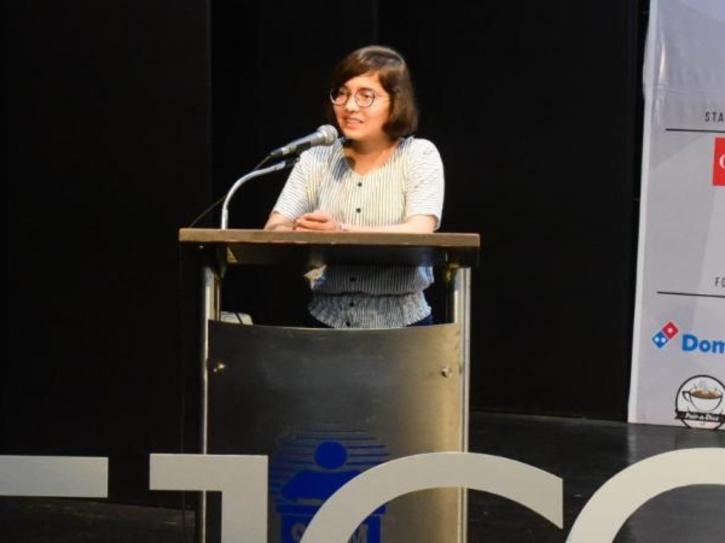
Ridhima actively engages with school and college students to raise awareness about climate change, child rights, and biodiversity conservation. She has spoken at international conferences, delivered TEDx talks, appeared in the international film The Letter, inspired by Pope Francis’s encyclical on the environment and featured in National Geographic’s Disney+ Hotstar series One For Change. She has been part of Earth Day Network’s global initiative, My Future My Voice, which amplifies the voices of fifty inspiring youth activists from seventeen countries.
She received the Mother Teresa Memorial Award for Social Justice in 2021. The Nickelodeon Kids’ Choice Award in 2023. The ELLE 100 Women Change Makers recognition. The 2025 ELLE Sustainability Award for Youth Climate Leader. Each award, she has said, is not a destination but a reminder of how far there is still to go.
Her goal now is expansive: to work with young people from indigenous Himalayan communities; giving them not just a platform, but the tools to become advocates for their own landscapes, their own futures.
A Himalayan Inheritance
There is a tradition in many Himalayan communities of speaking for the mountains when the mountains cannot speak for themselves. Ridhima Pandey is, in many ways, the latest in a long line of such voices; though she carries her message further than most, and louder.
She travels to the hills to visit her great-grandmother, who lives in a village where the rhythms of life are still governed by seasons, snowfall, and the generosity of the land. In those visits, one imagines, something essential is restored; a reminder of what is at stake, of who bears the heaviest cost when the glaciers retreat and the monsoons arrive wrong and the forests thin.
The girl who had nightmares about losing her family to the floods has, in the years since, transformed that fear into something extraordinary: a legal petition, an international complaint, a forest saved, a generation of young people awakened. She has stood before the United Nations, addressed climate summits on multiple continents, and taken on governments many times her size; all before finishing school.
But perhaps her most remarkable act is a quieter one. It happens in classrooms and community meetings, on the banks of rivers and in the shadow of mountains. It is the act of looking a young person in the eye and saying: your voice matters, your future matters, and it is not too late.
The Himalayas are ancient and indifferent to human lifetimes. But they are not indifferent to human choices. Ridhima Pandey knows this better than most. And she has dedicated her life to making sure the rest of the world knows it too.
“Real change begins on the ground. Through every awareness session and every conversation, I’ve seen the spark in young minds; a spark that can ignite global action.” — Ridhima Pandey
Disclaimer: The content and images published in this article are provided for general informational and educational purposes only. Some images may be generated or enhanced using artificial intelligence (AI) and are intended solely for illustrative use. The views, interpretations, and information expressed do not necessarily reflect the official position of Himalayan Geographic Research Foundation, nor do they constitute professional, legal, medical, or financial advice.
While efforts are made to ensure accuracy, no guarantees are given regarding completeness or reliability. Readers are encouraged to independently verify information and use their own judgment. By reading this article, you acknowledge that any reliance on the content is at your own risk, and Himalayan Geographic Research Foundation assumes no responsibility or liability for disagreements, interpretations, or outcomes arising from its use. If you do not agree with these terms, you are advised to discontinue reading.

One Response
Thiss article ofers cleear idea forr thee new users of blogging, that realoly howw too ddo bblogging andd site-building.