
Protecting the Himalayas during New Year celebrations is urgent. Discover how rising tourism, plastic pollution, and waste crisis threaten fragile mountain ecosystems and what you can do about it.
Protecting the Himalayas
Picture this: You’re standing at 4,000 meters, surrounded by snow-capped peaks that touch the sky. The air is crisp. The silence is sacred. Then you look down and see a bright red chip packet stuck between ancient rocks.
This isn’t fiction. This is the Himalayas today.
As we prepare to welcome 2026 with celebrations, adventure, and travel, the Himalayas are drowning in our waste. Over 71% of plastic waste collected in the Indian Himalayan Region is non-recyclable, and the problem is getting worse every single day. The question isn’t whether we should travel to these magnificent mountains. The question is: Will they survive our love?
When Tourism Becomes a Tsunami
December and January transform Himalayan destinations into bustling hubs. Nepal alone welcomed over 1.06 million international tourists in just the first eleven months of 2025. Pokhara’s Street Festival from December 28 to January 1 draws massive crowds. Shimla, Manali, Dharamshala, and countless other hill stations see visitor numbers skyrocket.
Everyone wants to ring in the New Year against a backdrop of mountains and snow. And why not? The Himalayas are breathtaking.
But here’s what nobody talks about during those Instagram-perfect moments: Each tourist consumes 150-200 liters of water daily compared to just 30-40 liters used by local residents. During peak season, 67% of Himalayan tourist destinations experience water rationing for local populations. Luxury hotels can use up to 500 liters per guest per day.
The celebrations leave behind more than memories. They leave behind mountains of trash.
Numbers That Should Shock You
Let’s talk facts. Hard, uncomfortable facts.
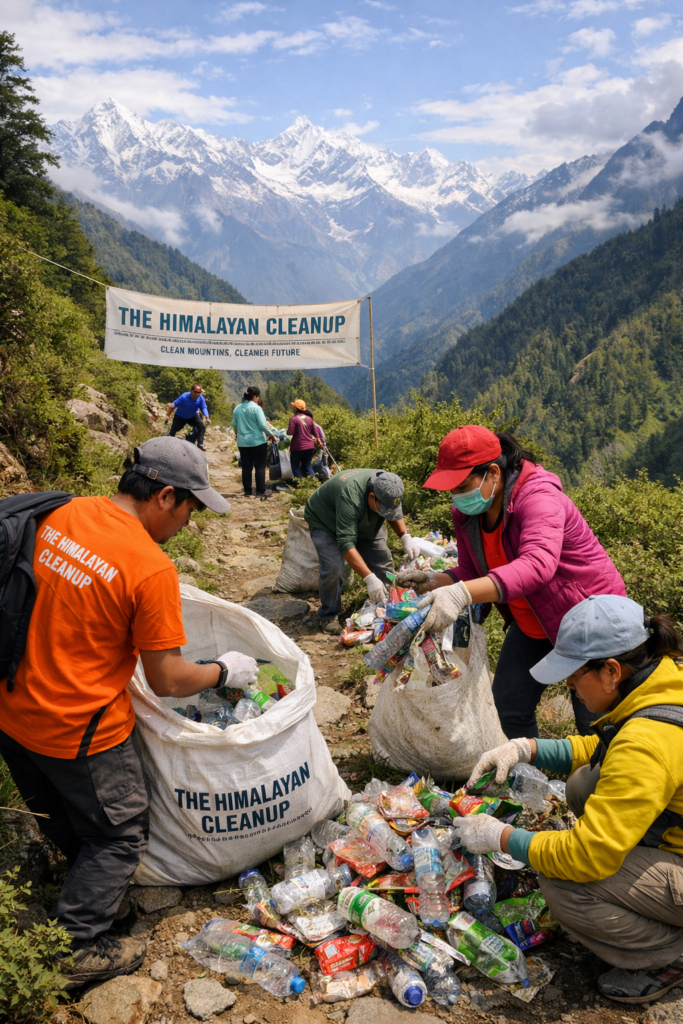
In 2024, The Himalayan Cleanup campaign collected 121,739 pieces of waste across nine mountain states. Of these, 106,857 were plastic. That’s 88% plastic waste. Even more alarming? Nearly 80% came from single-use food and beverage packaging.
Think about your last mountain trip. How many instant noodle packets did you eat? How many energy drinks? Those convenient plastic bottles, those snack wrappers, those disposable cups of chai? They all add up. And in the mountains, they don’t disappear.
Mount Everest accumulated over 50 tons of waste during the 2023 climbing season alone. The world’s highest peak has earned the heartbreaking nickname “the world’s highest garbage dump.” Microplastics have been detected in snow samples at elevations above 5,000 meters. In places where humans should barely be able to breathe, plastic thrives.
The reality is even grimmer in remote villages. Chitkul, the last village on the Indo-China border, accumulates 2 tonnes of non-recyclable trash annually. The pristine landscape is littered with Maggi wrappers, plastic bottles, beer cans, and layers of discarded plastic.
Why Plastic Pollution in Mountains Is Different
You might wonder: “Every place has waste problems. What makes mountains special?”
Everything.
Mountains aren’t like cities. They don’t have garbage trucks that come every morning. They don’t have recycling plants nearby. The terrain is brutal. Transportation is expensive. Collection is dangerous. And 85% of plastic waste in remote Himalayan areas remains completely uncollected.
Here’s something most people don’t know: Plastic moves only one way in the Himalayas – up. There’s no infrastructure to bring it back down. Once plastic reaches high altitudes, it stays there, breaking down into microplastics that contaminate snow, glaciers, rivers, and eventually, drinking water.
The Himalayan region feeds major river systems including the Indus, Ganges, and Brahmaputra. These rivers provide fresh water to 1.9 billion people. When we pollute mountain water sources, we’re not just harming local communities. We’re poisoning water that flows to millions downstream.
Research by the International Centre for Integrated Mountain Development found bacterial contamination from improper waste disposal in 72% of high-altitude water sources. Human waste from trekkers and climbers has contaminated water sources in 63% of popular trekking routes.
Mountains Are Sacred
For local communities, the Himalayas aren’t just tourist destinations. They’re home. They’re sacred. They’re ancestors and gods.
The word “Himalaya” means “abode of snow” in Sanskrit. These mountains are revered in Hinduism, Buddhism, and indigenous faiths. Pilgrims have walked these paths for thousands of years. Shepherds have grazed their flocks here for generations.
Now imagine being a local resident. Imagine watching tourists arrive, enjoy your sacred spaces, and leave garbage behind. Imagine picking up someone else’s plastic from your village stream. Imagine explaining to your children why outsiders treat your home like a dumping ground.
Ganita Devi, a community worker in Uttarakhand, makes a three-hour climb three times a week to collect waste from scattered households. She carries up to 35 kg of waste each time, even in bad weather. “We used to simply throw waste in the backyard,” she says. “Now we need to segregate and hand it over. The most challenging part is convincing villagers to change.”
This is the hidden cost of tourism: Local communities bearing the burden of waste they didn’t create.
The Wildlife Crisis Nobody Sees
Plastic pollution doesn’t just affect humans. It’s killing wildlife.
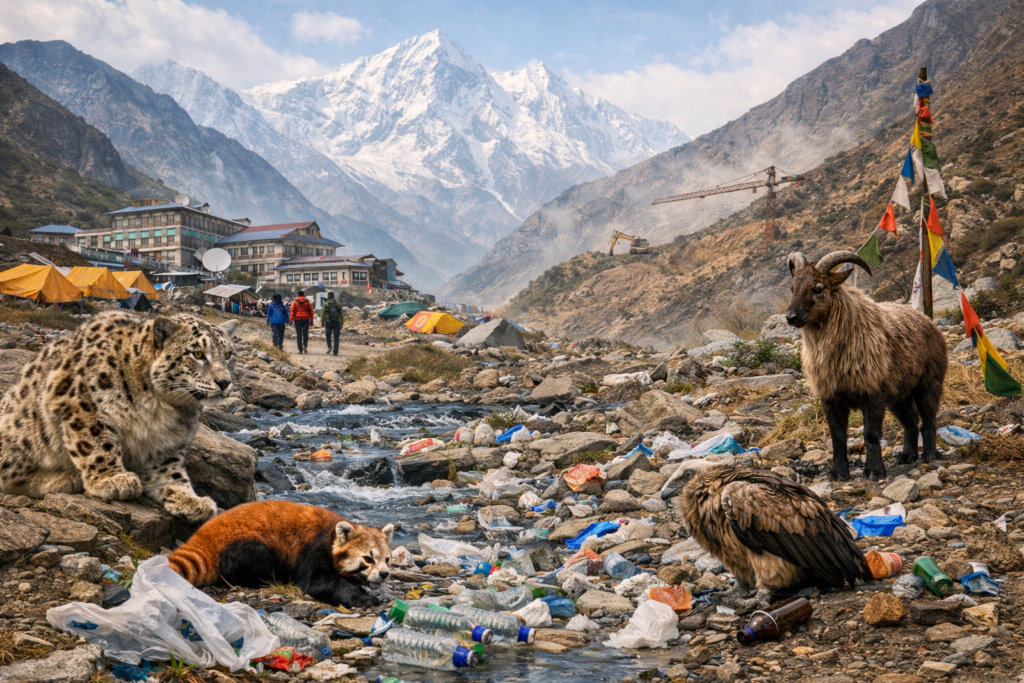
Snow leopard sightings near tourist areas have declined by 47% despite increased conservation efforts. Himalayan black bear populations have fragmented into isolated groups. Red panda habitat has contracted by 23% in regions with high tourism. In Assam’s Ramsar site at Deepor Beel, Greater Adjutant storks have been found eating plastic waste from landfills instead of fish.
Animals mistake plastic for food. They get entangled in discarded fishing lines and tent ropes. Microplastics accumulate in their bodies. Noise pollution from tourist activities disrupts mating calls of endangered pheasant species.
The mountains are losing their soul. And we’re the ones taking it away.
The Silent Killer
Walk into any mountain tea shop during tourist season. What do you see? Shelves stacked with instant noodles. Coolers filled with plastic water bottles. Packets of chips. Plastic-wrapped snacks.
These weren’t available in mountain villages two decades ago. Tourism brought them. And with them came the waste crisis.
Top polluting products identified by The Himalayan Cleanup include instant noodles like Maggi and Wai Wai, energy drinks like Sting and Mountain Dew, and snacks like Lays and Bingo. Multi-layered plastics from these products form nearly 68.5% of waste and are completely non-recyclable.
Here’s why this matters: Regular plastic bottles can theoretically be recycled. Multi-layered plastics cannot. They have no market value. Waste pickers won’t touch them. They end up in open pits, rivers, and roadsides. They blow away in mountain winds. They fragment into microplastics that persist for centuries.
And it’s not just food packaging. Personal care products, smoking materials, and packing materials contribute significantly. Every plastic toothbrush, every disposable razor, every cigarette wrapper adds to the crisis.
Running Dry While Tourists Flourish
In 2018, Shimla made international headlines when water shortages became so severe that the city implemented water distribution once every five days. Local residents queued for hours with buckets while many hotels continued advertising “24/7 running water” to tourists.
This isn’t an isolated incident. Groundwater depletion has caused 275 natural springs to dry up in the past two decades across the Himalayas. Tourism contributes directly to this crisis.
Think about it: Hotels need water for bathrooms, laundry, kitchens, swimming pools, and landscaping. Restaurants need water for cooking and cleaning. Tourists use water for showers, toilets, and washing clothes. All this while local communities struggle with basic water access.
In Manali, locals joke bitterly that tourists get water 24/7 while they get water once a week. This isn’t funny. It’s a humanitarian crisis fueled by unsustainable tourism.
How Pollution Affects Daily Mountain Life
People from plains and cities often don’t understand mountain challenges. Everything is harder here. Transportation costs more. Construction takes longer. Waste management is nearly impossible using conventional methods.
When waste accumulates, it doesn’t just look ugly. It has real, devastating consequences:
Open burning of plastic releases toxic fumes that cause respiratory problems, especially for children and elderly residents. Waste dumped near water sources contaminates drinking water with bacteria and chemicals. Animals that graze in polluted areas fall sick. Soil quality deteriorates, affecting agriculture. Tourism-dependent economies suffer when destinations become too polluted.
In many villages, waste is dumped near riverbanks deliberately so monsoon rains can wash it away. Out of sight, out of mind. Except it doesn’t disappear. It flows downstream, contaminating water for millions of people who depend on these rivers.
The New Year’s Eve Reality Check
New Year celebrations in the Himalayas have become mega events. Pokhara’s Street Festival attracts thousands. Dharamshala and Rishikesh host massive countdowns. Goa of the mountains, Kasol, turns into a party hub.
These celebrations generate massive waste spikes: Single-use plates, cups, and cutlery from street food vendors. Alcohol bottles and cans. Plastic decorations. Disposable party supplies. Abandoned camping equipment. Food waste from mass gatherings.
After the party ends, someone has to clean up. Usually, it’s local communities and environmental organizations. In 2024, The Himalayan Cleanup had 15,000 volunteers from 350 organizations participating across 450 locations. These are people who give their time, energy, and often money to undo the damage caused by irresponsible tourism.
Why should locals clean up after tourists? Why should environmental volunteers spend weeks removing trash that shouldn’t have been left behind in the first place?
The Long-Term Damage
Research published in scientific journals paints a grim picture. Microplastic pollution has been documented in Himalayan glaciers, rivers like the Ganga, Indus, Brahmaputra, Alaknanda, and Kosi, and even in high-altitude lakes.
Solar radiation in mountains is intense. It accelerates the breakdown of plastic into microplastics through UV-photooxidation. These microplastics then enter water systems, soil, and eventually food chains.
Studies show microplastics have been found in human tissues, including lungs and placenta. In mountain regions where people depend directly on natural water sources, the exposure is even higher.
Climate change makes everything worse. Melting glaciers release accumulated microplastics into rivers. Changing weather patterns make waste management more challenging. Extreme weather events wash waste from dumping sites into pristine areas.
The mountains are sending us a message. Are we listening?
When Responsible Tourism Works
Not everything is doom and gloom. Some initiatives show that change is possible.
Kedarnath’s Digital Refund System: This prominent pilgrimage destination in Uttarakhand implemented a structured plastic waste management system. Visitors pay a deposit for plastic bottles and get refunds when they return them. It incentivizes proper waste disposal.
Zero Waste Himalaya Alliance: Formed in April 2025, several organizations across the Indian Himalayan Region joined forces to tackle the reported 80% of single-use plastics from food and beverage packaging.
Green Road Initiative in Bhutan: This innovative project used 830 tonnes of plastics to construct 157 km of roads, replacing 780 tonnes of imported bitumen. It’s not perfect, but it’s a creative solution for non-recyclable plastics.
Community-Led Initiatives: Organizations like Waste Warriors and Healing Himalayas Foundation have established Material Recovery Facilities in remote regions. They employ locals, educate communities, and create sustainable waste management systems.
In Sikkim, Anantnag became the first urban local body to declare all its campuses green. Dharamshala introduced measures encouraging participation across businesses and neighborhoods. These examples prove that when communities, governments, and tourists work together, change happens.
The Role of Responsible Travelers
Here’s the truth: Tourism doesn’t have to be destructive. Responsible tourism can actually benefit mountain communities and ecosystems. But it requires conscious choices.
The “Leave No Trace” principle is simple: Take only photographs, leave only footprints. But in practice, it means much more.
Before You Travel: Research eco-friendly accommodations that practice water conservation and waste management. Pack reusable items: water bottles, coffee cups, shopping bags, cutlery. Choose accommodations that avoid single-use plastics. Plan meals to minimize packaged food dependence.
During Your Visit: Carry a personal waste bag and bring all non-biodegradable waste back to proper disposal facilities. Say no to single-use plastics even when offered. Use refill stations instead of buying bottled water. Eat at restaurants that use reusable dishes. Support local businesses that practice sustainability.
Cultural Respect: Learn about local customs and sacred sites. Ask permission before photographing people or religious places. Respect local dress codes and behavior norms. Understand that mountains are not just tourist playgrounds but homes and sacred spaces.
Spread Awareness: Share responsible tourism practices with fellow travelers. Call out littering when you see it. Support cleanup initiatives with donations or volunteering. Choose tour operators committed to environmental protection.
Every choice matters. Every bottle you don’t buy makes a difference. Every piece of trash you carry back helps. Tourism isn’t the enemy. Irresponsible tourism is.
What Governments and Tourism Operators Must Do
Individual responsibility is crucial, but systemic change requires policy action.
For Governments: Implement and enforce plastic bans with teeth, not just announcements. Create mountain-specific waste management policies recognizing unique challenges. Mandate Extended Producer Responsibility where manufacturers take responsibility for their product lifecycle. Invest in waste collection infrastructure for remote areas. Zone tourist areas to protect fragile ecosystems. Limit tourist numbers in ecologically sensitive zones.
For Tourism Operators: Provide only reusable or biodegradable alternatives to guests. Install proper waste segregation and treatment facilities. Educate staff and guests about responsible practices. Support local cleanup initiatives financially. Partner with environmental organizations. Make sustainability a core business value, not a marketing gimmick.
For Accommodation Providers: Eliminate single-use toiletries and plastic water bottles. Install water refill stations. Implement greywater recycling systems. Practice rainwater harvesting. Source locally to reduce packaging and transportation. Display clear waste segregation instructions in local and English.
The tourism industry makes billions from the Himalayas. It’s time to invest that money back into protecting these ecosystems.
The Knowledge Bridge
Scientific research organizations like the International Centre for Integrated Mountain Development, Himalayan Geographic Research Foundation, and various universities play a critical role.
They provide data that shapes policy. They develop sustainable tourism models. They monitor environmental changes. They train local communities. They connect international best practices with local realities.
Supporting research isn’t glamorous. It doesn’t make for great Instagram content. But it’s essential for long-term solutions. When you donate to environmental organizations, you’re funding the science that saves mountains.
This New Year, Choose Differently
As 2026 approaches, millions of travelers will head to the Himalayas. Some will be respectful and conscious. Others will leave behind a trail of waste.
Which type of traveler will you be?
Imagine if every tourist brought back just one piece of plastic they found. Imagine if every hotel eliminated single-use bottles. Imagine if every restaurant offered only reusable cutlery. Imagine if tour operators included cleanup as part of every trek.
The Himalayas don’t need saving from tourism. They need saving from irresponsible tourists.
This New Year, make a resolution that actually matters. Not about gym memberships or diet plans. Make a resolution to travel responsibly. To respect the mountains. To leave them better than you found them.
Share your experience below: Have you witnessed plastic pollution in the Himalayas? What steps do you take to travel responsibly? What changes would you like to see? Let’s start a conversation that leads to action.
Remember, these mountains give us water, beauty, adventure, and peace. The least we can do is give them respect.
Will you be part of the problem or part of the solution?
Useful Resources
YouTube Documentary: Watch The Himalayan Cleanup Campaign to see ground reality of waste management challenges.
Learn More: Visit The Himalayan Cleanup to understand how you can participate or donate.
Waste Warriors: Support community-led cleanup initiatives at Waste Warriors
Healing Himalayas Foundation: Donate to Material Recovery Facilities helping remote communities at Healing Himalayas
Comments from Nikhil Raj Sharma, Founder, Himalayan Geographic Research Foundation
“The waste crisis in our mountains isn’t just an environmental issue ; it’s a humanitarian crisis affecting millions who depend on Himalayan water sources. Every piece of plastic left behind tells a story of disrespect. As we document and research these ecosystems, we see firsthand how tourism can either save or destroy our mountains. The choice is ours.
At Himalayan Geographic, we believe in the power of awareness backed by action. Our research consistently shows that informed travelers make better choices. When people understand that their plastic bottle will remain in these mountains for 450 years, behavior changes. When they see how microplastics contaminate the water their children drink, choices shift.
This New Year, I urge every traveler: Come, celebrate, enjoy our beautiful mountains. But come with respect. Come with awareness. Come ready to be part of the solution. The Himalayas have sustained civilizations for millennia. Let’s ensure they sustain millions more for centuries to come.
Our organization is committed to producing research-based content that drives policy change and individual action. But research means nothing without implementation. That’s why we partner with communities, governments, and conscious travelers to create real, lasting change.
Related Articles
- The Complete Guide to Eco-Friendly Mountain Travel
- How Climate Change is Reshaping Himalayan Communities
- Traditional Himalayan Wisdom: Lessons in Sustainability
“Disclaimer: The content and images published in this article are provided for general informational and educational purposes only. Some images may be generated or enhanced using artificial intelligence (AI) and are intended solely for illustrative use. The views, interpretations, and information expressed do not necessarily reflect the official position of Himalayan Geographic Research Foundation, nor do they constitute professional, legal, medical, or financial advice.
While efforts are made to ensure accuracy, no guarantees are given regarding completeness or reliability. Readers are encouraged to independently verify information and use their own judgment. By reading this article, you acknowledge that any reliance on the content is at your own risk, and Himalayan Geographic Research Foundation assumes no responsibility or liability for disagreements, interpretations, or outcomes arising from its use. If you do not agree with these terms, you are advised to discontinue reading.”
