
The air in the far-western hills of Nepal carries a particular kind of silence; the kind that settles deep into your bones and teaches you, whether you want to learn or not, that the world is vast and that most of it will not come looking for you. Krishnaraj Prasad Khanal (K.P. Khanal) grew up breathing that air. And somewhere between the terraced hillsides of Achham district and the crackling static of a small-town radio station, he made a decision that would quietly alter the lives of hundreds, perhaps thousands; of people across the Himalayan nation.
He was thirteen years old.
The Boy K.P. Khanal, Who Refused to Look Away
A Voice Before a Vision
It didn’t begin with a foundation, a campaign, or a viral social media post. It began with a microphone.
When KP Khanal’s family migrated from Achham to Kailali in Nepal’s far-western Terai, he was just a boy adjusting to a new town, a new school, and the quiet vertigo of feeling out of place. But instead of retreating inward, he leaned toward something bigger. At thirteen, studying in Grade VII, he walked into Radio Namaste in Tikapur and launched Bal Bahas; a children’s debate program focused entirely on child rights. He hosted it, produced it, and kept it running for three years, interviewing community members and giving young voices a platform they hadn’t known they needed.
“That was when I started to seriously think about social work for the first time,” he would later recall.
It is worth pausing here to let that sink in. While most thirteen-year-olds are navigating the turbulence of early adolescence, Khanal was asking hard questions about child rights on air in rural Nepal. Not because someone told him to. Because he looked around, saw gaps, and decided; almost instinctively; that silence was not an option.
Dishwasher, Dreamer, Doer
After his Grade X exams, Khanal did something unexpected. He left for Mumbai and took a job as a dishwasher in a hotel. People told him he was unsuited for it. He disagreed. “I enjoyed it and it was a wonderful learning experience,” he later said; and you believe him, because the thread running through every chapter of his life is a refusal to let humility curdle into shame.
He returned to Nepal, enrolled in Grade XI, and almost immediately launched his first cleanliness campaign in his neighborhood; gathering friends, picking up trash, asking people not to tether cattle in the road. It was unglamorous work. It was exactly the kind of work that changes places over time.
Then came Dasha Lageka Lai Dashain; his first experiment with the idea that social media could be more than noise. As Nepal prepared for Dashain, its most beloved festival, Khanal turned to Facebook with a simple, earnest plea: donate what you might otherwise spend on cards or entertainment, and help feed those who have nothing to celebrate. The response stunned him.
He raised approximately Rs. 250,000; far more than he had imagined; and used it to support around 50 families with food, groceries, and stationery. Something unlocked in him that season. Not just the power of generosity, but the architecture of it: how you build trust, how you share numbers openly, how you make people feel that their small contribution matters.
Into the Mountains, Into the Need
Nepal is a country of breathtaking contrasts. Its peaks are among the highest on earth; its valleys, among the most isolated. The Himalayan regions; Humla, Bajura, Achham, and dozens of districts like them — are places where tragedy can unfold in anonymity, where a family’s loss might never make it past the nearest ridge.
Khanal heard about one such tragedy: people from Humla who had been travelling to Bajura in search of salt and rice had died in accidents along the way. He did not file it away as someone else’s problem. He raised Rs. 300,000, traveled to Humla with his friends, and delivered food and groceries to 20 families who had been left to grieve quietly in the mountains.
Then came the orphans of Bajura; children with no shelter, no safety, no certain future. Khanal’s response was not a social media post expressing sorrow. It was a plan. His team launched a transparent crowdfunding campaign, publicly listing every donor’s name and contribution. They raised approximately Rs. 500,000; enough to build three buildings, each with four rooms, designed to give those children a home.
In a country where aid can sometimes feel distant and abstract, this kind of radical transparency was quietly revolutionary. It said: your money went here, to this child, into these walls.
Clean Kasthamandap
By the time Khanal arrived in Kathmandu at seventeen to study social work at Texas International College, he carried with him a way of seeing urban spaces that those born into them sometimes lose; as places that belong to everyone, and therefore are everyone’s responsibility.
He launched “Clean Kasthamandap,” a campaign to address the mounting waste crisis in one of South Asia’s most storied cities. Kathmandu, home to UNESCO World Heritage Sites and ancient temples, had become a city choking on its own refuse. Khanal mobilized over 1,700 volunteers for cleanup drives along key urban corridors. His slogan; Ma Badlinxu Ani Mero Desh Badlinchha, “After I change, my country changes”; became a quiet anthem for a generation of young Nepalis who were tired of waiting for someone else to go first.
The Maina Devi Foundation, formally registered on January 11, 2020; his birthday; became the institutional backbone of this vision. Named with quiet devotion, it now operates with a network of over one lakh volunteers across Nepal, running programs in environmental sustainability, child education, women’s empowerment, health, and the welfare of marginalized communities. The Foundation has grown to include the Cleanup Premier League, a college competition that turns waste management into civic pride, and the Kathmandu Trash Collection Race, a 6-kilometer run where participants collect garbage as they go; transforming environmental action into something joyful and communal.
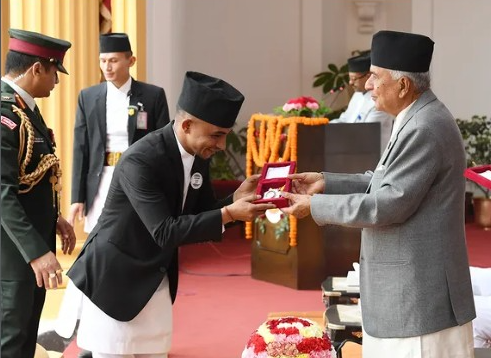
Honored with the National Youth Lead Award by the National Youth Council in 2019, the Youth Icon Award in New Delhi in 2020, and most recently named Best Youth Activist at the Galaxy Excellence Awards in 2024, Khanal has earned formal recognition. But the recognition that seems to matter most to him is simpler: the sight of a cleaner road, a fed family, a child with a roof.
Good Karma and the Long Game
Khanal speaks often about karma; not as a passive concept, but as an active one. He believes that genuine desire to help society summons support from the universe itself. His life, thus far, has done little to challenge that belief. A boy from Achham who started with a microphone now leads one of Nepal’s most visible youth-driven NGOs, with nearly 800,000 followers on Facebook alone watching him do the work in real time.
But what is perhaps most striking about KP Khanal is not the scale of what he has built. It is the texture of how he built it; one campaign at a time, one donation acknowledged by name, one village reached on foot, one orphan given a room with a door that locks. In the Himalayas, where the terrain itself teaches you that nothing worth having comes without effort, he has absorbed that lesson completely.
He is, at the time of this writing, still a young man. The story is not finished. The mountains are still waiting. The rivers still carry plastic. The children in Bajura still need advocates who will not look away.
And KP Khanal shows no signs of looking away.
“If you genuinely desire to benefit society,” he has said, “the universe will support your efforts.”
In his case, so far, it has.
Follow K.P. Khanal on social media www.instagram.com/kepikhanal1 | Maina Devi Foundation: mainadevifoundation.org
Disclaimer: The content and images published in this article are provided for general informational and educational purposes only. Some images may be generated or enhanced using artificial intelligence (AI) and are intended solely for illustrative use. The views, interpretations, and information expressed do not necessarily reflect the official position of Himalayan Geographic Research Foundation, nor do they constitute professional, legal, medical, or financial advice.
While efforts are made to ensure accuracy, no guarantees are given regarding completeness or reliability. Readers are encouraged to independently verify information and use their own judgment. By reading this article, you acknowledge that any reliance on the content is at your own risk, and Himalayan Geographic Research Foundation assumes no responsibility or liability for disagreements, interpretations, or outcomes arising from its use. If you do not agree with these terms, you are advised to discontinue reading.
