
Himalayan snowfall decline reaches alarming 23-year low in 2026. Discover why snow is disappearing from the roof of Asia and what it means for 2 billion people downstream.
Imagine planning a winter trip to Shimla or Auli, expecting white peaks and snowy slopes, only to find bare brown hills staring back at you. That’s not a future scenario anymore. It’s happening right now across the Himalayas, and what you’re witnessing isn’t just disappointing weather; it’s infrastructure collapse in slow motion.
Snow persistence across the Hindu Kush-Himalaya region dropped to a concerning 23.6% below normal in 2025, marking the lowest level in 23 years. To put that in perspective, if snowfall was normally around 80%, it plummeted to just 61% this winter. For millions who depend on Himalayan snow, this isn’t about missed ski trips. It’s about survival.
Snow in the Himalayas isn’t weather. It’s infrastructure. It’s the region’s water tower, agriculture lifeline, and disaster buffer rolled into one frozen blanket.
When the Mountains Go Naked
Drive up to Uttarakhand this January and you’ll see something that should alarm you. Mountains that should glow white under winter sunlight remain dark, exposed, almost naked. Uttarakhand recorded no rainfall at all in January 2025, while Himachal Pradesh faced a shocking 90% precipitation deficit and Jammu and Kashmir saw 96% below-normal winter precipitation.
These aren’t just numbers on a weather report. They represent fields dying, rivers shrinking, and communities watching their futures evaporate.
Winter rainfall in Uttarakhand dropped from 182 mm in 2021 to just 12 mm in 2024 and 4 mm in 2025. That’s not a decline; that’s a freefall. Scientists at the India Meteorological Department confirm what mountain communities already know: snowfall that used to begin in late December now often delays until February, a shift of 30 to 40 days resulting in an estimated 70% reduction in overall snowfall.
The Science Behind the Silence
What’s killing Himalayan snow? The answer lies thousands of kilometers away, in warming oceans and changing atmospheric patterns.
Western Disturbances are the heroes of Himalayan winters. These low-pressure weather systems originate over the Mediterranean Sea, Black Sea, and Caspian Sea, traveling eastward while gathering moisture. When they collide with the Himalayas, they rise, cool, and dump that moisture as snow; or at least, they used to.
Research shows a 43% decline in Western Disturbances in north India between 1980 and 2019. Fewer disturbances mean less snow. It’s that simple and that devastating.
Climate change has disrupted this ancient pattern. Rising global temperatures, erratic El Niño-Southern Oscillation patterns, and weakened La Niña events are all contributing to the crisis. The IPCC’s reports confirm what scientists on the ground already observe: low-elevation snow cover is declining across the Himalayas, and what little snow does fall melts faster than ever before.
Snow Drought
Scientists have coined a term for what we’re witnessing: snow drought. It’s when winters repeatedly bring far less snow than mountains normally receive. This is now the third consecutive year of significant snow deficits, and four of the past five winters have recorded below-average snowfall.
Think about that. The exception has become the rule. Below-normal snow is now normal.
What does a snow drought look like on the ground? In villages across Himachal Pradesh, apple farmers are panicking. Snow isn’t just pretty scenery for them; it provides essential chilling hours for apple trees, maintains soil moisture, and controls pests naturally. Without it, their entire livelihood crumbles.
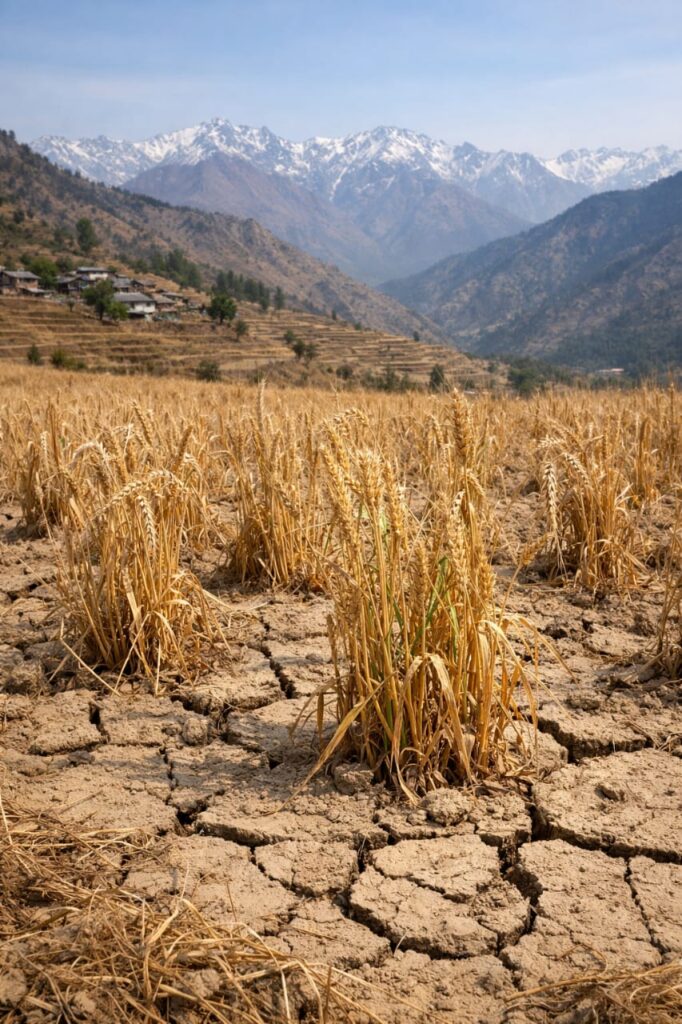
Preliminary assessments indicate crop losses of 15 to 20% in districts including Chamoli, Tehri, and Bageshwar. Wheat crops have suffered around 15% damage so far, and experts warn losses will increase if precipitation doesn’t arrive soon.
The Water Tower Is Running Dry
Here’s the terrifying math: nearly two billion people across Asia depend on rivers fed by Himalayan snow and glaciers. The Indus, Ganges, Brahmaputra, Yangtze, Mekong, and Salween all originate in these mountains. Snowmelt contributes about one-quarter of annual runoff for these river basins.
Now, some basins like the Mekong and Salween are losing over 50% of snow cover. The Ganges Basin, which sustains hundreds of millions, recorded its lowest snow persistence at -24.1% in 2025. The Brahmaputra Basin dropped to -27.9% snow persistence in 2025.
Every percentage point matters. Each represents millions of liters of water that won’t be there when farmers need it most, when cities turn on their taps, when hydropower turbines need to spin.
Less Snow + Faster Glacier Melt
If declining snowfall wasn’t bad enough, Himalayan glaciers are melting at unprecedented rates. This creates a dangerous double threat.
Glaciologist Manish Mehta warns that lack of snow accumulation could push glacier mass balance in Uttarakhand into negative territory, meaning glaciers lose more ice than they gain. Without fresh snow to replenish them, glaciers are essentially dying of thirst.
Research shows Himalayan glacier area has shrunk by 40% since the Little Ice Age maximum. Even the Karakoram range, where glaciers had been stable for decades, is now showing signs of accelerated melting. Scientists project that at least one-third, and potentially two-thirds, of the region’s glaciers could vanish by the end of this century.
Initially, glacier melt increases river flow. But that’s a temporary boost; borrowed water from a savings account that’s rapidly depleting. Once glaciers shrink significantly, dry-season water availability plummets. We’re spending our water inheritance recklessly, and our children will inherit the debt.
When Mountains Lose Their Glue
Here’s something most people don’t realize: snow and ice act as natural cement holding mountains together. As they disappear, mountain stability weakens dramatically.
The changing pattern of Western Disturbances and decline in snowfall has direct implications for climate-induced disasters like Glacial Lake Outburst Floods. GLOFs occur when lakes formed by melting glaciers suddenly burst through weakened ice or rock dams, sending devastating flash floods downstream.
Reduced snow also means increased risk of landslides, rockfalls, and avalanches. Forest fire risk skyrockets during summer months when forests remain dry and vulnerable. The same mountains that once protected communities now threaten them.
Local Eyes See What Satellites Confirm
Talk to anyone who’s lived in the Himalayas for decades and they’ll tell you winter isn’t what it used to be. Elders remember snow arriving reliably in early December, staying through February, sometimes into March. Children built snowmen, farmers welcomed the moisture, and the rhythm of seasons felt predictable.
Now? Uncertainty rules. Will it snow this year? When? How much? Nobody knows anymore.
Glaciologists like Dr. Manish Mehta note patterns like snowfall arriving late, melting faster, and being less reliable, even in traditionally snow-rich regions. A recent Nature publication documented a rising number of snow drought events across Himalayan river basins, confirming the decline isn’t imaginary; it’s measurable, mappable, and worsening.
The International Centre for Integrated Mountain Development monitors snow across the entire Hindu Kush Himalaya region using satellite data. Their 23-year time series reveals recurrent seasonal deficits coupled with severe yearly fluctuations. The pattern is unmistakable.
From Peaks to Plains
The crisis doesn’t stay in the mountains. States in north India like Punjab, Haryana, and Uttar Pradesh reported large deficient winter rainfall; minus 80%, minus 86%, and minus 99% respectively.
Winter rains provide gentle, consistent moisture during wheat’s critical germination and vegetative growth phase. Without it, India’s breadbasket struggles. Food prices rise. Imports increase. Food security weakens.
Hydropower generation suffers too. Dams across the region depend on steady water flow from snowmelt. Less snow means less reliable electricity, affecting everything from hospitals to factories to homes.
Tourism, a major economic driver for Himalayan states, takes a hit. Ski resorts operate shorter seasons. Trekkers find barren trails instead of winter wonderlands. Local economies dependent on mountain tourism face existential questions about their future.
What the Experts Are Saying
Pema Gyamtsho, Director General of ICIMOD, doesn’t mince words: “Carbon emissions have already locked in recurrent snow anomalies. We need a paradigm shift in water governance and climate adaptation.”
The urgency in his statement reflects what scientists across the region understand: we’re not facing a problem we can reverse quickly. The carbon already in the atmosphere guarantees continued warming and snow decline for decades, even if we stopped all emissions tomorrow.
The UN Office for Disaster Risk Reduction and ICIMOD urge immediate action: regional cooperation, science-led water policy, seasonal water storage, and efficient meltwater use. Without urgent intervention, climate-induced disruptions could ignite widespread socio-political instability across the Indo-Pacific region.
Kieran Hunt, principal research fellow in tropical meteorology at the University of Reading, analyzed four major climate datasets from 1980 to 2021 and found consistent precipitation decline across the region. His conclusion? This isn’t a temporary blip; it’s the new reality.
Finding Hope in Action
Despite the grim outlook, solutions exist. They require political will, community engagement, and immediate action.
Water management must evolve. Communities need to capture and store monsoon water more efficiently. Artificial glacier projects in Ladakh show promise; creating ice stupas that store winter water for spring use. Traditional water harvesting systems deserve revival and expansion.
Agriculture needs adaptation. Farmers must shift to crop varieties that require less water and tolerate temperature fluctuations. Drip irrigation and precision agriculture can stretch limited water further.
Forests need protection. Healthy forests act as natural sponges, retaining moisture and regulating water flow. Reforestation efforts, especially with native species, help stabilize slopes and reduce disaster risk.
Early warning systems save lives. Better monitoring of glacial lakes, improved weather forecasting, and community-based disaster preparedness can reduce casualties when GLOFs occur.
Regional cooperation is non-negotiable. Rivers cross borders. Solutions must too. The 12 major river basins fed by Himalayan snow require coordinated, science-based management across countries.
Why This Matters to You
Even if you’ve never seen the Himalayas, this crisis affects you. Food prices, energy security, climate refugee movements, political instability; all connect back to water scarcity.
The Himalayas feed Asia. When they fail, consequences ripple globally. Understanding this connection is the first step toward demanding action.
Every winter that passes with below-normal snow is a warning we can’t afford to ignore. The mountains are speaking. We need to listen.
What You Can Do Right Now
Individual action matters. Reduce your carbon footprint. Support organizations working on Himalayan conservation. Educate your community about the crisis. Vote for leaders who prioritize climate action.
Share this article. Start conversations. Make noise. The silence of snow-free mountains should be deafening enough to drive us to action.
Have you witnessed changing snow patterns in the Himalayas? Share your observations in the comments below. Your local knowledge helps build the complete picture of what’s happening to the roof of Asia.
Related resources to explore:
- Watch PBS documentary on Himalayan glacier melt
- Read ICIMOD’s latest Snow Update Report
- Explore interactive maps at Down to Earth’s Himalayan coverage
Comments from Nikhil Raj Sharma, Founder, Himalayan Geographic:
“The declining snowfall in the Himalayas isn’t just an environmental issue; it’s a civilizational challenge. For centuries, our mountains have sustained billions of people. Now they’re sending us an urgent distress signal. At Himalayan Geographic, we’re committed to documenting these changes, amplifying scientific voices, and pressuring policymakers for immediate action. This isn’t about future generations anymore. This is about us, here, now. The time for awareness has passed. We need action, accountability, and adaptation; immediately. Every article we publish, every story we tell, every photograph we share is part of a larger campaign to save the roof of Asia. Because when the mountains fail, we all fail.”
“What strikes me most about the current crisis is how rapidly it’s accelerating. When we started documenting Himalayan change a decade ago, scientists talked about projections for 2050, 2100. Now those worst-case scenarios are arriving in 2026. The mountains aren’t waiting for our policy debates to conclude. They’re changing now, and communities are suffering now. Our role is to ensure this crisis stays visible, stays urgent, and stays on every decision-maker’s desk until real solutions emerge.”
Disclaimer: The content and images published in this article are provided for general informational and educational purposes only. Some images may be generated or enhanced using artificial intelligence (AI) and are intended solely for illustrative use. The views, interpretations, and information expressed do not necessarily reflect the official position of Himalayan Geographic Research Foundation, nor do they constitute professional, legal, medical, or financial advice.
While efforts are made to ensure accuracy, no guarantees are given regarding completeness or reliability. Readers are encouraged to independently verify information and use their own judgment. By reading this article, you acknowledge that any reliance on the content is at your own risk, and Himalayan Geographic Research Foundation assumes no responsibility or liability for disagreements, interpretations, or outcomes arising from its use. If you do not agree with these terms, you are advised to discontinue reading.
