
How ancient Himalayan monasteries are masterpieces of sustainable engineering, featuring revolutionary acoustic design, thermal physics, and vibration control; all built without modern blueprints.
Picture this: You’re trudging through knee-deep snow at 14,000 feet, your breath forming ice crystals in the thin air. The temperature gauge on your jacket reads -15°C. Then you push open a heavy wooden door and step into… warmth. Not just any warmth, but the kind that wraps around you like your grandmother’s hug on a winter morning.
This isn’t some high-tech facility with underfloor heating and smart thermostats. This is a 700-year-old stone building, and somehow, it knows exactly how to keep you comfortable without burning a single piece of coal or flicking a single switch.
I’ve had this experience dozens of times while documenting monasteries across the Himalayas, and it never stops feeling like magic. But here’s the thing; it’s not magic at all. It’s something far more incredible: it’s human ingenuity distilled into stone and wood by people who understood their environment so intimately that they could make buildings that literally breathe with the rhythm of the mountains.
The Thermal Miracle: When Stones Become Heaters
Your Building’s Got a Heartbeat

Let me tell you about Tashilhunpo Monastery in Tibet. The first time I visited, I couldn’t understand why the main hall felt so different from every other building I’d been in. Then the head monk, Lobsang, put his weathered hand on the massive stone wall and smiled.
“Feel,” he said. “The stone remembers the sun.”
I pressed my palm against the wall. It was warm; genuinely warm; even though the sun had set hours ago. This wasn’t some mystical energy; it was thermal mass doing what it does best.
These monastery walls are typically three to four feet thick, built from local stone that acts like a massive battery for heat. During the day, these stones soak up every ray of mountain sunshine. As night falls and temperatures plummet, the stones slowly release that stored warmth, keeping the interior comfortable throughout the night.
But here’s where it gets really clever: the builders didn’t just stack stones randomly. They understood that different types of stone absorb and release heat at different rates. The outer layer might be made of dark granite that heats up quickly, while the inner layer uses limestone that holds heat longer. It’s like having a sophisticated heating system that runs on nothing but sunshine and stone memory.
The Courtyard That Breathes for You
Most Himalayan monasteries have courtyards at their center, and I used to think they were just pretty spaces for contemplation. Then I spent a winter night in Hemis Monastery in Ladakh and realized I was sleeping inside a giant lung.

Here’s how it works: During the day, the courtyard floor heats up faster than the surrounding rooms. This creates a column of rising warm air that literally sucks fresh air through the monastery’s carefully placed windows and doors. At night, the process reverses, creating a gentle circulation that keeps the air fresh without losing precious warmth.
Tenzin, a young monk at Hemis, showed me how they crack specific windows just slightly during winter nights. “Too much, and we freeze,” he laughed. “Too little, and we can’t breathe. Our grandmothers taught us exactly how much.”
This isn’t just architecture; it’s climate control that runs on physics instead of electricity.
The Science of Sacred Sound
When Buildings Become Musical Instruments
The first time I heard morning prayers in the main hall of Rongbuk Monastery, I thought someone had secretly installed the world’s most expensive sound system. The chanting seemed to come from everywhere and nowhere, wrapping around me like audio silk.

Then I realized: the building itself was the sound system.
These prayer halls aren’t just rooms; they’re precision-tuned acoustic instruments carved from stone. The monks who built them understood something that took modern acousticians decades to figure out: the relationship between space, sound, and the human voice.
The ceiling height, the width of the room, even the texture of the stone walls; everything is calculated to make human voices sound not just louder, but more beautiful. The proportions create what engineers now call “optimal reverberation time.” Your voice lingers just long enough to blend with the next syllable, creating that otherworldly harmony that makes monastery chanting so mesmerizing.
I once brought a sound engineer friend, Maya, to Tashilhunpo. She spent an hour walking around with her equipment, measuring acoustic properties. Finally, she just sat down and shook her head. “These people were doing things with sound in the 12th century that we’re still trying to perfect,” she said.
The Golden Ratio Hidden in Plain Sight
Here’s something that’ll blow your mind: many of these monasteries are built using proportions found throughout nature; the same mathematical relationships you see in nautilus shells, sunflower spirals, and the human body.
The prayer hall at Sera Monastery, for instance, has ceiling heights that relate to the floor dimensions in a 1:1.618 ratio; the golden ratio. This isn’t coincidence. These proportions create acoustic sweet spots where sound waves dance together instead of fighting each other.
Standing in one of these sweet spots during prayer time is like being inside a living musical instrument. Every chant, every bell, every whispered prayer becomes part of a symphony that the building itself is conducting.
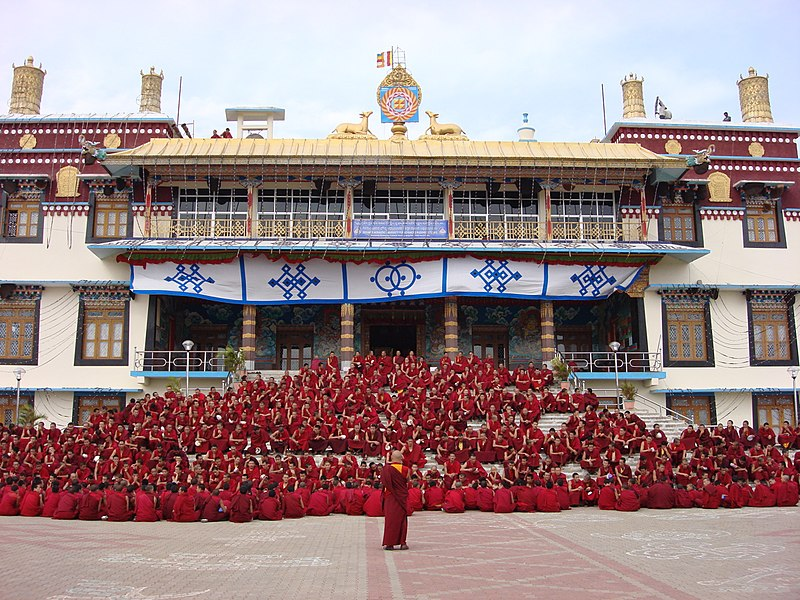
Dancing with Earthquakes: Flexibility as Strength
Buildings That Bend but Don’t Break
The Himalayas shake. A lot. We’re talking about one of the most seismically active regions on Earth, where tectonic plates are still pushing mountains skyward. Yet monasteries that were built before America was “discovered” are still standing strong while modern concrete buildings crumble.
I learned why during the 2015 Nepal earthquake. I was documenting damage in Kathmandu when I met Dr. Anil Shrestha, a structural engineer who’d been studying traditional building techniques. He took me to see Boudhanath Stupa, which had suffered damage, and then to a nearby 400-year-old monastery that was virtually untouched.
“Look at the foundation,” he said, pointing to where renovation work had exposed the base. Instead of solid concrete, I saw carefully fitted stones with no mortar between them. “It’s like a puzzle that can shift and move. When the earth shakes, the whole building dances together instead of fighting the movement.”
The walls tell the same story. Rather than rigid concrete blocks, they’re built with interlocking stones and wooden elements that can flex during tremors. It’s like the difference between a brittle stick that snaps under pressure and a bamboo cane that bends but springs back.
Weight as Wisdom
There’s another secret weapon these monasteries use against earthquakes: they’re really, really heavy. All that stone mass doesn’t just store heat; it also dampens vibrations. When seismic waves hit, all that weight absorbs and dissipates the energy before it can build up destructively.
Modern skyscrapers now use massive pendulums called tuned mass dampers for the same purpose. But Himalayan builders figured this out centuries ago just by working with the natural properties of stone.
Building with the Mountain’s Gifts
Every Stone Has a Story
I once watched an 80-year-old master builder named Pemba selecting stones for a monastery renovation in Mustang. He’d pick up each rock, feel its weight, even smell it before deciding where it belonged. When I asked him how he knew, he just smiled.
“The mountain tells me,” he said. “This stone for outside; it likes the sun. This one for inside; it holds warmth like a grandmother holds a baby.”
It sounds mystical, but Pemba was actually applying sophisticated materials science. He could tell by touch and sight which stones had the right thermal properties, which would resist weathering, and which would provide the best acoustic properties. This knowledge, passed down through generations, creates buildings perfectly adapted to their specific environment.
The mortar between stones often contains yak hair; not because they couldn’t afford “proper” materials, but because organic fibers provide flexibility and additional insulation. This bio-composite is completely biodegradable yet can last centuries when properly maintained.
The Zero-Waste Masters

When every stone has to be carried up a mountain path on the back of a yak or human, waste becomes impossible. But what started as necessity became art.
In these monasteries, every chip of stone finds a purpose. Large stones become walls, medium stones become interior structure, small stones become fill, and even the dust gets mixed into mortar. It’s the ultimate circular economy, achieved not through environmental consciousness but through pure practical intelligence.
This approach is now inspiring modern sustainable architecture, but these builders were doing it centuries before “sustainability” became a buzzword.
The Psychology of Sacred Spaces
Proportions That Heal Your Mind
There’s something about stepping into a Himalayan monastery that immediately calms your racing thoughts. I used to think it was just the spiritual atmosphere, but there’s actual science behind this feeling.
The ceiling heights are typically one and a half to two times human height; high enough to feel expansive without being overwhelming. Windows are positioned to maximize natural light while avoiding harsh glare. Even the colors; those warm earth tones; are chosen to complement the natural lighting patterns.
Dr. Sarah Johnson, an environmental psychologist I met at a conference in Delhi, explained it to me this way: “These spaces work with human psychology instead of against it. They understand that our brains respond to certain proportions and lighting conditions in predictable ways.”
Light That Follows Your Body Clock
The windows in these monasteries aren’t just randomly placed. They’re positioned to capture specific angles of sunlight throughout the day, creating changing light patterns that follow natural circadian rhythms.
In Thiksey Monastery in Ladakh, I noticed how the morning light gradually moves across the prayer hall during the dawn ceremony. By the time prayers end, natural daylight has fully replaced the flickering butter lamps. It’s like the building is gently waking up with the monks.
This natural light regulation helps maintain healthy sleep patterns even at high altitudes where traditional environmental cues might be disrupted.

What We’re Learning from Ancient Wisdom
The Future is Actually the Past
As an architect friend of mine in Mumbai likes to say, “We’re spending billions to rediscover what village builders knew for free.” These monasteries represent solutions to problems we’re desperately trying to solve: energy efficiency, sustainable materials, natural climate control, and buildings that last centuries instead of decades.
Passive solar heating, thermal mass construction, natural ventilation, and local material usage are all cutting-edge green building practices today. But they were perfected in Himalayan monasteries when Europe was still in the Dark Ages.
Biomimicry Before We Had the Word
Today’s architects study biomimicry; designing buildings that work like living organisms. But Himalayan monasteries have been doing this for over a thousand years. They breathe through natural ventilation, regulate temperature like warm-blooded animals, and respond to environmental stress like flexible plants.
The more I study these buildings, the more I realize they’re not just structures; they’re artificial organisms that live in harmony with their mountain ecosystem.
Racing Against Time to Save the Knowledge
When Wisdom Walks Away
Here’s the heartbreaking part: much of this incredible knowledge exists only in the minds and hands of aging master builders. Traditional apprenticeship systems are breaking down as young people migrate to cities for modern jobs.
I’ve met master builders in their 80s and 90s who can tell you which stones will sing in the wind and which will hold heat through a Himalayan winter. When they pass away, libraries of knowledge disappear with them.
Tenzin Norbu, a master builder I interviewed in Spiti Valley, put it simply: “My sons want to work with computers, not stones. I understand, but who will teach the stones to sing?”
Digital Memory for Ancient Wisdom
Fortunately, some initiatives now use 3D scanning and digital modeling to record monastery construction details. These projects combine traditional knowledge with modern analysis to understand exactly how these buildings achieve their remarkable performance.
But we need to hurry. Every monsoon season, every earthquake, every harsh winter threatens both the buildings and the people who know how to maintain them.
For a beautiful documentary showing these master craftsmen at work, check out this traditional Himalayan architecture film that captures building techniques being passed from grandfather to grandson.
The Deeper Magic
When Stone Becomes Prayer
In these monasteries, the boundary between building and spiritual practice dissolves completely. The stones don’t just provide shelter; they become part of the meditation itself. Their thermal mass creates comfortable temperatures for hours of sitting meditation. Their acoustic properties turn every whispered prayer into something beautiful. Their visual textures provide focal points for contemplation.
I remember sitting in Hemis Monastery during a winter storm, watching snow pile up outside while inside remained perfectly comfortable. The monk beside me noticed my amazement and whispered, “The building meditates with us. We built it to pray.”
This integration of practical engineering and spiritual function represents something modern architecture is desperately trying to rediscover: buildings as tools for human flourishing, not just human housing.
Economics of Eternity
While we build structures designed to last 50 years, these monasteries were built for forever. This changes everything. Materials are chosen for longevity over cost. Maintenance is designed into the structure. The result is buildings that require minimal resources over centuries of use.
At Tashilhunpo, I met a monk whose job is maintaining the heating system; which consists entirely of opening and closing certain windows at specific times. “Very efficient,” he grinned. “No electricity bill, no repairs, no replacement parts. Just wisdom passed from teacher to student.”
Living with the Challenges
When Ancient Wisdom Meets Modern Problems
Even these incredible buildings face new challenges. Climate change is bringing more extreme weather patterns to high altitudes. Temperature swings are becoming more dramatic. Precipitation patterns are shifting.
Some monasteries are carefully adapting, incorporating selective modern improvements while maintaining traditional techniques. Solar panels might provide electricity for lights, but the thermal mass heating system remains unchanged.
At Rongbuk Monastery, near Everest Base Camp, the monks have added modern insulation to certain areas while preserving the traditional acoustic design of the prayer hall. “We take the best of both worlds,” explained the monastery manager. “Ancient wisdom for what works, modern help for what’s needed.”
The Balance Between Old and New
The challenge isn’t choosing between traditional and modern; it’s combining them wisely. How do you add internet connectivity without compromising acoustic properties? How do you improve earthquake safety without changing the flexible foundations that already work brilliantly?
These questions are driving fascinating research that combines traditional building knowledge with modern engineering analysis. The goal isn’t to replace ancient wisdom but to understand it well enough to evolve it thoughtfully.
The Sound of Tomorrow
The next time you hear Tibetan singing bowls or experience monastery chanting, remember that you’re experiencing centuries of acoustic engineering refined through generations of master builders. Every resonant tone results from carefully calculated stone placement and room proportions.
But more than that, you’re experiencing a completely different relationship with the built environment; one where buildings aren’t just shelters imposed on the landscape, but living extensions of the natural world.
In our age of climate crisis and energy shortages, these ancient monasteries offer more than technical solutions. They offer a different way of thinking about human habitation: not conquering nature, but dancing with it.
Have you ever experienced the unique atmosphere of a Himalayan monastery? What surprised you most about these ancient buildings? Share your stories and thoughts in the comments below—I’d love to hear about your own encounters with this remarkable architecture!
Related Article:
Nikhil Raj Sharma, Founder, Himalayan Geographic:
“Every time I step into one of these monasteries, I’m reminded that we’re not just documenting buildings—we’re documenting a completely different way of understanding the relationship between humans and their environment. These structures embody wisdom that’s both deeply practical and profoundly spiritual. What moves me most is how the builders saw no separation between solving engineering problems and creating spaces for the human soul to flourish.”
“I’ve recorded prayer sessions in over fifty monasteries, and each one has taught me something new about the marriage of acoustics and architecture. The most humbling realization? These master builders achieved with stone and intuition what we’re still struggling to accomplish with all our modern technology. We have so much to learn from their patient observation of how sound, light, and human beings interact in sacred space.”
“We strive to use only images that are either royalty-free, in the public domain, or shared with appropriate permissions. However, if you believe any image on this website has been used without proper credit or violates copyright, please contact us immediately. We will promptly review the content and, if necessary, update the attribution or remove the image without delay. We do not claim ownership of any third-party images unless explicitly stated.”
