
How reckless Himalayan development through hydropower projects, highway widening, and uncontrolled tourism is destroying the world’s most fragile mountain ecosystem. This witness account reveals the devastating truth about “progress” in the Himalayas.
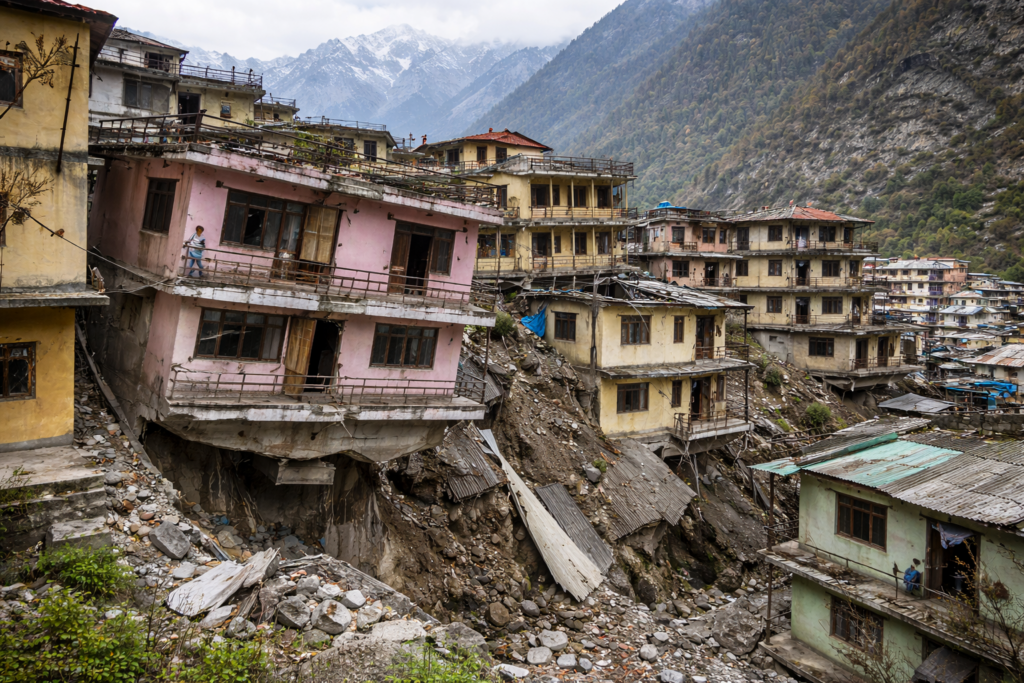
Anita stands in what used to be her home. “There’s no light or water, but I stay here with my kids,” she says, pointing to cracks so wide you could slide your hand through them. Her house in Joshimath, Uttarakhand, is sinking; literally disappearing into the mountain. This isn’t a natural disaster. This is what we call “development.”
In fragile mountains, reckless development isn’t just dangerous; it’s a slow ecological assassination.
The Mountains Are Screaming, But No One’s Listening
Picture this: over 200 people buried alive in 2021 when a glacier broke free in Chamoli. Five more dead in 2024 when the Malana Dam collapsed. Entire villages swallowed by landslides. Houses cracking open like eggshells. And the response? Build more. Dig deeper. Cut wider.
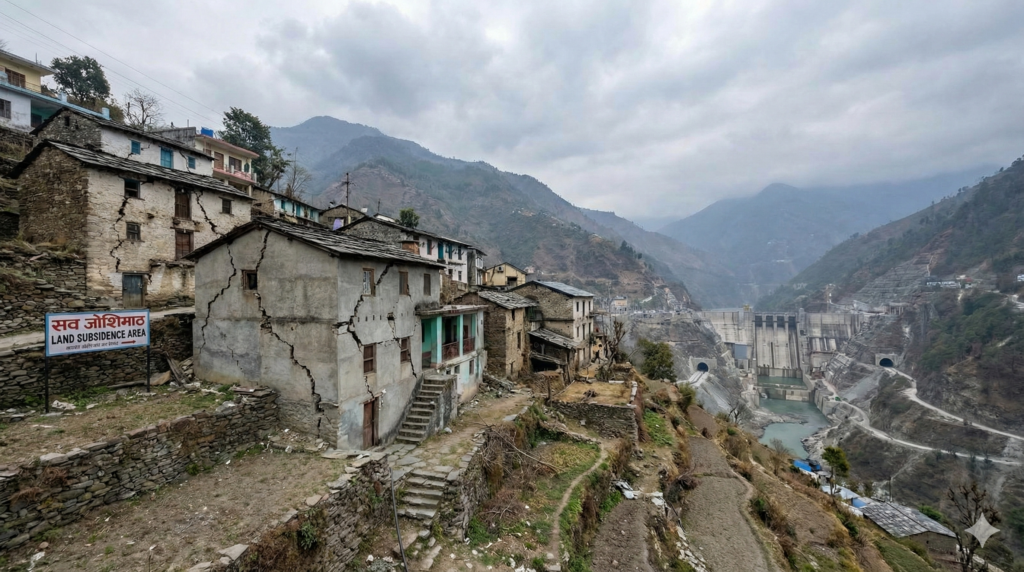
The 2023 land subsidence in Joshimath affected thousands of houses, with residents forced to live in crumbling homes. More than 800 buildings developed cracks. Families evacuated. Lives destroyed. And still, the machines keep running.
Hydropower Projects; Drilling the Himalayas to Death
The Himalayas are being sold as India’s “powerhouse.” The government wants to harness 115,550 MW of hydropower potential. Sounds impressive, right? But here’s what they don’t tell you: we’re drilling through one of the most earthquake-prone, landslide-vulnerable mountain ranges on Earth.
The Hidden Costs They Won’t Talk About
As of 2022, 81 large hydropower projects were operational in the Himalayan region, with 26 under construction and 320 more in the pipeline. That’s one dam every 32 kilometers in some stretches. Imagine drilling a tunnel through your home’s foundation every few meters. Now imagine that home sits on shifting tectonic plates.
Watch this powerful documentary on YouTube about hydropower disasters in the Himalayas: Hydropower in the Himalayas and Disaster Risks
The so-called “run-of-the-river” projects; marketed as environmentally friendly; are anything but. These projects divert river water through underground tunnels, leaving stretches of 10 to 30 kilometers completely dry. Rivers that sustained communities for thousands of years now run bone-dry for months.
When Mountains Become Graveyards
The disasters speak for themselves:
- 2012: Assi Ganga floods destroyed two hydroelectric projects
- 2013: Kedarnath floods killed 5,000 people, damaged three major projects
- 2021: Rishiganga avalanche killed 200+, caused Rs 1,500 crore in losses
- 2024: Malana Dam burst, five dead, 50+ missing
In 2024 alone, 73 people died and property worth Rs 648 crore was damaged in Himachal Pradesh during the monsoon season. Most incidents occurred near hydropower projects or highway construction sites.
Here’s the kicker: 97.42% of Himachal Pradesh’s geographical area is prone to landslides. Yet we’re drilling tunnels, blasting mountains, and dumping debris like there’s no tomorrow. Because for many communities, there literally might not be.
Cutting Mountains Like Butter
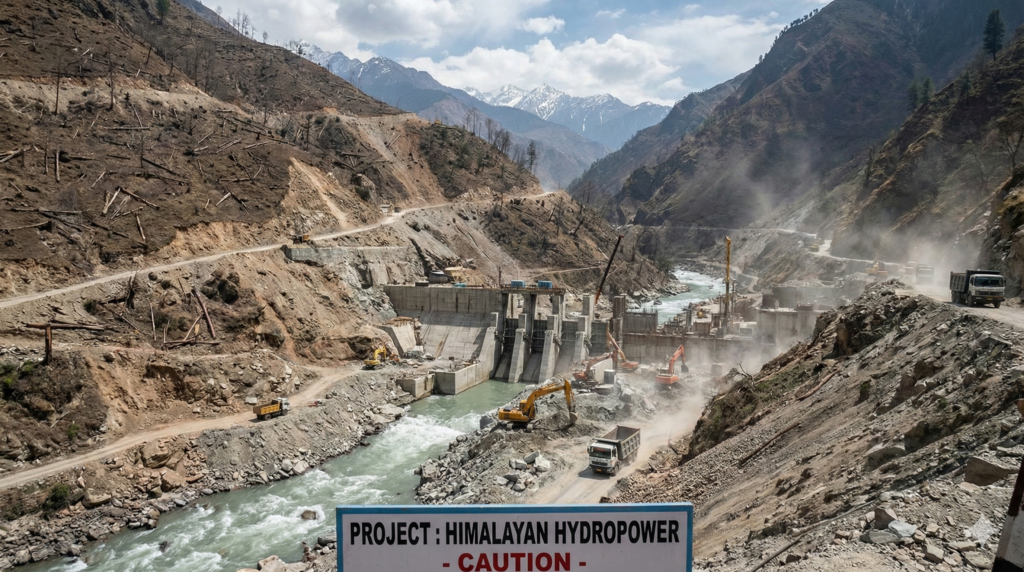
The Char Dham highway project; a Rs 12,000 crore prestige venture connecting four Hindu pilgrimage sites; epitomizes everything wrong with Himalayan development. Nearly 900 kilometers of roads being carved through one of Earth’s most fragile ecosystems. The cost? Let’s count.
The Environmental Massacre
Nearly 700 hectares of forest land lost, 47,043 trees felled, and natural drainage of streams and springs blocked by muck dumping. In just four months of 2020, 11 landslides occurred. People died. Infrastructure crumbled.
But here’s the scandal: The entire project proceeded without a comprehensive Environmental Impact Assessment by splitting it into 53 segments of less than 100 km each. A legal loophole. A bureaucratic sleight of hand. An environmental catastrophe.
Professor Yaspal Sundriyal, a geologist, says road widening is being done by workers and JCB operators without engineers or technical guidance on site, with slopes cut steeply that remain unstable even after five years.
When National Security Becomes an Excuse
The defense ministry argued for wider roads to move troops faster. The Supreme Court agreed in 2021, overruling environmental experts. The High-Powered Committee argued that a disaster-resilient road is more critical than a wider road prone to frequent blockages and landslides.
What good are wide roads when they’re buried under landslides every monsoon? Three valleys in Pithoragarh near the China border were cut off for two months due to landslides; precisely the “strategic” areas these roads were meant to serve.
For more insight, check out this analysis: Special Report on Char Dham Highway Project
Tourism and Military Pressure; Love Them to Death
The Himalayas attract over 15 million tourists annually. Sounds like economic prosperity, right? Wrong. It’s ecological suicide.
The Carrying Capacity Crisis
Here’s a number that should terrify you: each tourist in high-altitude regions consumes 7-8 times more resources than a local resident, and ecological carrying capacity in popular areas has been exceeded by 30-175%.
Think about that. We’re not just at capacity; we’ve blown past it by up to 175%.
In Manali, the built-up area increased from 4.7% to 15.7% during 1989-2012, while tourist numbers swelled from 140,000 to 2.8 million from 1980-2011. More hotels. More waste. More pressure. Less forest. Less water. Less life.
The Supreme Court Finally Speaks
In August 2023, the Supreme Court of India called for a complete and comprehensive study on the carrying capacity of the Himalayan region, terming it a “very important issue” after unplanned development caused devastation.
Too little, too late? Maybe. But it’s a start.
The government now admits that due to non-existent carrying capacity studies, grave geological hazards including landslides, land subsidence, land cracking and sinking issues are being witnessed.
Military Development
The Zoji La tunnel; set to become Asia’s longest; is being built to rapidly deploy troops near the China border. Farmer Tanzong Le from Leh says the government prioritizes military agendas over the safety of local communities and ecology, with dynamite blasting destabilizing geological foundations and endangering wildlife.
Military security is important. No one disputes that. But what security exists when the mountains themselves collapse? When entire towns sink? When water sources dry up?
The Science They Choose to Ignore
After the 2013 Kedarnath disaster that killed 5,000 people, the Supreme Court mandated an expert committee led by environmentalist Ravi Chopra to examine 24 hydropower projects in the Alaknanda and Bhagirathi basin. The conclusion? “Irreversible impact” on the ecology by 23 projects.
Another committee from IIT Kanpur reached the same conclusion. The Supreme Court expressed concern about “the mushrooming of a large number of hydroelectric projects” and noted “the cumulative impact has yet to be scientifically examined.”
Ravi Chopra, the environmental hero who led these studies, resigned in 2022 from the Char Dham committee. His reason? “My belief that the committee could protect this fragile ecology has been shattered”.
When experts give up in frustration, you know we’re in trouble.
What This Really Means for People
Forget statistics for a moment. Let’s talk about real lives.
Underground springs; lifelines for Himalayan communities for millennia; are disappearing. When underground work disturbs geology and geohydrology, the effects emerge as construction starts: villages become unsafe, leading to indirect displacement, irrigation and drinking water availability gets affected.
Jobs promised by hydropower projects? Activist Atul Sati reports that jobs were mostly temporary and low-paying, and people whose water, forests, land and resources are being used are not at the center of decision-making.
The tourism boom? Higher density of populations in small areas leads to more solid waste generation, ambient air pollution, water pollution and deforestation. Local communities bear the burden while profits flow elsewhere.
The Downstream Catastrophe
Here’s what terrifies climate scientists: Himalayan glaciers feed rivers that sustain 1.3 billion people across Asia. When we destroy the Himalayas, we’re not just killing mountains; we’re threatening the water security of one-fifth of humanity.
The Himalayas function as Asia’s water tower, with glaciers feeding major rivers. Mess with the source, and everyone downstream pays the price; from India to Bangladesh, from Pakistan to China.
Climate change is already melting glaciers faster. Now we’re drilling through them, cutting down protective forests, and destabilizing entire slopes. It’s like setting your house on fire while it’s already flooding.
Solutions Exist; If We Choose Them
This isn’t hopeless. We have options. We’re just choosing not to use them.
Bhutan shows us a different path. Their “High Value, Low Volume” tourism model requires international visitors to pay $200 per day as a Sustainable Development Fee. Result? Limited visitor numbers to 70,000 annually, generated over $85 million for conservation, and maintained forest cover at over 70%.
Small-scale, decentralized solar and wind power can provide electricity without drilling through mountains. Local, homestay-based tourism can generate income without destroying ecosystems.
We need:
- Mandatory carrying capacity assessments before ANY development
- Complete halt to new hydropower projects in high-risk zones
- Disaster-resilient infrastructure, not just wider roads
- Genuine local community participation in all decisions
- Transparent environmental impact assessments; no legal loopholes
The Price of Silence
Every landslide. Every cracked home. Every disappeared spring. Every life lost. This is the price of calling destruction “development.”
Union Minister Nitin Gadkari, responsible for the highway projects, blamed “civil engineers” for “small mistakes” causing “hundreds of deaths.” But geologist Yaspal Sundriyal criticizes the road-widening process done by workers without engineers providing technical guidance on site. Who’s accountable when systems fail from the top down?
Dr. Anjal Prakash, who contributed to IPCC reports, states clearly: “India needs to do a rethink and hydropower projects in the Himalayan region should be stopped.”
Expert committees say stop. Scientists say stop. Local communities say stop. The Supreme Court expresses concern. Even the mountains themselves; through landslides, subsidence, and floods; are screaming stop.
This Is Your Wake-Up Call
Anita’s sinking house in Joshimath isn’t an anomaly. Subsidence is evident in several other Himalayan towns. Joshimath was just the warning shot.
The Himalayas aren’t unlimited. They have a breaking point. And we’re racing toward it with bulldozers, dynamite, and concrete.
When the mountains break, they won’t break quietly. They’ll take communities, ecosystems, water sources, and lives with them. And downstream; in the plains where millions depend on Himalayan rivers; the consequences will be catastrophic.
Here’s the uncomfortable truth: This isn’t about choosing between development and environment. It’s about choosing between sustainable development and total collapse. Between smart growth and suicidal growth. Between respecting carrying capacity and exceeding it until everything breaks.
What You Can Do Right Now
This isn’t just a Himalayan problem. It’s a human problem. And humans solve problems when they decide to.
Share this article. Talk about it. Make noise.
Write to your representatives. Demand carrying capacity studies. Question every new project. Support local communities fighting for their mountains.
And when you visit the Himalayas; because their beauty deserves to be experienced; do it responsibly. Choose homestays over hotels. Carry your waste back. Respect local cultures. Leave only footprints.
The Himalayas have given us everything: water, climate stability, biodiversity, spiritual inspiration. The least we can do is stop killing them in the name of progress.
The Choice Is Ours
We can choose differently. We can build smarter, smaller, safer. We can respect carrying capacity. We can listen to science. We can value ecosystems as much as economies.
Or we can keep drilling, cutting, and building until the mountains themselves give up and take us down with them.
What will you choose?
Because when the Himalayas change, the world downstream changes with them.
Comments from Nikhil Raj Sharma, Founder, Himalayan Geographic:
“This article captures the urgency of the Himalayan crisis with brutal honesty. We’ve documented this destruction for years, watching as warnings go unheeded and communities suffer. The data is clear: we’ve exceeded carrying capacity by dangerous margins. What troubles me most is the systemic failure; from bypassing environmental assessments to ignoring expert recommendations. The Himalayas don’t need ‘development at gunpoint.’ They need thoughtful, science-based, community-centered growth that works with nature, not against it. This isn’t just about saving mountains; it’s about survival for billions dependent on Himalayan ecosystems. The question isn’t whether we can afford to stop; it’s whether we can afford not to.”
Related Resources:
- Video: Hydropower in the Himalayas and Disaster Risks
- Documentary: How Hydropower Projects Increase Disasters
- Special Investigation: Char Dham Highway Project
Share your experience in the comments below! Have you witnessed Himalayan development firsthand? What solutions do you see? Your voice matters in this conversation.
Disclaimer: The content and images published in this article are provided for general informational and educational purposes only. Some images may be generated or enhanced using artificial intelligence (AI) and are intended solely for illustrative use. The views, interpretations, and information expressed do not necessarily reflect the official position of Himalayan Geographic Research Foundation, nor do they constitute professional, legal, medical, or financial advice.
While efforts are made to ensure accuracy, no guarantees are given regarding completeness or reliability. Readers are encouraged to independently verify information and use their own judgment. By reading this article, you acknowledge that any reliance on the content is at your own risk, and Himalayan Geographic Research Foundation assumes no responsibility or liability for disagreements, interpretations, or outcomes arising from its use. If you do not agree with these terms, you are advised to discontinue reading.
