
Proposed changes to Himachal’s land laws threaten to transform locals from landowners to tenants. This investigative article examines Section 118 amendments, real estate lobbying, comparative lessons from Uttarakhand and Goa, and the irreversible consequences for hill communities if protective land safeguards are weakened.
Land Is Not Property in the Mountains ; It Is Survival
Land in the mountains is not just real estate. It is identity, inheritance, livelihood, and survival.
When Section 118 of the Himachal Pradesh Tenancy and Land Reforms Act was enacted in 1972 under Chief Minister Dr. Y.S. Parmar, it was never meant to block development. It was designed as a protective shield; to ensure that Himachal’s people were not displaced by economic forces far stronger than themselves.
Today, that shield is being dismantled, piece by piece, under the banner of “ease of doing business.”
This is not a routine policy debate.
It is a warning.
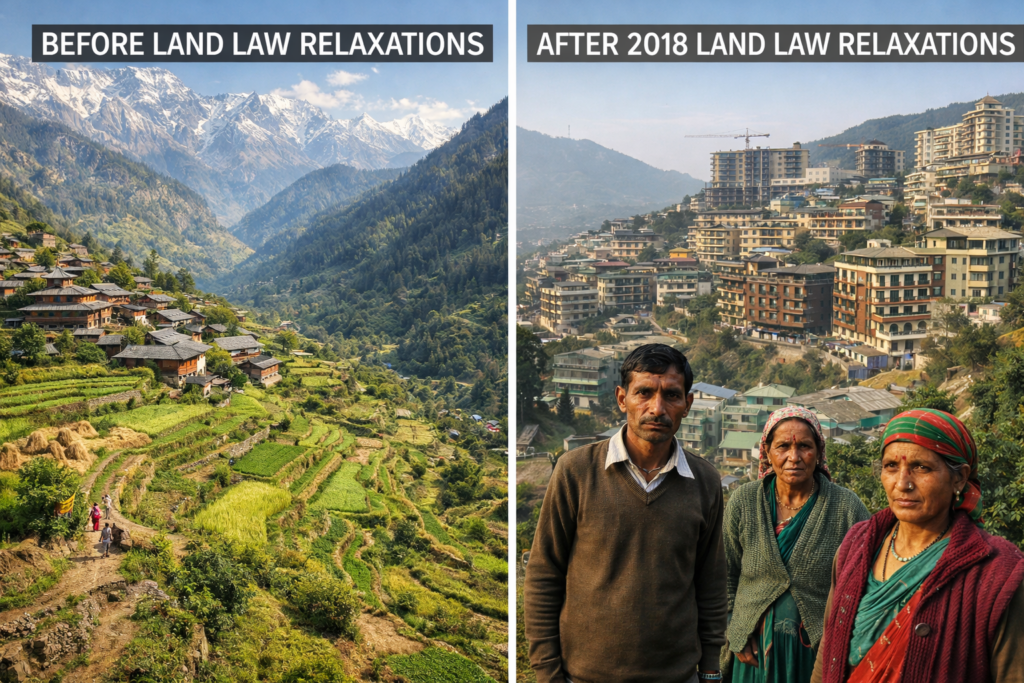
Across India’s hill states, a familiar pattern has played out: land protections are relaxed, corporate and speculative interests rush in, land prices soar, locals sell under distress, and within a generation, the original inhabitants become tenants in their own homeland.
Uttarakhand has lived through this.
Goa is experiencing it now.
Himachal stands at the edge.
What Is Section 118 ; and Why It Matters
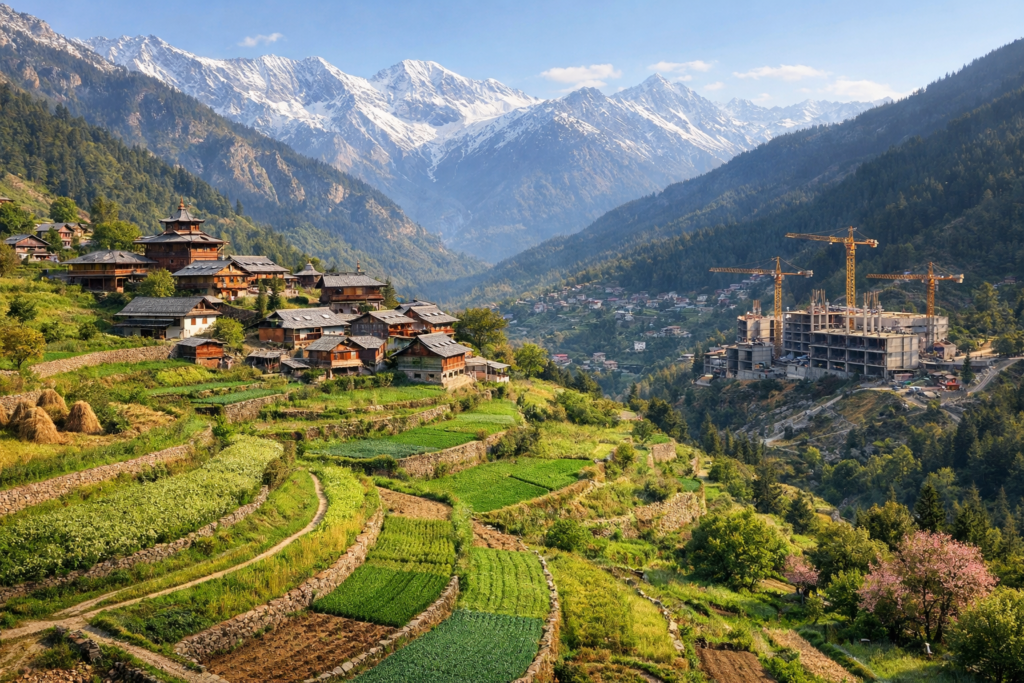
Section 118 of the Himachal Pradesh Tenancy and Land Reforms Act, 1972, restricts the transfer of agricultural land to non-agriculturists without government permission. Crucially, it applies not only to outsiders but also to Himachalis who are not farmers.
The law was crafted with precision to protect small and marginal farmers; who constitute 88.86% of the state’s farming community; from being priced out by wealthy buyers.
Himachal has only 14% cultivable land. The rest consists of steep mountains, forests, or protected zones. Nearly 60% of landholdings are under 6 bighas (about 1.5 acres). In such conditions, land is not a tradable commodity; it is survival infrastructure.
The Himachal Pradesh High Court, in Ashok Madan v. State of HP (2004), affirmed that Section 118 prevents the “economically advantageous class from taking undue advantage of small agriculturists.” The provision is placed under the Ninth Schedule, giving it constitutional protection beyond routine judicial challenge.
Section 118 is not a bureaucratic hurdle.
It is Himachal’s economic and demographic stabilizer.
The Proposed Amendments; Opening the Floodgates
In December 2024, the Himachal Pradesh government introduced amendments to Section 118 under the guise of “Ease of Doing Business” and economic liberalization. The amendments include:
- Exempting cooperative societies with 100% Himachali agriculturist membership from Section 118 approval.
- Allowing non-agriculturists to purchase completed flats or buildings up to 500 sq m in RERA-registered projects without permission.
- Permitting short-term leases (up to 10 years) in rural areas for tourism and business ventures.
- Extending exemptions granted to HIMUDA (Himachal Pradesh Housing and Urban Development Authority) to subsequent purchasers, creating a legal loophole for resale without restrictions.
- Introducing a penalty-based system for extending project timelines instead of mandating land reversion to the government if unused.
These changes, presented as bureaucratic reforms, fundamentally alter the protective architecture of Section 118. The government claims the “spirit” of the law will remain intact. But laws do not operate on spirit ; they operate on language, loopholes, and enforcement. And the language being proposed opens the door to speculative land grabbing, real estate flipping, and permanent demographic transformation.
Lessons from Uttarakhand
Uttarakhand’s experience with land law relaxations serves as a grim preview of Himachal’s potential future. In 2018, then-Chief Minister Trivendra Singh Rawat amended the state’s land laws, removing the upper limit on land purchases and allowing outsiders to acquire up to 12.5 acres for commercial and tourism projects without stringent oversight.
The consequences were catastrophic:
- Land Prices Soared: In hill districts like Nainital, Dehradun, and Almora, land prices skyrocketed by 300–500%, putting property ownership beyond the reach of locals. Circle rates increased by 9–22% in 2025 alone.
- Corporate Land Hoarding: External investors and real estate developers bought vast tracts for resorts, villas, and speculative holdings, converting agricultural and horticultural land into commercial zones.
- Demographic Displacement: A 2021 report indicated that 50% of Uttarakhand’s population is now of non-local origin. Locals, unable to afford housing in their own villages, have either migrated or become low-wage laborers on properties they once owned.
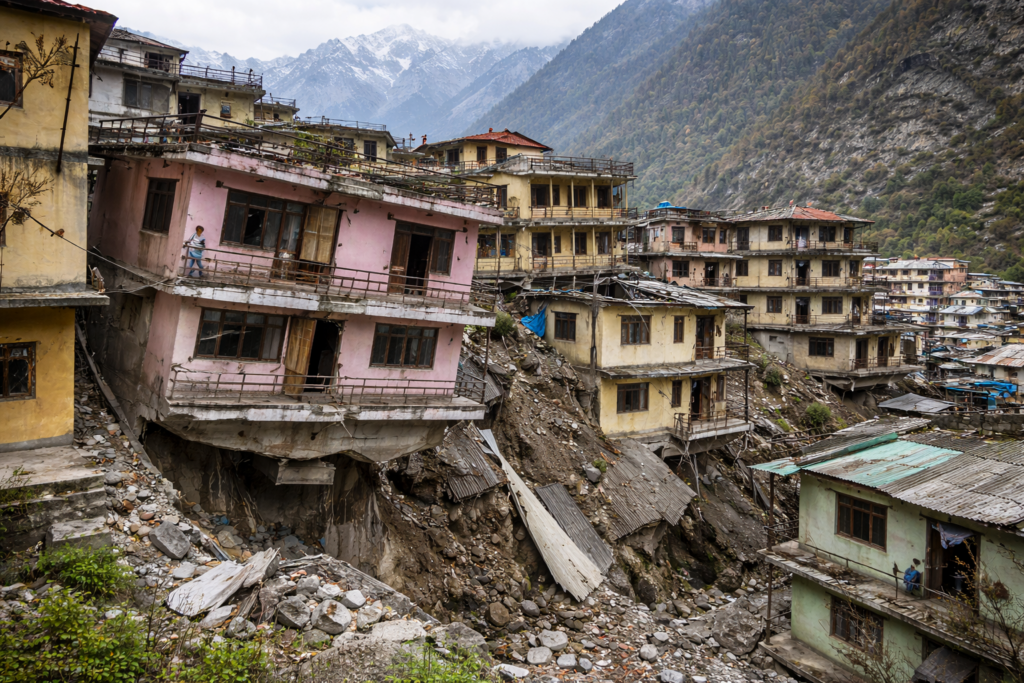
- Environmental Degradation: Unregulated construction led to deforestation, landslides, and aquifer depletion. The 2023 Joshi math crisis ; where entire neighbourhoods sank due to uncontrolled building on unstable slopes was a direct consequence of ignoring geological warnings in pursuit of tourism revenue.
- Cultural Erosion: Traditional livelihoods, languages, and customs have been diluted as local communities shrink and outsider-dominated settlements expand.
Uttarakhand Farmer Speaks;
“With large chunks of arable land in the hills already sold off, the rich land mafia can now focus entirely on acquiring land in our area.”
; Gurpreet Singh, Young Farmer, Udham Singh Nagar (owns 15 acres)
“All the work that is included in the development is being done on agricultural land, and so this danger looms over our heads, that we might lose all our agricultural land. And once that land is gone, our capacity to grow anything will go away; what will the people do then?”
; Mohit Dimri, Convener of Land Rights Protests, Uttarakhand
By 2025, Uttarakhand’s government was forced to reverse course, enacting the Uttarakhand Bhu Kanoon (Land Law Amendment) Act 2025, which banned outsiders from purchasing agricultural and horticultural land in 11 of 13 districts and capped residential purchases at 250 square meters. But the damage was already done. Thousands of hectares had been transferred, land prices remained inflated, and the original residents had already been displaced.
Environmentalist Ravi Chopra summarized the debacle: “Successive state governments have, in a sense, cheated the people. They have talked about land laws, but the laws that have been passed do not secure the land for the people of Uttarakhand.”
Goa’s Struggle; When Land Laws Become Tools of Dispossession
Goa offers another sobering case study. Despite its unique Comunidade land system designed to protect communal ownership, the state has witnessed systematic erosion of local land rights through zoning manipulations, political favoritism, and regulatory capture.
Section 39A of the Goa Town and Country Planning Act allows landowners to apply for zoning changes ; converting orchards or agricultural plots into settlement zones. What was intended as a planning mechanism has become a tool for land conversion scams. Wealthy outsiders buy land cheaply under agricultural zoning, then lobby politically connected officials for rezoning, increasing land value by 500–1000% overnight.
In 2024, Goa’s Chief Secretary Puneet Kumar Goyal was caught purchasing land that had been rezoned just weeks earlier through his office’s approval. The transaction violated civil service conduct rules, but the damage was systemic. Such conversions have become routine, facilitated by political patronage and unchecked bureaucratic discretion.
The consequences mirror Uttarakhand’s trajectory:
- Land animosity against wealthy buyers from northern India has pushed property beyond the reach of ordinary Goans.
- Half of Goa’s population is now of non-Goan origin, leading to cultural dilution and resentment.
- Civil society organizations have filed multiple petitions to stop land conversions, but enforcement remains weak and politically influenced.
Goa’s struggle highlights a critical truth: once land control shifts to outsiders, political will to protect locals evaporates. The real estate lobby becomes too powerful, politicians too compromised, and locals too dispersed to resist effectively.
Why Locals Don’t Want to Sell ; Even When Offered High Prices
The narrative that locals willingly sell land to outsiders is incomplete and often misleading. In hill communities, land is not merely an economic asset. It is generational wealth, cultural continuity, and livelihood security rolled into one. Selling land is not a simple market transaction ; it is an irreversible severance from identity.
Most land sales in Himachal occur under distress:
- Medical Emergencies: Families sell ancestral land to cover hospitalization costs unavailable in local facilities.
- Education Expenses: With limited quality education in rural areas, parents sell land to fund children’s schooling in cities.
- Debt Traps: Agricultural loans, climate-induced crop failures, and lack of alternative income sources force distress sales.
- Power Imbalance: Wealthy buyers, often from urban centres, have access to legal expertise, financial leverage, and political connections that locals lack. The negotiation is never equal.
Once land is sold, there is no going back. The money received is spent on immediate needs, while the land ; which could have sustained generations ; is permanently lost. The seller becomes a tenant or migrant labourer, working on land that was once theirs. This pattern has repeated across Uttarakhand, Goa, and now threatens Himachal.
The Government’s Role; Protector or Facilitator?
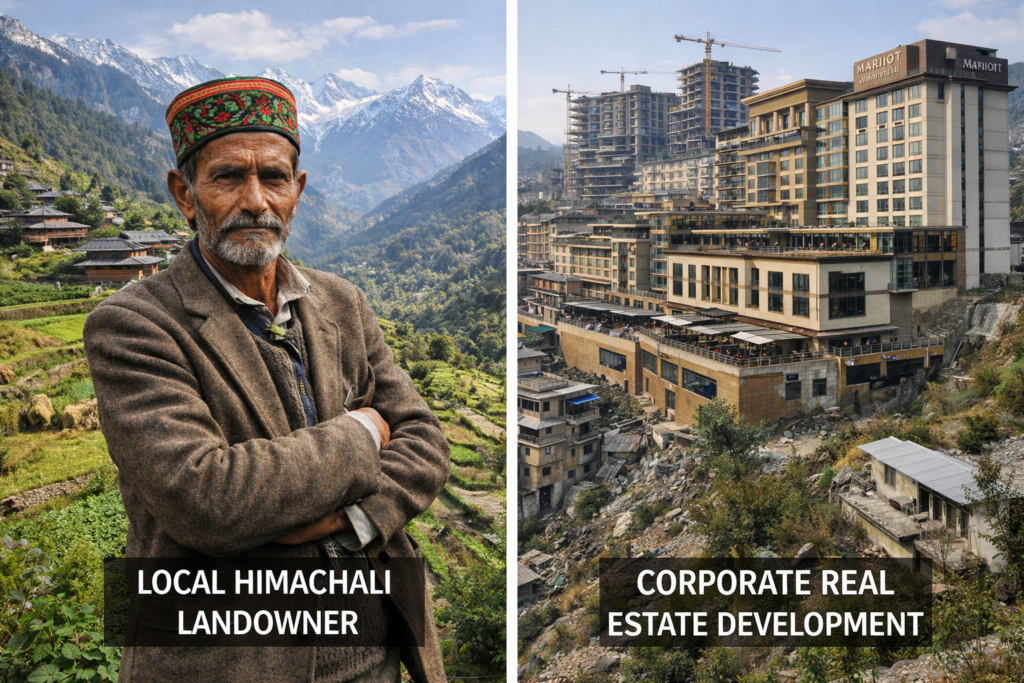
The Himachal Pradesh government claims the amendments aim to streamline bureaucratic processes, attract investment, and boost employment. Revenue Minister Jagat Singh Negi has repeatedly stated that the “spirit” of Section 118 will remain intact. But the question is not what the government says ; it is what the law permits.
Critical Questions That Demand Answers:
- Who requested these amendments? Industry associations like the Baddi Barotiwala Nalagarh Industries Association have publicly lobbied for relaxations. Real estate developers have long complained about Section 118 being an “impediment.” Are these amendments driven by local needs or corporate demands?
- Who benefits immediately? Developers, cooperative societies with political backing, and RERA-registered builders gain instant access to rural land markets. Locals gain nothing except the risk of displacement.
- Who absorbs the long-term damage? Small farmers, landless laborers, and future generations will inherit a state where they cannot afford to live. The government collects short-term revenue; the people pay the permanent price.
- Was there genuine public consultation? Or were these amendments introduced without adequate debate, public hearings, or impact assessments?
The government’s track record raises concerns. In 2018, then-Chief Minister Jai Ram Thakur hastily relaxed Section 118 to allow all employees ; regardless of origin ; to buy land without permission. The move was withdrawn within weeks due to public outcry and fears of misuse. If the government itself acknowledges the danger of such relaxations, why are they being reintroduced now?
Furthermore, the amendments were referred to a Select Committee in December 2025 after opposition members including BJP MLA Randhir Sharma ; raised concerns about provisions allowing rural leases and commercial activities by outsiders. If the government is confident in its reforms, why the need for extended review? The delay suggests internal doubts, political maneuvering, or both.
Corporate and Real Estate Lobbying
Land law changes are never politically neutral. Behind every amendment is a coalition of interests ; builders, investors, tourism operators, and political patrons ; who stand to profit from relaxed regulations.
In Himachal, the Baddi, Barotiwala, Nalagarh Industries Association has explicitly called Section 118 a “major impediment” to investment, citing years lost in obtaining permissions. Rajiv Aggarwal, the association president, complained that “a lot of time is consumed in settling series of objections raised by the officials and there is no time-frame for dealing with such cases.” But what they frame as bureaucratic inefficiency is actually deliberate gatekeeping ; designed to prevent speculative land grabs and ensure that land is used for genuine productive purposes, not resale or hoarding.
Similar lobbying shaped Uttarakhand’s 2018 land law relaxations and Goa’s zoning manipulation scandals. The pattern is consistent: developers complain about “restrictive” regulations, politicians promise “ease of doing business,” amendments are passed, land values spike, locals are displaced, and within a decade, civil society demands the laws be reversed. But by then, the damage is irreversible.
The real question Himachalis must ask is: Do we trust the same political and economic forces that failed Uttarakhand and Goa to protect us?
Environmental and Geological Fragility
Himachal Pradesh is not the plains. It is a tectonically active, landslide-prone, ecologically fragile region where every construction project carries geological risk. The state has already experienced devastating consequences of unregulated development:
- Shimla’s sinking crisis: Multiple neighborhoods in Rampur and surrounding areas have experienced land subsidence, building collapses, and infrastructure failures due to over-construction on unstable slopes.
- Water scarcity: Unchecked construction depletes aquifers faster than they can recharge, leaving local communities without drinking water while hotels and resorts draw heavily from the same sources.
- Forest encroachment: Commercial projects often involve illegal clearing of forest land, erosion control failures, and loss of biodiversity.
Uttarakhand’s 2023 Joshimath crisis serves as a stark warning. Entire streets sank, buildings cracked, and hundreds of families were evacuated because developers and authorities ignored geological surveys showing the area was unsuitable for heavy construction. The National Green Tribunal (NGT) had repeatedly warned against such development, but economic pressures overruled environmental caution.
If Section 118 is weakened and land becomes freely tradable, there is no guarantee that the same mistakes won’t be repeated in Himachal. Developers prioritize profit, not geological stability. Once buildings are constructed and people are displaced, reversing the damage becomes politically and economically impossible.
This is a Point of No Return
Land ownership determines political power, cultural continuity, and economic control. Once locals lose ownership, they lose everything. They become laborers on land their ancestors tilled, tenants in houses their families built, and strangers in villages they once called home.
Uttarakhand tried to reverse course in 2025 ; after the damage was done. Goa is still fighting land conversion scandals ; after thousands of acres have been transferred. Himachal has the advantage of hindsight. The question is whether it will use it.
This is not about being anti-development. It is about asking: Development for whom? Who benefits? Who pays the price? And who decides?
If Himachal’s land laws are weakened, the state will not become richer. It will become a real estate market where the original residents are priced out, displaced, and forgotten. The mountains will still stand. But the people who belong to them will be gone.
Recommendations for Protecting Himachal’s Future
- Reject the amendments to Section 118 in their current form. The Select Committee must conduct genuine public hearings in rural areas where the impact will be felt most.
- Mandate impact assessments that include demographic, environmental, and cultural consequences ; not just economic projections.
- Enforce strict penalties for benami (proxy) transactions and land misuse, with automatic reversion to the state.
- Require joint ownership provisions where large projects must partner with local Himachalis, ensuring profit-sharing and local control.
- Establish an independent Land Use Monitoring Authority, free from political influence, to oversee permissions and enforce compliance.
- Zone ecologically sensitive areas as permanent no-development zones, with strict enforcement and criminal penalties for violations.
These are not radical demands. They are the minimum safeguards needed to prevent Himachal from repeating Uttarakhand’s and Goa’s mistakes.
Key Takeaways
- Section 118 was designed to prevent displacement of small and marginal farmers in Himachal Pradesh.
- Proposed amendments risk opening rural land markets to speculative real estate interests.
- Uttarakhand and Goa offer documented evidence of land law dilution leading to displacement, price inflation, and ecological damage.
- Once land ownership shifts away from locals, reversal becomes politically and economically impossible.
- Development without land safeguards produces tenants, not prosperity, in mountain communities.
Himachal is Not for Sale
Land Laws Are Not Barriers ; They Are Shields. Section 118 was never meant to stop development. It was meant to ensure that development serves Himachalis, not displaces them.
This article is a warning. It is a record for the future. If these amendments pass, and Himachal’s land is opened to unrestricted corporate and outsider ownership, the consequences will be irreversible. Future generations will ask: Why didn’t we fight? Why didn’t we resist? Why did we trade our inheritance for short-term revenue?
The choice is clear. Himachal can protect its people, culture, and ecology. Or it can become another Uttarakhand, another Goa ; a cautionary tale of what happens when land laws are weakened and corporate interests take precedence over local rights.
Himachal is not for sale. Not now. Not ever.
What are your thoughts on the proposed amendments to Section 118? Do you believe these changes will benefit Himachal or threaten its identity? Share your views in the comments below and join the conversation to protect our mountains.
Video Resources & Further Learning
For deeper understanding of Section 118 and land rights issues in Himachal Pradesh, explore these video resources:
- “Section 118 Himachal Pradesh explained” – Legal experts explain the law’s history and purpose
- “Uttarakhand land law changes impact” – Ground reports from affected communities
- “Himachal development vs displacement” – Documentary perspectives
- “Joshimath crisis documentary” – Visual evidence of unregulated development consequences
References and Further Reading
- Himachal Pradesh Assembly Winter Session 2024 – Section 118 Amendment Bill
- The Tribune: “CM Sukhu rakes up issue of relaxation in Section 118” (September 2024)
- Down to Earth: “Why agricultural land in Himachal Pradesh should be left for farmers of the state” (December 2025)
- Outlook India / Geojuris Today: “Himachal Pradesh’s Article 118 Amendment: The Great Divide” (December 2025)
- ThePrint: “Uttarakhand bans outsiders from buying agricultural land in 11 districts” (February 2025)
- National Herald India: “Uttarakhand: The gaping loopholes in the new land law” (March 2025)
- The Quint: “Why Goa Has Gone from ‘Susegad’ to Anti-Outsider” (November 2025)
- Herald Goa: “Goa’s Silent Struggle: Rising Crime, Vanishing Land” (April 2025)
- Mongabay: “Uttarakhand limits agricultural land sales amid protests & tourism development” (October 2024)
- HimbuMail: “Proposed Dilution of Section 118 Puts the Sukhu Government on the Mat” (2025)
- The News Himachal: “Section 118 Reforms Tabled in Assembly” (December 2025)
Nikhil Raj Sharma, Founder, Himalayan Geographic:
“Section 118 is not just a legal provision ; it is the constitutional spine protecting Himachal’s demographic, cultural, and ecological integrity. When we see the devastation in Uttarakhand and Goa, we see our potential future if we fail to resist.
The amendments being proposed are not administrative reforms ; they are structural dismantling of protections that took decades to build. Every Himachali must ask: do we want development that enriches us, or development that displaces us? Because we cannot have both.
This is not alarmism. This is reality documented across India’s hill states. We publish this not to obstruct progress, but to ensure progress serves the people it was meant for ; the residents of Himachal Pradesh. Our responsibility as journalists is not to make people comfortable, but to make power accountable.”
Disclaimer: The content and images published in this article are provided for general informational and educational purposes only. Some images may be generated or enhanced using artificial intelligence (AI) and are intended solely for illustrative use. The views, interpretations, and information expressed do not necessarily reflect the official position of Himalayan Geographic Research Foundation, nor do they constitute professional, legal, medical, or financial advice.
While efforts are made to ensure accuracy, no guarantees are given regarding completeness or reliability. Readers are encouraged to independently verify information and use their own judgment. By reading this article, you acknowledge that any reliance on the content is at your own risk, and Himalayan Geographic Research Foundation assumes no responsibility or liability for disagreements, interpretations, or outcomes arising from its use. If you do not agree with these terms, you are advised to discontinue reading.
