
Illegal rave parties in Parvati Valley are destroying biodiversity, endangering snow leopards, Himalayan monals, and fragile ecosystems. When beats rise, nature fall.
The Parvati Valley was never meant to sound like this.
Imagine standing at 3,000 meters above sea level, where the air is thin and crisp, where snow leopards once prowled silently across rocky ridges, where Himalayan monals displayed their iridescent plumage in morning light. Now imagine that same sacred landscape pulsing with electronic beats at 120 decibels, strobe lights cutting through the darkness, and hundreds of partygoers trampling alpine meadows that took centuries to form.
This isn’t a dystopian future. This is happening right now in one of India’s most ecologically sensitive regions. And the silence of extinction is being drowned out by bass drops.
The valley has become synonymous with psytrance parties, music festivals, and raves, leading to significant environmental stress on the fragile ecosystem. What was once revered as “Devbhoomi” ; the Land of Gods ; is now marketed as India’s party capital, where overnight revelry comes at a cost that nature cannot afford to pay.
The Night the Mountains Stopped Breathing
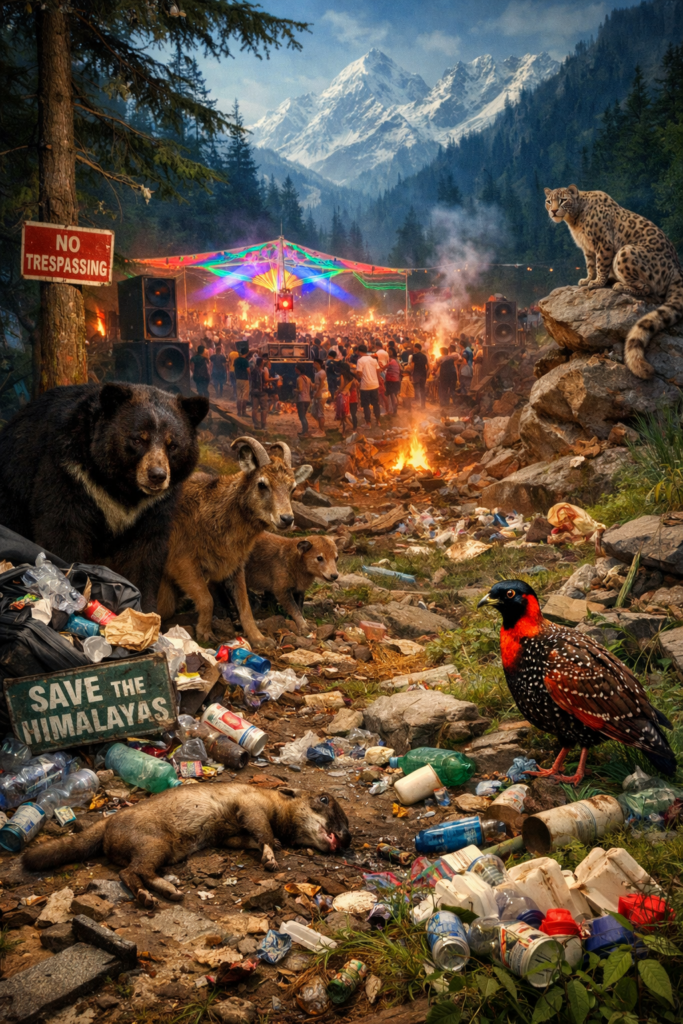
Every weekend, the ritual repeats. Organizers set up massive sound systems in remote forest clearings. DJs fly in from around the world. Tickets sell for thousands of rupees, promising “transcendence” and “connection with nature” while systematically destroying the very ecosystem they claim to celebrate.
Rave parties often leave behind trails of litter, including plastic waste and other pollutants, which disrupt the natural beauty and biodiversity of the region.
But here’s what the promotional videos don’t show: the Himalayan brown bears abandoning their dens mid-hibernation. The musk deer fleeing their breeding grounds. The Western tragopan, one of the world’s rarest pheasants, unable to hear its mate’s call over the electronic thunder.
A single night of music can undo years of natural balance. And in Parvati Valley, these nights are no longer rare ; they’re becoming the norm.
Species That Cannot Protest
Snow Leopards; The Ghosts Forced Into Exile
There are an estimated 400-700 snow leopards in India, and the number is thought to be falling owing to various challenges.
In the Great Himalayan National Park, which borders Parvati Valley, researchers have documented something heartbreaking: snow leopards altering their hunting patterns to avoid areas with persistent human noise. These apex predators, already critically endangered, are being pushed into smaller and smaller territories.
Snow leopards rely on silence. Their hunting success depends on hearing the alarm calls of blue sheep from over a kilometer away. Sound levels during peak periods can result in as much as a 70% reduction in the size of an area in which predators can hear their prey.
When rave parties shatter the mountain silence, these magnificent cats don’t just miss one meal. They miss dozens. Female snow leopards nursing cubs need to hunt successfully every 3-4 days. Prolonged acoustic disturbance during critical breeding seasons can mean the difference between survival and starvation for an entire litter.
Himalayan Monal; When Iridescence Fades into Noise
The Himalayan monal, Nepal’s national bird and a jewel of the Parvati region, faces a different crisis. These birds are typically found in alpine meadows and forests of rhododendron at elevations of 2100m to 4500m, where they forage for roots, insects, and berries.
During breeding season, male monals perform elaborate courtship displays accompanied by specific calls. But when bass frequencies from sound systems vibrate through the forest floor, these calls become meaningless static.
The most enticing calls are typically low-pitched, but some animals have been observed making their voices higher to compete with low-frequency noises. These less attractive vocalizations can lower the males’ ability to find and keep mates.
The result? Breeding pools shrink. Genetic diversity plummets. Population decline accelerates. All because birds cannot be heard over speakers blasting music that will be forgotten by sunrise.
Musk Deer; Poaching’s Perfect Cover
Musk deer require tough terrain with deep forest and plant cover, found at altitudes ranging from 2,500 to 4,500 meters in upper temperate, alpine scrub, and meadow zones.
The Himalayan musk deer, hunted nearly to extinction for its valuable musk gland, has found refuge in Parvati Valley’s remote corners. But rave parties create the perfect cover for poachers.
When 200 people are dancing in the forest at 2 AM, who notices one hunter with a crossbow? When generators roar and music pounds, who hears a gunshot? Illegal poaching and hunting for musk remains the greatest threat to musk deer in India.
Forest officials report that illegal activities spike during party weekends. The chaos provides camouflage. The distraction is deliberate. The consequences are permanent.
How Noise Pollution Rewrites Ecological Scripts
The science is unequivocal and devastating.
Field-based studies have provided considerable evidence that exposure to noise can cause a wide range of ecological impacts to wildlife, including changing spatial distribution and deterring wildlife from important feeding and breeding areas.
Breeding Patterns Disrupted
Timing is everything in the Himalayas. Animals breed during narrow windows when food is abundant and weather permits. Traffic noise has been found to affect communication behavior in breeding tree frogs and to be detrimental to breeding success or survival.
In Parvati Valley, rave parties often coincide with peak breeding season for multiple species. March through June ; prime party season for tourists ; is precisely when Himalayan tahrs give birth, when birds build nests, when insects pollinate wildflowers.
Chronic noise exposure during these critical periods doesn’t just annoy wildlife. It causes:
- Female animals abandoning nests or young
- Males unable to establish territories
- Disrupted hormonal cycles
- Increased infant mortality rates
- Complete reproductive failure in sensitive species
Studies on birds have shown that chronic noise exposure can lead to fewer nestlings surviving or even complete abandonment of nests.
The Nocturnal Catastrophe
Parvati Valley’s ecosystem depends heavily on nocturnal species. Bats, owls, leopards, civets ; these animals orchestrate the night shift, controlling insect populations, dispersing seeds, maintaining predator-prey balance.
Nocturnal and aquatic species have adapted to their low-light environments in different ways. Bats can echolocate, emitting calls at a certain frequency. Human-generated noises can disorient these animals.
When rave parties blast music all night:
- Bats cannot echolocate, leading to an 8% decline in hunting success per decibel increase
- Owls abandon hunting grounds, causing rodent population explosions
- Nocturnal pollinators miss flowering windows, disrupting plant reproduction
- Predators shift to daytime hunting, creating dangerous human-wildlife encounters
The night belongs to wildlife. Stealing it with artificial sound is ecological theft.
Physiological Stress
Perhaps most insidious is what we cannot see.
Animals in noisy environments show altered levels of stress hormones, which are linked to increased stress responsiveness. Extensive exposure to stress affects hair growth, accelerates aging, depletes energy, and negatively impacts cognitive function.
A Himalayan black bear exposed to repeated noise events experiences:
- Elevated cortisol levels for weeks
- Suppressed immune function
- Reduced fat reserves before hibernation
- Increased vulnerability to disease
- Shortened lifespan
Chronic stress weakens immune systems, reduces reproductive success, and alters behavior patterns. Animals may spend more time on high alert, diverting energy from essential activities like feeding and raising young.
This isn’t just discomfort. This is systemic biological disruption that cascades through generations.
Breaking the Law While Breaking the Silence
The legal framework is clear. The violations are flagrant. The enforcement is virtually non-existent.
Wildlife Protection Act, 1972: Paper Tiger
The Wild Life Protection Act provides absolute protection for critically endangered species like tigers, elephants, and leopards, with penalties including imprisonment for a period ranging from three to seven years with fines not less than 10,000 rupees.
The Great Himalayan National Park, a UNESCO World Heritage Site bordering Parvati Valley, has strict protected area regulations. The park supports an extremely diverse wildlife population enriched by 300 species of birds and 30 species of mammals.
Yet rave parties routinely occur within buffer zones of protected areas, violating:
- Section 27: Prohibiting activities that disturb wildlife in sanctuaries
- Section 29: Banning unauthorized construction and gatherings
- Section 38: Protecting critical wildlife habitats
Penalties? Rarely enforced. Convictions? Almost never. The gap between law and reality is where ecosystems die.
Forest Conservation Act
The Wildlife Act does not allow for any commercial exploitation of forest produce in both national parks and wildlife sanctuaries.
Rave parties involve commercial exploitation of forest land. They require:
- Tree cutting for stage construction
- Forest floor trampling for dance areas
- Water diversion for facilities
- Unauthorized entry into reserved forests
Each represents a violation. Each goes unpunished.
Noise Pollution Rules
India’s Noise Pollution (Regulation and Control) Rules, 2000, set clear limits:
- 50 decibels in silence zones
- 55 decibels in residential areas
- Complete ban on loudspeakers after 10 PM
Rave parties regularly exceed 100 decibels. They continue until dawn. They occur in areas designated as ecologically sensitive.
Authorities have been deploying police force in advance in parties that have permission (only sound permission, of course) till 10 pm, so that police presence is seen.
But here’s the dark truth: organizers know the rules. They just know enforcement is weak enough to ignore.
How Organizers Bypass the System
The rave party industry has perfected the art of legal evasion.
The Permission Shell Game: Organizers apply for “cultural event” permits or “wedding celebrations,” then host full-scale raves. By the time authorities investigate, the event is over.
The Private Land Loophole: They claim events occur on “private property,” even when that property borders protected forests. Legal ambiguity creates enforcement paralysis.
The Bribery Network: The valley is infamous for the open sale and consumption of drugs. Where drug trade thrives, corruption follows. Local officials often look the other way for the right price.
The Social Media Ambiguity: Events are marketed on Instagram and Facebook with vague locations, announced hours before they begin, making advance planning by authorities nearly impossible.
The Foreign Tourist Shield: Many party-goers are international tourists. Authorities hesitate to take strong action, fearing damage to tourism reputation.
The system isn’t broken. It’s been deliberately exploited.
Tourism or Exploitation
Parvati Valley faces an existential question: Can it be both a tourist destination and an ecological sanctuary?
Responsible Eco-Tourism vs. Destructive Rave Culture
Compare two types of visitors:
The Eco-Tourist:
- Hikes designated trails
- Camps in approved sites
- Carries waste out
- Respects wildlife viewing guidelines
- Contributes to local economy through sustainable businesses
- Leaves minimal ecological footprint
The Rave Tourist:
- Tramples unmarked terrain
- Parties in restricted areas
- Leaves behind tons of waste
- Creates maximum disturbance during sensitive hours
- Money flows to external organizers
- Leaves permanent ecological damage
The ban on parties in Parvati Valley reflects a broader trend of balancing tourism with sustainability, aiming to restore the valley to a place of peace and natural beauty.
The choice isn’t between tourism and conservation. It’s between sustainable tourism that preserves what makes Parvati special, and extractive tourism that destroys it.
The Marketing Lie
Travel websites promise “authentic Himalayan experiences” while showing photos of crowded dance floors. They sell “connection with nature” through events that sever that connection for everyone else.
The valley is being marketed as:
- “India’s Mini Israel”
- “Stoner’s Paradise”
- “The Rave Capital of the Himalayas”
Kasol, often referred to as “Devbhoomi” or the Land of Gods, holds deep spiritual significance in Hindu culture, yet the region’s sacred identity is being overshadowed by a party-centric image.
This branding attracts exactly the wrong kind of visitor ; those seeking intoxication, not inspiration. Those wanting to escape nature, not experience it.

Local Communities
The human cost is as real as the ecological one.
The Livelihood Dilemma
Local residents face impossible choices. Many depend on tourism for income. Some have opened guesthouses, restaurants, and trekking businesses. When rave culture becomes dominant, they must either:
- Participate in an industry they know is destructive
- Lose income to those willing to facilitate parties
- Watch their community’s character erode
- Remain silent about environmental damage
One local guesthouse owner shared: “These parties bring money, yes. But they bring problems too. Our children see drugs openly. Our rivers fill with garbage. Our peace is destroyed. But if we speak against it, other villages get the business.”
Cultural Erosion
The influx of tourists, particularly for rave parties, has raised concerns about whether the region’s sacred identity is being overshadowed.
Parvati Valley’s indigenous communities have protected these forests for generations. Their traditional practices ; sacred groves, restricted harvesting seasons, wildlife respect ; created the biodiversity hotspot that now attracts tourists.
Rave culture dismisses this heritage. Parties occur on sites of spiritual significance. Traditional agricultural land is trampled. Local festivals are overshadowed by commercial events.
The very people who preserved this ecosystem are being marginalized in decisions about its future.
The Safety Crisis
Beyond ecology, rave parties create immediate dangers:
- Increased drug overdoses requiring emergency evacuation
- Sexual assaults in isolated areas
- Accidents on mountain roads by intoxicated drivers
- Forest fires from carelessly discarded cigarettes
- Drownings in Parvati River by inebriated swimmers
Authorities warn that going near Parvati river, which is quite deep, especially under intoxication, can be dangerous.
Local resources ; police, medical facilities, rescue teams ; are stretched thin managing preventable crises caused by irresponsible tourism.
The Waste Crisis
If noise is the invisible pollutant, trash is the undeniable evidence.
The Morning After
After every rave party, the same scene repeats:
- Plastic bottles scattered across meadows
- Glass shards embedded in soil
- Food waste attracting and disrupting wildlife
- Abandoned camping gear tangled in bushes
- Human excrement near water sources
- Drug paraphernalia in children’s hiking areas
- Cigarette butts numbering in thousands
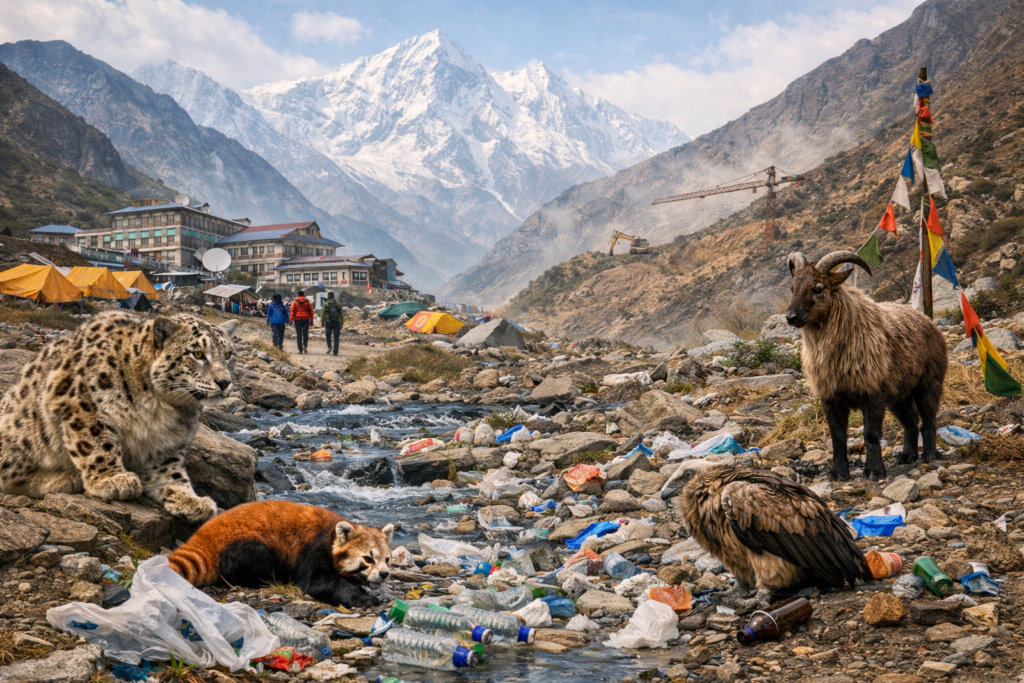
Trash, particularly non-biodegradable waste like plastic bottles, wrappers, and discarded party paraphernalia, began to accumulate in forests and along riverbanks.
Volunteer cleanup groups have removed over 5 tons of waste from a single post-party site. And that’s just the visible trash.
Chemical Contamination
The pollution runs deeper than plastic:
- Sunscreen and insect repellent chemicals wash into streams
- Battery acid from generators leaches into soil
- Diesel fuel spills from power equipment
- Alcohol and drug residues enter water systems
- Cleaning chemicals from portable toilets contaminate groundwater
These substances don’t disappear. They accumulate. They concentrate. They poison.
Long-Term Ecological Damage
Microplastics from decomposing bottles enter the food chain. Fish consume them. Birds feed contaminated fish to chicks. Predators accumulate toxins in their tissues.
The Parvati River, considered sacred and once pristine, now carries pollution downstream to the Beas River, which feeds agricultural land and drinking water supplies for hundreds of thousands of people.
What happens in the valley doesn’t stay in the valley. Poison flows downhill.
Why Authorities Struggle to Act
The enforcement failure isn’t just corruption. It’s structural.
Resource Constraints
Himachal Pradesh’s forest department is chronically understaffed. The department is deploying police force in parties that have permission till 10 pm to ensure police presence is seen.
The entire Parvati Valley region is monitored by:
- Fewer than 50 forest guards
- Limited vehicle access to remote areas
- No night-vision equipment
- Minimal legal authority to stop events in progress
- No real-time surveillance capabilities
One forest officer protecting 100 square kilometers of rugged terrain cannot prevent illegal parties. The math doesn’t work.
Legal Ambiguity
Events that technically violate environmental laws often exploit grey areas:
- Is a gathering of 50 people a “party” or a “private function”?
- When does amplified music become illegal noise pollution?
- How close to protected areas is “too close”?
- Who has jurisdiction when events span multiple administrative boundaries?
By the time legal questions are resolved, the evidence is gone and the damage is done.
Political Will Deficit
Tourism contributes significantly to Himachal’s economy. Politicians hesitate to impose strict bans that might reduce revenue.
The calculus is cynical but clear:
- Short-term economic gain from rave tourism: measurable, immediate
- Long-term ecological cost: diffuse, delayed
- Political consequences of environmental collapse: won’t happen before next election
Until that calculation changes, enforcement will remain inadequate.
What Real Solutions Look Like
The situation is urgent but not hopeless. Here’s what actually working would require:
Immediate Actions
Enforce Existing Laws: Before creating new regulations, simply enforce what’s already on the books. Issue real penalties. Pursue convictions. Make violations costly enough to deter.
Ban Amplified Sound After Dark: Implement and enforce a complete prohibition on loudspeakers, generators, and amplified music between 8 PM and 8 AM in ecologically sensitive zones.
Mandatory Environmental Impact Assessments: Require formal EIAs for any gathering over 25 people in protected area buffer zones. No assessment, no permission. No exceptions.
Real-Time Monitoring: Install acoustic monitoring systems at vulnerable points. When noise thresholds are exceeded, authorities receive automatic alerts and can respond immediately.
Systemic Reforms
Dedicated Eco-Police Units: Train and deploy specialized enforcement teams focused solely on environmental crimes in Parvati Valley.
Hefty Financial Penalties: Increase fines to meaningful levels. A ₹5,000 fine for noise pollution causing ₹50 lakhs in ecological damage is a joke. Make penalties proportional to harm.
Organizer Liability: Hold event organizers personally and financially responsible for all environmental damage. Require damage deposits upfront. Test soil and water before and after. Bill them for restoration.
Community Oversight: Empower local panchayats with legal authority to approve or reject events. Give those who know the land best a voice in protecting it.
Tourism Licensing: Create a tiered permit system for tourism businesses. Those following sustainable practices get preferential status. Those facilitating illegal activities lose licenses.
Long-Term Vision
Rebranding Parvati Valley: Shift marketing from “party destination” to “biodiversity sanctuary” and “eco-tourism pioneer.” Target a different visitor demographic.
Alternative Livelihoods: Invest in training locals as wildlife guides, conservation educators, and sustainable tourism operators. Make protecting nature more profitable than destroying it.
Buffer Zone Management: Establish clear boundaries where certain activities are prohibited, others are allowed with restrictions, and everything is monitored.
Scientific Research: Fund ongoing biodiversity monitoring to document recovery or continued decline. Use data to inform policy.
Public Awareness: Education campaigns targeting both visitors and residents about why these rules matter and what’s at stake.
The Choice We Face
Here’s the uncomfortable truth: We cannot have both unrestricted rave culture and thriving biodiversity in Parvati Valley. The two are mutually exclusive.
Every decibel of bass that reverberates through the mountains is a communication call that wildlife cannot hear. Every strobe light that pierces the darkness is a navigation system disrupted. Every piece of trash left behind is a habitat degraded. Every party that continues is an ecosystem pushed closer to collapse.
The Himalayan monal doesn’t care about your transcendent dance experience. The snow leopard doesn’t understand your need to “connect with nature” through electronic music. The musk deer cannot petition the government. The rivers cannot vote.
Nature doesn’t negotiate. It either thrives or it dies. Right now, in Parvati Valley, it’s dying to the beat.
A Record for the Future
When future generations ask what happened to Parvati Valley’s biodiversity, the answer will be documented in articles like this. They’ll read about:
- The snow leopards that vanished because we valued parties over predators
- The Himalayan monals that stopped breeding because beats drowned out their calls
- The musk deer hunted to extinction under cover of electronic music
- The forests that became garbage dumps for a generation’s hedonism
- The sacred valley that was marketed, monetized, and destroyed
They’ll ask: “Didn’t you know? Didn’t you see what was happening? Why didn’t you stop it?”
This article is the answer. Yes, we knew. Yes, we saw. The question is: Will we stop it?
The valley doesn’t need more bass drops. It needs silence. It needs darkness. It needs space for wild things to be wild.
It needs us to care more about what we’re destroying than what we’re enjoying.
Because once the music stops, once the parties end, once the tourists move on to the next trendy destination, Parvati Valley will still be here. Or rather, the land will be here.
But the life? The biodiversity that took millions of years to evolve? The delicate balance of predator and prey, pollinator and plant, silence and sound?
That might be gone forever.
Your Move
If this article made you uncomfortable, good. It should.
If it made you angry, better. Direct that anger at change.
If it made you want to act, best. Here’s how:
Report Illegal Parties; If you witness events violating environmental laws, document and report them to the Himachal Pradesh Forest Department and Wildlife Crime Control Bureau.
Support Sustainable Tourism; Choose eco-certified accommodations, hire local guides committed to conservation, and practice leave-no-trace principles.
Spread Awareness; Share this article. Tag your friends who love Parvati Valley. Make noise about silence.
Demand Accountability; Contact your elected representatives. Ask what they’re doing to protect biodiversity in ecologically sensitive areas.
Refuse to Participate; Don’t attend illegal rave parties. Don’t support businesses that facilitate them. Vote with your wallet.
The beats will eventually stop. The question is: Will there be any biodiversity left to hear the silence?
Related Articles:
- Himalayan Wildlife Under Threat: Climate Change and Human Impact
- Sustainable Tourism in India: Success Stories and Lessons Learned
- The Economics of Eco-Tourism: Why Conservation Pays
Comments from Nikhil Raj Sharma, Founder – Himalayan Geographic
“The situation in Parvati Valley represents a critical juncture for environmental conservation in India. We’ve reached a point where the choice between short-term economic gain and long-term ecological preservation couldn’t be clearer.
As someone who has documented the Himalayas for over a decade, I’ve witnessed first-hand the degradation happening in real-time. The rave culture isn’t just another tourism trend ; it’s an ecological emergency that demands immediate intervention.
What disturbs me most is the silence. Where are the environmental organizations? Where is the scientific community? Where are the conservation voices that should be screaming about this crisis? Wildlife doesn’t have lobbyists. Ecosystems don’t have PR teams.
Through Himalayan Geographic, we’re committed to being that voice. This isn’t clickbait environmentalism. This is documentation of destruction that will serve as evidence when future generations ask what happened to their natural heritage.
I urge everyone reading this to understand: Parvati Valley’s biodiversity isn’t a resource to be consumed. It’s a trust we’ve inherited, a responsibility we must honor. Every snow leopard, every monal, every ancient tree ; they have more right to be there than any bass speaker ever will.
The time for gentle suggestions has passed. We need enforcement. We need accountability. We need people to care more about what they’re losing than what they’re missing at a party.
Himalayan Geographic will continue investigating, documenting, and exposing environmental crimes in protected areas. Because somebody has to. And if not us, then who?”
Disclaimer
The content and images published in this article are provided for general informational and educational purposes only. Some images may be generated or enhanced using artificial intelligence (AI) and are intended solely for illustrative use. The views, interpretations, and information expressed do not necessarily reflect the official position of Himalayan Geographic Research Foundation, nor do they constitute professional, legal, medical, or financial advice.
While efforts are made to ensure accuracy, no guarantees are given regarding completeness or reliability. Readers are encouraged to independently verify information and use their own judgment. By reading this article, you acknowledge that any reliance on the content is at your own risk, and Himalayan Geographic Research Foundation assumes no responsibility or liability for disagreements, interpretations, or outcomes arising from its use. If you do not agree with these terms, you are advised to discontinue reading.
