
Bhutan’s Education is undergoing its biggest transformation in 60 years. Discover how the Cambridge curriculum, GNH values, and 21st-century skills are reshaping young Bhutanese minds; without losing their roots.
Did you know that Bhutan went 60 full years without a single internationally recognized school qualification? That changes now. In a bold and historic move, Bhutan’s Ministry of Education and Skills Development has completed aligning the national curriculum with Cambridge International standards; a move that will affect every single school in the country starting from the 2026 academic year.
This isn’t just a policy update. This is a revolution. And it’s one that the tiny Himalayan kingdom is pulling off while doing something almost no other country has managed; keeping its ancient soul intact.
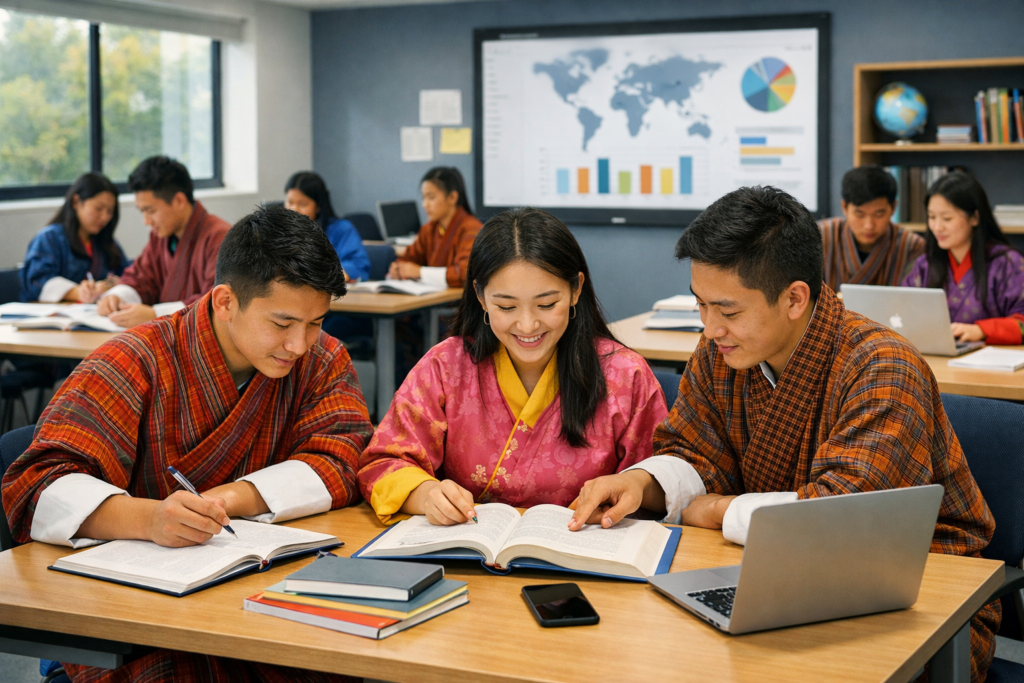
Why Bhutan’s Education Needed a Serious Upgrade
For decades, Bhutan’s education system ran on a simple, familiar engine: memorize, reproduce, pass. Students crammed facts into their heads, answered exam questions, and moved on; without ever being asked to question, create, or solve a real-world problem.
Bhutan’s Education Minister, Yeezang De Thapa, said it plainly: “Everyone questions the quality of education. During our time, if any foreign party asked about the quality of our education, we did not have an accurate answer.” That’s a striking admission. But it’s also the first step toward something remarkable.
The GNH (Gross National Happiness) survey; Bhutan’s unique national wellbeing index; found that education was scoring the lowest among all nine domains of national happiness. Citizens didn’t feel that the school system was truly making their lives or their children’s futures better. Something had to change.
The Cambridge Partnership
Here’s a number that will surprise you: 163 out of 193 United Nations member countries already follow the Cambridge curriculum framework. Over 10,000 schools worldwide use it. Bhutan was not among them; until now.
In early 2024, the Ministry of Education and Skills Development (MoESD) began a formal partnership with Cambridge University Press & Assessment. Cambridge experts visited Bhutan in March–April 2024 to assess the existing curriculum. What they found was mixed. For Grades I to VIII, Bhutan’s curriculum was already partially aligned with Cambridge standards in subjects like Maths, English, and Science. But for Grades IX to XII; the critical years; there were significant gaps.
The new plan is sweeping. It covers four key areas:
- Curriculum alignment across all grades, with the biggest changes in Grades IX–XII
- Assessment reform: The Bhutan Higher Secondary Education Certificate (BHSEC) will now be co-branded with Cambridge International, giving it global recognition
- Teacher training: Workshops, seminars, and online tools to prepare educators for the new system
- International accreditation: For the first time, Bhutan’s education system will earn a globally recognized stamp of quality
The education minister called it “a historic milestone in the history of education.” It’s hard to argue with that.
Watch this BBS documentary to see how Bhutan’s classrooms are changing: https://www.youtube.com/results?search_query=Bhutan+Education+Reform+BBS
“Locally Rooted, Globally Competent”
Here is where Bhutan’s story gets truly special. Most countries that adopt international curricula lose something in the process; local language, local knowledge, local identity. Bhutan refuses to let that happen.
His Majesty The King’s vision, enshrined in the Royal Education Kasho, is that Bhutanese children must be “locally rooted and globally competent.” These are not just beautiful words. They are the guiding principle behind every decision in this curriculum reform.
Dzongkha; Bhutan’s national language; is being aligned with Cambridge literature standards, not dropped. Cultural studies remain central. Buddhist values, community vitality, and ecological awareness; all core to Bhutan’s GNH philosophy; are woven into the new framework. Curriculum developers are not simply copy-pasting Cambridge materials; they are contextualizing every lesson to make it Bhutanese.
“Our goal is to deliver a curriculum that nurtures competent, values-driven citizens who can contribute meaningfully to Bhutan’s future while confidently engaging with the rest of the world.”; Education Minister Yeezang De Thapa
That is not a political slogan. That is a road map.
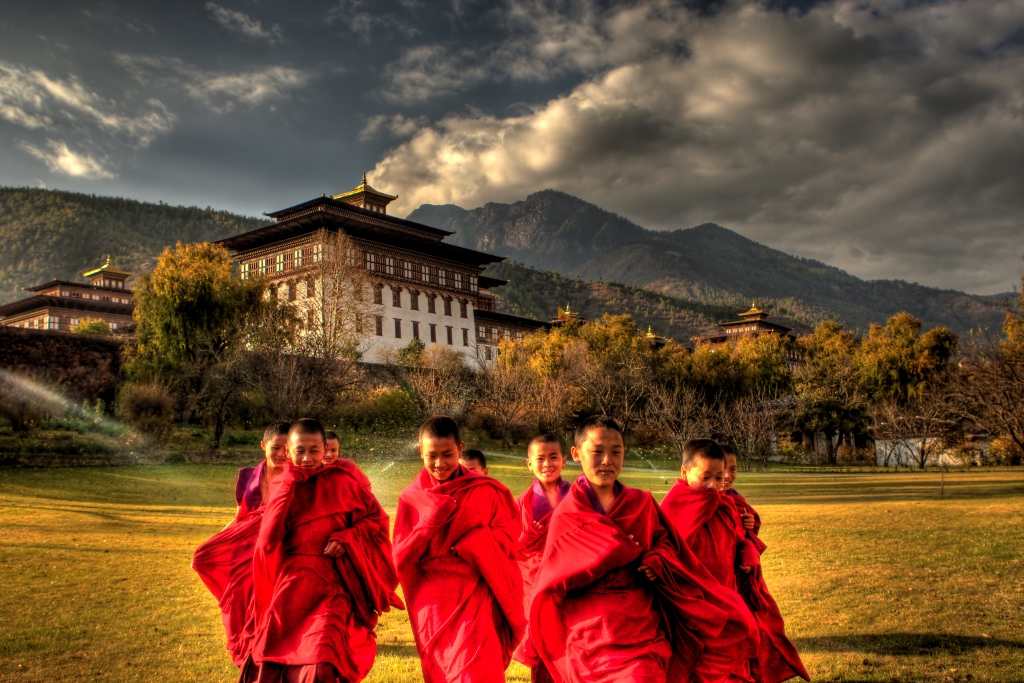
What’s Actually Changing in the Classroom?
From Rote Learning to Real Thinking
The most visible change will be inside the classroom. Instead of memorizing answers, students will be asked to think. Cambridge’s approach is built around critical thinking, problem-solving, creativity, and analytical skills. A student won’t just learn what happened; they’ll be asked why it happened and what they would do about it.
Think of it like the shift from watching a cricket match to actually playing one. You learn so much more when you’re on the field.
103 New Textbooks and Teachers Working Weekends
This transformation is happening fast. The MoESD is developing 103 brand new textbooks aligned with the Cambridge framework; all to be ready for the 2026 academic year. Curriculum developers and teachers are working weekends to get it done. Even the Cambridge team has been responding to emails on Saturdays and Sundays to support them.
That level of commitment from both sides speaks volumes about how serious this reform is.
A Grading System That the World Recognizes
Right now, if a Bhutanese student applies to a university in Singapore, the UK, or Canada, they face an instant problem: their BHSEC qualification is unknown. Admissions officers don’t know what to make of it. Under the new system, the BHSEC will be co-branded with Cambridge International. Universities worldwide will immediately recognize and trust it. That opens doors that have been shut for Bhutanese students for 60 years.
The Role of Community in Bhutan’s Education
Bhutan has always understood something that the rest of the world is slowly rediscovering: education doesn’t happen only in classrooms. The GNH framework places enormous value on community vitality; the idea that families, villages, and traditions are just as much teachers as any textbook.
The new curriculum reform explicitly involves teachers, school leaders, parents, curriculum experts, and community stakeholders in its design. This is not a top-down command. It’s a community conversation.
Pelkhil School in Thimphu already piloted the Cambridge curriculum and reported strong improvements in student engagement and learning outcomes. Teachers there noted that students who completed Cambridge-aligned courses made much smoother transitions into universities around the world. That pilot is now the blueprint for the entire nation.
Related reading from UNICEF Bhutan on the National Education Assessment 2024: https://www.unicef.org/bhutan/reports/national-education-assessment-2024
Honoring Indigenous Knowledge in a Digital Age
One of the most inspiring parts of this story is how Bhutan is refusing to let modernization erase traditional wisdom. In a world where a 10-year-old in Tokyo or Toronto can learn about any subject from YouTube in minutes, Bhutan is asking: what does our ancient, mountain culture know that the internet doesn’t?
The answer is more than you might think. Sustainable agriculture rooted in Buddhist ecological principles. Architectural wisdom passed down through generations of Dzong builders. Oral traditions that carry centuries of storytelling, philosophy, and community knowledge. The GNH framework; Bhutan’s unique gift to the world; measures happiness not just by income or test scores, but by spiritual wellbeing, cultural resilience, and ecological health.
The Cambridge alignment doesn’t throw any of this away. It gives Bhutanese students the tools to share this wisdom with the world; in a language the world understands.
What Bhutan Is Teaching the World
It’s worth pausing to appreciate how counterintuitive Bhutan’s story is. Here is a small, landlocked country of fewer than 800,000 people, nestled in the Himalayas, with a GDP smaller than many city budgets; and it is leading the world in asking the most important educational question of our time.
What is education actually for?
Is it for passing exams? For getting a job? For earning money? Or is it for building a life with meaning, contributing to your community, protecting your environment, and being happy; truly happy?
Bhutan’s answer, backed by decades of GNH research, is: all of the above, and none of them alone. The Cambridge framework gives students global competencies. The GNH values give them purpose. And the Bhutanese community gives them roots.
That combination; rigorous skills plus human values plus community belonging; is exactly what 21st-century education experts around the world are calling for. Bhutan is already doing it.
What Comes Next?
The 2026 academic year will be the true test. New textbooks. New assessments. Newly trained teachers. An entirely new way of measuring student learning; focused on authentic outcomes, not rote recall.
Here is what to watch for:
- How Dzongkha and cultural subjects are woven into the new Cambridge-aligned framework
- Whether rural and remote schools receive the same quality of implementation as urban ones
- How the BHSEC co-branding impacts Bhutanese students’ success in global university applications
- Whether the GNH wellbeing indicators in schools improve alongside academic performance
The Ministry of Education is working alongside Singapore institutions to also introduce Multi-Pathway Education at Gedu College of Business Studies; offering diplomas in Agriculture Entrepreneurship, Healthcare Services, and Aviation Operations beginning August 2026. Vocational education (TVET) will also be available from Grade VIII onward, giving every student a meaningful pathway forward.
Learn more about Bhutan’s education reforms from The Bhutanese: https://thebhutanese.bt
A Message to Every Parent, Teacher, and Young Person in the Mountains
Bhutan’s education story is not just for Bhutan. It’s for every Himalayan community; in India, Nepal, Tibet, Sikkim, Arunachal Pradesh; that is watching its children caught between two worlds. Between tradition and technology. Between the wisdom of grandparents and the demands of a global economy.
The lesson from Bhutan is this: you don’t have to choose. You can honour what your ancestors knew, teach your children what the world requires, and build something new that is entirely and beautifully your own.
That is the real renaissance. And it is happening right now, in the mountains, one classroom at a time.
Related Articles You Might Love
- The GNH Index: How Bhutan Measures Happiness Instead of Just Growth
- Himalayan Schools and the Fight to Preserve Indigenous Languages
- How Community-Led Learning Is Changing Rural Education Across South Asia
- STEM Education in the Mountains: Bhutan’s New Multi-Pathway Classrooms
Comments from Nikhil Raj Sharma, Founder ; Himalayan Geographic Research Foundation
“What Bhutan is doing right now is nothing short of extraordinary. For decades, we have watched our Himalayan communities struggle to find the balance between preserving who they are and preparing for a world that moves faster every year. Bhutan’s approach; anchoring global curriculum standards in GNH values and community identity; is exactly the model that HGRF believes in. We are not meant to erase our roots to grow. We are meant to grow from them.”
“At Himalayan Geographic Research Foundation, we celebrate this moment. The courage it takes for a small nation to say ‘our children deserve world-class education AND they deserve to know who they are’; that courage is what the entire Himalayan region needs right now. This story must be shared widely. Our mountains have wisdom the world needs, and now, our children will have the tools to share it.”
“I personally believe that the King of Bhutan’s phrase; ‘locally rooted and globally competent’; should become the guiding principle for every school in the Himalayan belt. That is the HGRF vision. That is the future our children deserve.”
Disclaimer: The content and images published in this article are provided for general informational and educational purposes only. Some images may be generated or enhanced using artificial intelligence (AI) and are intended solely for illustrative use. The views, interpretations, and information expressed do not necessarily reflect the official position of Himalayan Geographic Research Foundation, nor do they constitute professional, legal, medical, or financial advice.
While efforts are made to ensure accuracy, no guarantees are given regarding completeness or reliability. Readers are encouraged to independently verify information and use their own judgment. By reading this article, you acknowledge that any reliance on the content is at your own risk, and Himalayan Geographic Research Foundation assumes no responsibility or liability for disagreements, interpretations, or outcomes arising from its use. If you do not agree with these terms, you are advised to discontinue reading.
