
The Himalayan tipping point is no longer a theory. Ice is melting twice as fast, lakes are multiplying, and floods are getting deadlier. Here are 7 warning signs from Nepal, Bhutan, India, and Tibet, backed by real science, real disasters, and real people.
On August 5, 2025, the small village of Dharali in Uttarakhand was celebrating. It was festival day. Families had gathered to offer fresh milk to their local deity. Election results were being announced. Then, at around 1:30 PM, a wall of mud and water came down the valley and erased a large part of the village in minutes. Scientists are still debating whether a cloudburst, a glacier collapse, or a glacial lake burst caused it. But almost everyone agrees on one thing: this is what a Himalayan tipping point looks like from the ground.
A “tipping point” is not just a scary phrase. It means a system has changed so much that it cannot go back to how it was before, at least not in a human lifetime. New data suggests the Himalayas may be crossing exactly that kind of line. Glaciers are shrinking twice as fast as they were in the year 2000. Snow that should stay on peaks for months is vanishing early, four years running. And glacial lakes, some with no name at all, are turning into flash-flood factories above villages that had no warning.
This is not one bad monsoon. It is a pattern. And in this article, we walk through seven signs from Nepal, Bhutan, India, and Tibet that show why scientists, governments, and mountain communities are all using the same word: alarming.
What Do Scientists Mean by a “Himalayan Tipping Point”?
The Hindu Kush Himalaya region stretches across eight countries. It holds more ice and snow than anywhere on Earth outside the two poles, which is why people call it the “Third Pole.” Over 60,000 glaciers sit here, feeding ten major rivers, including the Ganges, Indus, and Brahmaputra.
The International Centre for Integrated Mountain Development, known as ICIMOD, is the leading scientific body tracking this region. In 2023, its major HI-WISE report described the changes to Himalayan ice, snow, and permafrost as “unprecedented and largely irreversible.” That is a strong statement from a cautious scientific organisation, and it is why the word “tipping point” keeps showing up in serious research, not just headlines.
A tipping point does not always look dramatic on the day it happens. It looks like a lake that grows a little every year. Then one day, it does not grow a little. It bursts.
7 Alarming Signs the Himalayas Are Changing Fast
1. Glaciers Are Losing Ice Twice as Fast as Before
A landmark ICIMOD study released in 2026 found that Himalayan glaciers are now losing ice at double the rate seen since the year 2000. Global data backs this up. Glaciers outside Greenland and Antarctica lost 408 billion tonnes of mass in a single recent year, the second-highest loss ever recorded.
Even under a moderate warming path of 2°C, scientists say only about 25% of the Hindu Kush Himalaya’s glacier mass from 2020 would remain. Stay closer to 1.5°C, and the region could keep 40 to 45% of its ice. Every fraction of a degree genuinely matters here.
Source: ICIMOD press release, March 2026
2. Winter Snow Is Vanishing Before It Can Even Settle
Glaciers get the headlines, but snow is the quieter crisis. ICIMOD reported that snow persistence, meaning how long snow actually stays on the ground after it falls, was 27% below the long-term average in the winter of 2025-26. This is the fourth year in a row of decline, breaking the previous record set just one year earlier.
Only two river basins, the Ganga and the Irrawaddy, showed anything close to normal snow levels. Everywhere else, especially the Indus, Amu Darya, and Helmand basins, saw sharp drops. Less snow means less slow-release water for farms and rivers in the dry months.
Source: Down To Earth / ICIMOD, 2026
3. Thousands of New Glacial Lakes Are Forming Like Ticking Time Bombs
As glaciers melt, the water has to go somewhere. It pools into lakes in the hollows the ice leaves behind. A recent survey counted 19,300 glacial lakes across the Himalayas by 2020, nearly 1,700 more than in 1990. Some of these lakes have no official name and are not even on any danger list.
That is exactly what happened above Thame, a village of 370 people in Nepal’s Everest region. In August 2024, rockfall dropped into a small, unnamed lake above the village. Around 100 million gallons of water surged downhill within minutes, destroying the school, the medical clinic, two dozen homes, and the potato fields families depended on. Nobody died, only because the flood struck in daylight and people saw it coming in time to run.
Glaciologist Daniel Shugar of the University of Calgary compares this kind of collapse to a cannonball landing in a swimming pool, except instead of a splash, an entire wall of the pool gives way. Nawang Doma Sherpa, who lives near another threatened lake called Imja, put it simply: “In summertime, we don’t feel peace.”
Source: The New York Times, via Pulitzer Center, November 2025
4. Glacial Lake Floods Are Turning Deadlier
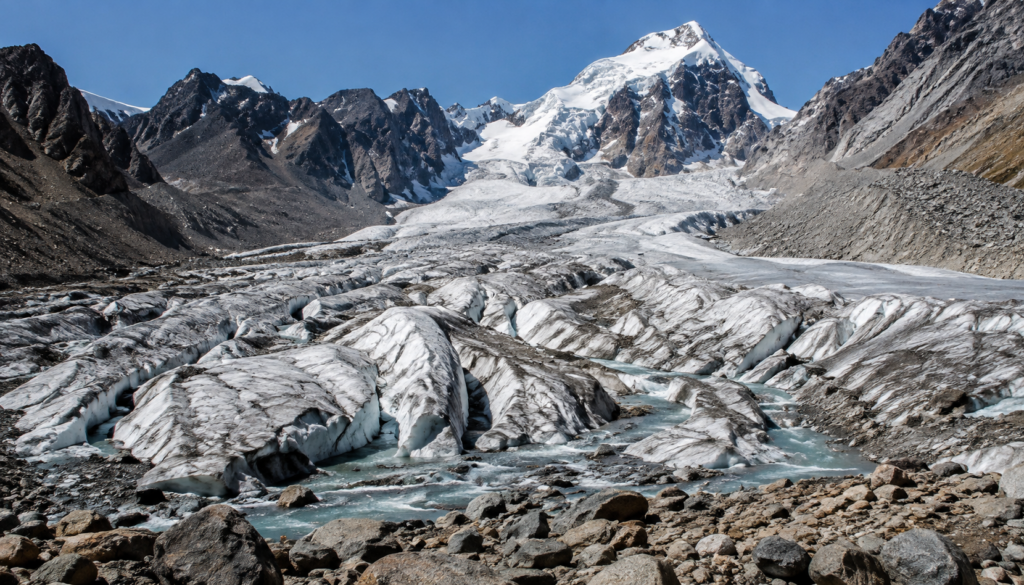
Nepal and India already have painful proof of how bad a glacial lake outburst flood, or GLOF, can get. On October 4, 2023, a chunk of frozen debris the size of a small town collapsed into South Lhonak Lake in Sikkim. It triggered a wave nearly 20 metres high that tore through the Teesta valley, destroyed a 1,200 MW hydropower dam, and killed dozens of people, with dozens more never found.
Bhutan is watching a similar disaster build in slow motion. Two lakes, Thorthormi and Raphstreng, are separated by a thin, crumbling wall of rock and ice. If that wall gives way, officials expect a flood nearly three times worse than Bhutan’s last major GLOF in 1994. Newcastle University researchers recently confirmed that this kind of risk is bigger and more widespread across Bhutan than previously mapped.
In July 2025, a similar lake on the Tibetan side of the border overflowed and killed at least 11 people. It had formed from nothing but a few small ponds only months earlier.
Sources: ICIMOD, 2025 and Newcastle University, 2026
5. Cloudbursts and Flash Floods Are Hitting Harder, More Often
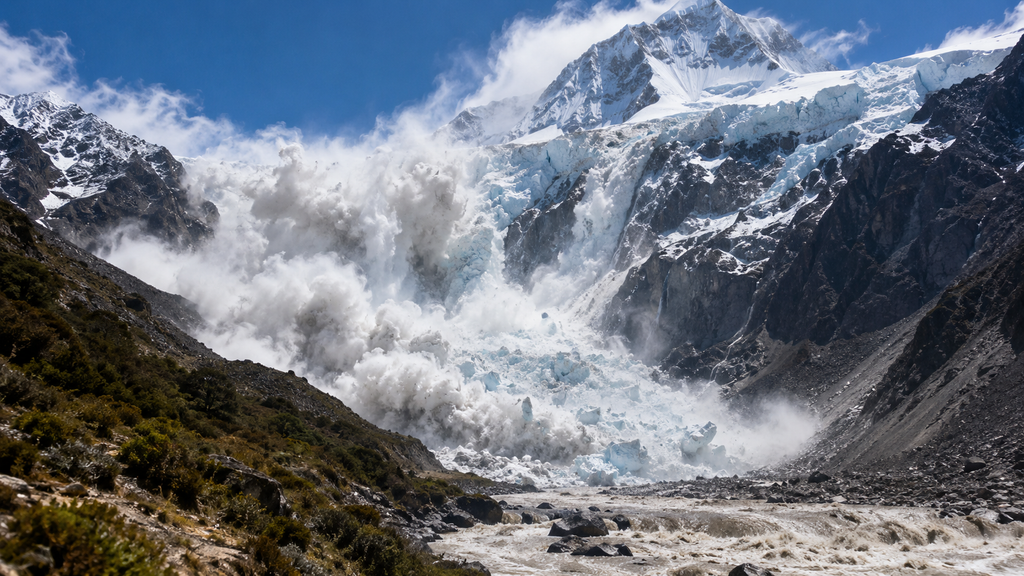
A warmer atmosphere holds more moisture, and mountains squeeze that moisture out fast. Anil Kulkarni, a distinguished scientist at the Indian Institute of Science, explains the physics plainly: “Higher temperature increases water holding capacity of the air.” When that moist air rises sharply against a mountain slope, it can dump enormous rainfall in under an hour.
This is not a one-off. Studies going back to 2017 already showed rising cloudburst frequency across the Western Himalayas. In 2025 alone, Jammu and Kashmir saw an unusually high number of cloudbursts, Himachal Pradesh’s Kullu and Shimla districts were hit hard, and Uttarakhand’s Dharali disaster made national headlines. The 2021 Chamoli disaster, where 27 million cubic metres of rock and ice broke off a peak and killed over 200 people, showed the same pattern from a different trigger: a hanging glacier that simply gave way.
Sources: Hindustan Times, August 2025 and The Xylom, 2025
6. Water Security for 2 Billion People Is Under Threat
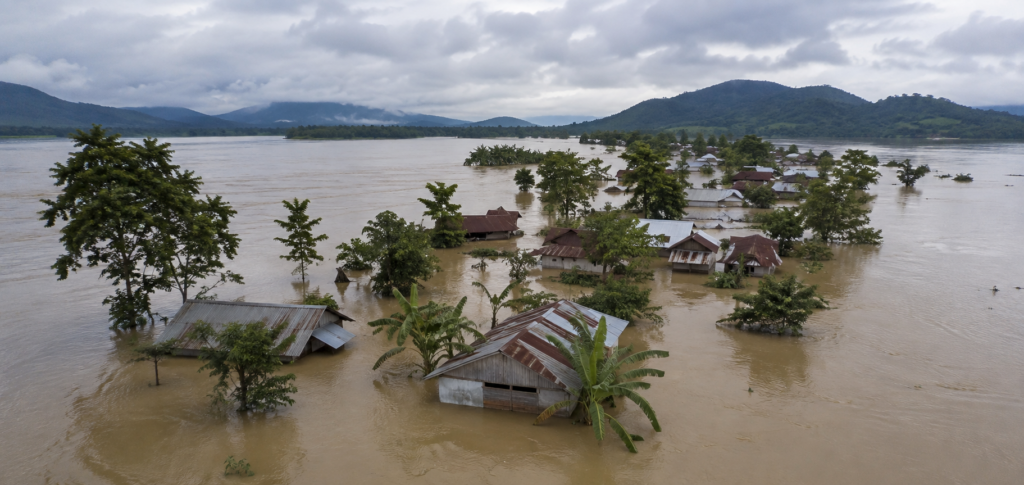
This is the part that goes beyond mountain villages. Glaciers and snow in this region feed rivers that nearly two billion people rely on for drinking water, farming, and electricity. As glaciers shrink and snow disappears earlier each year, that steady water supply becomes less predictable.
ICIMOD’s deputy chief has said losing this frozen water tower would create consequences “too vast to contemplate.” Researchers project that meltwater could actually increase for a while as glaciers shrink faster, then drop off sharply within a few decades, leaving farmers and cities with far less buffer during dry seasons.
This is not a future problem. It is already showing up as unpredictable river flows in Nepal, Pakistan, and northern India today.
7. Mountain Communities and Infrastructure Are Paying the Price
Every one of these signs eventually lands on real people and real buildings. The 2021 Melamchi flood in Nepal, triggered by a landslide dam breaking after heavy rain, destroyed 260 households, displaced 600 people, and caused an estimated 436 million dollars in damage, including serious harm to a drinking water project that took nearly three decades to build.
Hydropower has been hit especially hard. The Sikkim GLOF wiped out a major dam. The Chamoli disaster destroyed two under-construction hydropower plants. Roads, bridges, schools, and clinics across Uttarakhand, Himachal Pradesh, Nepal, and Bhutan keep showing up on the same list: built in the way of a flood path nobody had mapped yet.
A mountain that took thousands of years to freeze can come apart in one bad afternoon.
Are These Disasters Connected, or Just Bad Luck?
It is tempting to treat each flood as its own isolated tragedy. Bad rain here, unlucky geology there. But when you place ICIMOD’s glacier data, the snow persistence records, the growing lake count, and the disaster timeline side by side, a single, connected story starts to appear.
Warmer air melts more ice. More ice melt fills more lakes and softens more mountain slopes. Warmer air also holds more moisture, which fuels harder rainfall. Put these three things together in the steep, crowded valleys of the Himalaya, and the result is exactly what we have watched happen in Kedarnath in 2013, Melamchi in 2021, Chamoli in 2021, Sikkim in 2023, and Dharali in 2025.
This is what makes scientists uncomfortable using the word “coincidence” anymore.
Comment from Nikhil Raj Sharma, Founder, Himalayan Geographic Research Foundation
“I have watched these mountains for years, and I can tell you, they do not change quietly anymore. What used to take a generation now happens in a single monsoon. Our teams have walked valleys where a lake did not exist ten years ago, and villages where a school used to stand.
This is not a distant story about ice. It is about a shepherd in Bhutan, a headmaster in Nepal, a family rebuilding in Uttarakhand. The Himalayas hold water for two billion people downstream, and we are running out of time to treat that lightly.
At Himalayan Geographic, our job is to keep showing you what is actually happening up here, without exaggeration and without looking away. The mountains are talking, we just need to listen.”
What Is Being Done About It?
The response so far is a mix of hope and hard limits.
- Bhutan has spent years physically lowering the water level of its most dangerous lakes using hand tools, since heavy machinery cannot safely reach those slopes.
- Nepal built drainage channels at Tsho Rolpa and Imja lakes, and recently secured a 36 million dollar grant from the UN’s Green Climate Fund to do the same at four more high-risk lakes.
- ICIMOD and national governments across the region are pushing for better satellite monitoring, since many dangerous lakes, like the one above Thame, are too small or too remote for older tracking systems to catch in time.
- India’s disaster authorities have flagged 13 glacial lakes in Uttarakhand alone as high-risk, with five rated extremely dangerous.
None of this stops glaciers from melting. What it can do is buy time and save lives while the world decides how seriously to take global emissions cuts.
What Can You Do?
You do not need to live in the mountains for this to matter to you. Here is where an ordinary reader actually fits in:
- If you trek or travel in the Himalayas, check recent official advisories for your route, not just old blog posts.
- Support organisations doing real glacial lake monitoring and community early-warning work in Nepal, Bhutan, and India.
- Push for climate policy that takes the 1.5°C target seriously, since the difference between 1.5°C and 2°C could decide whether large parts of these glaciers survive this century.
- Share verified information, not panic. Misinformation about disaster causes slows down real rescue and research work.
Watch: Understanding the Melting Himalayas
For a deeper visual explainer on how Himalayan glacier melt is unfolding, this report is a useful watch.
For a closer, more recent look at how a single glacial lake destroyed a Nepali village, the New York Times’ visual investigation is worth your time.
Frequently Asked Questions
Is the Himalayan tipping point definitely happening, or is this exaggerated?
No single event proves a tipping point on its own. But ICIMOD, a cautious, government-backed scientific body, has directly called recent Himalayan changes “unprecedented and largely irreversible.” That is about as close to a direct answer as serious science gets.
What is a glacial lake outburst flood (GLOF) in simple words?
It is what happens when a lake formed by melting glacier ice suddenly breaks through its natural rock-and-debris wall, sending a huge, fast wave of water and mud downhill.
Which countries are most affected?
Nepal, India (especially Uttarakhand, Himachal Pradesh, Sikkim, and Jammu & Kashmir), Bhutan, and the Tibetan plateau are seeing the most frequent and severe events right now, though the whole eight-country Hindu Kush Himalaya region is affected.
Can these floods be predicted in advance?
Sometimes. Well-studied lakes like Imja have drainage systems and monitoring. But many dangerous lakes, including the one that hit Thame in 2024, are too small, new, or remote to be on any watch list yet.
References
- ICIMOD (2026). Hindu Kush Himalaya glaciers losing ice at double the rate since 2000.
- Down To Earth / ICIMOD (2026). Hindu Kush Himalaya sees record 27% drop in snow persistence.
- ICIMOD (2023). Landmark report on impacts of disappearing snow and ice in the Hindu Kush Himalaya (HI-WISE).
- ICIMOD (2025). New study confirms climate change played key role in 2023 South Lhonak (Sikkim) lake outburst.
- Wikipedia. 2021 Uttarakhand flood (Chamoli disaster).
- Shugar, D.H. et al. (2021). A massive rock and ice avalanche caused the 2021 disaster at Chamoli, Indian Himalaya. Science. Summarised via USGS.
- Wikipedia. 2021 Melamchi flood.
- Wikipedia. 2025 Uttarakhand flash flood (Dharali).
- The Wire (2025). Dharali floods: cause missing, early-warning system, scientists ask.
- The Xylom (2025). Extreme rainfall events pummel the Himalayas and California.
- BBS Bhutan (2025). Thorthormi–Raphstreng glacial lake outburst flood risk.
- Newcastle University (2026). Data suggests greater glacial flood risk faced by Bhutan.
- Gulley, J., Zhong, R., Erden, B. (2025). A Dead Glacier Is a Loss. A Dying One Is a Threat. The New York Times, via Pulitzer Center.
- Rajya Sabha TV. In Depth — Melting of Himalayan Glaciers.
- Gulf News (2025). Nepal holds tribute for disappearing glacier.
Related Articles for Further Reading
World Economic Forum — Why we need climate action to avert glacial lake outburst floods in Bhutan.
NASA Earth Observatory — Thorthormi Glacier Lake, Bhutan.
SANDRP — Uttarakhand’s Dharali disaster: human causes.
PBS NewsHour Classroom — Himalaya Glaciers Melting Away.
Kathmandu Post — ICIMOD warns glacier loss already extreme at 2°C.
Disclaimer: The content and images published in this article are provided for general informational and educational purposes only. Some images may be generated or enhanced using artificial intelligence (AI) and are intended solely for illustrative use. The views, interpretations, and information expressed do not necessarily reflect the official position of Himalayan Geographic Research Foundation, nor do they constitute professional, legal, medical, or financial advice.
While efforts are made to ensure accuracy, no guarantees are given regarding completeness or reliability. Readers are encouraged to independently verify information and use their own judgment. By reading this article, you acknowledge that any reliance on the content is at your own risk, and Himalayan Geographic Research Foundation assumes no responsibility or liability for disagreements, interpretations, or outcomes arising from its use. If you do not agree with these terms, you are advised to discontinue reading.
