
Himalayan culture is changing fast as homestays, cafes, and adventure tourism spread across Himachal, Ladakh, Sikkim, Nepal, and Bhutan. Real data, real voices, and honest questions on whether Devbhoomi can keep its soul while feeding the tourism economy that now feeds it back.
Seven thousand. That is roughly how many registered homestays now sit across just Himachal Pradesh and Ladakh, two Himalayan regions that had almost none twenty years back. In Kullu and Shimla districts, homestays already make up more than half of all guest accommodation. That is not a small side business anymore. That is a whole way of life changing, one guest room at a time.
I write this from Kullu myself, so I am not reporting from far away. I have watched a Kath-Kuni house two lanes from mine get pulled down and rebuilt in concrete, with a “Homestay; AC Rooms Available” board going up before the paint even dried. This article looks at what is really happening to Himalayan culture; the homes, the food, the festivals, the clothes, the language; as tourism stops being an outside visitor and becomes the main breadwinner of the house.
Why the Himalayas Are Having Their “Airbnb Moment”
Homestays did not explode by accident. Village families needed steady cash, tourists wanted something more personal than a hotel, and state governments needed a low-cost way to spread tourism beyond Shimla and Manali’s main streets. All three needs met at the same door.
A few numbers show the scale:
- Himachal Pradesh has around 4,500 registered homestays today, and tourism now contributes 7.78% of the state’s GDP, according to the Himachal Economic Survey 2024–25.
- Ladakh’s Leh and Kargil districts together have crossed 2,000 registered homestays, up from a handful when the Snow Leopard Conservancy first tried the idea to protect wildlife habitats.
- The Himachal government’s new Chief Minister’s Tourism Startup Scheme now gives interest subsidies of 3% to 5% to locals who build or upgrade a homestay, with tribal areas getting the highest support.
This is good news on paper. Money is reaching villages that never saw a rupee from tourism before. But the same growth is now asking a harder question: can a house still feel like a home, and can a valley still feel like itself, once it is built to be sold as an experience?
When Houses Stop Looking Like Home; The Kath-Kuni Story
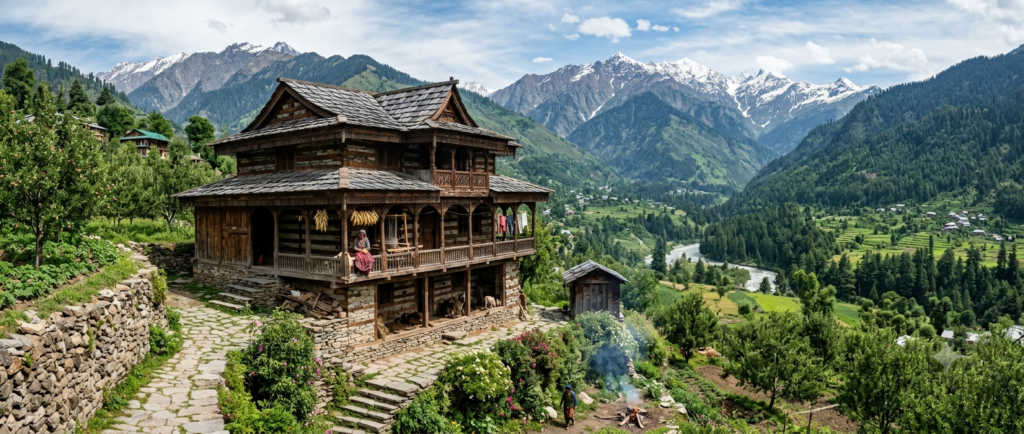
Kullu Valley’s old houses were not just pretty; they were smart. Kath-Kuni construction uses layers of deodar wood and dry stone, no cement, no mortar, and it survived the massive 1905 Kangra earthquake far better than newer buildings did, according to old Punjab gazetteer records.
Yet today, most new construction in the valley is concrete. Researchers studying the Kullu Valley have found that tourism itself is a big reason. Concrete guesthouses look “modern,” come up fast, and match what visitors expect from a hotel back home, so families building for the tourism trade skip the old style entirely.
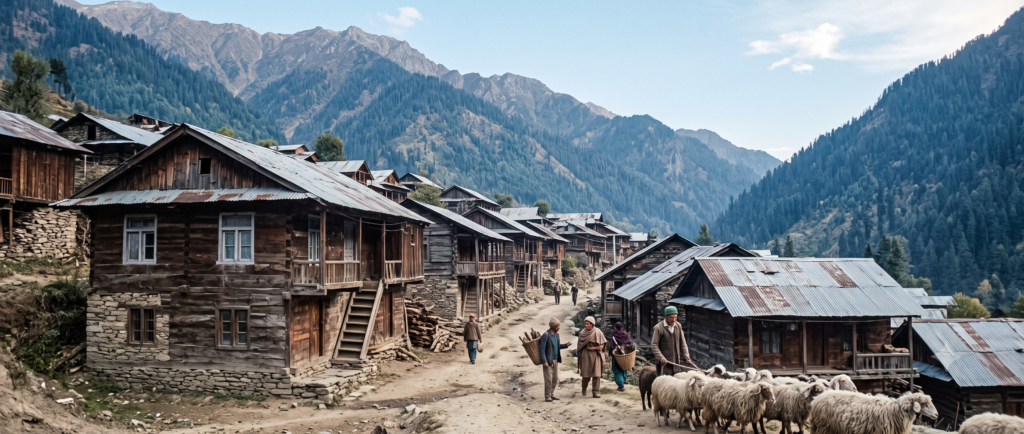
An architect quoted in a Hill Post report on Kullu’s changing skyline put it simply: old Kath-Kuni homes are going dilapidated while new concrete ones multiply, because the market rewards speed and shine over roots. Old Manali in the 1970s was a village of wooden, slate-roofed houses connected by a wooden bridge over the Manalsu stream. Almost none of that survives today.
There is a small pushback happening too. A new generation of Himachali architects is reviving Kath-Kuni for boutique resorts and homes, arguing that a style tough enough to survive a Richter 7.8 earthquake deserves better than being treated as backward. Some villages at higher altitude, where land is cheaper and aspirations are more local, still keep 80% of homes in the old style; proof that the shift is driven more by tourism-facing economics than by the technique failing.
If you want to see the technique itself, this short explainer on YouTube walks through how Kath-Kuni buildings are put together layer by layer.
Homestays, Women, and a Fragile High-Altitude Desert
Ladakh tells a slightly different story, because the homestay idea there was born out of conservation, not commerce. The Snow Leopard Conservancy started it so that villages living near snow leopard habitat had an income that did not depend on herding alone.
That idea has now scaled into the Ladakh Homestay Policy 2023, which gives every new homestay a standard kit; solar lights, bedding, kitchenware, signage; plus training in hospitality and eco-tourism. Padma Angmo, Assistant Director of Tourism in Leh, has said the goal is to pull tourists away from just Pangong and Tso Moriri lakes and into villages, so farmers earn from tourism without having to leave farming altogether.
That is the hopeful side. The other side is that researchers studying Ladakh call it an “explosive” growth story where the environment, water tables, and waste systems are under real strain, even as local pockets benefit financially. A 2025 policy brief from the Centre of Excellence for Himalayan Studies notes that Ladakh’s tourism and agriculture sectors are still not well coordinated at the administrative level, so gains in one area can create stress in another.
Ladakhi women, in particular, run a large share of homestays, giving them direct income and decision-making power in households where farming income alone often was not enough. That is a genuine, measurable social shift; not just a tourism statistic.
Sikkim, Nepal, and the Himalayan Kitchen Table
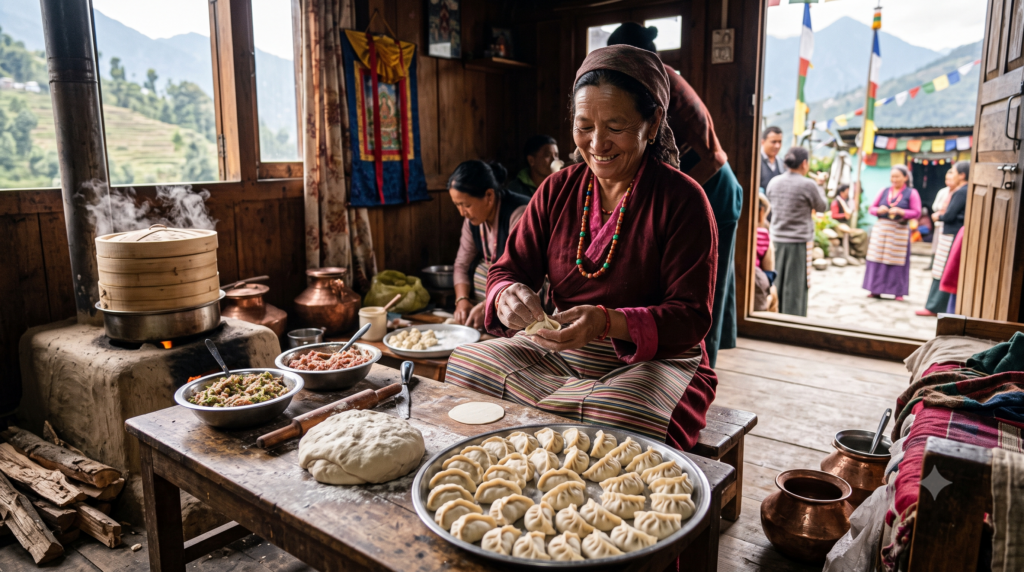
Move east, and the story is less about buildings and more about food and festival. Sikkim’s cuisine; thukpa, momo, gundruk, sinki, kinema curry; is a mix of Nepali, Tibetan, and Lepcha traditions, and homestays in villages like Kewzing and Ravangla are now built around exactly this: guests cooking and eating with the host family instead of ordering off a menu.
Festivals like Losar, Losoong, Saga Dawa, and Phang Lhabsol, which used to be purely community events, now double as tourist calendar dates. Sikkim Tourism itself markets trips timed around these festivals, which cuts both ways; more visibility for the tradition, but also more pressure to perform it on schedule for an audience rather than live it in its own time.
Dzongu in north Sikkim, kept reserved for the Lepcha community, shows one way to manage this tension: limited, permission-based entry that protects a smaller group’s culture from being overwhelmed even as tourism grows around it.
Bhutan’s Different Bet; Fewer Tourists, Higher Price
Bhutan looked at the same problem the rest of the Himalayas is facing now and picked a completely different answer decades ago: charge tourists a daily Sustainable Development Fee and deliberately keep numbers low. The fee, currently $100 a night for most foreign visitors (halved from $200 through September 2027 to help revive numbers post-pandemic), funds free healthcare, education, and cultural preservation directly.
It is not a perfect model; the higher fee did cut visitor numbers hard after 2022, and Bhutan is still adjusting the balance between income and openness. But it is proof that a Himalayan destination does not have to choose mass tourism as the only path. “High value, low volume” is now studied as a template by places from Iceland to Hawaii that are dealing with the same overcrowding worries Himachal and Ladakh face today.
The Café Culture Question; Old Manali and the New Aspiration
Here is the part that data does not fully capture but anyone living here can see. Old Manali and Bir now have more espresso machines than they have working water mills. Cafés with wifi passwords printed on menu cards have replaced the old dhabas that served rajma-chawal to truckers and pilgrims.
This is not automatically a bad thing. Local youth who used to migrate to Chandigarh or Delhi for jobs are now running these cafés, guesthouses, and trekking outfits themselves, right here in the valley. Tourism has genuinely slowed the “brain drain” out of the hills in a way that government schemes alone never managed. But it has also changed what young people in these towns aspire to be; fewer are learning the old crafts, the wood carving, the wool weaving, because a barista job or a homestay booking pays faster and looks more “with the times.”
Comment from Nikhil Raj Sharma, founder of Himalayan Geographic,
“I have been walking these mountains for close to fifteen years now, and I will say something that may not sound fashionable: tourism did not start the erosion of Himalayan culture. It only made it visible faster. Long before the first homestay board went up in Kullu or Leh, our young people were already leaving for Chandigarh, Delhi, and Dubai because there was no dignity in staying back.
Farming was hard, weaving was hard, and nobody was paying for either. Tourism simply arrived at a moment when the old economy was already thinning out, and it offered something the village could not refuse; quick, visible income.
What worries me is not that homestays exist. What worries me is the pace. A Kath-Kuni house takes a master carpenter years to learn and a season to build. A concrete guesthouse can come up in three months and rent out by the next tourist season. When speed becomes the only currency, culture always loses the race, because culture was never designed to be fast. It was designed to be repeated, generation after generation, slowly enough that people did not even notice they were passing something down.
In Kullu and Manali, tourism grew faster than any policy could keep up with, and that is exactly where you see the old wooden houses disappearing quickest. Bhutan chose the opposite path entirely; charge more, host fewer, protect more; and whatever one thinks of the fee, they have kept their festivals and their architecture largely untouched by comparison.
My own view, for what it is worth, is that the villages themselves need to hold the pen on this story, not the travel platforms and not the influencers. A family that runs a homestay should be treated as a custodian of that valley’s memory, not just a vendor of rooms.
That means real training, real building codes that respect local material, and real say for the community in how fast a village is allowed to grow. Without that, we will end up with valleys that look like postcards of themselves; pretty on Instagram, but hollow underneath, because the people who actually knew how to live there have quietly moved on or given up the old ways for something that pays faster.
I do not think it is too late. But I think the next ten years, not the next fifty, will decide which way this goes.”
Can Culture and Commerce Live Under the Same Roof?
What’s working:
- Direct household income from homestays, especially for women-run properties in Ladakh and Sikkim
- Slower rural-to-urban migration as tourism jobs open up locally
- Revival interest in old architecture styles like Kath-Kuni, driven partly by tourists wanting “authentic” stays
- Festival visibility bringing younger diaspora back to learn and participate
What’s at risk:
- Vernacular architecture disappearing faster than it can be documented
- Water stress and waste management in fragile zones like Ladakh and Spiti
- Local food habits shifting toward tourist-friendly menus, sidelining daily household cooking traditions
- Weak or delayed policy enforcement; Himachal’s own homestay portal, for example, was delayed over seven months before its February 2026 launch, and training programs for homestay owners have often existed only on paper
What Travellers Can Actually Do
- Choose registered homestays over “look-alike” resorts built purely for the tourist eye
- Ask before photographing people, homes, or rituals, especially in smaller Ladakhi and Sikkimese villages
- Eat what the host family eats instead of asking for pizza in a mountain village
- Spend a rupee more at the one shop still selling handwoven wool or local crafts, not just at the trendiest café
Final Word
Homestays and heritage are not actually enemies. The real danger is speed; culture changing faster than communities can decide, on their own terms, what to keep and what to let go. Himachal, Ladakh, Sikkim, Nepal, and Bhutan are each answering that differently, and there is no single right answer yet.
What do you think; can a Himalayan village stay itself while paying its bills through tourism, or is some change simply the price of survival? Share your own homestay or village experience in the comments below.
Related reads:
References:
- Himachal Pradesh Economic Survey 2024–25 (tourism = 7.78% of state GDP) — via Newspoint report on the Chief Minister’s Tourism Startup Scheme.
- “Homestays as Catalysts for Sustainable Tourism: Balancing Growth, Culture, and Conservation in Rural Himachal Pradesh” (4,500 registered homestays; Kullu/Shimla figures) — ResearchGate
- Himachal Pradesh Home Stay Rules 2025 / registration portal delay — Raacho Trekkers
- “Eco-Tourism Grows In Ladakh As Homestays Drive Cultural And Economic Change” (2,035 registered homestays across Leh and Kargil; Padma Angmo quote) — ETV Bharat
- “Livelihoods in Transition: Tourism and Agriculture in Ladakh” — Centre of Excellence for Himalayan Studies (Shiv Nadar University)
- “Science of Kathkuni Architecture in Himachal Pradesh” (Kullu concrete shift, aspiration/status angle) — ResearchGate
- “Tangible Changes In Traditional Kullu Valley Architecture” (architect Dhuni quote) — Hill Post
- “Traditional architecture: A concrete change is underway” (1905 Kangra earthquake data) — The Tribune
- “How Kullu Manali looked like before mass tourism hit it” (Old Manali 1970s photos) — Wildcone
- “A new school of Himalayan architecture taking shape” (80% villages still traditional) — ThePrint
- Sikkim food culture and homestays (Kewzing, Ravangla) — Sikkim Tourism official site
- Sikkim festivals (Losar, Losoong, Saga Dawa, Phang Lhabsol) — Bucket List Sikkim
- Bhutan Sustainable Development Fee, high-value-low-volume policy — TravelAge West
- Kath-Kuni architecture explainer video — YouTube
Disclaimer: The content and images published in this article are provided for general informational and educational purposes only. Some images may be generated or enhanced using artificial intelligence (AI) and are intended solely for illustrative use. The views, interpretations, and information expressed do not necessarily reflect the official position of Himalayan Geographic Research Foundation, nor do they constitute professional, legal, medical, or financial advice.
While efforts are made to ensure accuracy, no guarantees are given regarding completeness or reliability. Readers are encouraged to independently verify information and use their own judgment. By reading this article, you acknowledge that any reliance on the content is at your own risk, and Himalayan Geographic Research Foundation assumes no responsibility or liability for disagreements, interpretations, or outcomes arising from its use. If you do not agree with these terms, you are advised to discontinue reading.