
Trading ancestral land, culture and identity for quick money, Himachal Pradesh and Uttarakhand are facing over 1,700 ghost villages, a sinking Joshimath, and record landslides. Here is the full story with real data, real quotes and a way forward for 2026.
Would you sell your grandfather’s house for a one-time payment, even if it meant your children never see the mountain village where your family has lived for 300 years? Across Himachal Pradesh and Uttarakhand, this is not a hypothetical question anymore. It is happening every single week.
Trading land, language, and lifestyle for fast cash has become so common in these two Himalayan states that entire villages have gone silent. Uttarakhand alone now has more than 1,700 ghost villages, homes locked, fields empty, and no one left to answer when you knock. That number was only 1,034 in 2011. In just seven years it jumped by 734 more villages.
This article is not about blaming tourists or outsiders alone. It is about something harder to accept: local people are also choosing, willingly, to sell what cannot be bought back. Let’s look at how, and what can still be saved.
1. Selling Ancestral Land
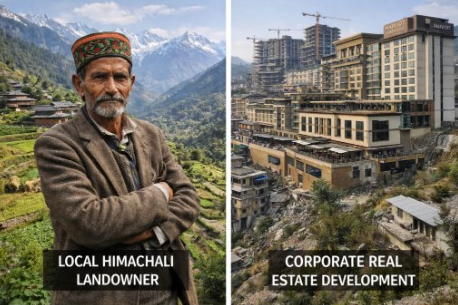
Himachal Pradesh has a law called Section 118 of the Tenancy and Land Reforms Act, 1972. It says a person who is not a farmer from Himachal cannot buy agricultural land without government permission. The law was made by the state’s first Chief Minister, Dr Y.S. Parmar, because nearly 90 percent of Himachalis depended on farming and small landholdings, and rich outsiders could easily buy them out.
But laws only work if people want them to work. In December 2025, the Himachal government tabled amendments that let non-farmers buy flats in RERA projects without any Section 118 permission, and lease rural buildings for commercial use for up to 20 years. Critics call this a slow way of removing the law without repealing it on paper.
Uttarakhand already shows where this road goes. In 2018, the state removed its upper limit on land purchases, letting outsiders buy up to 12.5 acres for tourism projects. The result: land prices in Nainital, Dehradun and Almora rose by 300 to 500 percent, pricing locals out of their own soil. A 2021 report found that half of Uttarakhand’s population is now of non-local origin.
Land is not just property in the hills. With only 14 percent of Himachal’s land being cultivable, and 60 percent of landholdings under 6 bighas, one bad sale can wipe out a family’s only source of food and income.
Himachal’s tribal district of Kinnaur goes even further, where no outsider, not even a Himachali from another district, can buy land at all. It is the strictest version of the same idea: once land here is gone, there is no getting it back, so the safest rule is to not let it go in the first place.
2. When Language, Farming and Homes Disappear Together
Here is a number that should worry every Pahadi family: a century ago, over 80 percent of Uttarakhand spoke Garhwali or Kumaoni. Today it is 40 to 50 percent, and both languages are now listed in UNESCO‘s Atlas of the World’s Languages in Danger.
Why is this happening? Mostly because of jobs, or the lack of them.
- Youth unemployment in Uttarakhand is around 20 percent, against a national average of 15 percent.
- Nearly 40 percent of graduates in the state cannot find work.
- The Migration Commission says half of all people who leave villages do so because farming and small trades no longer earn enough.
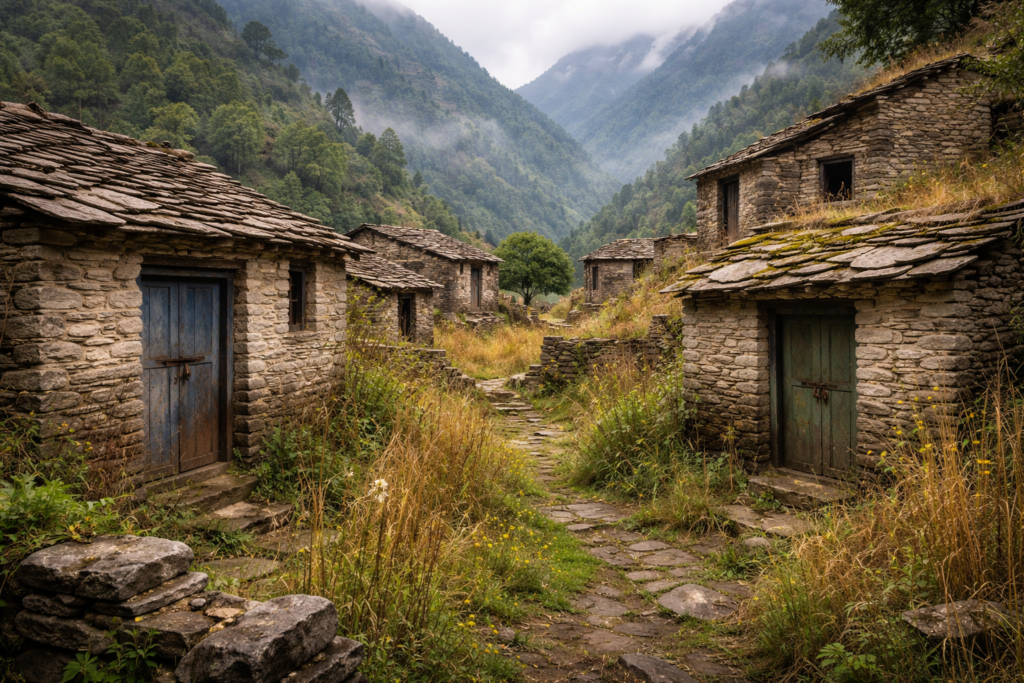
A reporter who collected these stories put it simply, saying traditional farming “is no longer viable.” Villages like Boundil in Pauri, once home to 60-65 families, are now down to a single elderly resident.
This is not only about jobs though. It’s about a family choosing city comfort over ancestral duty, generation after generation, until the choice becomes permanent. Local food habits are fading along with this shift. Dishes once cooked in every kitchen are now found mostly in old cookbooks, because the people who knew the recipes have moved to cities, and their children never learned them.
Watch this: Ghost villages of Uttarakhand: Can migration be reversed? — a ground-level documentary from Pauri Garhwal.
3. Tourism and Construction
Tourism brings money fast. It also brings crowds the mountains were never built for.
Take the Char Dham Yatra in Uttarakhand. Badrinath temple has a daily carrying capacity of just 12,000 to 14,000 people. Last year, over 22 lakh pilgrims visited during the season. In 2024, registrations crossed 12.48 lakh in the first seven days alone, compared to about 4 lakh in the same week the year before.
A detailed report by the SDC Foundation, based on 192 days of on-ground data, said the state government keeps celebrating record pilgrim numbers instead of managing the strain those numbers put on roads, water, and hospitals.
The same rush is visible in Himachal’s Kullu and Manali, where homes, hotels and highways have crept right up to the Beas riverbanks, from Manali down to Aut. Locals themselves have asked the government for years to channel the river properly, since flash floods keep damaging buildings built too close to the water.
The Forest Department has fined the National Highways Authority of India more than Rs 1.6 crore over the last few years for illegally dumping construction debris along the Beas during highway building.
This isn’t only an outsider problem. Many of these hotels and homestays are built and sold by local landowners chasing quick tourist money, often without checking whether the slope or riverbank beneath them can take the weight.

4. The Land Is Answering Back
Nature does not send warning letters. It sends landslides.
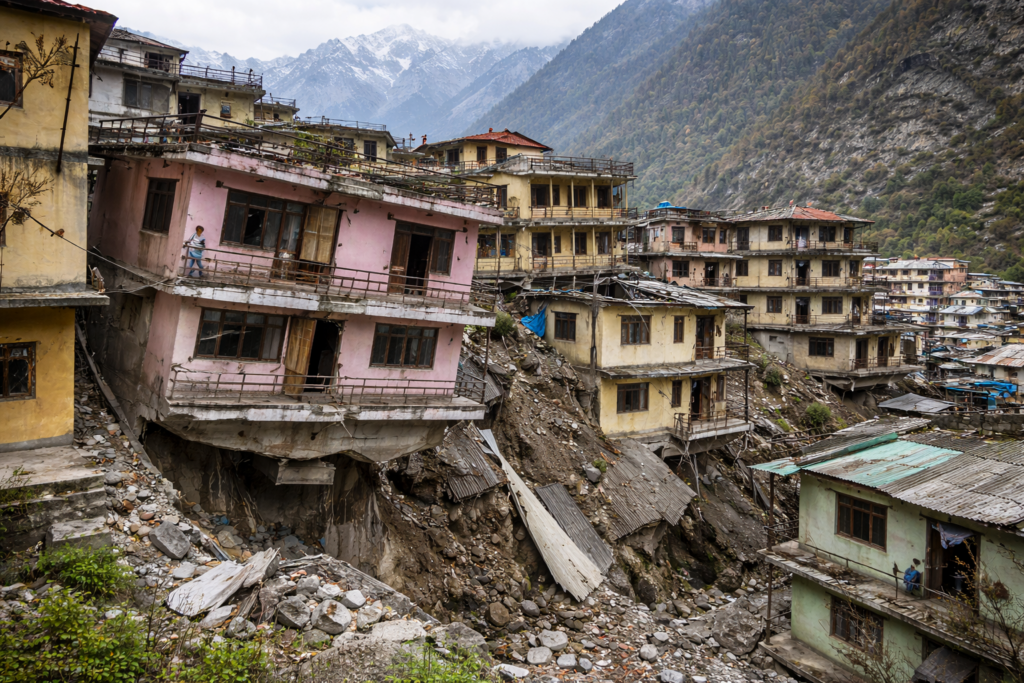
In July-August 2023, Himachal Pradesh recorded its worst monsoon disaster in years: 428 deaths, 5,748 landslides, and losses of around Rs 8,665 crore. A temple collapse in Shimla alone killed 20 people. In August 2025, another monsoon spell killed close to 179 more people.
Then there is Joshimath, gateway to Auli and Badrinath. In early 2023, over 800 buildings developed cracks and the town began sinking. Studies point to unplanned construction, blocked natural drainage (the town’s original nine nalas are down to five), and unchecked hydropower and highway projects.
Shimla’s own water crisis in 2018 shows what happens when a hill town grows faster than its water sources. The city, with a resident population of around 200,000, needs about 44 million litres of water a day. That year, most of the city got water only once every eight days, and hotels asked tourists to stay away so residents could survive.
Watch this: Explained: Why is Joshimath sinking?
5. Can Development Happen Without Losing the Himalayas?
- Enforce carrying capacity limits at pilgrimage and tourist sites, the way courts and green tribunals have already recommended.
- Protect land laws instead of diluting them. Section 118 exists because Himachal’s terrain simply cannot support unlimited land sales.
- Bring jobs to villages, not just to towns. Reverse migration only works if there is internet, healthcare, and real income at home, not just nostalgia.
- Mix farming with tourism sensibly; homestays run by locals, on their own land, following slope-safety rules, rather than large resorts built by outside investors.
- Fix drainage and construction norms before building, since experts have repeatedly linked blocked natural water channels to landslides and subsidence.
None of this is easy. But the alternative, watching 1,700-plus villages become ghost villages and towns like Joshimath sink further, is far harder to live with.
6. Where Does the Tourist Money Actually Go?
Not every rupee spent by a tourist stays in the hills. Big hotel chains and outside operators often take the largest share, while local families are left with seasonal, low-paying work. When a local landowner sells a plot to a big resort chain, he gets one lump sum, and the resort keeps earning every year after that, from land that used to be his.
Comment from Nikhil Raj Sharma, Founder of Himalayan Geographic
“Having tracked land records and disaster reports across Himachal and Uttarakhand for years, I keep returning to one pattern: the damage rarely comes from a single bad decision, it comes from thousands of small, individually reasonable ones. A farmer sells four bighas because his son needs college fees. A hotelier adds two more floors because bookings are good this season.“
“A contractor skips a drainage survey because the deadline is close. None of these choices look reckless on their own. Together, over twenty years, they have emptied villages, cracked towns like Joshimath, and turned monsoons into disasters. If Himachal and Uttarakhand want a different next twenty years, protecting land laws and slowing down construction cannot be seen as anti-development. They are the only insurance the mountains have left.”
Final Word
Himachal Pradesh and Uttarakhand are not being taken from their people. In many cases, they are being sold by their own people, one plot, one job change, one hotel deal at a time. The mountains are patient, but as 2023’s landslides and Joshimath’s cracks show, they are running out of patience.
What do you think; is this mostly about outside pressure, or are local choices the bigger problem? Share your experience in the comments below.
References :
- The Migration Story — Uttarakhand’s ghost villages: The hidden migration crisis
- The Mooknayak — Ghost Villages, Abandoned Lives
- Outlook India — No EVMs, No Polling Parties Sent To 1,564 Uttarakhand’s Ghost Villages
- Local Samosa — As Uttarakhand Empties Out Into ‘Ghost Villages’
- Himalayan Geographic — Himachal’s Land Laws Under Attack
- The Wire — How Himachal Is Being Sold Without a Sale Deed
- The Tribune — Land laws in HP are restrictive for outsiders, but not inhibitive
- Taylor & Francis Online — Geospatial and statistical assessment of monsoon-induced disasters in Himachal Pradesh (2023 study)
- Mongabay India — Monsoon left widespread destruction and uneasy questions in Himachal
- The Tribune — NDMA report on Himachal floods
- Newsreel Asia — 179 Deaths in Himachal Monsoon Disaster Expose Governance Failures
- Springer, Discover Geoscience — A case study on land subsidence occurrence in Joshimath
- Nature Scientific Reports — Analyzing Joshimath’s sinking with remote sensing
- The Secretariat — Five Reasons Why Joshimath Subsidence Is A Man-Made Tragedy
- SDC Foundation — Char Dham Yatra 2024 Report
- World Bank — How Shimla is trying to overcome a crisis and move towards water for all
- The Tribune — Kullu residents want Beas channelized
- The Tribune — NHAI fined for illegal dumping of waste along Beas
Read more suggestions:
- NPR — ‘Ghost villages’ of the Himalayas reflect India’s changes
- ThePrint — Why towns and villages in Uttarakhand are sinking
- Village Square — Finding a soul in Uttarakhand’s ghost village (on filmmaker Srishti Lakhera’s National Award-winning documentary)
- ETV Bharat — Year-ender 2023: Sinking Joshimath hill town remains a ticking time bomb
Disclaimer: The content and images published in this article are provided for general informational and educational purposes only. Some images may be generated or enhanced using artificial intelligence (AI) and are intended solely for illustrative use. The views, interpretations, and information expressed do not necessarily reflect the official position of Himalayan Geographic Research Foundation, nor do they constitute professional, legal, medical, or financial advice.
While efforts are made to ensure accuracy, no guarantees are given regarding completeness or reliability. Readers are encouraged to independently verify information and use their own judgment. By reading this article, you acknowledge that any reliance on the content is at your own risk, and Himalayan Geographic Research Foundation assumes no responsibility or liability for disagreements, interpretations, or outcomes arising from its use. If you do not agree with these terms, you are advised to discontinue reading.