
Himalayan overtourism is destroying Shimla, Manali, and Nainital. Discover the shocking truth about water wars, waste mountains, and locals paying the price; and what must change now.
Imagine standing in a queue at midnight; not for concert tickets, not for a movie; but for a bucket of drinking water. That is exactly what thousands of Shimla residents did in May 2018 while hotels around them advertised “24/7 running water” to tourists. One city. Two realities. That is Himalayan overtourism in a single, gut-punching image.
The Himalayas are not just beautiful mountains. They are home to 50 million people. But in 2024, Himachal Pradesh alone received 1.80 crore tourists; a 13.23% jump from 2023 and more than three times the number in 2021. Uttarakhand saw nearly 6 crore visitors in the same year. These are not just record numbers. They are warning signals written in melting snow, overflowing waste plants, and dry taps.
The problem is not tourism itself. The problem is tourism without limits, without planning, and without a thought for the people who call these mountains home.
The Numbers Tell a Frightening Story
Let us start with facts, because facts do not lie.
In 2023, Uttarakhand received almost 6 crore tourists compared to 3.68 crore in 2018; a 62% jump in just five years. By 2026, that number is expected to touch 6.7 crore. Himachal Pradesh registered 1.80 crore tourists in 2024. In 2021, the same state had only 56.32 lakh visitors. That is a growth of over 200% in three years.
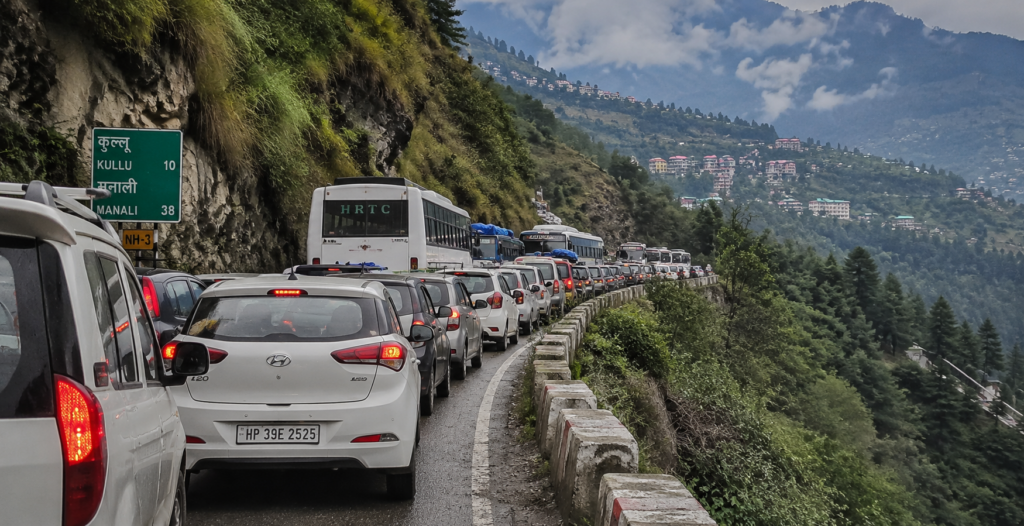
Meanwhile, mountain towns were never built for this. Shimla, the old summer capital of British India, has a resident population of roughly 2 lakh people. In peak tourist months, over 20,000 tourists arrive every single day. Nainital, a quiet lake town, has road capacity for about 3,000 cars. On summer weekends, 50,000 vehicles try to enter. The police have had to physically stop cars from entering the town.
The bold truth: The mountains did not grow bigger. The planning did not get smarter. Only the crowds got larger.
Between January 2022 and March 2025, the Indian Himalayan states experienced extreme weather events on 822 of 1,186 days, resulting in the deaths of 2,863 people. Tourism kept rising through all of it.
The Water War Nobody Talks About
Every tourist who checks into a Himalayan hotel uses 150 to 200 litres of water per day. A local resident uses 30 to 40 litres. Luxury hotels can use up to 500 litres per guest per day.
During peak season, Shimla needs 45 million litres of water per day. It barely gets 20 to 30 MLD. In 2018, the crisis became so bad that residents received water once every eight days. About 100 people staged a midnight sit-in protest outside the waterworks office on Mall Road. The Himachal Pradesh High Court stepped in. The situation got international media attention.
In Nainital, the water level of Naini Lake; the city’s main water source; has been dropping steadily. In Manali, locals joke bitterly that tourists get water all day while they get water for one hour in the morning, if they are lucky.
Springs Are Dying
This is not just about taps. Across the Himalayas, 275 natural springs have dried up over the past two decades. Groundwater depletion, unregulated hotel construction, and tourism-driven demand are all connected. When you build a resort on a hillside without checking where the water table is, you do not just break a rule. You break a spring that a village has depended on for 500 years.
During peak tourist season in 2024, 67% of Himalayan tourist destinations experienced water rationing for local people.
Mountains of Garbage, Rivers of Waste
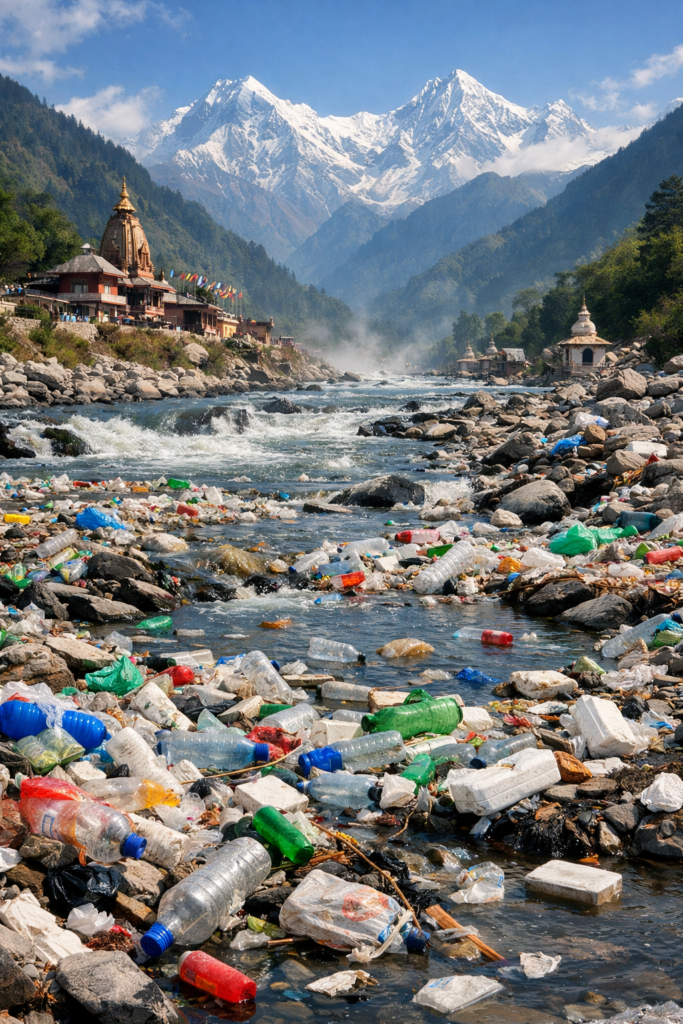
In 2024, the Himalayan Cleanup campaign collected 1,21,739 pieces of waste across nine mountain states. That is in one campaign, in one year. Imagine what is left behind.
Manali’s waste treatment plant is working at five times its capacity. Social media is full of videos showing plastic waste on trekking trails, in rivers, and across camping sites that once looked like paradise. The same “Instagram-worthy” spots are becoming dumping grounds because waste management infrastructure has not grown anywhere near as fast as tourist numbers.
Kasol, once known as a quiet backpacker village in the Parvati Valley, now has litter problems that have locals furious. On 5th August 2025, a flash flood in the Khirganga River swept away more than 80 hotels and the local marketplace in Dharali, Uttarakhand. Residents directly link the scale of destruction to unchecked construction in a fragile mountain zone.
“The mountains are not garbage bins. They are living systems. When you overload a living system, it collapses.”
Traffic That Turns Peace Into Chaos
There was a time when people planned Himalayan trips months in advance. They booked trains. They carried books. The journey itself was part of the joy. Today, you are more likely to hear car horns and Bollywood music blasting from SUVs than the sound of a river or birds.
Narrow mountain roads were built for a fraction of today’s traffic. During peak season, kilometres-long traffic jams on routes to Manali, Rohtang Pass, Mussoorie, and Nainital are normal. Vehicles sit in queues for 4 to 6 hours. Diesel engines idle in thin mountain air. The pollution damages lungs, trees, and the very snow that tourists came to see.
In both 2023 and 2024, over 5 lakh vehicles entered the Char Dham pilgrimage area. Geologists warn that this level of vehicular activity is raising temperatures in glacial zones, with consequences that could last decades.

When Locals Can No Longer Afford Their Own Town
Tourism brings money. That is true. Hotels, guides, taxi drivers, shopkeepers, and hundreds of thousands of families earn from it. Nobody is saying stop the tourists. But here is what the money does to the local housing market.
Property prices in Manali have risen steadily, with eco-friendly accommodations seeing a 25% rise in demand in just three years. Dharamshala saw property sales grow by 15% annually as of 2025. Remote workers, travel influencers, and outside investors are buying up land and buildings. Local families, especially young people, find it harder and harder to afford a home in the town where they were born.
This is called the “tourism gentrification” effect. It has happened in Goa. It happened in parts of Rajasthan. It is now happening quietly in the Himalayas. A local apple farmer cannot compete with a Delhi developer who wants to build another boutique hotel.
Cultural Tensions Are Rising
When your town is flooded with people who play loud music till 2 AM outside your window, leave garbage on your ancestral trails, and treat your home like a theme park; frustration builds. Himalayan communities are proud, deeply rooted, and often deeply spiritual. Some areas near Kasol and Kasauli have seen visible cultural tensions between visitors and residents.
It is not that locals hate tourists. It is that they have lost control of their own space. That is a different kind of anger; quiet, deep, and very fair.
Is the Tourist the Villain? No. The System Is.
Here is the most important thing this article wants to say: the tourist is not the problem.
A family from Delhi driving to Manali for a summer holiday is not evil. A college student backpacking to Kasol is not ruining the mountains. They are simply using a system that has no limits, no rules, and no plan.
The real problem is:
- No enforced carrying capacity limits for popular sites
- No coordinated Tourism-Water-Waste master plans
- No checks on hotel and resort construction in ecologically sensitive zones
- No incentive for tourists to spread out to less-visited areas
- No community participation in tourism planning
- Weak municipal bodies with no funding or power to manage the load
The Himachal Pradesh Eco-Tourism Policy 2025 is a positive step. It requires hotels above a certain size to maintain waste water treatment facilities and manage garbage through composting. It focuses on community-led tourism and registered eco-homestays. But policy on paper and policy on the ground are two very different things in India.
Uttarakhand launched its “Tourism Policy 2030” which includes nature tourism, adventure, heritage, and wellness segments. Good intent. But enforcement on the ground remains the question.
What Barcelona and Bhutan Can Teach Us
Himalayan towns are not alone in this fight. Barcelona in Spain has been battling overtourism for years; residents have protested with signs reading “Tourists go home.” The city introduced tourist taxes, capped Airbnb licences, and limited cruise ship arrivals.
Bhutan, India’s Himalayan neighbour, charges international tourists a Sustainable Development Fee of USD 100 per day. The money goes directly into conservation and local welfare. The result? Bhutan has some of the world’s best-preserved ecosystems and tourist experiences. You visit Bhutan and it feels different; because it is. Because it is planned, limited, and valued.
India’s NITI Aayog has itself recommended a “green cess”; a small fee collected from tourists visiting the Indian Himalayan Region; to fund conservation and infrastructure. The idea has been floating since 2018. It has still not been implemented at scale.
“If Bhutan can charge USD 100 and protect its mountains, India can charge ₹200 and protect Shimla’s springs.”
7 Real Solutions That Can Work Right Now
These are not dreams. These are practical steps that experts, researchers, and communities have already identified:
1. Enforce Carrying Capacity Limits
Every popular site; from Rohtang Pass to Triund to Valley of Flowers; must have a maximum daily visitor number backed by law, like national parks in many countries.
2. Introduce a Green Tourism Cess
Charge a small, nominal fee from all tourists. Use it exclusively for waste management, water infrastructure, and local community welfare. Transparent and accountable.
3. Spread Tourism Across the Calendar and the Map
Promote off-season travel. Promote lesser-known destinations like Tirthan Valley, Barot, Chopta, and Munsiyari. Offer incentives for tourists who visit in October or February rather than May.
4. Community-Led Tourism Planning
Local panchayats and urban bodies must have real power in deciding how many hotels can be built, where, and with what conditions. Tourism planning cannot only happen in state capitals.
5. Strict Waste Management Rules for Hotels
Every hotel above 10 rooms must have its own waste treatment system. No licence renewal without compliance. Simple and enforceable.
6. Invest in Mountain Public Transport
Build ropeways. Expand bus networks. Introduce electric vehicle shuttle services into crowded zones like Nainital and Manali’s Old Town. Reduce private car access.
7. Digital Visitor Management
Use technology. Create real-time dashboards showing visitor loads at popular spots. Let tourists book timed entry slots the way Kedarnath and some national parks are beginning to do.
What Nikhil Raj Sharma, Founder of Himalayan Geographic, Says
Nikhil Raj Sharma, who has spent years documenting and researching Himalayan ecosystems through Himalayan Geographic Research Foundation, puts it plainly:
“The Himalayas are not an amusement park. They are a living, breathing system. When we ignore carrying capacity and let unchecked tourism run wild, we are not just damaging a view; we are destroying the water towers of Asia. The springs, the glaciers, the rivers; they all begin here. We cannot afford to lose them for the sake of a weekend selfie.”
“Sustainable tourism is not a luxury idea for rich countries. It is survival planning for Himalayan communities. We need policy with teeth, not just brochures with pictures.”
And on the water crisis: “In 2018, Shimla became a warning. In 2025, Dharali became a warning. How many warnings do we need before we act?”
Watch and Learn
- Himalayan Meltdown; Open The Magazine’s in-depth video investigation.
- HIMALAYA: The Giants of Earth | 4K Documentary; A stunning and sobering look at what we stand to lose.
- World’s Most Remote Village: Growing Up in the Himalayas; Understand what local life looks like.
The Mountains Are Still Beautiful. Let Us Keep Them That Way.
The Himalayas have survived ice ages, earthquakes, and millennia. They can survive tourism; if tourism learns to be respectful, limited, and planned. The mountains are not asking us to stay away. They are asking us to slow down.
Next time you plan a trip to Shimla, Manali, or Nainital, think about these things:
- Go in the off-season. You will have a better experience and the locals will thank you.
- Carry your own water bottle. Do not add to plastic waste.
- Stay in a homestay. Your money goes directly to a local family.
- Follow the trail rules. Do not go off-path. Do not leave anything behind.
- Respect the quiet. The mountains are not a party venue.
Tourism is not the enemy of the Himalayas. Thoughtless tourism is.
The mountains are beautiful. The tourists are not bad people. But nobody put any limits. No one planned. No one asked the locals. Now the water is running out, the waste is piling up, and young people from these hill towns cannot afford to live in their own homes. The fix is simple: set limits, charge a fair green fee, involve local communities, and spread tourists across time and place. If Bhutan can do it, India can do it. The question is whether our government will act before the mountains themselves say: enough.
Have you visited a Himalayan town and seen overtourism up close? Share your experience in the comments below. Did the crowds surprise you? Did you see something that made you angry or hopeful? Tell us your story matters.
Subscribe to the Himalayan Geographic newsletter for monthly stories on conservation, communities, and conscious travel from the roof of the world.
References:
- Observer Research Foundation — Tourism and Water Stress in the Himalayas (2026)
- Open The Magazine — Himalayan Meltdown (July 2025)
- Himachal Pradesh Tourism Statistics PDF (2025)
- Himalayan Geographic — Protecting the Himalayas (2026)
- Scientific Reports — Carrying Capacity and Char Dham (2025)
- PMFIAS — Tourism Crisis in Himalayas (2026)
- GLP Films — Travelers and Locals Don’t Fail Tourism, Broken Systems Do (2025)
- World Bank — Shimla Water Security (2019)
- Mongabay India — NITI Aayog Green Cess Proposal
- Himachal Pradesh Eco-Tourism Policy 2025
Related Articles:
- How Himalayan Communities Are Fighting Climate Change From the Ground Up
- Valley of Flowers: What Happens When Paradise Goes Viral
- Responsible Travel in India: 10 Rules Every Tourist Should Know
Disclaimer: The content and images published in this article are provided for general informational and educational purposes only. Some images may be generated or enhanced using artificial intelligence (AI) and are intended solely for illustrative use. The views, interpretations, and information expressed do not necessarily reflect the official position of Himalayan Geographic Research Foundation, nor do they constitute professional, legal, medical, or financial advice.
While efforts are made to ensure accuracy, no guarantees are given regarding completeness or reliability. Readers are encouraged to independently verify information and use their own judgment. By reading this article, you acknowledge that any reliance on the content is at your own risk, and Himalayan Geographic Research Foundation assumes no responsibility or liability for disagreements, interpretations, or outcomes arising from its use. If you do not agree with these terms, you are advised to discontinue reading.