
India is losing trees in the plains and choking the Himalayas with tourist traffic. Here’s what deforestation and Himalayan overtourism are really costing us and what must change now.
We are destroying two Indias at once; the hot, treeless plains and the choked, crumbling mountains. Both have the same cause: we call destruction “development.” Plant trees. Limit tourist vehicles. Or pay the price with floods, heat, and dead rivers.
Every summer, India breaks its own heat record. In 2024, Delhi crossed 52°C. In Shimla, tourists waited 6 hours in traffic just to reach Mall Road. These are not separate problems. They are the same wound on two different bodies.
India is quietly destroying itself from both ends; cutting trees in the plains in the name of development, and suffocating the Himalayas under the weight of uncontrolled tourism. The result? Hotter cities, dying rivers, crumbling mountains, and a climate bill that future generations will pay with their lives.
This is not a scary future story. This is happening right now.
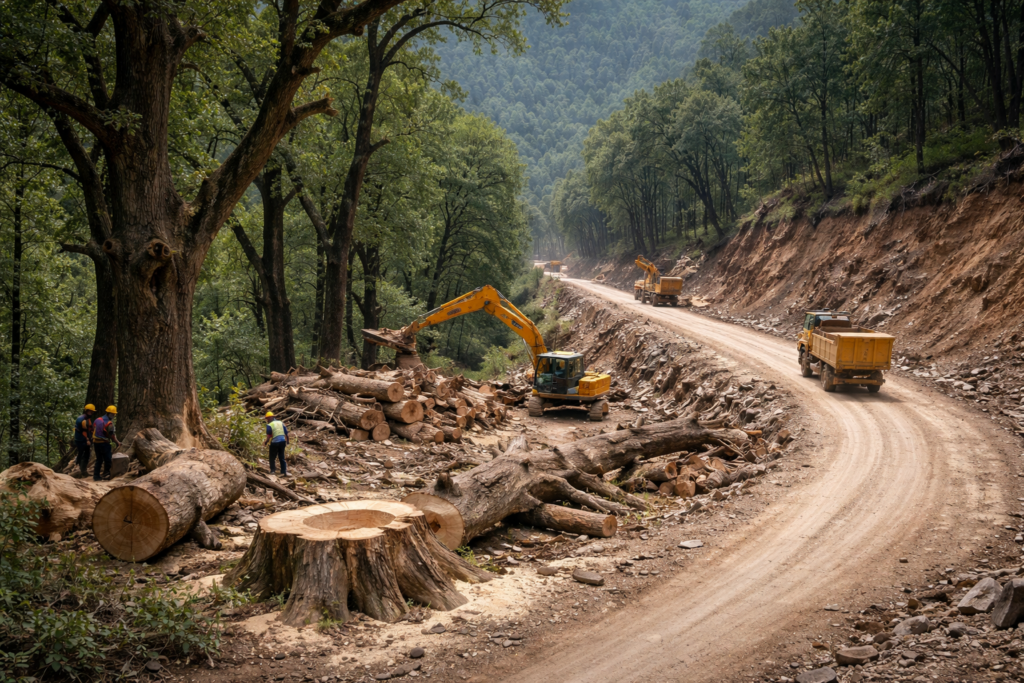
The Plains Are Getting Hotter. Trees Are the Answer We Keep Ignoring.
India lost over 1.5 million hectares of tree cover between 2001 and 2023, according to Global Forest Watch. That is an area bigger than the entire state of Nagaland; gone. And every tree that falls takes with it shade, groundwater, clean air, and cooler nights.
In cities like Delhi, Bengaluru, and Lucknow, the Urban Heat Island effect has made neighbourhoods 4–7°C hotter than surrounding rural areas. Roads and concrete absorb heat all day and release it at night. Without trees, there is nothing to break this cycle.
“A city without trees is not a city. It is a slow oven.”
The World Health Organisation estimates that urban heat stress causes over 1.5 lakh deaths annually across South Asia. In India, heatwaves between 2015 and 2022 killed over 6,500 people officially; and unofficial numbers are far higher.
What Happens When You Cut a Tree in the Plains?
- Groundwater recharge drops because roots no longer hold rainwater
- Topsoil erodes and becomes useless for farming
- Local temperatures rise by 2–3°C within a 1 km radius
- Air pollution increases as natural filters disappear
- Flood risk increases because water has nowhere to go
We build flyovers where forests stood. We celebrate smart cities that have no smart tree cover. Meanwhile, the plains bake.
The Aarey Forest in Mumbai. In 2019, over 2,700 trees were cut overnight to build a metro car shed. Citizens protested. Courts intervened. Some trees were replanted. But the damage was done; a green lung lost in a city that already cannot breathe. (Reference: The Hindu, October 2019)
The Chipko Movement of the 1970s, led by women in Uttarakhand who hugged trees to stop loggers, showed us what was at stake. Fifty years later, we are still learning the same lesson.
The Himalayas Are Not Just Mountains. They Are India’s Water Tower.
The Himalayas feed 10 major river systems including the Ganga, Yamuna, Indus, and Brahmaputra. Over 600 million people depend on these rivers for drinking water, farming, and survival. These mountains are not tourist attractions. They are life-support systems.
And we are treating them like a theme park.
In 2023, India recorded over 35 million tourist visits to Himalayan states; Himachal Pradesh, Uttarakhand, Sikkim, and Jammu & Kashmir combined. Shimla alone received nearly 5 million visitors. The town was built by the British for 25,000 people. It now hosts over 4 lakh residents and millions of tourists annually.
“We do not visit the mountains. We invade them.”
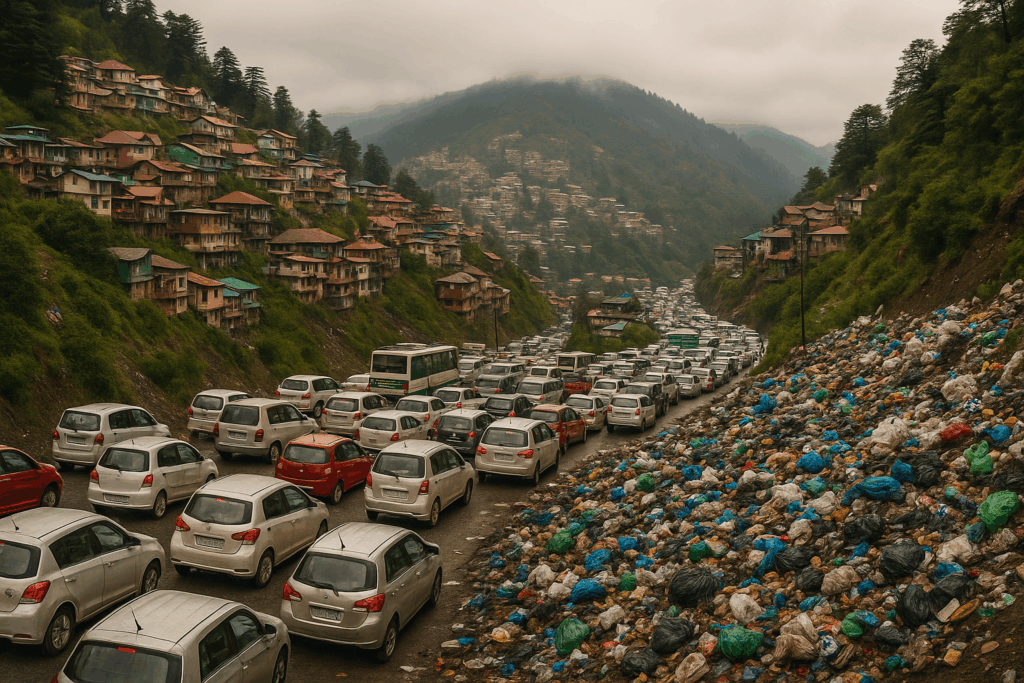
Himalayan Overtourism: What the Traffic Jams Are Really Costing Us
On peak weekends in May and June, the Shimla-Kalka highway turns into a parking lot. Vehicles queue for 10–15 kilometres. Tourists sit in diesel fumes for 4–6 hours. Hotel generators run all night. Plastic bottles and polythene bags end up in khads (mountain streams). And the mountain silently absorbs it all; until it cannot.
The real cost of Himalayan overtourism:
- Landslides — Unplanned construction on slopes weakens the geology. In 2023, over 70 people died in landslides in Himachal Pradesh alone during the monsoon. (Reference: IMD, 2023 Disaster Report)
- Water scarcity — Hotels and resorts extract groundwater faster than the mountains can recharge. Shimla faced a severe water crisis in 2018 when supply dropped to 20 litres per person per day. (Reference: Times of India, June 2018)
- Solid waste — The Himalayan states generated over 3,000 metric tonnes of solid waste per day in peak tourist season in 2022. (Reference: Central Pollution Control Board)
- Air pollution — Vehicle emissions in narrow Himalayan valleys get trapped by mountains. PM2.5 levels in Manali and Shimla regularly cross safe limits during tourist season. (Reference: CPCB Annual Report 2023)
- Glacial melting acceleration — Soot and black carbon from vehicles and tourism activities settles on glaciers and speeds up melting. The Gangotri Glacier is retreating at 22 metres per year. (Reference: ISRO, 2022)
The Joshimath Warning Nobody Took Seriously Enough
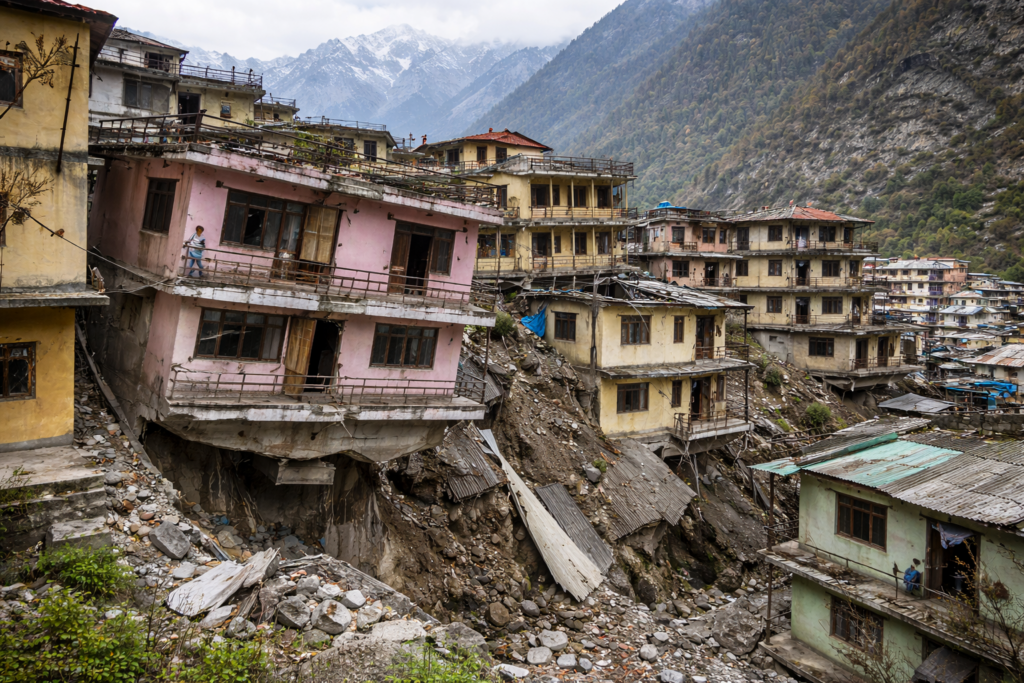
In January 2023, Joshimath; a holy town in Uttarakhand; began to sink. Over 800 homes cracked. Families were evacuated in the night. A town that sits at the gateway to Badrinath and Auli ski resort was literally splitting apart.
Why? Decades of heavy construction, unplanned hotels, roads cut without geological surveys, and a hydro-power project beneath the surface. Experts had warned of this since 1976. Nobody listened. (Reference: Misra Committee Report, 1976; Wadia Institute of Himalayan Geology, 2023)
Joshimath is not an isolated case. It is a preview.
Two Problems, One Root Cause
In the plains, we cut trees for roads, malls, and apartments. In the mountains, we cut slopes for hotels, helipads, and highways. The logic is the same: short-term money over long-term survival.
“Efficiency is doing things right. Effectiveness is doing the right things.” We are building efficiently roads, tunnels, hotels; but we are not doing the right things. A road that triggers a landslide is not progress. A hotel that drains a glacier is not hospitality.
India’s GDP grows. India’s green cover shrinks. India’s disaster losses grow. These three lines on a graph tell the whole story.
According to a 2023 report by the Reserve Bank of India, climate-related disasters cost India ₹2.5 lakh crore annually. That is more than the entire education budget of the central government. (Reference: RBI Report on Climate Risk, 2023)
What India’s Own Data Is Telling Us (But We Refuse to Hear)
- India ranks 180th out of 180 countries in the Environmental Performance Index 2022 (Yale University)
- Forest cover in Himachal Pradesh declined by 400 sq km in the last decade (Forest Survey of India, 2023)
- Over 65% of the Himalayan glaciers are retreating (ICIMOD, 2023)
- Delhi’s average summer temperature has risen by 2°C in 30 years (IMD)
- Only 22% of India’s urban areas meet the WHO guideline of 9 sq metres of green space per person
These are not opinions. These are measurements.
What Responsible Tourism and Urban Planning Look Like
There is good news. Some places are getting it right or at least trying.
Sikkim became India’s first fully organic state and has strict limits on tourist numbers in sensitive zones like Dzongri. Plastic bags have been banned for decades. The state has 82% forest cover; one of the highest in India. (Reference: Government of Sikkim, Tourism Policy 2022)
Bhutan charges a Sustainable Development Fee of $100 per night from foreign tourists. The money funds conservation, schools, and hospitals. Tourist numbers are controlled. The mountains are intact. (Reference: Tourism Council of Bhutan)
Amsterdam reduced tourist numbers in its city centre by banning new hotels and limiting short-term rentals. A European city teaching us that saying “no” to some tourists protects the destination for future generations.
India can do this too. Some suggestions:
- Vehicle caps on Himalayan roads; like the odd-even system, but permanent and seasonal
- Eco-tourism permits; with real enforcement, not just websites
- Mandatory tree-planting ratios; for every building, a fixed number of trees must be planted and maintained
- Green buffer zones around urban areas; legally protected, not just promised
- Tourist taxes in sensitive zones, redirected entirely to local conservation
The Human Cost Nobody Photographs
Behind every traffic jam on the Rohtang Pass, there is a Lahauli farmer who cannot get his apple crop to market because the road is blocked with tourist cars. Behind every hotel that drains the aquifer in Kullu, there is a village woman walking 3 kilometres for water.
The mountain communities; Gaddis, Lahaulis, Kinnauris, and Spitians; have lived in the Himalayas for thousands of years. They developed cultures, farming methods, and water harvesting systems that worked with the mountains, not against them. Now they watch outsiders come, extract, and leave; while the cracks in the walls of their homes grow wider each monsoon.
This is not romantic poverty. This is injustice dressed as progress.
“The mountains belong to those who respect them, not to those who Instagram them.”
Nikhil Raj Sharma, Founder, Himalayan Geographic Research Foundation,
“Every time I drive through Shimla in May, I see what overtourism looks like in real time; diesel fumes, plastic on every trail, and locals pushed to the margins. We are not managing tourism. We are enabling a slow disaster. The plains need more trees. The mountains need fewer vehicles. Both need political will, not just awareness campaigns.”
“At Himalayan Geographic, we believe data must drive policy. The Joshimath sinking was not a surprise; it was predicted. What failed was action. The same is true for deforestation in the plains. We know what to do. We just need the courage to do it before the next disaster forces us to.”
What You Can Do (Yes, You)
You do not have to be a forest officer or a climate scientist to make a difference. Here is a practical list:
- Plant one tree this monsoon; in your compound, your school, your colony
- Travel in the off-season; June is the worst time for the mountains. Go in September or October
- Use public transport or shared cabs in hill stations; reduce your vehicle footprint
- Carry a reusable bag and bottle; every piece of plastic you don’t bring to the mountains is a win
- Support local, not just branded; eat at dhabas, stay in homestays, buy from local artisans
- Share this article; awareness is the first step
The Solution Is Already Written in Nature
A banyan tree planted today will give shade for 200 years. A glacier protected today will give water for 500 years. A mountain slope left undisturbed today will prevent a landslide in the next monsoon.
Nature does not need our help to recover. It needs us to stop hurting it.
The solution is not to stop development, but to redefine it. A truly developed society plants more trees than it cuts, manages tourism responsibly, and ensures that economic growth strengthens rather than weakens the natural systems that sustain life.
The plains need shade. The mountains need silence. India needs both.
Related Articles:
- Why Shimla Is Running Out of Water (And What You Can Do)
- The Chipko Movement: India’s First Climate Protest
- Sikkim’s Secret: How One State Got It Right
- Urban Heat Islands: Why Your City Is Getting Hotter Every Year
References:
- Global Forest Watch — India Tree Cover Loss 2001–2023
- Environmental Performance Index 2022, Yale University
- ISRO Glacier Study 2022
- ICIMOD Himalayan Glacier Report 2023
- Central Pollution Control Board Annual Report 2023
- RBI Climate Risk Report 2023
- Forest Survey of India 2023
- Wadia Institute of Himalayan Geology, Joshimath Report 2023
- Government of Sikkim Tourism Policy 2022
- Tourism Council of Bhutan, SDF Policy
- IMD Heatwave Reports 2015–2024
Disclaimer: The content and images published in this article are provided for general informational and educational purposes only. Some images may be generated or enhanced using artificial intelligence (AI) and are intended solely for illustrative use. The views, interpretations, and information expressed do not necessarily reflect the official position of Himalayan Geographic Research Foundation, nor do they constitute professional, legal, medical, or financial advice.
While efforts are made to ensure accuracy, no guarantees are given regarding completeness or reliability. Readers are encouraged to independently verify information and use their own judgment. By reading this article, you acknowledge that any reliance on the content is at your own risk, and Himalayan Geographic Research Foundation assumes no responsibility or liability for disagreements, interpretations, or outcomes arising from its use. If you do not agree with these terms, you are advised to discontinue reading.