
The Himalayan heat crisis is real, urgent, and already changing forests, water, farming, and daily life across Himachal Pradesh, Uttarakhand, Sikkim, and Arunachal Pradesh. Here is what is happening right now.
The mountains used to keep us cool. Not anymore.
In May 2024, Shimla recorded temperatures above 30°C; something almost unthinkable two decades ago. Across the Himalayas, from Himachal Pradesh to Arunachal Pradesh, a slow and dangerous transformation is underway. Scientists call it accelerated mountain warming. Local people call it something simpler: the mountains feel different now.
The Himalayan heat crisis is not a future warning. It is happening today, in villages, forests, rivers, and farms across four Indian states. And most of us are not paying enough attention.
Why the Himalayas Are Warming Faster Than the Rest of India
Here is the surprising part. Mountains are warming faster than plains.
According to the IPCC Sixth Assessment Report (2021), high-altitude regions like the Himalayas are warming at nearly twice the global average rate. The Hindu Kush Himalaya Assessment Report by ICIMOD (International Centre for Integrated Mountain Development) confirmed that temperatures across the Hindu Kush-Himalayan region rose by about 1.3°C between 1951 and 2014 faster than most other regions on Earth.
Why does this happen? Energy imbalance more heat energy is being absorbed and less is being reflected as snow and ice cover decreases. Less snow means darker land surfaces. Darker surfaces absorb more heat. More heat melts more snow. It becomes a self-reinforcing cycle.
This is not theory. This is physics playing out on mountain slopes right now.
- In Himachal Pradesh, mean annual temperatures have risen by approximately 1.6°C over the last 50 years (India Meteorological Department, 2022).
- In Uttarakhand, pre-monsoon heat waves have become more frequent and intense.
- Sikkim and Arunachal Pradesh are seeing ecological shifts that researchers have not observed before in recorded history.
The Himalayas were never supposed to face an extreme heat crisis. They were the crisis shelter. Now they need one themselves.
When Springs Dry Up; The Hidden Water Emergency
Ask any elderly woman in a Himachali village about the local spring. She will likely tell you it used to flow all year. Now, it dries up before summer even officially begins.
Across Himachal Pradesh and Uttarakhand, traditional water springs called “baolis” or “naulas” are becoming seasonal or disappearing completely. A 2019 report by the National Institute of Hydrology found that nearly 50% of natural springs in the Indian Himalayan Region showed declining water discharge over the previous decade.
This is directly connected to warming. Snow melts earlier in the season. Groundwater recharge patterns change. The forests that once held moisture in the soil are thinning. Together, these factors are drying out the underground systems that feed springs.
The results are immediate and painful for communities:
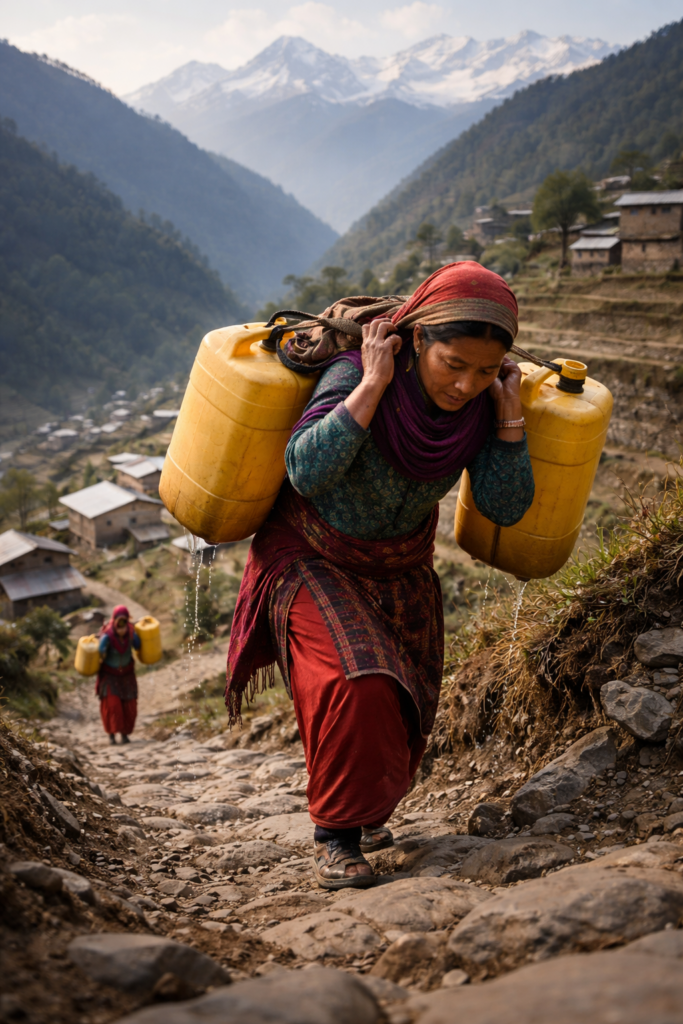
- Women and children walk longer distances to fetch water.
- Livestock health declines as water access reduces.
- Irrigation for small farms becomes unreliable.
- Village drinking water systems face seasonal failure.
The systems communities depended on for generations, both natural and governmental, are not adapting fast enough to protect people.
Mountain communities, largely dependent on local water sources, have no easy market substitute.
“A spring that dries in April does not just mean thirst. It means a way of life begins to break.”
Forests on Fire
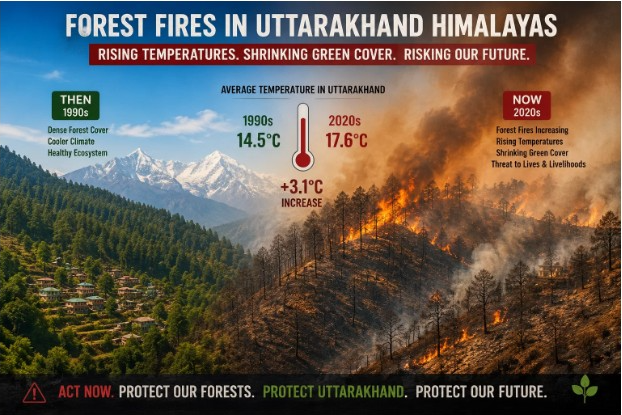
Uttarakhand’s forests have been burning more frequently and more intensely. The numbers are hard to ignore.
In 2024, Uttarakhand reported over 1,200 forest fire incidents between February and June; significantly higher than the ten-year average. Himachal Pradesh also recorded a sharp rise in fire incidents in dry years. The Forest Survey of India’s 2023 report flagged that forest fire vulnerability in Himalayan states is increasing in direct proportion to rising temperatures and declining moisture.
Ecosystems that evolved under specific temperature and moisture conditions do not adapt instantly when those conditions change rapidly. Oak forests that once retained moisture and resisted fire are stressed. Pine dominance in many areas has increased fire susceptibility. Biodiversity collapses when the foundational species struggle.
When forests burn:
- Local air quality deteriorates; respiratory issues spike in nearby towns.
- Wildlife habitats fragment, pushing animals into human settlements.
- Soil loses its protective cover, increasing landslide risk.
- The natural cooling function of forests disappears, making surrounding areas even hotter.
- Carbon stored in trees releases back into the atmosphere, worsening the very problem causing the fires.
It is a cruel loop. Heat dries forests. Dry forests burn. Burned forests produce more heat.
We built roads, hotels, and concrete towns without understanding that the forest was the architecture. The forest was the infrastructure.
Himalayan Agriculture Under Stress
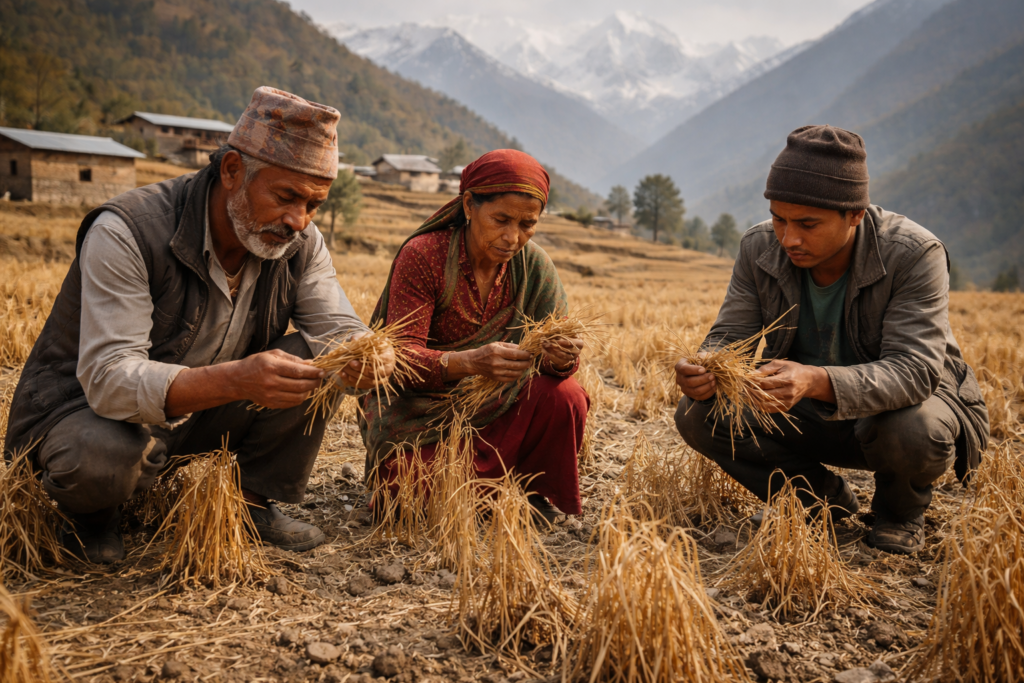
Mountain farming was built on predictability. Specific crops planted at specific times, using snowmelt water, in specific temperature windows. That predictability is breaking.
In Himachal Pradesh, apple farming; a cultural and economic backbone of the state; is already showing serious stress. Apples need a certain number of chilling hours (below 7°C) during winter to bloom properly. As winters warm, those chilling hours are decreasing. Apple yields in traditional growing belts like Shimla and Kinnaur are becoming erratic.
A study by ICAR-Central Institute of Temperate Horticulture, Srinagar (2022) found that apple-growing zones in Himachal Pradesh are shifting to higher altitudes; farmers are moving orchards upward chasing cooler temperatures.
Meanwhile:
- Wheat and barley cropping windows are shortening.
- Pest attacks are increasing as warmer winters no longer kill off insects.
- Unseasonal rain and hail are destroying standing crops.
- Small farmers without insurance or savings are pushed into debt.
Market forces respond to price signals, not to temperature rises. Without active policy intervention, farmers will simply lose and markets will not compensate them fast enough.
Agricultural education needs urgent redesign; farmers need to learn climate-adaptive farming practices, new crop varieties, and water management. Learning must happen in the field, not just in government pamphlets nobody reads.
Wildlife in Retreat
A warming mountain is a shrinking mountain for wildlife.
As temperatures rise, species adapted to cold conditions move upward in altitude to find their comfort zone. Sounds simple. But mountains are not infinite. At some point, there is no higher to go.
The snow leopard, a symbol of Himalayan wilderness, is facing habitat compression. The Western Tragopan, one of India’s rarest birds found in Himachal Pradesh, is losing its cool forest zones. Medicinal plants that communities harvested for generations are appearing at higher elevations, beyond easy reach.
ICIMOD researchers have documented what they call “escalation trap” species move up, space reduces, competition increases, and local extinctions follow. In Sikkim and Arunachal Pradesh, biodiversity researchers have reported that species distribution maps made just 20 years ago are already becoming outdated.
Rapid environmental change leaves no time for adaptation. Evolution is slow. Climate disruption is fast. When the environment changes faster than a species can adapt, extinction is not dramatic; it is quiet and incremental, until one day the animal simply is no longer there.
Public Health in Mountain Communities
People do not associate Himalayan towns with heat-related illness. They should start.
Dehydration, heat exhaustion, and respiratory problems from smoke and dust are rising across mountain communities. Elderly populations in remote villages face serious risk because they have no air conditioning and no nearby health facilities. Outdoor labourers; construction workers, farmers, forest workers; work through increasing heat without protection.
A 2023 Lancet Countdown report on India noted that heat-related labour capacity loss has increased significantly, affecting outdoor workers disproportionately. Mountain communities, already economically vulnerable, now face a health burden layered on top of economic and ecological stress.
Pollution from forest fires and vehicle congestion in Himalayan tourist towns like Manali, Mussoorie, and Gangtok is worsening air quality during peak summer; exactly when the most people are present.
The Development Contradiction
Here is the uncomfortable truth that nobody in power wants to say clearly.
We are building more roads, more hotels, more concrete structures in the Himalayas and cutting trees to do it. Every new road that blasts through a hillside removes vegetation. Every new hotel that rises without green buffers increases local temperature. Every deforested slope increases erosion, reduces rainfall retention, and bakes in the sun.
Buildings must grow from their landscape, not against it. The Himalayas are showing us what happens when we ignore that completely.
The same state governments that issue climate change advisories are simultaneously approving construction projects that worsen the conditions they claim to be worried about.
The powerful will always prioritise short-term economic gain over long-term ecological survival; unless citizens force a different calculus. That is the political reality.
What Must Be Done; Real Solutions, Not Just Slogans
The Himalayan heat crisis will not be solved by one conference or one policy paper. It needs action at every level.
Forest Protection and Restoration
- Strict enforcement of felling bans in ecologically sensitive zones.
- Large-scale plantation of native species, not just commercially convenient ones.
- Community forest rights must be strengthened; local people protect what they own and manage.
Water Conservation
- Revival of traditional water harvesting systems (baolis, kuhls, naulas).
- Watershed management programmes linked to forest cover restoration.
- Real-time spring monitoring systems so governments know which springs are dying before communities lose access entirely.
Climate-Smart Agriculture
- Support for farmers shifting to new crop varieties suited to changing temperatures.
- Crop insurance that actually works in mountain terrain.
- Knowledge sharing across farming communities through local agricultural extension networks.
Sustainable Urban Planning
- Mandatory green cover requirements for all new construction in Himalayan hill towns.
- Moratorium on deforestation for tourism infrastructure within a defined ecological zone.
- Public transport investment to reduce vehicle congestion and associated pollution.
Education and Community Awareness
- Schools in Himalayan states must teach climate literacy as lived experience, not just textbook content. Take students to drying springs. Show them old photographs of glaciers. Make the crisis real, not abstract.
Voices from the Mountains
History is best told through people, not just data. So here is what people are saying.
A 70-year-old farmer in Kinnaur, Himachal Pradesh, speaking to India Climate Dialogue (2023): “When I was young, we had snow until April. Now, by February, the slopes are bare. The apple trees are confused. We are confused.”
A forest ranger in Uttarakhand told Down To Earth: “Ten years ago, we worried about fires in April or May. Now we are putting out fires in February.”
These are not isolated stories. They are consistent reports from across Himachal Pradesh, Uttarakhand, Sikkim, and Arunachal Pradesh. The mountains are sending signals. The question is whether we are listening.
The Himalayas Cannot Wait
The Himalayan heat crisis will not pause while we debate it.
Glaciers are retreating. Springs are drying. Forests are burning. Farmers are struggling. Species are disappearing. Communities are suffering.
This is the mountain reality in 2025. Not a prediction. A current condition.
Every tree planted matters. Every spring protected matters. Every policy that prevents needless deforestation matters. Every school lesson that teaches a child to respect the mountain ecosystem matters.
The Himalayas gave generations of people clean water, cool air, stable food, and breathtaking life. Returning that care is not optional. It is urgent.
The Himalayas are getting hotter. Water is disappearing. Forests are burning. Animals are running out of space. Farmers are losing income. Villages are struggling.
This is not coming. It is already here.
Plant trees. Protect springs. Stop cutting forests for buildings. And teach children why this matters; before they grow up and the cool mountains they read about in books no longer exist outside those books.
Comments from Nikhil Raj Sharma, Founder, Himalayan Geographic
“What this article captures is what I have been witnessing on the ground for over a decade. The spring near my grandmother’s village in Himachal Pradesh; a spring that fed three families and their cattle for as long as anyone could remember; ran dry in March 2023. For the first time in living memory. These are not statistics. These are losses. Real, daily, irreversible losses that mountain communities are absorbing silently while the world argues about net-zero targets.”
“The Himalayan heat crisis is a justice issue. The people least responsible for global carbon emissions; mountain villagers, tribal forest communities, small farmers; are paying the highest price. Himalayan Geographic exists to document this truth and amplify these voices. Every article, every photograph, every data point we share is an act of witness. We owe the mountains and their people; that much.”
“I want to especially highlight the forest fire data in this article. Our teams on the ground in Uttarakhand and Himachal Pradesh have confirmed these patterns. The fire season is no longer a season; it has become a near-permanent condition in dry years. We need urgent policy action, not just awareness campaigns.”
Related Articles to Explore:
- Glacier Retreat in the Indian Himalayas: What the Data Shows
- Water Scarcity in Mountain Villages: The Crisis Beneath the Tourism
- How Himalayan Farmers Are Adapting to Climate Change
- Forest Fires in Uttarakhand: Causes, Consequences, and Solutions
References:
- IPCC Sixth Assessment Report, 2021 — Climate Change 2021: The Physical Science Basis.
- ICIMOD — Hindu Kush Himalaya Assessment Report, 2019.
- India Meteorological Department — Climate Trends Report, 2022.
- National Institute of Hydrology — Spring Atlas of India, 2019.
- Forest Survey of India — State of Forest Report 2023.
- ICAR-CITH Srinagar — Apple cultivation and climate change study, 2022.
- Lancet Countdown on Health and Climate Change — India Chapter, 2023.
- India Climate Dialogue — Farmer testimonies, Kinnaur, 2023.
- Down To Earth — Forest fire reports, Uttarakhand, 2024.
- Nature Climate Change — Mountain warming acceleration studies.
Disclaimer: The content and images published in this article are provided for general informational and educational purposes only. Some images may be generated or enhanced using artificial intelligence (AI) and are intended solely for illustrative use. The views, interpretations, and information expressed do not necessarily reflect the official position of Himalayan Geographic Research Foundation, nor do they constitute professional, legal, medical, or financial advice.
While efforts are made to ensure accuracy, no guarantees are given regarding completeness or reliability. Readers are encouraged to independently verify information and use their own judgment. By reading this article, you acknowledge that any reliance on the content is at your own risk, and Himalayan Geographic Research Foundation assumes no responsibility or liability for disagreements, interpretations, or outcomes arising from its use. If you do not agree with these terms, you are advised to discontinue reading.