
Himalayan digital education is in crisis. Students in Himachal Pradesh, Uttarakhand, Sikkim, and Arunachal Pradesh face a growing digital divide. Here’s what’s really happening and what must change.
Imagine preparing for your Class 10 board exam and your internet cuts out every time it rains. For thousands of students across the Himalayas, this is not a bad day. It is every day.
India is racing toward digital education. Smart classrooms, AI tutors, online libraries, live video lectures; the country’s EdTech sector was valued at over USD 7.5 billion in 2024 (IBEF, 2024). But while cities connect faster, Himalayan students in Himachal Pradesh, Uttarakhand, Sikkim, and Arunachal Pradesh are being left at the starting line. The gap is not small. It is growing. And it is reshaping who gets a real education in this country and who does not.
This is the story of Himalayan digital education and why it cannot wait any longer.
THE MOUNTAIN CLASSROOM NO ONE TALKS ABOUT
Walk into a government school in a remote valley of Kinnaur, Himachal Pradesh. The building stands. Teachers show up. Students sit down. But when the teacher opens a DIKSHA app lesson or tries to stream a video from the PM eVidya platform, the connection buffers or drops entirely.
This is not a unique story. Across Uttarakhand’s Pithoragarh district, Arunachal Pradesh’s Tawang and Upper Subansiri, and parts of rural Sikkim, the same scene plays out daily. Students who are supposed to benefit from India’s National Education Policy 2020 (NEP 2020) and its push for digital learning are watching that promise load at 2G speed or not load at all.
According to TRAI’s Telecom Subscription Data (2023), teledensity in rural Himachal Pradesh is around 59%, and in Arunachal Pradesh it drops to roughly 30–35% in remote areas. Compare that to urban India’s 150%+ teledensity. The numbers tell a quiet story of exclusion.
“The problem is not lack of interest. It is lack of access.”
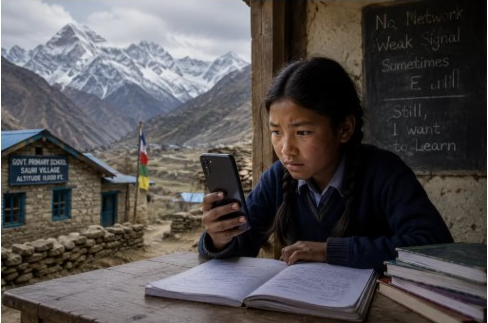
FOUR STATES, FOUR STRUGGLES
Himachal Pradesh; Buffering in the Valley
Himachal Pradesh has made visible efforts. The state launched its “Digital Himachal” programme and connected many panchayats through BharatNet. But BharatNet’s last-mile delivery in high-altitude zones remains weak. Many schools in Lahaul-Spiti and Pangi face frequent outages, especially during winter when snowfall damages cables and towers.
Students preparing for JEE, NEET, or Himachal Pradesh Administrative Services exams rely on platforms like Unacademy, Vedantu, and YouTube. When their connection fails, they fall behind peers in Shimla or Chandigarh who never missed a live class. The ASER Report 2023 found that while smartphone ownership has risen in rural India, actual learning outcomes in remote hill districts remain significantly lower than urban counterparts.
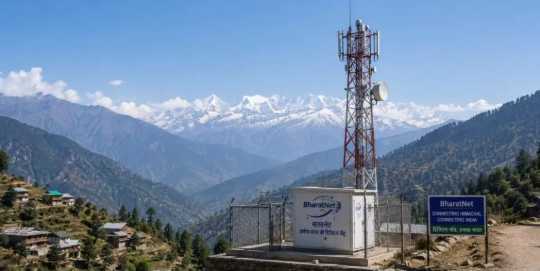
Uttarakhand; The Reverse Migration Trap
Uttarakhand has one of India’s highest rates of rural-to-urban migration; partly driven by the collapse of local opportunity, including education. Families in remote blocks of Chamoli, Rudraprayag, or Bageshwar often send children to boarding schools or relatives in cities; not because they want to, but because digital connectivity at home cannot support competitive-level learning.
The Uttarakhand Space Application Centre (USAC) has worked on satellite-based connectivity solutions, but coverage remains inconsistent. Teachers trained for digital classrooms sometimes find that neither they nor their students can access the content reliably. According to UDISE+ 2022–23 data, many rural Uttarakhand schools still lack functional computer labs or reliable electricity connections.
Arunachal Pradesh; The Terrain Problem
Arunachal Pradesh covers 83,743 sq km with a population density of just 17 people per sq km. Its terrain makes infrastructure expensive and slow. Some villages are accessible only by foot or helicopter. A 2022 report by the Ministry of Education noted that Arunachal Pradesh had some of the lowest digital infrastructure scores among all Indian states in remote school categories.
Yet the human spirit here is strong. Local teachers, many untrained in EdTech, create their own informal systems; hand-written notes photocopied and shared, older students tutoring younger ones, community radio used for announcements about exams. These are beautiful workarounds. But workarounds are not solutions.
Sikkim; Small State, Big Conversations
Sikkim is different. Smaller, better connected in its urban areas, and politically more focused on sustainability. The state has run programmes to integrate digital tools in schools while protecting indigenous knowledge and local languages. Discussions around “education for the mountains” not just in the mountains are happening in Sikkim more than elsewhere.
Still, the North and West districts of Sikkim, particularly in high-altitude zones, face similar gaps. And Sikkim’s own ASER data shows rural students still lag in digital literacy compared to their urban peers within the state itself.
THE NEW KIND OF ISOLATION
For generations, Himalayan students were isolated by geography. Snow blocked roads. Rivers flooded paths. Teachers did not come. These were physical barriers.
Today, a new barrier has arrived digital isolation. A student without reliable internet is not just cut off from a video lesson. They are cut off from:
- Live coaching for competitive exams
- Digital libraries like National Digital Library of India (NDLI)
- DIKSHA platform content and e-textbooks
- SWAYAM courses for higher education
- Career counselling platforms
- STEM learning tools and simulations
“A student without reliable internet is no longer only geographically isolated. They are academically isolated as well.”
This matters because India’s job market increasingly rewards digital skills. A Class 12 student in Spiti who never learned to navigate an online platform is starting their career with one hand tied behind their back; through no fault of their own.
WHAT THE DATA ACTUALLY SAYS
WHAT THE DATA ACTUALLY SAYS
Let us be honest with numbers:
- India has over 1.4 million schools. Around 40% lack internet access as of UDISE+ 2022–23.
- In Himalayan states, that percentage is significantly higher in remote blocks.
- The Gross Enrolment Ratio (GER) at secondary level in Arunachal Pradesh is around 70%, versus the national average of 79.6% (UDISE+ 2022–23).
- ASER 2023 found that only 26.5% of rural students in Grade 8 could read a simple English sentence digital content in English makes this worse.
- BharatNet Phase II targets connecting all gram panchayats, but last-mile delivery to schools remains incomplete in most Himalayan districts.
The National Education Policy 2020 promises “equitable and inclusive education.” But equity without infrastructure is just a document.
THE TEACHERS CARRYING THE WEIGHT
No conversation about Himalayan digital education is complete without talking about teachers. Many are posted in remote areas with little training, no tech support, and personal smartphones as their only digital tools. They are expected to teach using DIKSHA, run virtual classrooms, and digitally submit records often on a phone with 1 bar of signal.
A primary school teacher in Pithoragarh shared (as reported by The Hindu, 2022) that she downloaded lessons at night when the signal improved slightly, printed content at her own cost, and distributed it the next day. Her salary did not cover these expenses. She paid from her own pocket because the children needed it.
This is not a system. This is a person holding the system together with her own hands.
WHAT IS WORKING AND WHAT NEEDS TO SCALE
Community Radio and Offline Learning
Stations like AIR Itanagar and community radio networks in Uttarakhand have used broadcast to deliver lessons during school closures especially during COVID-19. This model works and costs less than fibre cables. It deserves more investment.
Offline-First EdTech
Some EdTech organisations are designing offline-first platforms. iSPIRT’s work on open digital infrastructure and platforms like Pratham’s offline content for low-connectivity zones show that solutions exist. They just need government support to scale in hill states.
Satellite Internet
SpaceX’s Starlink received TRAI approval in India in principle in 2023. For remote Himalayan schools, satellite internet though expensive could be a game-changer. Pilot programmes in Ladakh with satellite connectivity have shown early promise. This needs to move faster.
Solar Power + Digital Infrastructure
Electricity is the base layer. Many Himalayan villages use solar micro-grids. Combining solar power with satellite internet and offline-capable devices (like those designed under PM eVIDYA) offers a real infrastructure solution for remote schools.
VOICES FROM THE MOUNTAINS
These videos give you the real picture:
- “Education in Remote India” — by Vikram Nair on YouTube (Documentary on rural schooling in hill states):
- DIKSHA Platform Overview — Ministry of Education, India
- BharatNet Rural Connectivity Project Explainer
- Khan Academy India — Free Learning for All
WHAT POLICY MUST DO NOW
The Himalayas do not need educational charity. They need systems built with geographic intelligence.
Here is what must happen:
- State-specific digital education policies; Not a copy of Delhi’s smart classroom plan, but plans built for altitude, climate, and scattered populations.
- Mandatory connectivity audit for all hill-district schools; Know the exact problem before throwing money at it.
- Teacher digital support allowance; Reimburse teachers who use personal devices and data for school work.
- Offline-first content mandate; Any EdTech funded by the government for hill states must work without internet.
- Satellite internet pilots in every Himalayan state; Immediately expand Ladakh-style satellite pilots.
- Community knowledge integration; Digital tools must complement, not replace, local languages and traditional knowledge systems.
“Technology should expand opportunity, not deepen inequality.”
THE HUMAN COST OF WAITING
Every year this problem is not solved, a generation of Himalayan students falls further behind. They are not less intelligent. They are not less motivated. Anjali from a village in Chamoli wants to become a doctor. She is studying hard. But she missed 40 live biology classes last year because her phone could not load video in her valley. She may not crack NEET not because she failed, but because the system failed her.
This is the real cost. Not bandwidth. Not towers. A child’s future.
THE OPPORTUNITY WE ARE MISSING
Here is the twist: the Himalayas have something cities do not. They have communities that still trust teachers, respect education, and push children to learn despite every difficulty. That social capital is rare. If we give these students real connectivity and real tools, they will not just catch up. They will lead.
Mountain thinking adapted, resilient, local is exactly the kind of thinking India needs. We should be investing in it, not ignoring it.
Comment From The Nikhil Raj Sharma, Founder, Himalayan Geographic Research Foundation:
“When we travel into remote valleys of Himachal Pradesh and Arunachal Pradesh, the hunger for learning is visible in every child’s eyes. What is missing is not ambition; it is access. Our foundation has documented schools where teachers walk two hours uphill to reach students who have no internet, no library, and no lab. Himalayan digital education is not a niche issue. It is a national emergency that is hiding in plain sight behind beautiful mountains. We need satellite internet, offline learning tools, and policies that respect mountain geography not urban blueprints copy-pasted onto hillsides.”
“At Himalayan Geographic, we believe the future of these mountains depends on children who are both digitally connected and rooted in their own culture. Both must happen together. One without the other will create a generation that is either lost in screens or lost in isolation. The balance must be found and found urgently.”
WHAT CAN YOU DO RIGHT NOW?
- Share this article. Awareness is where change starts.
- Support NGOs working in Himalayan education: Teach For India, Pratham, Avni (Uttarakhand-based), Chirag (Community Hill Resource and Action Group).
- Write to your MP or MLA about BharatNet delivery in your district.
- If you are an EdTech company: Build offline-first. The mountain market is real.
RELATED ARTICLES YOU MAY FIND USEFUL:
- “How NEP 2020 Is Changing Rural Indian Schools — And What It Is Missing“
- “BharatNet: India’s Biggest Internet Project and Why It Is Still Incomplete“
- “Offline EdTech: The Quiet Revolution Reaching India’s Most Remote Classrooms“
Disclaimer: The content and images published in this article are provided for general informational and educational purposes only. Some images may be generated or enhanced using artificial intelligence (AI) and are intended solely for illustrative use. The views, interpretations, and information expressed do not necessarily reflect the official position of Himalayan Geographic Research Foundation, nor do they constitute professional, legal, medical, or financial advice.
While efforts are made to ensure accuracy, no guarantees are given regarding completeness or reliability. Readers are encouraged to independently verify information and use their own judgment. By reading this article, you acknowledge that any reliance on the content is at your own risk, and Himalayan Geographic Research Foundation assumes no responsibility or liability for disagreements, interpretations, or outcomes arising from its use. If you do not agree with these terms, you are advised to discontinue reading.