
Education Reform in Nepal is long overdue. Discover 6 urgent, practical changes from smarter curriculum to teacher accountability that can genuinely transform Nepal’s youth and future economy. Read now.
Every single day, nearly 1,500 young Nepalis board a plane not to study abroad, but to pour concrete in Qatar, clean offices in Malaysia, or work in kitchens in South Korea. Many of them finished school. Some even finished college. Yet Nepal’s education gave them no real skill, no real path. That is not a coincidence. That is a system failing in plain sight.
Education Reform in Nepal is not a new topic. Ministers have talked about it for decades. Reports have been written. Frameworks have been launched. But classrooms still reward the child who memorises best not the one who thinks best. That gap between policy and reality is where an entire generation is quietly being lost.
This article does not ask for everything to change at once. It asks for six honest, specific shifts backed by evidence, driven by urgency.
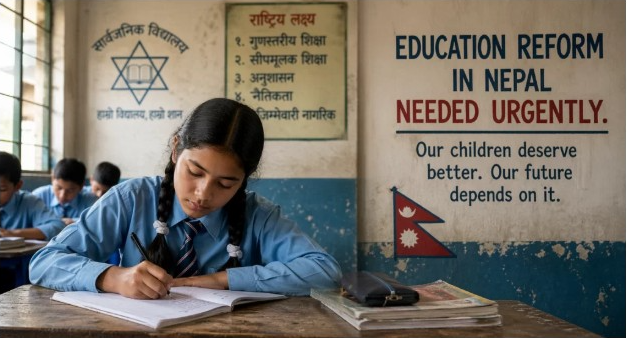
1. Stop Rewarding Memory. Start Rewarding Thinking.
“Education is not preparation for life. Education is life itself.” — John Dewey
Nepal’s curriculum has long treated knowledge as a list of facts to be swallowed and vomited in exams. A Class 10 student can recite the formula for photosynthesis but may not be able to explain why plants in their own backyard matter to their food supply.
Competency-based learning means students learn by doing solving problems, running experiments, debating ideas, building things. Countries like Finland and Singapore redesigned their curricula around skills, not syllabus coverage. Nepal’s National Curriculum Framework of 2019 pointed in this direction. But pointing and walking are different things.
What needs to happen right now:
- Replace rote-heavy exam formats with project-based assessments in at least three core subjects.
- Train curriculum designers to think in outcomes: “What should a student be able to do after this lesson?”
- Pilot competency-based classrooms in 100 schools across all seven provinces by 2026.
A 2022 World Bank report on Nepal’s education noted that learning outcomes remain “alarmingly low” even as enrolment has improved. Being in school and actually learning are two very different things. Reference: World Bank Nepal Education Overview
2. Teachers Are the System. Treat Them Like It.
“Management is doing things right. Leadership is doing the right things.” — Peter Drucker
In Nepal, teacher recruitment has historically rewarded seniority, political connections, and paperwork not classroom performance. A teacher who has taught for 25 years and taught poorly gets the same respect and pay as one who transforms students.
That is not accountability. That is bureaucracy wearing the mask of a meritocracy.
What strong teacher systems look like:
- Regular classroom observation by trained academic supervisors not just inspectors checking registers.
- Continuous professional development linked to actual subject knowledge, not just generic training certificates.
- Performance incentives tied to student learning growth, not attendance alone.
- A national teacher competency standard clearly defined, fairly assessed.
Nepal’s Teacher Service Commission has struggled with delays, controversy, and regional imbalance in recruitment. Thousands of schools run on temporary teachers for years. This is not a funding problem alone it is a governance and political will problem.
Reference: Teacher Service Commission Nepal
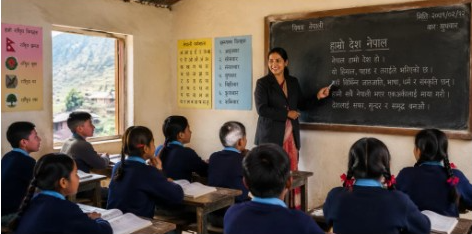
3. Decentralisation Must Mean Responsibility, Not Just Authority
“Bureaucracy develops the more perfectly, the more it is dehumanised.” — Max Weber
Nepal became a federal state under its 2015 Constitution. Education responsibilities were distributed to provincial and local governments. On paper, this is good local governments know local needs better. In practice, many local governments received power without capacity.
Some municipalities run their schools well. Others have no idea who is responsible for teacher transfers, school construction, or learning assessments. The result is confusion wearing the clothes of reform.
What genuine decentralisation requires:
- Clear, written accountability: who is responsible for what outcome, at which level.
- Local government officials trained in education administration, not just general governance.
- A national minimum standard that every province must meet with consequences if they do not.
- A transparent data system where any citizen can see how their local school is performing.
The federal structure is an opportunity. But opportunity without structure becomes disorder. Reference: Nepal’s Constitution 2015 on Education Rights
4. Education Must Answer One Simple Question: Can This Student Earn?
“It is not from the benevolence of the butcher or the baker that we expect our dinner, but from their regard to their own self-interest.” — Adam Smith
Smith understood that economic systems work when people can participate usefully. Nepal’s education system produces graduates who cannot participate. Technical skills, vocational training, and entrepreneurship thinking are treated as less prestigious than academic degrees even when they produce better outcomes.
Around 500,000 Nepali youth enter the job market each year. Nepal’s domestic economy can absorb a fraction of them. The rest leave. Many of those who leave had years of schooling that prepared them for nothing specific.
Practical fixes:
- Integrate Technical and Vocational Education and Training (TVET) pathways starting at Grade 9.
- Remove the social stigma around vocational education through public campaigns and policy language.
- Partner with local industries construction, IT, agriculture, tourism, hospitality to co-design curriculum.
- Create entrepreneurship modules in secondary school that teach basic financial literacy and business thinking.
Reference: CTEVT Nepal — Council for Technical Education and Vocational Training
Watch: Nepal’s Vocational Education: What’s Working? — YouTube
5. Equal Access Means Nothing Without Equal Quality
“If the algorithm is biased, the outcome is biased no matter how efficient the system.” — Joy Buolamwini
Nepal’s enrolment rate has improved significantly net enrolment at primary level is above 95%. That is real progress. But enrolment data hides a deeper truth: a child in Kathmandu’s private school and a child in a rural public school in Karnali Province are receiving vastly different educations.
Private schools dominate learning outcomes. Public schools dominate in numbers. The gap between them is not just about money it is about teacher quality, infrastructure, expectations, and accountability.
What equity really demands:
- Targeted investment in public schools in remote and disadvantaged areas not just buildings, but trained teachers and learning materials.
- Digital infrastructure that works Nepal’s broadband and mobile penetration has improved, but rural areas still lag.
- Special support programmes for girls, Dalit children, children with disabilities, and communities with historically low educational attainment.
- Annual public school learning assessments that are published and acted upon not filed and forgotten.
A 2023 UNICEF Nepal report found that children from the poorest households are three times more likely to be out of school than children from the richest. Reference: UNICEF Nepal Education
6. If a Child Cannot Read by Grade 3, the Rest Does Not Matter
“Language is not just words. It is a culture, a tradition, a unification of a community.” — Noam Chomsky
Early grade literacy and numeracy in Nepal remain deeply weak. Many children reach Grade 5 without being able to read a simple paragraph fluently in any language Nepali, their mother tongue, or English. When the foundation cracks, every floor above it is unsafe.
Nepal has over 120 spoken languages. Many children begin school in Nepali a language they do not speak at home. This is a serious barrier to foundational learning.
What works, based on evidence:
- Mother-tongue-based multilingual education (MTB-MLE) in the first three grades transition to Nepali and later English gradually.
- Structured literacy programmes with phonics-based instruction in early grades.
- Early childhood education (ECE) expansion; especially in rural and semi-urban areas.
- Community reading programmes that involve parents and local volunteers.
Nepal’s National Early Grade Reading Programme (NEGRP), supported by USAID, showed measurable improvements in reading outcomes where it was implemented. The lesson: it can be done. The question is whether it gets scaled. Reference: USAID Nepal Education
Watch: Why Early Childhood Education Matters — TED Talk
What Should Nepal Actually Do First?
Do not try to fix everything at once. Governments that try to fix everything usually fix nothing.
Fix three things, deeply:
- Curriculum; make it skill-based, not memory-based.
- Teachers; recruit on merit, train continuously, evaluate fairly.
- Jobs alignment; build vocational and entrepreneurship pathways into secondary school.
If these three improve, the rest of the system will start correcting itself. Governance will have something real to govern. Equity gains will have quality behind them. Language reforms will have a functioning school to land in.
Nepal’s schools are producing students who can pass exams but cannot solve problems. Fix the curriculum, fix the teachers, fix the link to jobs. Do not try to change everything change these three things properly. The rest will follow. A country that educates its children well does not need to export them.
Comment from Nikhil Raj Sharma, Founder, Himalayan Geographic:
“This article puts words to what every Nepali parent quietly fears that their child is getting a certificate, not an education. The point about vocational education is long overdue. We at Himalayan Geographic have seen first hand how communities with practical skills thrive, while those with only academic degrees struggle to find footing in their own land. Nepal needs reform that smells like its soil, not just reform that sounds good in a conference room.”
“The equity gap between Kathmandu’s private schools and a village school in Humla is not just an education crisis it is a justice crisis. If we are serious about a federal Nepal, we must be serious about equal learning outcomes, not just equal access. I hope policymakers read this and feel the weight of it.”
Related Articles You Might Like
- “Why Nepali Youth Are Leaving: The Education-Employment Gap Explained“
- “Mother Tongue Education: Why Nepal’s Children Learn Better in Their Own Language“
- “TVET in Nepal: The Quiet Revolution in Vocational Training“
Disclaimer: The content and images published in this article are provided for general informational and educational purposes only. Some images may be generated or enhanced using artificial intelligence (AI) and are intended solely for illustrative use. The views, interpretations, and information expressed do not necessarily reflect the official position of Himalayan Geographic Research Foundation, nor do they constitute professional, legal, medical, or financial advice.
While efforts are made to ensure accuracy, no guarantees are given regarding completeness or reliability. Readers are encouraged to independently verify information and use their own judgment. By reading this article, you acknowledge that any reliance on the content is at your own risk, and Himalayan Geographic Research Foundation assumes no responsibility or liability for disagreements, interpretations, or outcomes arising from its use. If you do not agree with these terms, you are advised to discontinue reading.