
Digital Education in Nepal promises equal learning for all but are we really bridging the gap, or quietly making it worse? Here’s the honest truth every parent, teacher, and policymaker needs to read.
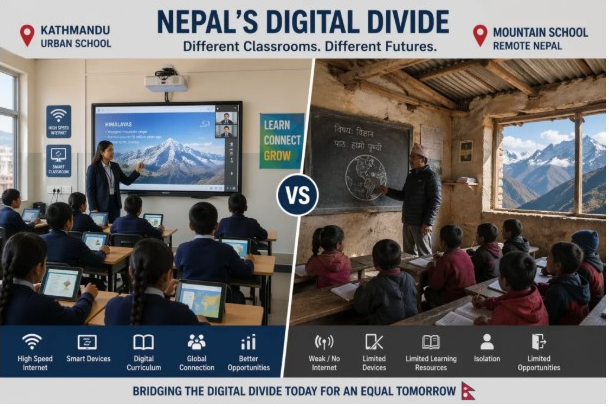
Imagine two children waking up at the same time on a school morning in Nepal. One is in Kathmandu, opening a laptop, joining a Zoom class, watching an animated lesson in English. The other is in a village in Humla, walking 45 minutes on a mountain trail to reach a school with no electricity, let alone Wi-Fi. Both are Nepali. Both deserve the same future. But digital education in Nepal as it stands today is not giving them the same future. It may actually be making things worse.
Here’s the shocking number: only 3% of children and youth in rural Nepal have access to computers and the internet, compared to urban centres like Kathmandu where connectivity is becoming the norm. That is not a technology gap. That is an inequality crisis dressed up as a progress story.
The Promise vs. The Reality of Digital Education in Nepal
Nepal’s government has written beautiful policies. The 2015 National ICT Policy. The 2019 National Education Policy. The 2021–2030 Education Sector Plan. All of them promise digital integration, better learning, and equal access. The 2019 National Education Policy aims to develop ICT infrastructure, platforms, and skills. That sounds wonderful on paper.
But here is the truth: the policy is developed by government and mandated to schools, but government does not commit funding to resource infrastructure or train teachers in ICT use. NGOs have stepped in to fill the gap creating a second, parallel system that the government neither controls nor funds consistently.
So who benefits? Schools that are already well-connected. Private schools in cities. Children of families that can afford devices and data. Digital education in Nepal, without serious intervention, becomes a tool that rewards the already-advantaged and ignores the rest.
The Urban-Rural Divide
Nepal is not just a country with inequality. It is a country with mountains. And those mountains make the digital divide almost impossible to ignore.
Urban areas, especially Kathmandu Valley, enjoy somewhat dependable and fast internet connectivity, while rural areas especially mountainous regions face significant problems like unreliable electricity and limited infrastructure.
Urban areas, especially Kathmandu Valley, exhibit much higher connectivity with 79.3% internet penetration, while rural areas lag significantly. In some households below the poverty line, only 9.5% have internet access highlighting a substantial affordability challenge.
Think about what this means for a child in Solukhumbu or Bajura. Even if a school gets a donated tablet, there may be no electricity to charge it. Even if there is electricity, there may be no signal. Even if there is a signal, the content may be in English a language that child barely uses outside a classroom.
This is not an infrastructure problem alone. It is a geography problem, a language problem, an economic problem, and a social justice problem all wrapped into one.
Watch this: UNESCO’s look at Nepal’s education system and digital challenges search “Nepal digital divide education UNESCO YouTube” to find relevant documentary content from reputable educational channels covering this crisis.
Recommended YouTube resource: Search “OLE Nepal digital learning” on YouTube to see how organisations are trying to bring interactive local-language digital content to rural Nepali schools. OLE Nepal (Open Learning Exchange Nepal), founded in 2007, creates open-source Nepali-language educational activities one of the few genuine efforts to make digital education culturally relevant.
Access Is Not the Same as Equity
Here is what confuses most people. Nepal’s broadband penetration number looks impressive. According to the Nepal Telecommunications Authority’s MIS report of April 2024, Nepal has achieved a 144.56% broadband penetration rate meaning subscriptions exceed the population, largely because many people have both mobile and fixed connections.
Sounds great, right? But read this carefully: the actual digital literacy rate remains significantly lower, at around 31%, revealing a gap between access and meaningful use.
This is the difference between having a road and knowing how to drive. Between owning a book and being able to read it. Having the internet does not mean you can use it for learning. It does not mean the content is in your language. It does not mean your teacher knows how to teach with it.
Joy Buolamwini, who has spent her career fighting algorithmic injustice, would say this clearly: access without equity is just a photo opportunity. You can photograph the laptop handout. You cannot photograph the child who still doesn’t understand the lesson because it came in a language she barely speaks.
The Teacher Training Crisis
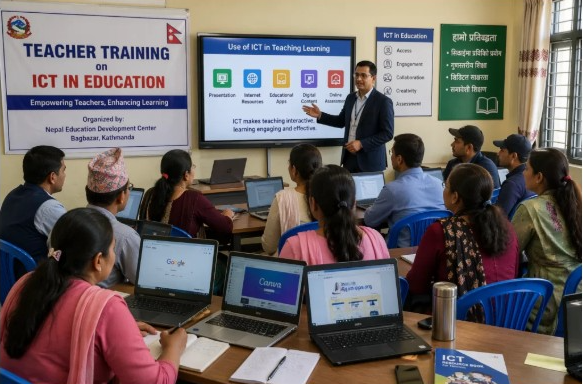
Let us talk about teachers. Nepal’s teachers are hardworking, underpaid, and often placed in schools far from their homes. Now the government is asking them to become digital educators without proper training, without devices of their own, and without a stable internet connection.
In Nepal, the shortage of trained teachers in science and computer-related subjects is severe. Teachers are often required to teach outside their area of expertise or to deliver technical subjects without the necessary background.
None of the educational policies in ICT have articulated how to manage funding for developing ICT infrastructure in schools and equipping teachers with ICT skills.
What happens when an untrained teacher is handed a smart board? At best, it becomes a fancy projector. At worst, it sits in a corner covered with a cloth, gathering dust. This is not imagination. This is what researchers have found in rural school after rural school across Nepal.
OLE Nepal’s teacher training model a 7-day intensive program followed by in-school support is one of the better models. But it covers only a fraction of Nepal’s 35,000+ government schools. The government’s own programs, as research consistently shows, remain underfunded and inconsistent.
When Content Doesn’t Speak Your Language
Nepal has over 120 spoken languages. Nepali is the official language. English is the language of most digital content. Most children in hills and mountains grow up speaking Tamang, Rai, Gurung, Tharu, Maithili, or one of dozens of other languages.
When a child in Taplejung logs into a digital platform and finds content only in English or even in formal Nepali that feels foreign the technology has already failed them. Chomsky would say language is not just communication. Language is identity, cognition, and power. When you exclude a child’s mother tongue from education, you are not just creating inconvenience. You are signalling that their knowledge system does not matter.
Very few digital platforms in Nepal offer content in local languages. Most public digital tools use Nepali. Most private platforms use English. The child in the mountains is excluded at both levels.
This is why the “digital education revolution” in Nepal, if not planned carefully, could quietly teach a generation of rural children that their world is not worth learning about.
Public vs. Private Schools
Here is a pattern that Drucker and Weber both would recognise instantly. When a new technology arrives, it goes first to those with money. Private schools in Kathmandu already have smart classrooms, internet labs, and teachers trained in blended learning. Public schools in the same city are still waiting for basic infrastructure.
This disparity is not just an inconvenience; it is shaping the future opportunities of millions of young Nepalis. Private school students will go on to be digitally fluent. Public school students especially rural ones will not. The economic gap between them will grow. The social stratification will deepen.
Weber called this “bureaucratic expansion that benefits the already advantaged.” Bureaucracies do not automatically serve the poor. They serve those who know how to navigate them. And in digital education, those who navigate it best are already privileged.
This is a social stratification issue dressed in the language of progress.
What Good Policy Would Actually Look Like
Let us not just complain. Let us say what should actually happen.
1. Fund teacher training properly and consistently. Not one week. Not an NGO pilot. A national program with government money, district-level coordination, and regular refreshers.
2. Build infrastructure before pushing devices. Electricity before tablets. Connectivity before content. A tablet in a school with no power is waste. Solve the infrastructure problem first.
3. Mandate local language content. Platforms receiving government support must offer content in at least the five most widely spoken regional languages. No exceptions.
4. Separate the metric of “access” from “learning outcomes.” Stop measuring success by the number of devices distributed. Start measuring by whether children are actually learning more. These are very different numbers.
5. Close the public-private gap actively. Spend more on public schools. Tax digital education companies fairly and use that money to fund rural connectivity.
6. Let communities design their own digital tools. Top-down content fails. Communities know what their children need to learn. Involve local teachers, parents, and students in content creation.
The Real Cost of Getting This Wrong
If digital education in Nepal continues on its current path distributing hardware without equity, building platforms without language inclusion, and training teachers without budget the result will not be neutral. It will be harmful.
Children in Kathmandu will become more digitally literate. Children in Humla will fall further behind. The educated urban class will get better jobs, earn more, and move up. The rural poor will stay where they are; or worse, develop a new form of educational inferiority complex, believing that they simply do not belong in the digital world.
Nepal is marked by pronounced gaps in internet and data communication access, driven by factors such as income inequality, gender imbalances, educational disparities, and rural-urban distinctions. This economic constraint perpetuates a stark divide, relegating a significant portion of the population to the outskirts of the digital realm.
That divide is not accidental. It is the natural result of designing systems for the already-connected and calling it universal progress.
What Is Already Working
Not everything is dark. Let us be fair.
OLE Nepal has been doing quiet, serious work since 2007 building open-source digital learning content in Nepali, training teachers, and working inside the public school system rather than around it. Their model shows that interactive, local-language, teacher-supported digital education can work even in resource-limited settings. (https://olenepal.org)
The Himalayan Times and Kathmandu Post have consistently reported on both the failures and the experiments and that public accountability matters. The digital divide in Nepal is not invisible. It is discussed. The question is whether that discussion leads to action.
Comments from Nikhil Raj Sharma, Founder, Himalayan Geographic
“Digital education in Nepal cannot be separated from Nepal’s geography. We keep designing solutions for Kathmandu and hoping they travel to Humla on their own. They don’t. Nepal’s hills and mountains demand that we build education solutions that go to the child not solutions that wait for the child to come to a city.”
“What excites me about digital tools is the possibility of preserving local knowledge; Himalayan ecology, indigenous languages, traditional practices through digital media. But only if the communities lead that effort. If outsiders decide what to document and what to teach, we will lose that opportunity.”
“I have seen government policies on ICT in education that look excellent on paper and do nothing in practice. The honest question Nepal must ask is this: are we building digital education for the learner, or for the report?”
Final Verdict
Digital education in Nepal is an opportunity; but only if the focus shifts from technology distribution to equity in learning experience. Right now, it is mostly distribution. Devices get counted. Connections get announced. Learning outcomes get ignored.
If Nepal continues this way, digital education will not solve inequality. It will rebrand it. The rich will stay rich, the connected will stay connected, and the mountain child will be told that the future is digital just not theirs.
Nepal is buying televisions for children who don’t have homes yet. First, fix the roof. Then, bring the television. In education terms; first, train the teacher, electrify the school, and build content in the child’s own language. Then talk about digital transformation. Technology is a tool. Equity is the goal. Don’t confuse them.
The solution is not more laptops. It is more justice.
Related Articles to Read Next:
- Why Nepal’s Public Schools Are Still Fighting for Basics in 2025
- How OLE Nepal Is Quietly Changing Rural Education
- Language and Learning: Why Mother Tongue Education Still Matters
- Can Satellite Internet Save Nepal’s Remote Schools?
References:
- Sato (2024); Adhikari (2024) — Digital literacy and employment in Nepal. International Journal of Asian Social Science, 2025, 15(10): 315–323.
- Chand, M. B., K.C., S., & Maharjan, M. (2024). Unveiling Disparities: A Case of Digital Divide in Nepal. The Journal of Economic Concerns, 15(1), 130–142.
- Nepal Telecommunications Authority MIS Report, April 2024. The Himalayan Times.
- DataReportal — Digital 2024: Nepal.
- Gurkha Technology — Digital Landscape of Nepal.
- Horion Nepal — Rural vs Urban Schools: Smart Displays (2026).
- Rana, K., Greenwood, J., & Fox-Turnbull, W. (2020). Implementation of Nepal’s education policy in ICT. Electronic Journal of Information Systems in Developing Countries.
- OLE Nepal — Teacher Trainings.
- OLE Nepal — Wikipedia.
- Education Profiles — Nepal Technology.
- Tandfonline — Teachers’ use of mobile devices in Nepal (2024).
- Medium/Illumination — Improving Nepal’s Education System (2025).
- NetMission.Asia — Bridging the digital divide, Nepal and Sri Lanka (2025).
- Springer — Inequalities reinforced through online education, Nepal, COVID-19.
Disclaimer: The content and images published in this article are provided for general informational and educational purposes only. Some images may be generated or enhanced using artificial intelligence (AI) and are intended solely for illustrative use. The views, interpretations, and information expressed do not necessarily reflect the official position of Himalayan Geographic Research Foundation, nor do they constitute professional, legal, medical, or financial advice.
While efforts are made to ensure accuracy, no guarantees are given regarding completeness or reliability. Readers are encouraged to independently verify information and use their own judgment. By reading this article, you acknowledge that any reliance on the content is at your own risk, and Himalayan Geographic Research Foundation assumes no responsibility or liability for disagreements, interpretations, or outcomes arising from its use. If you do not agree with these terms, you are advised to discontinue reading.