
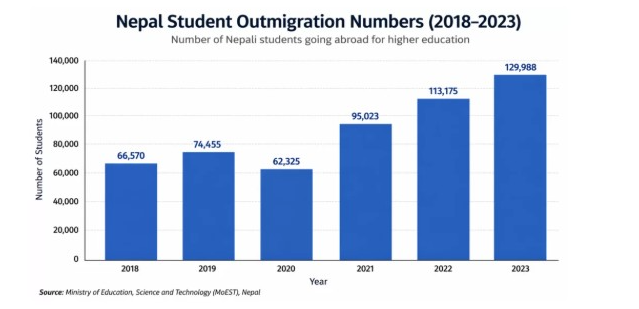
Every year, over 100,000 students leave Nepal for higher education abroad. This is not just a trend it is a system failure. Here are the real drivers, the real numbers, and what Nepal must do right now.
Every four minutes, one Nepali student boards a plane not for a holiday, but to build a future somewhere else.
That is not a guess. Nepal’s Department of Foreign Employment and the Nepal Rastra Bank both confirm that student outmigration has become one of the country’s biggest economic and social stories. In the fiscal year 2022–23 alone, Nepal’s foreign exchange spending on education abroad crossed NPR 90 billion nearly USD 680 million. That money left the country. So did the students.
If you think students leave Nepal for higher education abroad simply because they want to “see the world,” you are missing the real picture. This is a structured, rational, and very predictable outcome driven by six powerful forces that Nepal’s policy world has largely failed to address.
Let us break it down honestly.
Nepal’s Student Drain in Numbers
Before we talk about why, let us talk about how many.
According to the Nepal government’s data compiled by the Ministry of Education, Science and Technology (MoEST), more than 500,000 Nepali students were studying abroad as of 2023. The top destinations include:
- Australia; historically the number one choice
- Japan; especially for vocational and language programmes
- Canada; popular for post-study work rights
- United States; for research and graduate studies
- United Kingdom; for one-year master’s programmes
- South Korea and India; for affordable and nearby options
The numbers grew sharply after COVID-19 restrictions lifted. In 2022, Australia alone issued over 40,000 student visas to Nepali nationals a record high at the time.
This is not random. Students are rational actors. As Adam Smith would say they follow incentives. And right now, every big incentive points outward.
Driver 1: The Academic Quality Gap
Walk into many Nepali colleges today, and you will find syllabi that have not changed in a decade. Rote learning dominates. Lab infrastructure is weak or missing. Research culture is nearly absent.
John Dewey spent his life arguing that education must connect to real life learning by doing, not learning by memorising. Most Nepali institutions fail this test completely.
Students compare what they get at home with what YouTube, LinkedIn, and friends abroad tell them foreign universities offer project-based learning, industry partnerships, research stipends, and professors who have actually worked in the field. The comparison is not close.
The University Grants Commission of Nepal (UGC) has acknowledged curriculum staleness as a serious problem. The National Education Policy 2076 (2019) called for reforms, but implementation has been painfully slow.
Real consequence: When a Kathmandu student sees that Tribhuvan University’s BSc Computer Science curriculum barely touches machine learning while universities in Australia, Canada, and the US run full AI and data science programmes the choice feels obvious.
Reference: UGC Nepal Annual Report 2022–23
Driver 2: Missing Programmes
Nepal’s young population is increasingly interested in fields like:
- Artificial Intelligence and Machine Learning
- Data Science and Analytics
- Biotechnology and Genomics
- Environmental Engineering
- UX/UI Design and Product Management
- Clinical Psychology and Counselling
Most of these are either missing entirely or poorly designed in Nepal’s higher education system. The institutions that do offer them often lack qualified faculty, updated software, or industry connections.
This is a classic supply-demand mismatch. The market demands certain skills. The domestic education market does not supply them. Students go where supply exists.
As Drucker would remind us organisations that do not serve their customers’ real needs will lose them. Nepal’s universities are losing their customers to other countries.
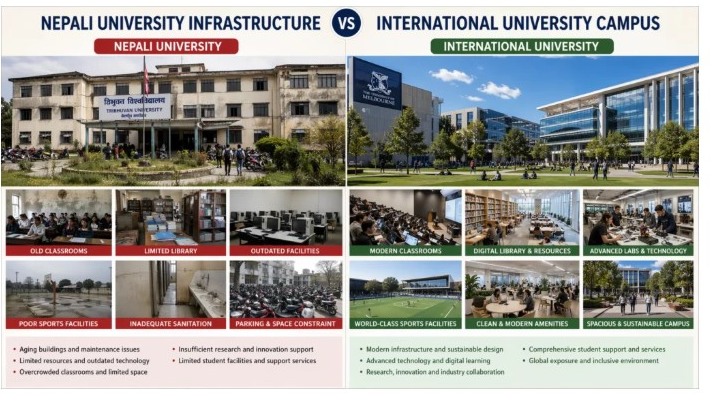
Driver 3: Employment Outcomes
Here is something many education policymakers miss: students are not just buying knowledge. They are buying a signal.
In labour markets especially global ones a degree from the University of Melbourne, University of Toronto, or even a mid-ranked UK university carries more weight than a top Nepali degree. This is the signalling theory of education, well-documented in economics literature.
But it goes beyond signalling. Foreign degrees actually do open doors to better-paying jobs both abroad and increasingly in Nepal’s private sector, INGOs, and multinational companies operating locally.
The World Bank’s 2021 report on South Asian labour markets noted that education-to-employment linkages in Nepal remain weak, with many graduates unable to find work matching their qualifications. Employers confirm this they prefer graduates with practical skills, and they often find foreign-educated candidates better prepared.
Bold statement worth sharing: “In Nepal, your degree tells people where you studied. Abroad, your degree tells employers what you can do.”
Reference: World Bank Nepal Education Sector Report
Driver 4: Education as a Visa Strategy
Let us be honest about something that everyone knows but few policy documents say clearly.
For a large number of Nepali students especially those going to Canada, Australia, and the UK the degree is secondary. The primary goal is permanent residency.
This is not a criticism. It is a rational response to limited opportunity at home. If your country cannot offer you a decent income, safety, political stability, and upward mobility and another country can, through an education-to-residency pathway why would you not take it?
Australia’s post-study work rights, Canada’s Post-Graduate Work Permit (PGWP), and UK’s Graduate Visa Route have all made this pathway very accessible. Nepal’s students have figured this out often before they even choose which course to apply for.
Machiavelli would call this pragmatism of the highest order: people use the tools available to reach their goals. The question is whether Nepal’s policymakers are pragmatic enough to respond.
Recent development: Australia tightened its student visa rules in 2024, including raising English language score requirements and scrutinising visa applications more carefully. This slowed Nepali student numbers temporarily but did not stop the flow. Students shifted to Canada and the UK instead.
Reference: Australian Department of Home Affairs, Student Visa Data 2023–24
Driver 5: Social Signalling and the Herd Effect
In Nepali society today, studying abroad is a status marker. Families celebrate it. Marriage prospects improve. Social media is flooded with departure photos at Tribhuvan International Airport.
Once a critical mass of students left, a social norm was created. Now, not going abroad is sometimes seen as a failure to aspire high enough. This is what economists call a coordination effect individual choices start to look like a collective march.
Herodotus recorded how civilisations move in waves once the tide turns, it takes extraordinary structural change to reverse it. Nepal is in that wave now.
This does not mean it cannot be reversed. But it means the solution is not just about universities. It is about making Nepal itself; its economy, its governance, its opportunity landscape aspirational again.
Driver 6: Governance Failure and the Trust Deficit
Nepal’s universities and education regulators have, over the years, earned a reputation for political interference, delayed examinations, frequent syllabus changes without notice, and lack of transparency.
Max Weber’s entire career studied how bureaucracies either build legitimacy or destroy it. Nepal’s education bureaucracy has, in many areas, destroyed trust through repeated affiliation scandals, low faculty accountability, and institutions that prioritise process over outcomes.
When a student cannot trust that their exam will happen on time, their results will be fair, or their degree will be recognised; they stop trusting the system altogether.
Chomsky would add the political layer: governance failure in education is not accidental. It reflects where power sits and who benefits from keeping institutions weak. When politicians control university appointments and affiliation processes, quality suffers by design, not by accident.
Reference: Transparency International Nepal — Education Sector Governance Report 2022
The Policy Gaps: What Nepal Is Not Doing
Nepal has produced policy documents. It has not produced results. Here are the most critical gaps:
Gap 1: No serious public investment in research universities Nepal spends roughly 3.7% of GDP on education but very little of it goes toward research infrastructure, faculty development, or technology upgrades at universities. Without research culture, universities cannot compete.
Gap 2: No national skills-mapping framework No government agency is systematically tracking which skills Nepal’s economy needs in 5 or 10 years, and then commissioning universities to build those programmes.
Gap 3: No return migration incentive Countries like India, South Korea, and Taiwan have built programmes to attract back their educated diaspora with tax incentives, startup funds, and research positions. Nepal has almost nothing equivalent.
Gap 4: Weak private sector university regulation Private colleges charge high fees but offer poor quality. Regulation is inconsistent, and accountability is low. Students who can afford it go abroad. Students who cannot are stuck with poor domestic options.
Gap 5: No bilateral recognition agreements Nepal lacks strong mutual recognition agreements with major economies that would allow Nepali degrees to be valued abroad which would reduce one major incentive for leaving.
What Can Actually Be Done? A Practical Roadmap
This is not hopeless. Here is what works, based on evidence from comparable countries:
1. Build 3–5 flagship national research universities Concentrate resources. Pick fields Nepal can genuinely compete in hydropower engineering, biodiversity, Himalayan ecology, digital health. Fund them seriously.
2. Reform the University Grants Commission Depoliticise it. Bring in independent academics and industry leaders. Link funding to measurable outcomes graduate employment, research publications, student satisfaction.
3. Create a “Study in Nepal” branding campaign Countries like Malaysia, Germany, and Japan actively attract international students. Nepal’s natural and cultural assets are underused. Foreign students bring fees, diversity, and connections.
4. Launch a Diaspora Re-engagement Programme Offer returning Nepali graduates subsidised housing, startup grants, and faculty positions. Let them rebuild what they left behind.
5. Partner with global universities for dual degrees Allow Nepali students to complete part of a globally recognised degree in Nepal. This reduces cost, keeps students in-country longer, and raises domestic quality standards.
YouTube Resource: Watch “Nepal’s Brain Drain Crisis Explained” on YouTube search for it on channels like TED-Ed South Asia or local channels like News24 Nepal and Online khabar English for real student stories and expert interviews.
A Word on What Students Are Really Saying
Talk to any Nepali student preparing to leave. They will tell you the same things:
“I am not leaving because I hate Nepal. I am leaving because Nepal does not have what I need right now.”
That sentence contains the entire policy challenge. It is not about patriotism. It is about systems. Fix the systems, and some of them will stay. Fix the systems better, and some who left will come back.
Comments from Nikhil Raj Sharma, Founder, Himalayan Geographic Research Foundation
“This is exactly what we see on the ground. Students do not lack ambition for Nepal; they lack options within Nepal. At Himalayan Geographic, we believe the solution starts with building knowledge ecosystems here, not just lamenting the ones that leave. Every student who goes abroad is a vote of no-confidence in our system. We need to earn that confidence back.”
“The data on foreign exchange outflow is staggering. Nepal is essentially funding universities in Australia, Canada, and the UK while our own institutions remain underfunded. This is a policy paradox that demands urgent attention. We need not just better universities; we need a national conversation about what kind of knowledge economy Nepal wants to be.”
In the Simplest Language Possible
Students leave Nepal because Nepal’s education system is not giving them what they need good teaching, relevant courses, real job connections, and a government they can trust.
This is not about love for Nepal or lack of it. It is about math. Students look at what they get here versus what they get there and the answer keeps pointing outward.
Nepal can change this. But it takes real investment, real reform, and real political will not just more policies written in Kathmandu offices.
The students are not wrong for leaving. The system is wrong for pushing them out.
Nepal is not losing students. Nepal is losing trust. The day Nepal builds systems worth trusting students will stay, and many who left will return. It is that simple, and that hard.
Related Articles You May Like
- “Nepal’s Brain Drain: Can the Diaspora Come Home?“
- “Top 10 Affordable Study Destinations for Nepali Students in 2026“
- “How Nepal’s Private Colleges Are Failing Their Students“
- “Inside Australia’s New Student Visa Rules: What Nepali Students Must Know“
Disclaimer: The content and images published in this article are provided for general informational and educational purposes only. Some images may be generated or enhanced using artificial intelligence (AI) and are intended solely for illustrative use. The views, interpretations, and information expressed do not necessarily reflect the official position of Himalayan Geographic Research Foundation, nor do they constitute professional, legal, medical, or financial advice.
While efforts are made to ensure accuracy, no guarantees are given regarding completeness or reliability. Readers are encouraged to independently verify information and use their own judgment. By reading this article, you acknowledge that any reliance on the content is at your own risk, and Himalayan Geographic Research Foundation assumes no responsibility or liability for disagreements, interpretations, or outcomes arising from its use. If you do not agree with these terms, you are advised to discontinue reading.