
Rural education in Nepal lags dangerously behind Kathmandu. Discover 7 shocking reasons why geography decides destiny for millions of children and what must change now.
Imagine being four years old, being handed to a stranger, and sent to Kathmandu; not because your parents do not love you, but because your village has no school worth trusting. That is not fiction. That is the story documented in the award-winning film “Children of the Snow Land” (watch the trailer ), where Himalayan children leave their families for over a decade just to get an education.
If that does not break your heart, here is a number that might: only 3% of children in rural Nepal have access to computers and the internet. In Kathmandu, that number is worlds apart. The question is not why rural schools are failing. The question is; why is Kathmandu so far ahead, and who is being left behind because of that?
Education is not preparation for life; it is life itself. Real learning happens through experience, community, and practice. But when a child’s entire environment is broken before she even sits in a classroom, no pedagogy on earth can fully fix what the system has already broken. This is Nepal’s challenge today. And it demands not silence, but honest analysis.
The Kathmandu Advantage
Kathmandu is not just a capital city. It is a vacuum cleaner. It sucks in money, talent, attention, and policy and most of it never leaves.
Nepal’s Ministry of Education received Rs 203.66 billion in the fiscal year 2024-25. Of this, 69.41% was sent to local governments. That sounds fair on paper. But here is the trap: 78.21% of that local budget goes directly to teacher salaries alone. What is left for libraries, labs, computers, training, and school meals? Almost nothing. The day-meal programme for students; which keeps poor rural children in school; received only 5.99% of the local budget.
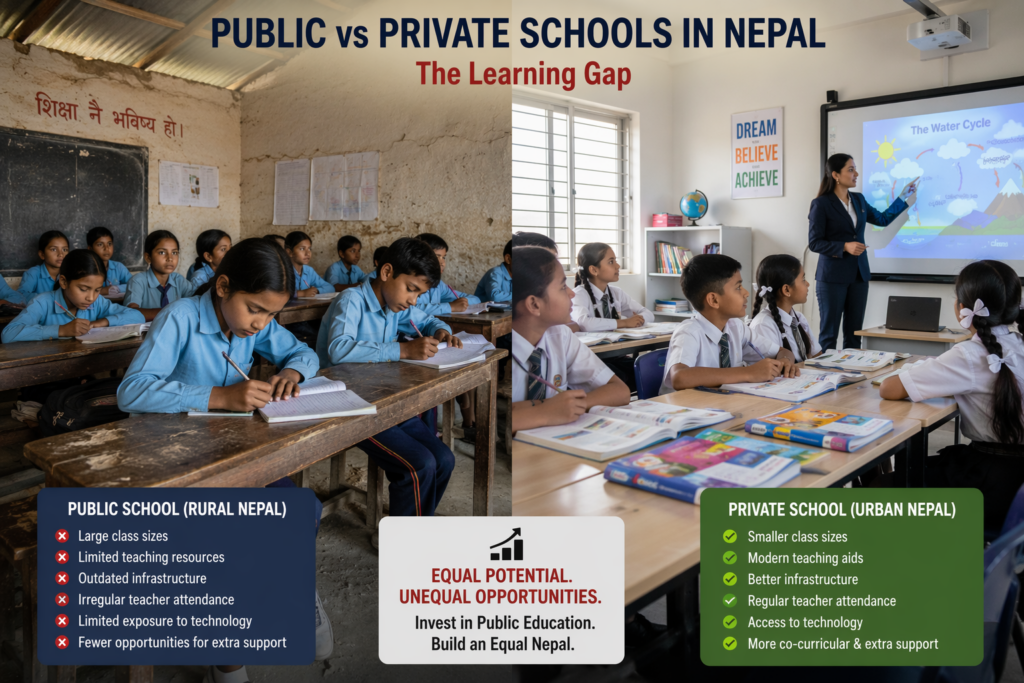
Private schools with digital whiteboards and air-conditioned classrooms cluster in Kathmandu. Public schools with broken walls and no toilets sit in Jumla, Humla, and Karnali. When the 2015 earthquake destroyed over 35,000 classrooms, urban schools were rebuilt fast.
Many rural schools are still using temporary corrugated-metal structures today; nearly a decade later. This is not neglect by accident. It is neglect by design.
“Kathmandu is not just a place. It is a concentration of advantage.” The further a child lives from it, the less chance she gets.
Why the Best Educators Never Arrive in Villages
When I built my educational philosophy, I believed deeply that a good teacher is a facilitator of experience. But you cannot facilitate what you never show up to do.
Nepal is staring at a shortage of more than 100,000 teachers within the next two to three years, according to Professor Bal Chandra Luitel, Dean of the School of Education at Kathmandu University. That crisis will not hit Kathmandu schools first. It will destroy rural schools.
In Achham district’s Chaurpati Rural Municipality, eight secondary schools posted teacher vacancies five separate times. Not one qualified teacher applied. Not one. Schools are running secondary-level science and English classes with primary-level teachers; people trained to teach 8-year-olds now trying to prepare 17 year-olds for national exams.
Why does this happen? Qualified teachers simply prefer Kathmandu. The pay is technically the same under government rules. But life is not the same. Roads, hospitals, electricity, internet, career growth, school management support all of these are better in Kathmandu. A science teacher with a B.Ed degree chooses a city school not out of greed, but out of survival.
The Karnali Province; Nepal’s most remote; is the hardest hit. School management committees drive hours to Kathmandu and Surkhet searching for a single science teacher. Some schools advertise positions four times without success. A basic level teacher ends up teaching English to Grade 10 students. The students sit exams designed for a standard they were never taught. They fail. Then we blame them.
When a Child’s World Is the Classroom’s Enemy
In my work at the University of Chicago’s Laboratory School, I saw what happens when children are given rich environments. They explode with curiosity. Now imagine the opposite: a child who wakes at 5 AM to milk cows, collect firewood, walk one hour to school, and sit in a classroom with no books, no electricity, and a teacher who shows up three days a week.
In Kathmandu, students have:
- School libraries and reading programmes
- Digital classrooms and interactive boards
- Coaching centres open after 4 PM
- Competitive peer groups who push each other
- Parents who went to college and help with homework
In rural Nepal, students have:
- Shared, outdated textbooks (if any)
- Classrooms built before their parents were born
- Teachers who double as administrators, peons, and cooks
- Parents who may themselves be illiterate
- No one to ask when they do not understand
Nepal’s National Assessment of Student Achievement (NASA) data confirms what the eye already sees: students from Kathmandu perform significantly better than students from countryside areas. The gap grows worse in higher grades. By Grade 8, the difference between a Kathmandu school student and a Karnali student is not just marks; it is a different future.
According to Nepal’s Fourth Living Standards Survey (June 2024), 28.1% of students who drop out cite weak learning achievement as the reason. In Koshi Province’s rural belt, that number rises to 35.4%. Children are not dropping out because they are lazy. They are dropping out because no one taught them anything they could understand.
Governance and Accountability; Monitoring That Never Reaches the Mountain
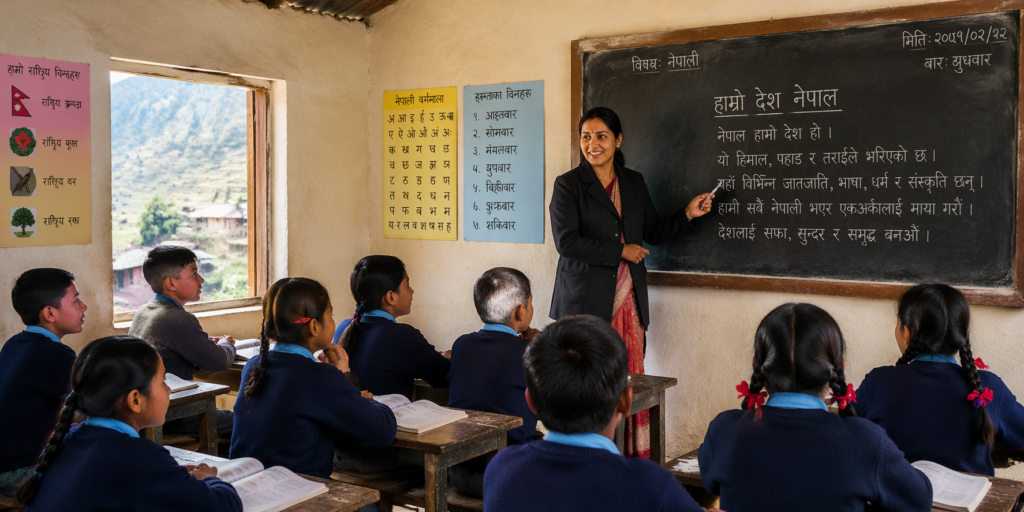
I always insisted that schools must be living communities, accountable to the people they serve. Nepal’s governance structure does the opposite in rural areas.
The President’s Education Reform Programme; meant to fix schools; has been captured by political patronage. In FY 2023-24, Education Minister Devendra Poudel reportedly directed a large share of project funds to 143 schools in his home district, Baglung. This is not education reform. This is constituency management using children as props.
In Kathmandu, school management committees are visible and vocal. Inspections happen. Media notices. In rural areas, school management committees are formed through political quota-sharing. Headteachers are picked by party connections, not by competence. As Professor Luitel put it bluntly: when a headteacher lacks the skills to lead, teachers do not listen, students listen even less, and the school falls into chaos.
Over 70% of students in one rural municipality study scored below a 2.5 GPA. Only 1.8% achieved above 3.6 GPA. In Panchakanya Rural Municipality of Nuwakot, only 30.6% of Grade 5 students passed their annual exams in 2025. Five schools recorded a zero-pass rate. These numbers do not exist in a vacuum. They are the output of a system that looks the other way.
“A school without accountability is not a school. It is a building with children inside.”
Poverty That Teaches Children They Are Not Worth Educating
Nepal’s rural education problem is not only about schools. It is about everything that happens before a child reaches the school gate.
Rural children especially from Dalit, Janjati, and Thami communities; carry adult burdens before 8 AM. Laxman, a ten-year-old from Ramechhap district, milks cows, feeds animals, gathers firewood, and then walks an hour to school every day. He is not an exception. He is the rule.
In rural areas, poverty and parental illiteracy combine into a double trap. Parents who never went to school do not see education as urgent. When a child falls behind in class, no parent can help at home. When a family needs money, the child becomes labour. Nepal’s rural dropout rate is a direct product of this socio-economic pressure not of any failure in the children themselves.
UNESCO data shows that while Nepal’s literacy rate has improved 79% male, 60% female as of 2018; the rural urban attendance gap is persistent. Only 55% of rural children attend early childhood education versus 66% in urban areas. Among the poorest households, only 52% attend versus 87% among the wealthiest. These numbers describe a system that sorts children by birth address, not by potential.
The COVID-19 pandemic exposed and deepened this divide. When Kathmandu schools moved online, rural students simply disappeared. No devices. No internet. No teachers. The academic year became a year of child labour and child marriage for many girls in villages. That loss has not been recovered.
Five Things Nepal Must Do Right Now
I will not end on despair. That is not my nature. Education is the most powerful social tool humanity has, and Nepal is not without solutions. But they require honesty and courage.
One: Deploy and incentivise teachers in rural areas urgently. Same pay is not enough. The government must offer rural teachers better housing, faster promotions, and career paths that reward rural service not punish it. The “Ghumti Teacher” model; teachers who rotate between schools can help in short-staffed areas. A Teacher Bank concept has been proposed for FY 2025-26 but remains only on paper due to budget shortfalls. Implementation must start now.
Two: Redirect the education budget toward learning, not just salaries. 78% of the local education budget going to salaries means 22% left for everything else. School libraries, labs, mid-day meals, and digital tools are not luxuries they are the environment that makes learning possible.
Three: Fix governance at the school level. Remove political appointment from school management committees. Headteachers must be selected by competence, not party membership. Rural schools need real monitoring; not once-a-year inspections that produce reports no one reads.
Four: Use technology as a bridge, not a trophy. Suryadaya Municipality in Ilam is already using interactive panel boards that connect rural students to city teachers in live math and science classes. This model works. It needs scale, funding, and replication across mountain districts.
Five: Address the socio-economic causes, not just the school-level symptoms. Free uniforms, free meals, and scholarships for Dalit and Janjati girls must become universal in rural schools; not pilot programmes. A child who is hungry cannot learn. A child who must work cannot attend. This is not charity. It is investment.
As Teach For Nepal’s fellows remind us every year: rural students are not less intelligent. They are less served. The talent is there. The system is not.
Nikhil Raj Sharma, Founder of Himalayan Geographic, Speaks
“When I travel through Nepal’s hills and mountains, I do not see children who cannot learn. I see children who have never been given a real chance to learn. Kathmandu keeps building taller private schools while village schools still lack a single science teacher. This is not development; this is abandonment with a good budget speech attached.”
“The most dangerous thing about this gap is how quietly it grows. No riot, no protest; just generation after generation of brilliant children who never had access to a fair start. Himalayan Geographic has been documenting this reality for years. Until we make it visible, nothing changes.”
The Simple Truth
Kathmandu is not strong because its children are smarter. It is strong because the system decided to invest there first, and keep investing there. Rural children are not weak. They are under-resourced, under-taught, and under-prioritised.
Education is not a gift that cities give to villages. It is a right that belongs to every child whether she is born in Thamel or Taplejung.
The real question is not why rural education fails. The question is: what kind of country do we want to be? One that builds walls of advantage around the capital? Or one that decides finally that geography will not decide destiny?
Kathmandu got good schools because Kathmandu got all the money, all the good teachers, and all the government attention. A village child in Karnali is not less smart than a child in Kathmandu. She just had the bad luck of being born far from where the budget goes. Fix the budget. Fix teacher postings. Fix who watches over the schools. Or just accept that Nepal has decided which children deserve a future and which ones do not.
Related Articles You May Like:
- Why Nepal’s Private School Industry Is Booming While Public Schools Collapse
- How Technology Could Finally Bridge Nepal’s Education Divide
- The Real Cost of Teacher Shortages in Himalayan Communities
References:
- First Steps Himalaya — Rural vs Urban Education in Nepal
- Horion Nepal — Smart Displays and Nepal’s Digital Divide
- The Kathmandu Post — Growing Rural-Urban Education Divide (April 2024)
- The Kathmandu Post — Where Does the Education Budget Go? (Dec 2024)
- Nepal News — Nepal Stares at 100,000 Teacher Shortfall
- The Kathmandu Post — Shortage of Secondary Teachers Hits Schools (Jan 2024)
- Nepal News — Nepal’s School Education at a Worrying Point (April 2026)
- UNESCO / NEQMAP — Learning Inequality in Nepal
- D+C Development and Cooperation — Nepal’s Deep Educational Divides
- UNICEF Nepal Education Budget Brief
- Royal Society for Asian Affairs — Curriculum Reform in Rural Nepal
- Rising Nepal Daily — Transformative Funding for Education
- Children of the Snow Land Documentary (Nepal Education)
- Springer — Inequalities in Online Education in Nepal (COVID-19)
- IJCRM Research Journal — Quality Education Barriers in Rural Nepal (2024)
Disclaimer: The content and images published in this article are provided for general informational and educational purposes only. Some images may be generated or enhanced using artificial intelligence (AI) and are intended solely for illustrative use. The views, interpretations, and information expressed do not necessarily reflect the official position of Himalayan Geographic Research Foundation, nor do they constitute professional, legal, medical, or financial advice.
While efforts are made to ensure accuracy, no guarantees are given regarding completeness or reliability. Readers are encouraged to independently verify information and use their own judgment. By reading this article, you acknowledge that any reliance on the content is at your own risk, and Himalayan Geographic Research Foundation assumes no responsibility or liability for disagreements, interpretations, or outcomes arising from its use. If you do not agree with these terms, you are advised to discontinue reading.