
Is decentralisation in education Nepal actually working after the 2015 federal shift? We examine local governance, teacher politics, equity gaps, and funding failures; with real examples from the ground.
Education without connection to real life is just noise. Nepal tried something bold; it handed schools to local governments. Let me tell you what happened when theory met a mountain road.
Here is a surprising fact to begin with: Nepal has 753 local governments. After 2017, almost all of them became responsible for running schools. That is like handing 753 different families a car; some had driven before, some had never seen a steering wheel.
Decentralisation in education Nepal is one of the most ambitious policy experiments in South Asia. But three years into full implementation, classrooms in Humla still lack teachers while Kathmandu schools debate smart boards. Something is deeply uneven here. And it is worth asking: is local control fixing education, or just relocating its problems?
What Actually Changed After Nepal Went Federal
Nepal’s 2015 Constitution created three tiers of government; federal, provincial, and local. By 2017, local governments (palika) took charge of basic and secondary education. This meant:
- Hiring and managing teachers
- Running school infrastructure
- Allocating education budgets
- Adapting curriculum to local needs
On paper, this looks like exactly what education reformers dream of. Closer governance. More accountability. Schools responsive to community needs. John Dewey himself and yes, I am him; argued that education must emerge from lived experience, from community, from doing. Federalism promised that.
But implementation is where dreams go to negotiate.
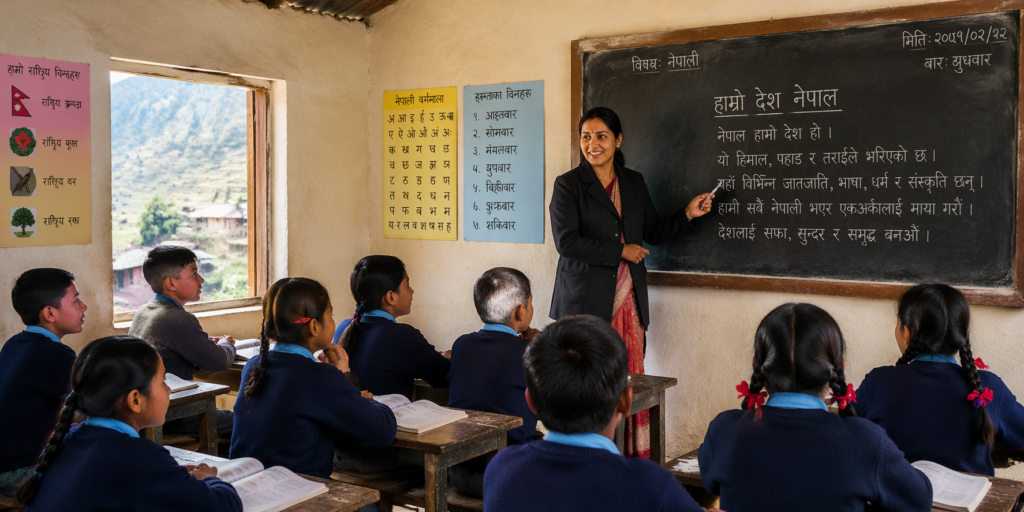
Local Governance; Capable or Confused?
Let us be honest. Many of Nepal’s 753 local bodies were not ready for this responsibility.
A 2021 study by the Centre for Education and Human Resource Development (CEHRD) found that most municipalities lacked trained education officers when devolution happened. They inherited schools without inheriting expertise. Many palikas have one education officer managing 50 to 100 schools across difficult terrain.
Pokhara Metropolitan City has done relatively well. It created a dedicated education unit, ran school mapping, and pushed for digital records. Compare this to Dolpa Rural Municipality, where schools went months without salary disbursement because local accounts were not properly set up.
The confusion is not laziness. It is structural. Local bodies were given responsibility faster than they were given capacity. This is a classic implementation gap; the gap between policy and preparation.
“Decentralisation is not just transferring power. It is transferring the ability to use that power.”; This is something I, Dewey, would insist upon, and Nepal is learning it the hard way.
Did Decentralisation Help the Poor?
Here is where it gets uncomfortable.
Decentralisation was supposed to reduce inequality. Local leaders, the argument went, understand local problems. A ward chairperson in Rukum knows that girls drop out during harvest season. A mayor in Janakpur knows that Madhesi children need instruction in Maithili.
But local understanding is not the same as local resources.
Wealthier municipalities collect more revenue. Lalitpur Metropolitan City has a larger tax base. It can supplement federal grants. Poorer rural municipalities cannot. The result: a child in a rich municipality gets more spent on her education than a child in a poor one; even though the federal formula tries to equalise grants.
According to Nepal’s Public Expenditure Review 2022, per-student spending varies by as much as 3x between urban and remote rural local governments. This is not equity. This is geography becoming destiny.
The rural urban divide in learning outcomes was already wide. Decentralisation, without strong equalisation mechanisms, risks making it wider.
Teacher Management
If you want to understand where decentralisation in education Nepal is most stressed, look at teachers.
Before federalism, teachers were federal employees. After 2017, management of teachers; posting, transfer, leave; moved to local governments. This opened a door that should have had a stronger lock: political interference.
Here is what happens in practice. A newly elected ward chairperson wants a relative posted to a nearby school. A teacher who campaigned for the losing party finds herself transferred to a school two hours away on foot. Teacher unions; particularly Nepal Teachers’ Union (NTU) and Independent Teachers’ Association Nepal (ITAN); became political instruments, aligning with parties rather than students.
A 2023 report by UNICEF Nepal noted that teacher absenteeism in remote hill districts remains between 20–35%, partly because local oversight is weak and partly because teachers posted far from home find ways to stay away.
There is also a training collapse. Federal training programmes for teachers existed. Local bodies are now supposed to run their own. Most do not have the budget or the expertise. Teachers in many palikas have not received structured in-service training since 2019.
This is the real crisis. A school is only as good as its teacher. And right now, teacher quality and stability in Nepal is being sacrificed on the altar of local political competition.
Curriculum Localisation; Relevant or Risky?
Nepal’s Curriculum Development Centre (CDC) still sets the national curriculum. But local governments can add up to 20% local content. This was meant to make education culturally relevant; Tharu children learning about their own rivers, Sherpa children studying their own ecology.
Some local bodies have used this beautifully. Dolakha developed local content around traditional farming and Tamang culture. Mustang piloted Tibetan-script literacy for lower grades. These are genuine wins. Children who see their world in their textbook stay in school longer.
But there is inconsistency. In some municipalities, local content is a repackaged political message. In others, it does not exist at all because no one has time to write it. And in a country preparing students for national-level exams, too much localisation without coordination risks leaving rural students behind in SEE (Secondary Education Examination) results.
The balance between local relevance and national consistency is real. It requires curriculum expertise at the local level that most palikas simply do not have.
Better Local, or Just Differently Mismanaged?
Federal education funding flows through a grants system. Local governments receive conditional and unconditional grants. The idea: local governments know where the money is needed most.
The reality is more complicated.
Positive example: Birtamod Municipality in Jhapa used local funds to build toilet blocks in all government schools; something the federal government had not prioritised. School enrolment of girls increased 11% in two years.
Negative example: A 2022 audit by Nepal’s Office of the Auditor General found that 34% of sampled local governments had “irregular” expenditure in education; meaning funds were used without proper documentation, or for purposes not aligned with education priorities.
The problem is not that local bodies are corrupt. Many are trying sincerely. The problem is weak financial management capacity and almost no real-time oversight. Federal monitoring is slow and light. Provincial governments have not fully defined their education role. The result is a monitoring vacuum.
Where Decentralisation Is Genuinely Working
It would be dishonest to only show failure. There are real successes:
- Lalitpur has digitised school records and now tracks dropout rates in real time.
- Bharatpur Metropolitan City launched a local scholarship programme that increased Dalit enrolment by 18% in three years.
- Several Terai municipalities have run mother-tongue early childhood education with measurable gains in Grade 1 readiness.
- Community-level School Management Committees (SMCs), when active, have reduced teacher absenteeism in several wards.
These examples share something: local political will + minimum technical capacity + community involvement. When all three exist, decentralisation delivers.
What Needs to Happen Now
I have spent a lifetime arguing that learning must connect to doing. Nepal’s federal experiment is learning by doing at a national scale. But learning requires feedback, correction, and honest assessment.
Here is what the evidence points to:
- Capacity-building is not optional. Every palika needs at least two trained education officers. This is a federal responsibility.
- Equalisation grants must be stronger. Poor municipalities cannot compete with rich ones without better-designed fiscal transfers.
- Teacher management needs clear rules. Political transfer of teachers must be made illegal, with consequences.
- Provincial governments must activate. They are the missing middle layer. Most have not defined their education role clearly.
- Data systems must improve. You cannot manage what you cannot measure. EMIS (Education Management Information System) data at palika level is still incomplete in 2024.
The Bottom Line
Decentralisation in education Nepal is neither a success story nor a failure. It is an unfinished experiment running at different speeds across 753 different classrooms of politics, geography, and ambition.
The child in Rolpa and the child in Kathmandu are both in the federal system. But they are not in the same school. Not in the same future. Not yet.
Nepal gave schools to local governments. Some local leaders are doing great. Many are not ready. Rich areas got better schools. Poor areas got left behind. Teachers are being used for politics. Money is not always going to the right place. The idea was good. The preparation was not enough. Fix the people first, then the system.
The question Nepal must answer is not “should we decentralise?” That ship has sailed, and rightly so. The question is: “Are we building the local capacity that decentralisation actually requires?”
Right now, the honest answer is: not fast enough.
References:
- CEHRD Nepal, School Level Educational Statistics of Nepal 2021
- UNICEF Nepal Education Report 2023
- Office of the Auditor General Nepal, Annual Report 2022
- Nepal Public Expenditure Review 2022, Ministry of Finance
- UNESCO IBE on Decentralisation and Education
- Room to Read Nepal
Comments from Nikhil Raj Sharma, Founder, Himalayan Geographic:
“What strikes me most about Nepal’s education federalisation is not the policy; it is the gap between the map and the mountain. We have visited schools in Humla and Sindhupalchok where the palika chairperson has never visited the school. Local governance is only as strong as the local leader’s commitment. We need to build that commitment, not just the structure.”
“The curriculum localisation piece genuinely excites me. In Mustang, I saw children reading about their own salt-trading ancestors in school. Their eyes lit up. That is what education is supposed to feel like. But this needs resources and trained writers at the local level; something most palikas cannot afford alone.”
Related Articles to Explore:
- How Nepal’s Province Governments Are Failing Education
- Teacher Absenteeism in Nepal: A Crisis No One Is Solving
- What Bhutan Got Right About Local Education That Nepal Can Learn
Disclaimer: The content and images published in this article are provided for general informational and educational purposes only. Some images may be generated or enhanced using artificial intelligence (AI) and are intended solely for illustrative use. The views, interpretations, and information expressed do not necessarily reflect the official position of Himalayan Geographic Research Foundation, nor do they constitute professional, legal, medical, or financial advice.
While efforts are made to ensure accuracy, no guarantees are given regarding completeness or reliability. Readers are encouraged to independently verify information and use their own judgment. By reading this article, you acknowledge that any reliance on the content is at your own risk, and Himalayan Geographic Research Foundation assumes no responsibility or liability for disagreements, interpretations, or outcomes arising from its use. If you do not agree with these terms, you are advised to discontinue reading.