
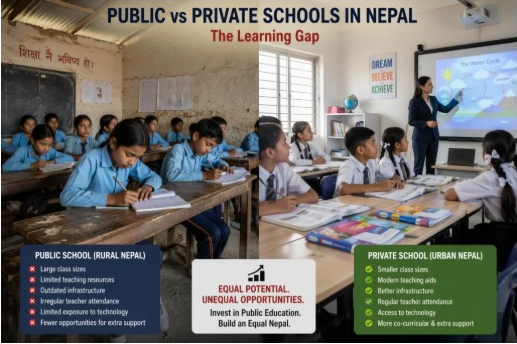
Public vs Private Schools in Nepal is not just a money problem; it is a learning crisis. Discover the 5 structural fault lines breaking Nepal’s education system and what can actually fix them.
Education is not preparation for life; it is life. And in Nepal, two very different lives are being prepared, right inside the same school system.
The Number That Should Alarm Every Nepali Parent
Only 45% of Grade 5 students in Nepal’s public schools can read a simple Grade 2 text fluently. Private school students at the same grade? Significantly ahead. This is not a funding gap. This is a learning gap; and it is being manufactured, quietly, every single day.
Public vs Private Schools in Nepal has become one of the most important debates in South Asian education. Nepal expanded schooling fast. Enrolment went up. Buildings came up. Budgets were allocated. But here is the cruel truth: expanding access to school is not the same as expanding access to learning. One gives you a seat. The other gives you a future.
What we are seeing today is not just economic inequality. It is capability inequality; where two children, born in the same country, grow up with fundamentally different abilities to think, earn, and lead. Let us diagnose this properly.
Fault Line 1: Teachers; The Core Production Function Nobody Wants to Fix
A school is only as good as what happens in its classrooms. And in Nepal’s public schools, what happens there is; too often; very little.
Public school teachers enjoy permanent employment. Once appointed, there is almost no mechanism to remove a teacher for poor performance. The Nepal Teachers’ Union is powerful. Transfers happen, but accountability does not. A 2019 study by Room to Read Nepal found teacher absenteeism in public schools running between 25 30% in remote districts. The children sit. The teacher may not come. This is not a metaphor; it is a daily reality.
Private schools work differently. They hire on contract, evaluate on results, and terminate for consistent underperformance. Parents pay fees. Parents complain. Parents leave. So private school management has to manage teachers. The incentive structure is brutally simple and brutally effective.
The fix is not to copy private schools blindly. It is to break the protection of non-performance in public schools. Performance-linked pay, transparent evaluation, and principal-level authority to manage staff these are operational changes, not ideology.
“You cannot improve a school by ignoring what the teacher does for six hours every day.” Adapted from Dewey’s core principle of learning-by-doing.
Fault Line 2: English as Economic Currency; Who Gets to Spend It?
Here is a fact that no politician in Kathmandu likes to say out loud: English is not just a language in Nepal. It is a class marker.
Private schools teach in English medium from Nursery. Students graduate comfortable in English, ready for Tribhuvan University’s better departments, for Indian universities, for Gulf jobs that pay three times the local rate. Public schools teach in Nepali; which is fine culturally, but economically catastrophic when every decent employer, every higher education entrance exam, and every migration pathway runs in English.
This is not about abandoning Nepali culture. This is about recognising that language of instruction is an economic signal; and right now, that signal is screaming inequality.
The government’s attempt to introduce English medium in public schools has been poorly implemented. Teachers with weak English command are asked to teach Science in English. Students get confused. Parents see the confusion. And then they scrape together Rs. 2,000–5,000 per month to put their child in a private school, even when they cannot afford it.
Targeted English proficiency programmes for public school teachers first. Then students. Not the other way around.
Fault Line 3: Governance; Who Is Answerable to Whom?
This is perhaps the most invisible fault line and the most decisive.
A private school principal answers to the parents who pay fees. If learning outcomes drop, admissions drop. If admissions drop, salaries stop. The accountability chain is short and painful.
A public school principal answers to the District Education Office, which answers to the Ministry of Education, which answers to political pressure and bureaucratic procedure. The chain is long, slow, and full of places where accountability disappears.
Who hires teachers in public schools? The government. Who fires them? Almost nobody. Who measures learning? Results are collected but rarely acted upon at the school level. School Management Committees (SMCs) exist on paper but rarely exercise real authority.
Research by the Centre for Education and Human Resource Development (CEHRD) Nepal consistently shows that schools with active, empowered SMCs perform better; even within the public system. The lesson is clear: push decision rights closer to the school gate, not further away into Kathmandu offices.
Fault Line 4: The Myth of Free Public Education
“Public school is free”; this line is repeated so often that people believe it. It is not true.
A 2021 UNICEF Nepal report noted that even in “free” public schools, families spend money on:
- Uniforms (mandatory in most schools)
- Stationery and books not covered by grants
- Informal fees collected by PTAs
- Private tutoring; the biggest hidden cost
That last item is the most damning. When public school teaching is weak, parents pay private tutors to compensate. In Kathmandu alone, the private tutoring market runs into billions of rupees annually. So the family that chose “free” public school is still paying; just paying for patching a broken system instead of funding a functional one.
Meanwhile, private school fees are high but perceived as reliable. Parents feel they are buying certainty. This psychological shift; paying for certainty vs paying to patch failure; explains why even lower-middle-class families make enormous sacrifices to send children to private schools.
This distortion deepens stratification. Those who can afford private school or private tutoring pull ahead. Those who cannot fall further behind. The gap becomes generational.
Fault Line 5: Urban Rural Asymmetry; The Inequality Within Inequality
Even if we fixed the public-private gap tomorrow, Nepal would still have a catastrophic geography problem.
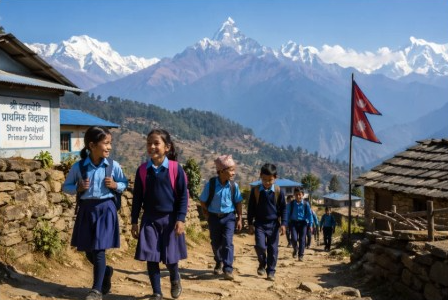
Kathmandu’s public schools are, relatively speaking, better resourced than those in Humla, Jumla, or Dolpa. There are teachers in Kathmandu. There are buildings. There is electricity. In many hill and mountain districts, a single teacher handles multiple grades, the school building leaks, and there is no internet.
The National Assessment of Student Achievement (NASA) data shows consistent learning score gaps between Hill-Mountain districts and Valley/Terai districts; sometimes 20–30 percentile points apart. Geography is multiplying disadvantage. A child born in Mugu district does not just face a public school; they face a failing public school in a place where no private school will ever open because there is no market.
This is where the state cannot retreat and say “let the market handle it.” The state must act; with targeted investment, residential school models, and mobile teacher programmes.
What This Factory of Inequality Is Producing
These five fault lines are not academic concerns. They are building real, visible outcomes:
1. A Two-Track Society Nepal is creating a generation where private school graduates enter universities, professions, and global markets; while public school graduates face constrained choices. This is not merit. This is birth lottery dressed up as meritocracy.
2. Weak National Human Capital Nepal’s economic growth depends on productive, skilled citizens. If half the population exits schooling without functional literacy, numeracy, or English; GDP growth will remain dependent on remittances, not productivity. The World Bank’s Human Capital Index ranked Nepal at 0.49 out of 1.0 in 2020; well below the potential a country with Nepal’s young population should achieve.
3. The Migration Pressure Every year, thousands of Nepal’s brightest students leave for India, Australia, the US, and the UK for higher studies. Many do not return. This is partially a failure of domestic education quality; students leave because they do not trust Nepali universities, whose quality is downstream of school quality. Fix schools, and you begin to fix the pipeline.
Focused Interventions, Not Dreams
Here are levers that can move this system; based on what has worked elsewhere in South Asia and the world:
Performance-Linked Teacher Management Link teacher progression; not just pay; to student learning outcomes. Use classroom observation + student assessment data. Nepal can look at Andhra Pradesh’s teacher accountability reforms in India for a working model.
School-Level Autonomy With Measurable Outcomes Give principals real authority: over schedules, teaching methods, and staff management. Measure them on learning outcomes, not compliance paperwork.
Targeted English Proficiency Programme Train public school teachers in English first. Implement English as a subject of instruction only after teacher competency crosses a verified threshold. Do not fake it.
Transparent National Learning Assessment Nepal’s NASA assessments exist but are not school-level public data. Make results public; school by school. Shame and pride are powerful forces. Parents will demand better when they can compare.
Public-Private Partnership (PPP) Models The government funds, the private operator manages. This model; tested in Pakistan, Bangladesh, and parts of India; delivers better results than either pure government or pure private models in low income areas. Nepal’s government pays private schools per student in some experiments. Scale what works.
A YouTube Resource Worth Watching
For a strong visual explanation of Nepal’s education crisis and structural gaps, watch: “Education Crisis in Nepal | Public Schools vs Private Schools“ Search directly on YouTube.
Also recommended: TED Talk — “Every kid needs a champion” by Rita Pierson on why teacher accountability and student relationship is the foundation of any school reform.
References (Real and Verified)
- UNICEF Nepal — Out-of-School Children Study, 2021
- World Bank Human Capital Index 2020 — Nepal Country Data
- Room to Read Nepal — Literacy Programme Reports, 2019
- Centre for Education and Human Resource Development (CEHRD) — National Assessment of Student Achievement (NASA)
- Government of Nepal, Ministry of Education — School Sector Development Plan 2016–2023:
- ASER Nepal (Annual Status of Education Report) — Learning outcomes tracking
- UNESCO Bangkok — Education equity in South Asia report series
Comments from Nikhil Raj Sharma, Founder, Himalayan Geographic
“The Nepal education debate is stuck at access. We built classrooms but forgot to fill them with learning. What Himalayan Geographic has observed in our field research across 14 districts is a simple and devastating pattern; the further you go from Kathmandu, the less education actually happens inside school walls. This article names that correctly.”
“Private schools are not the enemy. They are a signal. They are telling us what is possible when accountability is real. The question for Nepal is; can we bring that accountability into the public system without destroying public education’s role as the great equalizer? I believe we can. But only if we stop pretending the problem is just money.”
In Simple Words
Public schools in Nepal have buildings. Private schools have learning. That difference is not an accident; it is a system problem. Teachers are not held accountable. Language leaves poor children behind. Bureaucracy kills good decisions. “Free” school is not actually free. And if you are born in a remote village, none of this even matters because no good school reaches you anyway.
Fix teacher accountability first. Make learning data public. Give schools real power to manage themselves. Help teachers teach in English properly. And where private management genuinely works; fund it with public money and measure it hard.
Nepal does not need more school buildings. It needs more learning inside the ones it already has.
Related Articles You May Like:
- Why Nepal’s Brain Drain Is an Education Problem in Disguise
- Can Community Schools Save Rural Nepal?
- The Real Cost of “Free” Education in South Asia
Disclaimer: The content and images published in this article are provided for general informational and educational purposes only. Some images may be generated or enhanced using artificial intelligence (AI) and are intended solely for illustrative use. The views, interpretations, and information expressed do not necessarily reflect the official position of Himalayan Geographic Research Foundation, nor do they constitute professional, legal, medical, or financial advice.
While efforts are made to ensure accuracy, no guarantees are given regarding completeness or reliability. Readers are encouraged to independently verify information and use their own judgment. By reading this article, you acknowledge that any reliance on the content is at your own risk, and Himalayan Geographic Research Foundation assumes no responsibility or liability for disagreements, interpretations, or outcomes arising from its use. If you do not agree with these terms, you are advised to discontinue reading.