
Himalayan early warming is disrupting glaciers, snowmelt, and water supply across India and Nepal. Discover how rising April temperatures are creating a dangerous new water crisis; and what it means for millions of people.
When the seasons stop following their own rules, everything that depends on those rules; crops, rivers, people; starts failing. The Himalayas are not just melting. They are melting at the wrong time. That is the real crisis.
Shocking fact first: The Himalayas store more ice and snow than anywhere on Earth outside the polar regions; yet a 2023 study published in Nature found that Himalayan glaciers are losing ice 65% faster than in the previous decade. And now, the warming is arriving weeks ahead of schedule.
Imagine planning your entire farming year around the river that flows past your village; only to find it flooding in March and drying up in June. That is not a hypothetical story. That is the lived reality for millions of people across Himachal Pradesh, Uttarakhand, Nepal, and the broader Hindu Kush Himalayan region today.
Himalayan early warming is no longer a distant scientific concern. It is knocking on the doors of homes, fields, and water taps right now.
What Is “Early Warming” And Why Does It Matter?
Seasons in the Himalayas have always followed a rhythm. Snow falls from November to February. It melts slowly from April onwards. Rivers fill gradually. Farmers plant crops. Life moves in sync with that water clock.
But something has shifted.
April temperatures in parts of Himachal Pradesh and Uttarakhand have risen by 1.5°C to 2°C above historical averages in recent years. The Indian Meteorological Department (IMD) recorded anomalous warming across the Western Himalayan region in April 2022, 2023, and again in early 2024. This is not a one-off heatwave. This is a pattern.
What early warming does:
- Snow melts 3 to 6 weeks earlier than normal
- Rivers peak too early, increasing flood risk in March April
- By June July, when crops need water most, rivers run low
- Underground springs; called naulas in the local tradition; dry up ahead of schedule
- Glacial lakes fill faster, raising the risk of sudden glacial lake outburst floods (GLOFs)
The Himalayas don’t just need water. They need water at the right time.

The Glacier Problem
What the Science Says
The International Centre for Integrated Mountain Development (ICIMOD) released its Hindu Kush Himalaya Assessment in 2019. It warned that even if global warming is limited to 1.5°C, the region will lose at least one third of its glaciers by 2100. If warming crosses 2°C, that number jumps to two-thirds.
We are currently on track to exceed 2°C.
A 2021 study in Science found that glaciers in the Himalayan region lost an average of 40 cm of ice per year between 2000 and 2019. That rate has doubled since the early 2000s.
The Glacier-Water Connection
Glaciers act like a slow, frozen water tank. They absorb snow in winter and release meltwater steadily through summer. This is what keeps rivers like the Ganga, Indus, Beas, and Satluj flowing during dry months.
Early warming breaks this system. When snow melts in March instead of May, the river gets its “pulse” too early. By summer when 600 million people downstream depend on that water the pulse is already gone.
Watch: “Himalayan Glaciers: The Third Pole” by DW Documentary
Springs Are Drying Up And This Is Personal
If glaciers are the slow story, springs are the fast one.
Across Himachal Pradesh, Uttarakhand, and Nepal, thousands of natural springs the primary drinking water source for rural Himalayan communities are disappearing. The National Institution for Transforming India (NITI Aayog) estimated in 2018 that over 50% of springs in the Indian Himalayan Region have either dried up or become seasonal.
For families in villages like Chamba, Kinnaur, or the hills above Mussoorie, this is not a statistic. It is a daily crisis. Women walk longer distances to fetch water. Children miss school. Farmers delay sowing.
Himalayan early warming accelerates this problem. When snow melts too fast, water runs off on the surface instead of soaking into the ground slowly. Underground aquifers don’t recharge. Springs that have flowed for centuries go quiet.
When Crops Don’t Know the Season
Ask any apple farmer in Kinnaur or a wheat grower in the Kullu valley what they fear most. They will not say drought. They will say uncertainty.
Traditional Himalayan agriculture is built on predictability:
- Frost ends by a certain date sow seeds
- Snowmelt begins irrigate fields
- River levels stabilise manage water rotation
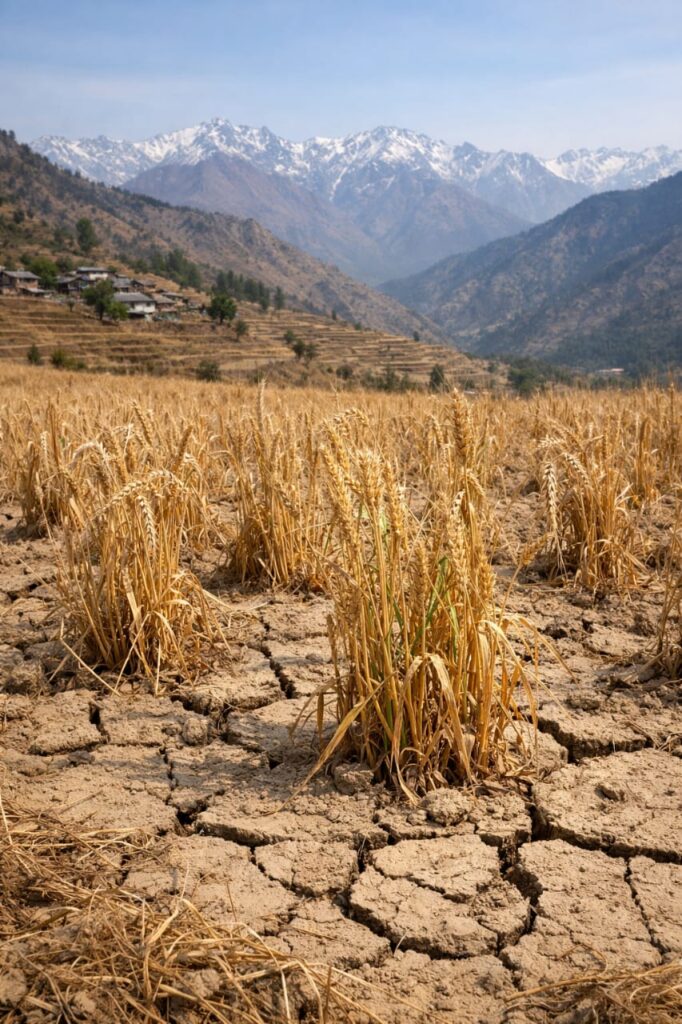
When early warming disrupts this timing, farmers lose their internal calendar. Apple trees are flowering 2–3 weeks early in parts of Himachal Pradesh meaning a late frost (which still happens) can kill an entire season’s bloom. Rice farmers in the lower hills face flash floods from early melt, followed by drought when the monsoon underperforms.
A 2022 study by the G.B. Pant National Institute of Himalayan Environment found that erratic snowmelt timing is directly affecting crop water availability in the Himalayan foothills. Farmers are caught between extremes too wet, then too dry, with no stable middle.
Glacial Lake Outburst Floods: The Explosive Risk
Here is a surprising and terrifying fact: there are over 5,000 glacial lakes in the Hindu Kush Himalayan region. At least 200 of them are considered potentially dangerous.
As glaciers melt faster due to Himalayan early warming, the lakes they leave behind grow larger. When the natural ice or moraine dam holding them breaks; suddenly, without warning; the result is a glacial lake outburst flood (GLOF). These floods can devastate entire valleys in hours.
In February 2021, a GLOF in Chamoli district, Uttarakhand, killed over 200 people and destroyed two hydropower projects. Scientists traced it to a collapsing glacier-fed lake above the valley.
This was not an accident. It was a warning.
Watch: “Chamoli Disaster 2021 Explained”
240 Million People Upstream, 2 Billion Downstream
The Himalayan region is not just a local issue. It is a water tower for a significant part of Asia.
- The Indus, Ganga, Brahmaputra, Yangtze, Mekong, and Irrawaddy all originate in this region
- Over 240 million people live directly in the mountain catchments
- Nearly 2 billion people depend on rivers fed by Himalayan snowmelt and glaciers
The IPCC Sixth Assessment Report (AR6, 2022) confirmed that South Asia faces “high confidence” risks to freshwater availability due to Himalayan glacier retreat and changing precipitation patterns. It specifically flagged early snowmelt as a key driver of seasonal water stress.
Reference: IPCC (2022). Sixth Assessment Report Impacts, Adaptation and Vulnerability. Chapter 10: Asia.
What Is Being Done? (And What Isn’t)
Good Steps
- ICIMOD’s HI-AWARE Programme is training Himalayan communities to track spring health and adapt water use.
- Himachal Pradesh’s Jal Shakti Vibhag has launched spring revival programmes in several districts.
- Community-based glacial monitoring projects in Uttarakhand are mapping meltwater trends.
- India’s National Action Plan on Climate Change includes a dedicated Himalayan mission though implementation remains slow.
What’s Still Missing
- Real-time glacier monitoring across most of the Indian Himalayan Region
- Community-level early warning systems for GLOFs in vulnerable valleys
- Policy that connects glacier science to water pricing, agriculture planning, and disaster risk
The science is ahead. The policy is behind. And the communities in the middle are absorbing the gap.
Quotable Lines Worth Sharing
“The Himalayas don’t just need more water they need water on time. Early heat breaks that clock.”
“When glaciers rush, rivers flood. When glaciers are spent, rivers vanish. Both happen in the same year now.”
“A farmer in Kinnaur and a city dweller in Delhi share the same glacier. One just knows it.”
Comments from Nikhil Raj Sharma, Founder Himalayan Geographic Research Foundation
“What we are witnessing in the Himalayas is not just climate change it is a civilisational signal. For centuries, Himalayan communities have calibrated their lives to the rhythm of snow and melt. That rhythm is now broken. Our research teams in Himachal Pradesh and Uttarakhand are recording spring failures and early glacial retreats that would have been unthinkable two decades ago. Himalayan early warming is the story of our time, and it demands urgent attention not just from scientists, but from every citizen who drinks water that once fell as Himalayan snow.”
“We often talk about water scarcity. But the deeper issue is water instability. When your river floods in March and goes dry in July, abundance and scarcity become the same crisis. The Himalayas are telling us something. The question is whether we are listening.”
What You Can Do
- Stay informed. Follow ICIMOD, India Meteorological Department, and Himalayan Geographic for regular updates.
- Support spring revival efforts. Organisations like Avani and CHIRAG work on Himalayan water security at the ground level.
- Reduce your carbon footprint. Every fraction of a degree matters for mountain glaciers.
- Engage your local representatives. Demand that Himalayan water policy is treated as a national priority.
The Clock Is Running Early
The Himalayas have always operated on timing. The snow, the melt, the rivers, the crops; everything was calibrated over thousands of years. Himalayan early warming has thrown that calibration off.
We are not running out of water yet. We are running out of the right water at the right time.
That distinction matters more than almost anything else in the coming decade; for farmers in mountain villages, for cities on the plains, and for the ecosystems that hold this region together.
Related Articles You May Like:
- “Why India’s Mountain Springs Are Disappearing Faster Than Expected”
- “Glacial Lake Outburst Floods: Living in the Shadow of Ice“
- “The Last Snowfall: How Changing Winters Are Reshaping Himalayan Culture“
Disclaimer: The content and images published in this article are provided for general informational and educational purposes only. Some images may be generated or enhanced using artificial intelligence (AI) and are intended solely for illustrative use. The views, interpretations, and information expressed do not necessarily reflect the official position of Himalayan Geographic Research Foundation, nor do they constitute professional, legal, medical, or financial advice.
While efforts are made to ensure accuracy, no guarantees are given regarding completeness or reliability. Readers are encouraged to independently verify information and use their own judgment. By reading this article, you acknowledge that any reliance on the content is at your own risk, and Himalayan Geographic Research Foundation assumes no responsibility or liability for disagreements, interpretations, or outcomes arising from its use. If you do not agree with these terms, you are advised to discontinue reading.