
Education in Nepal has 97% school enrolment; but only half the students can read or do math. Here are 5 uncomfortable truths about why schooling isn’t the same as learning.
Education in Nepal has a big secret. Over 34,000 schools now stand across Nepal’s seven provinces. The net enrolment rate in primary schools has reached 97%. By every government measure, Nepal is winning the school building race. But here is the question nobody asks loudly enough: Are children actually learning anything inside those buildings?
The answer, backed by hard data, is deeply uncomfortable. According to UNICEF, only half of students in grades 3, 5, and 8 meet the academic achievement criteria for Nepali and mathematics. That means roughly one in every two Nepali children goes to school and still cannot do the basic tasks their grade demands. In India, we talk about the “learning crisis” endlessly. In Nepal, the same crisis is playing out quietly; in mountain schools with no qualified teachers, in classrooms where rote memorisation is mistaken for education, in villages where a child’s mother tongue is not even the language of instruction.
This is not a story about buildings and budgets. This is a story about what real education means; and why Nepal’s children deserve better.
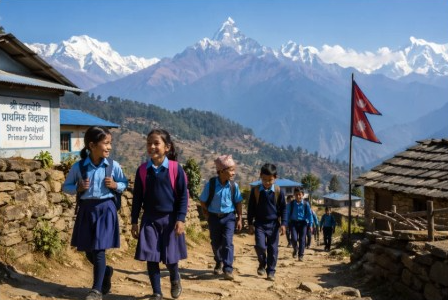
Nepal Built Schools. But Did It Build Learning?
In the 1950s, when Nepal opened its first public schools to ordinary citizens, the dream was simple: give every child a seat. That dream succeeded beyond expectation. Nepal raised its adult literacy rate from 21% in 1981 to 71% in 2021 and its youth literacy rate from 30% in 1981 to 94% in 2021. On paper, that is extraordinary progress.
But enrollment is not education. Net enrollment in basic education in Nepal has now crossed 95%, yet according to the National Assessment of Student Achievement (NASA), only 1 in 3 Grade 8 students meet the minimum competency in math, and over half of Grade 5 students cannot write a complete, grammatically correct paragraph in Nepali.
Think about that. A child spends five years in school; walking hours each day, sitting in class, writing in notebooks; and still cannot write a proper paragraph. The school existed. The attendance was recorded. But the learning? It did not happen.
“We are building schools the way we build roads by counting kilometers, not by checking if the road actually takes you somewhere.” — Nikhil Raj Sharma, Founder, Himalayan Geographic Research Foundation
The 5 Real Reasons Education in Nepal Is Failing
1. Rote Learning Is Destroying Curious Minds
Walk into most government schools in Nepal; especially in rural districts; and you will see the same scene. Children chanting multiplication tables. Teachers dictating notes from worn-out textbooks. Exams that test only what you can memorise, not what you can think.
Poor teaching practices; including rote-learning, teacher-centred, and exam oriented approaches; are among the long-standing problems in Nepal’s education sector, and the situation is worse in most rural and Terai area schools.
In Kalikot, one of Nepal’s most remote districts, even nursery classes are handled in lecture fashion. Instead of prioritising activities, games, or student engagement, the focus is already on rote learning. Five year-olds chant the alphabet and number tables, and at home they memorise books to prepare for exams. The government curriculum actually requires activity-based teaching. But teachers either do not know about this or ignore it since it takes too much effort to adopt a new style of teaching.
When I wrote Democracy and Education in 1916, I argued that education is not about filling a bucket; it is about lighting a fire. Nepal’s classrooms are still filling buckets. Often the buckets have holes.
2. Teacher Absenteeism and Poor Preparation
A school without a present, prepared teacher is just a building with benches.
Lack of dutiful qualified subject teachers and their absenteeism is one of the core reasons Nepal’s education quality suffers. In rural areas, teachers often hold political appointments; hired not for their skills but for their connections. Public schools in Nepal suffer from poor infrastructure, low quality teachers, political interference in teacher appointments, and weak management and regulation.
In 2025, the crisis even spilled into the streets. In 2025, public school teachers went on a nationwide strike in response to a proposed education reform bill in parliament; showing how deeply politicised the teaching profession has become. When teachers are busy fighting political battles, who is teaching the children?
A school in Khotang reported only 9 students with 2 untrained teachers. The teachers are consistently overworked and underappreciated, with an utter lack of motivation; and parents, frustrated but without any geographic or economic alternatives, have nowhere to go.
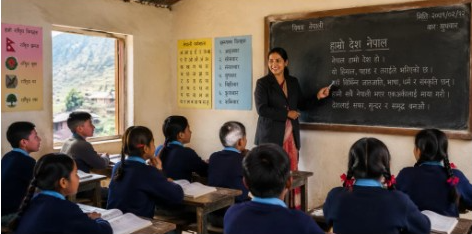
3. Language Barriers Nobody Talks About
Here is a surprising fact that shocks most people: Nepali; the national language of instruction; is not even the mother tongue of the majority of Nepal’s students.
According to the Nepal Census in 2011, there are 123 languages spoken as mother tongue; among them, Nepali is spoken as mother tongue by only 44.6% of the population. And only 24 languages are utilised for the development and publication of textbooks at the basic education level, meaning students whose mother tongue is not one of those 24 languages are severely disadvantaged.
In Himalayan regions; Humla, Mugu, Dolpa, Mustang; children speak Tibetan dialects, Gurung, Tamang, Sherpa, and dozens of other languages. When they enter school, they are suddenly expected to learn everything in a language they have never spoken at home. Imagine learning science and maths in a foreign language on day one of Grade 1. That is the daily reality for lakhs of Nepali children.
Many rural communities speak local languages that are not taught in schools, making it challenging for students to learn in a language that is not their first; and equally difficult for teachers to communicate effectively with students.
4. The Inequality Between Rich and Poor Is Shocking
Nepal’s education crisis is not shared equally. It falls hardest on the children who are already vulnerable.
There is stark inequity in the education sector: only 12% of children from the lowest wealth quintile are developmentally on track in literacy and numeracy, compared to 65% from the highest wealth quintile. That gap 12% versus 65% is not a difference in effort. It is a difference in access to everything that makes real learning possible: books, nutrition, electricity at night to study, parents who are educated themselves.
Dropout rates in rural areas are 30% higher than in urban areas, with poor teaching quality cited as a key factor.
For girls, the picture is even grimmer. According to a 2022 report by Plan International, 28% of girls in Nepal are married before the age of 18, disrupting their education. Gender-based violence and lack of separate sanitation facilities in schools also deter girls from attending regularly.
“When a girl walks three hours to school only to find no toilet, no female teacher, and no textbook she understands we haven’t given her education. We have given her exhaustion.” — Nikhil Raj Sharma, Himalayan Geographic Research Foundation
5. The Curriculum Has Nothing to Do With Real Life
Imagine studying a case study on Canadian fisheries in an A level economics class in a village near the Karnali River. That is not a joke. Indian or Western textbooks, commonly used in numerous schools, often lack contextual relevance; for instance, a case study in an A-level economics textbook about sustainable fisheries in Canada is incongruent with teaching in Nepal.
Children in the Himalayas are growing up learning about rivers they have never seen, industries they will never join, and problems from countries they may never visit. Meanwhile, nobody teaches them about the medicinal herbs growing outside their classroom window, or how to manage a small farm, or what their own culture’s history means.
The Nepalese curriculum has been criticised for being too theoretical and unrelated to the needs of the labour market. It frequently fails to provide pupils with real-world skills.
A good curriculum, as I have always argued, should connect to the child’s lived experience first, and expand outward. Nepal’s curriculum does the opposite; it starts from a world the child does not recognise, and expects the child to find their own way in.
What the Numbers Look Like Together
Let us put the full picture in one place:
- 97% — Primary school enrollment rate (UNICEF, 2024)
- 50% — Proportion of Grade 3, 5, and 8 students meeting minimum learning standards (UNICEF)
- 1 in 3 — Grade 8 students meeting minimum math competency (Nepal NASA Assessment)
- 33.1% — Survival rate to Grade 12, up from just 11.5% in 2016 (World Bank, 2022)
- 123 — Mother tongue languages spoken in Nepal; only 24 used in textbooks
- 12% vs 65% — Literacy development gap between poorest and richest children
- 770,000 — Children aged 5–12 still completely out of school (UNICEF)
- 30% — Higher dropout rate in rural areas versus urban
What Is Actually Working (So We Can Scale It)
Not everything is broken. There are rays of real hope.
The World Bank’s School Sector Development Programme (2016–2022) showed that with focused effort, results do come. The survival rate to Grade 12 increased from 11.5% in 2016 to 33.1% in 2022, exceeding targets, and the out-of-school children number was reduced by 6.76% nationwide.
In Kalikot, one school called Modern Model Residential School proved that a different way is possible. The school departed from traditional rote learning to allow children to be creative and knowledgeable about their surroundings through play and outdoor activities. A partnership with Leo Clubs brought qualified and motivated teachers under a “Rural Teaching Fellowship.”
UNICEF’s multilingual classroom research is another bright spot. UNICEF supports innovations and research on teaching in multilingual classrooms, and supports students with homework clubs and accelerated learning programmes for out-of-school girls aged 8 to 15.
These examples tell us one thing: the problem is not that Nepali children cannot learn. The problem is that the system is not designed for them to learn.
What Nepal Must Do Next 5 Real Solutions
1. Make learning experiential, not just instructional. Let children grow vegetables, build models, map their own villages. Learning by doing is not a luxury it is how real knowledge forms.
2. Teach in the child’s mother tongue first. Research across South Asia shows that children who learn to read in their home language first perform better even in a second language later. Nepal must expand its multilingual education programme rapidly, especially in Himalayan districts.
3. Fix teacher accountability; not just training. Training is useless if teachers don’t show up. Nepal needs merit-based hiring, regular performance reviews, and real incentives to serve in remote areas. Political appointments must end.
4. Redesign the curriculum around local context. The Karnali Valley needs a curriculum about the Karnali, not Canada. Local knowledge; farming, ecology, culture, history; must anchor the learning, not imported textbook examples.
5. Measure what children know, not just who is enrolled. Nepal must shift its national education targets from enrollment numbers to learning outcome scores. You cannot improve what you refuse to measure honestly.
A Call to Action for Every Reader
Nepal’s mountain children are not lacking intelligence. They are lacking a system that respects their reality.
If you are a teacher in Nepal, try one activity-based lesson this week and see what happens in the room. If you are a parent, ask your child not what grade they got, but what they understand. If you are a policymaker, please read the UNICEF Nepal Learning Report before approving the next school construction budget.
Watch this powerful UNICEF video on learning recovery in Nepal
Watch the Oxford “Lockdown Diaries” Nepal education documentary
For deeper research, explore UNICEF Nepal’s education
Comments from Nikhil Raj Sharma, Founder Himalayan Geographic Research Foundation
“In Himalayan Nepal, children recite the national anthem perfectly but cannot point to their own district on a map. That tells you everything about what we are calling ‘education.’ At Himalayan Geographic, we believe that the mountain, the river, and the forest are the first classrooms. Everything else comes second.”
“The data is clear we built 34,000 schools and forgot to build 34,000 reasons for children to love learning. Real education in Nepal will only happen when we stop measuring success in enrollment sheets and start measuring it in curious, capable children.”
“A school building is not education. A textbook is not learning. Real education is when a child understands something so well that they can use it in their own life. Nepal has built the walls. Now it must build the learning inside them; starting with the teacher, the language the child speaks, and the world the child already lives in.”
Suggested Related Articles:
- “Why Nepal’s Best Students Are Leaving: The Brain Drain Crisis“
- “Multilingual Education in South Asia: What Works and What Doesn’t“
- “Teaching at the Right Level: India’s ASER Model and What Nepal Can Learn”
- “Girls’ Education in the Himalayas: Stories of Courage and Systemic Failure“
References:
- UNICEF Nepal Education Page
- World Bank Nepal Education Results
- Broken Chalk — Educational Challenges in Nepal
- The Himalayan Times — Education in Federal Nepal:
- The Himalayan Times — Too Many Schools, Too Little Learning
- Nepali Times — Not Catching Them Young
- CollegeNP — Nepal Education System
- Wikipedia — Education in Nepal
- UNICEF USA — Let Us Learn Nepal
- UNICEF MICS Nepal Fact Sheet
Disclaimer: The content and images published in this article are provided for general informational and educational purposes only. Some images may be generated or enhanced using artificial intelligence (AI) and are intended solely for illustrative use. The views, interpretations, and information expressed do not necessarily reflect the official position of Himalayan Geographic Research Foundation, nor do they constitute professional, legal, medical, or financial advice.
While efforts are made to ensure accuracy, no guarantees are given regarding completeness or reliability. Readers are encouraged to independently verify information and use their own judgment. By reading this article, you acknowledge that any reliance on the content is at your own risk, and Himalayan Geographic Research Foundation assumes no responsibility or liability for disagreements, interpretations, or outcomes arising from its use. If you do not agree with these terms, you are advised to discontinue reading.