
Deodar trees, the ‘timber of gods,’ fell at Shimla’s CM residence Oakover. While Himachal Pradesh bans tree cutting on paper, ancient deodars bleed in practice. This is ecological suicide wrapped in bureaucratic hypocrisy.
They say murder is illegal in Shimla. But apparently, that rule only applies to humans.
Yesterday, right next to the Chief Minister’s residence at Oakover; the supposed fortress of law and order; a green, living deity was executed. It wasn’t a landslide. It wasn’t a storm. It was a saw. While the city slept and the so-called “environment warriors” warmed themselves by their heaters, sipping tea, a century-old Deodar was turned into a corpse.
The irony? It fell near the cemetery. Fitting, isn’t it? Because at this rate, Shimla is just one big graveyard waiting to happen.
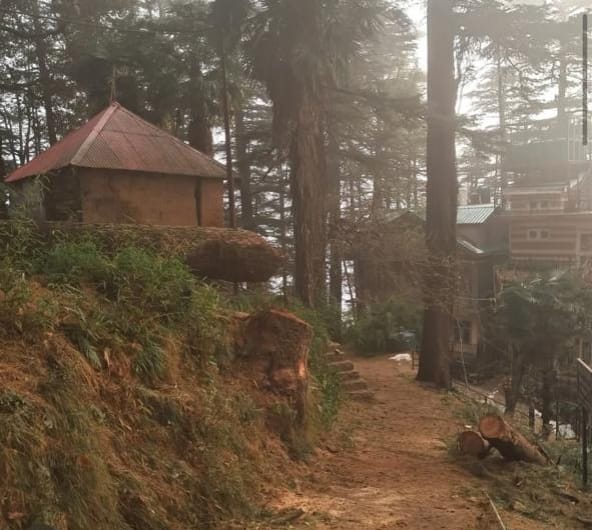
If Trees Aren’t Safe at the CM’s House, Where Are They Safe?
Let me paint you a picture. Oakover isn’t some remote village with illiterate contractors running wild. This is the Chief Minister’s official residence. The nerve center where “the most important political and economic decisions of Himachal Pradesh are taken,” as the tourism brochures proudly proclaim. This nineteenth-century palatial Raj-era bungalow, surrounded by lush gardens and stone walls, is supposed to be a symbol of governance, responsibility, and law.
Yet here, right under the nose of power, someone decided that a Deodar; a tree that takes 30 to 50 years to reach full maturity; was expendable. Inconvenient. In the way.
Who signed the death warrant? Which bureaucrat stamped the paper? Which forest officer looked the other way? These are not rhetorical questions. These are criminal investigations waiting to happen.
The Himachal Pradesh government imposed a complete ban on cutting green trees in January 2025. No permits. No exceptions. The forest department stopped issuing permissions entirely. The law is crystal clear: you cannot fell a green tree without extreme authorization. And yet, at Oakover, the chainsaw roared.
Is the law different for the powerful?
When a tree isn’t safe next to the Chief Minister, it isn’t safe anywhere. This wasn’t just a violation of environmental law. This was a middle finger to every citizen who believed that “Green Himachal” was more than just a manifesto slogan. This was the government showing its true colors: green on paper, blood red in practice.
Where Were You When the Deodar Fell?
Paryavaran par shor machane wale gharon mein aag tapte reh gaye.
Those making noise about the environment kept warming themselves at home.
Let’s be brutally honest. We are all guilty. Every single one of us who RT’d #SaveTheAmazon while ignoring the chainsaw in our own backyard. Every activist who posts Instagram stories about melting glaciers but couldn’t be bothered to walk 10 minutes to Oakover to stand between that tree and the blade.
The Deodar didn’t fall in silence. Someone heard it. Someone saw it. And they did nothing.
We’ve become armchair environmentalists, warriors of the retweet, champions of the hashtag. We mourn trees 10,000 kilometers away in the Brazilian rainforest but turn a blind eye when ancient deodars are butchered on our own streets. Our silence is complicity. Our apathy is a crime.
The sad truth? Most Shimla residents will read this article, nod sympathetically, maybe share it on WhatsApp, and then go back to their lives. They’ll complain about the weather, about traffic, about property prices; and they’ll forget that with every tree we lose, we’re digging our own graves.
Literally.
Shimla Is Built on Borrowed Time
Here’s something they don’t teach you in civics class: Shimla is a death trap waiting to spring.
This city is built on loose soil, perched precariously on slopes that geologists have been warning about for decades. The 2023 monsoon disaster was a wake-up call; landslides uprooted deodars in huge numbers, buildings crumbled like playing cards, and lives were lost. The culprit? Unscientific construction, excavation that exposed tree roots, and the systematic destruction of the very trees that held the mountain together.
Deodar roots aren’t just “pretty landscaping.” They are the steel bars reinforcing the mountain. Their deep root systems anchor the soil, preventing landslides and soil erosion. Studies show that tree roots stabilize slopes by reinforcing soil-root matrix cohesion and clamping superficial layers to stable substrates below. When you cut a Deodar, you’re not removing an obstruction. You’re removing the foundation.
According to research on soil erosion in Himalayan forests, deodar forests experience moderate erosion rates due to their role in stabilizing steep slopes. However, when these trees are removed; especially near construction sites; the soil loses its anchor. Rainwater, instead of being absorbed by roots and percolating underground, rushes downhill, creating gullies, destabilizing slopes, and triggering landslides.
As environmental engineer Raja Gaurav explained after the 2023 disaster: “Buildings have been constructed either uphill or downhill side of the trees, mud has been excavated, the roots of deodar trees which otherwise hold soil very well, are not able to hold; their centre of gravity which needs the roots to make strong grip on the soil, gets loosed.”
Cutting a Deodar in Shimla isn’t development. It’s not progress. It’s a suicide pact signed in bureaucratic ink.
And the location of this particular massacre? Near a cemetery. The symbolism writes itself.
You Can’t Buy Back a Century
A Deodar takes 30 to 50 years to reach full maturity. Under optimal conditions, it grows 1 to 3 feet per year. In its native Himalayan habitat, a Deodar can live for several centuries; some specimens are over 500 years old. In ideal conditions, they can survive for more than 1,000 years.
Think about that. One thousand years of photosynthesis. One thousand years of oxygen production. One thousand years of soil stabilization. One thousand years of providing habitat for birds, insects, and small mammals.
You can cut it down in one hour.
No amount of money can buy back that century of growth. No “compensatory plantation” can replace what was lost. Even if you plant 10 saplings today, it will take decades before they provide even a fraction of the ecological services that the mature tree offered.
The Himachal Pradesh government loves to talk about “compensatory afforestation.” They promise to plant new trees for every one that’s cut. But here’s the math they don’t want you to do: planting a sapling is not the same as replacing a century-old guardian. A 1-year-old sapling has soft, flexible roots. A mature Deodar has a root system that extends deep into the earth, holding tons of soil in place.
We are trading centuries for momentary convenience. We are bartering our children’s future for a parking spot, a driveway extension, or a “better view.”
Devdar; The Timber of the Gods We Desecrate
The word “Deodar” comes from the Sanskrit devadāru; “timber of the gods.” Deva means divine, deity, god. Dāru is cognate with the words tree, true, and druid.
In Hindu mythology, Deodar forests were the favorite dwelling places of ancient sages who lived in devotion to Lord Shiva. The Valmiki Ramayana mentions Deodar groves as sacred spaces. The tree is worshiped as divine by many Hindus even today.
This is not just a tree. This is heritage. This is culture. This is identity.
When we cut down a Deodar, we are not just destroying nature; we are desecrating our own culture. We are erasing the very symbols that gave Shimla its identity as the “Queen of Hills.” We are sawing off the branch we’re sitting on, both literally and metaphorically.
Shimla historian Raaja Bhasin has been warning for years: “The tree is culturally and environmentally significant to the town’s heritage.” Environmentalist V.P. Mohan, who retired as Principal Chief Conservator of Forests, has launched a one-man campaign, coining the term “green corruption” to describe what’s happening.
“Where will I walk, breathe?” Mohan asks. “Will I be able to show these deodars to my granddaughter a few years from now?”
The answer, at this rate, is no.
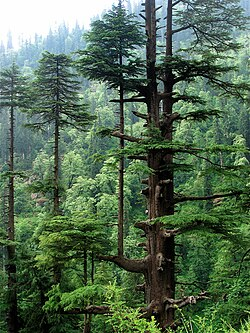
Ban on Paper, Execution in Practice
Let’s recap the legal situation.
In January 2025, the Himachal Pradesh government imposed a blanket ban on cutting green trees on private land. The forest department halted the issuance of permits for tree felling. The National Green Tribunal had already banned all tree felling in Shimla for construction, road clearing, or removing obstructions.
In 2018, the Himachal Pradesh High Court ordered the numeration and marking of each standing tree within Shimla’s municipal limits. The intention was to implant Radio Frequency Identification (RFI) tags in surviving deodars to prevent illicit felling.
The law is abundantly clear. The judicial precedent is unambiguous. The administrative orders are in black and white.
And yet, the saw roared at Oakover.
This is the definition of institutional failure. This is what happens when laws exist only to impress international donors and appease NGOs, but enforcement is a joke. This is greenwashing in its purest form—coating corruption and negligence with a thin veneer of environmental concern.
Who will be held accountable?
Will the forest officer who ignored the felling be suspended? Will the contractor who wielded the chainsaw be prosecuted? Will the official who signed off on this murder face consequences?
Or will this be swept under the rug, buried in files, lost in bureaucratic labyrinths, forgotten by the next news cycle?
What We Lose When a Deodar Falls
Let’s talk numbers. Not the sentimental kind; the hard, scientific kind.
Carbon Sequestration: A mature Deodar absorbs significant amounts of CO₂ annually. With climate change accelerating, every tree we lose is a blow to our planet’s ability to regulate temperature.
Oxygen Production: One large tree produces enough oxygen to support two human beings. That Deodar at Oakover was someone’s oxygen factory.
Soil Stability: Deodar roots prevent landslides. In a city where landslides killed people in 2023, this is not an abstract benefit. This is life and death.
Water Regulation: Tree roots help water percolate into the ground, recharging aquifers and preventing surface runoff. Shimla’s water crisis is worsening every year. Every tree we cut makes it worse.
Biodiversity: Deodars provide habitat for birds, squirrels, insects, and microorganisms. The ecological web is delicate. Pull one thread, and the whole thing unravels.
Cultural Heritage: Shimla without deodars is not Shimla. It’s just another concrete jungle with bad traffic and overpriced hotels.
This Is a Record for the Future
This article is not just an exposé. It’s a record. A witness statement for the future.
When our children and grandchildren ask, “Why did Shimla collapse? Why did the landslides bury homes? Why is the air unbreathable? Why is the water scarce?”; we will have to show them this article and say: “We knew. We documented it. We did nothing.”
Because that’s what we’re doing. We’re documenting the crime, cataloging the destruction, and then walking away.
But maybe; just maybe; this time will be different.
Maybe this time, one person will read this and get angry. Angry enough to file a complaint. Angry enough to demand accountability. Angry enough to stand in front of the next chainsaw.
Maybe this time, instead of liking and sharing, someone will act.
The Uncomfortable Truth
Here’s the part where I’m supposed to offer solutions. Five easy steps to save Shimla. A hopeful conclusion about collective action.
But I’m not going to lie to you.
The truth is, we are complicit. All of us. The government that bans tree cutting but allows it at the CM’s residence. The forest department that turns a blind eye. The contractors who wield the saw. The citizens who watch in silence. The activists who tweet but don’t march. The media that covers it for a day and moves on.
We are all holding the chainsaw, in one way or another.
The only question is: will we put it down?
What You Can Do ; (If You Actually Care)
- File a complaint: Demand an investigation into who authorized the felling at Oakover. Use RTI. Name names.
- Demand accountability: Call your MLA. Email the Chief Minister. Make noise until someone is held responsible.
- Support enforcement: The High Court ordered RFI tagging of trees in 2018. Ask why it hasn’t been implemented.
- Show up: The next time a tree is threatened, don’t just tweet about it. Physically stand between the tree and the chainsaw.
- Vote with consequences: Politicians care about power. Make it clear that voters will punish environmental destruction.
- Spread awareness: Share this article. Not to feel good about yourself, but to wake up someone who might actually do something.
- Support local activists: People like V.P. Mohan and Raaja Bhasin are fighting this battle alone. Stand with them.
Shimla Will Die Without Deodars
Some go as far as to say that Shimla will die in the absence of deodars.
They’re not exaggerating.
Shimla exists because of its climate, its beauty, its greenery. Take away the deodars, and what’s left? A collapsing, landslide-prone concrete mess with traffic jams and pollution.
The Deodar that fell at Oakover was not just a tree. It was a warning. It was a prophecy. It was a mirror held up to our faces, showing us exactly who we are: a society that talks big about the environment while casually committing ecological suicide.
We can ignore the warning. We can delete the article. We can go back to our comfortable lives.
Or we can wake up. We can get angry. We can demand change.
Because the next time a Deodar falls, it might be the last straw that breaks Shimla’s back. And when the landslides come, when the soil gives way, when the mountain collapses; we won’t be able to say we didn’t know.
We were warned. The evidence is here. The choice is ours.
The clock is ticking. The chainsaw is revving. And Shimla is running out of time.
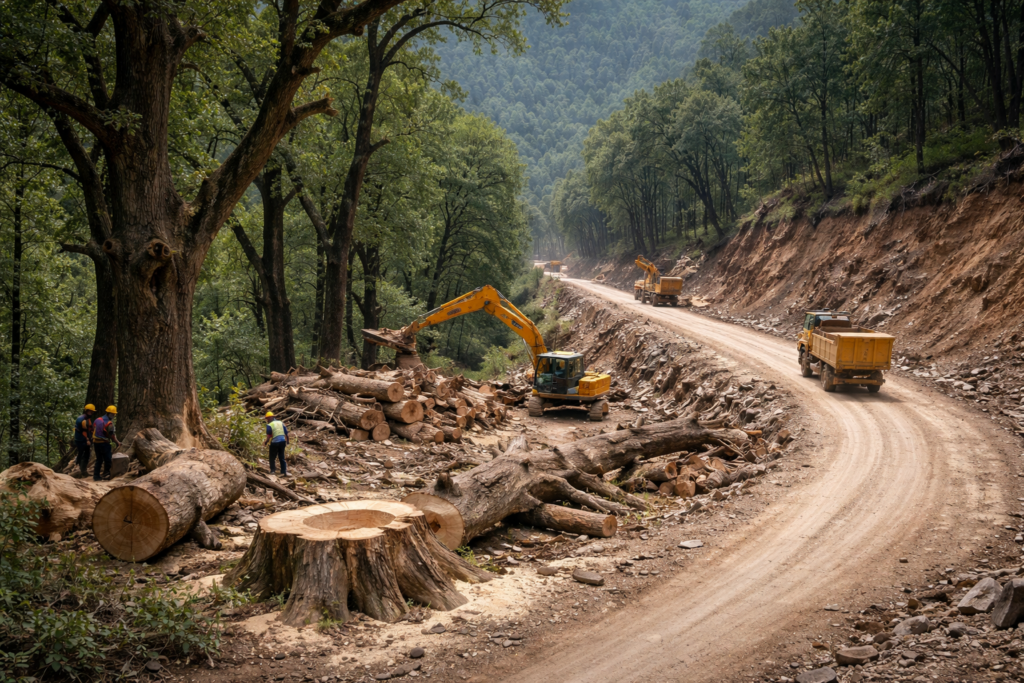
YouTube Video – Supreme Court Says Rampant Illegal Tree Felling Is Being Done In The Himalayan Region
Related Reading:
- The Whispering Deodars of Shimla – Outlook India
- Himachal Imposes Ban on Tree Cutting
- How Shimla’s Landslides Could Have Been Prevented – Hill Post
Comments from Nikhil Raj Sharma, Founder of Himalayan Geographic
“This is not just environmental reporting; this is bearing witness to ecological genocide. When a Deodar falls at the Chief Minister’s residence despite a state-wide ban, it exposes the rot at the heart of our governance. The hypocrisy is staggering.
Every tree we lose in Shimla is a step closer to catastrophe. The 2023 landslides were a warning, not a one-time tragedy. If we don’t stop this madness now, our grandchildren will inherit rubble, not the Queen of Hills.
At Himalayan Geographic, we’re committed to documenting these crimes against nature. Not because we enjoy being the bearers of bad news, but because silence is complicity. Someone has to keep the record. Someone has to ask the uncomfortable questions.
This article is a challenge. To the government: enforce your own laws. To the forest department: do your job. To the citizens: stop being spectators. And to the activists: stop tweeting and start marching.
The Deodar at Oakover is gone. But the fight for Shimla’s soul is not over. Not yet.
We invite every reader to join us in demanding accountability. Share this article. File complaints. Show up. Make noise. Because if we don’t, the next tree that falls might be the one holding up your home.”
Disclaimer: The content and images published in this article are provided for general informational and educational purposes only. Some images may be generated or enhanced using artificial intelligence (AI) and are intended solely for illustrative use. The views, interpretations, and information expressed do not necessarily reflect the official position of Himalayan Geographic Research Foundation, nor do they constitute professional, legal, medical, or financial advice.
While efforts are made to ensure accuracy, no guarantees are given regarding completeness or reliability. Readers are encouraged to independently verify information and use their own judgment. By reading this article, you acknowledge that any reliance on the content is at your own risk, and Himalayan Geographic Research Foundation assumes no responsibility or liability for disagreements, interpretations, or outcomes arising from its use. If you do not agree with these terms, you are advised to discontinue reading.