
Indigenous Himalayan communities have been warning about climate catastrophe for generations. Discover the traditional knowledge we dismissed and why listening to mountain peoples could save billions of lives downstream.
The old woman traces her finger across the barren hillside where a glacier once gleamed. “Forty years ago, the Fuchhme flowed like a river,” says Kancho Dolkar, her voice steady despite the devastation around her. “Now, it’s barely a trickle. The mountains have been crying out. We’ve been telling anyone who would listen.”
But few did listen. Today, communities that once depended on glacier-fed streams for survival have been forced to abandon their ancestral villages, driven out by the vanishing ice.
The Himalayas spoke through their people long before satellites noticed. Here’s what they’ve been trying to tell us; and why we’re finally starting to listen.
Indigenous Knowledge vs. Scientific Data
Over 95% of indigenous respondents in the Western Himalayas agree that the climate is changing. This observation comes from communities whose livelihoods depend on understanding nature’s subtle signals; seasonal snow patterns, plant flowering times, and water availability.
Here’s the remarkable part: their observations align almost perfectly with satellite data. When scientists finally checked, they found what indigenous peoples had been reporting for decades.
The difference? Indigenous communities noticed these changes 20 to 30 years earlier than scientific instruments confirmed them.
What Traditional Weather Prediction Teaches Us
In Dolpo, communities observe wind shifts, cloud formations, and snow patterns to anticipate storms; a form of local early-warning system that has safeguarded lives for centuries. This isn’t folklore. It’s precise, accumulated knowledge passed down through generations.
Indigenous weather indicators include:
- Bird migration patterns signaling seasonal shifts
- Plant blooming times revealing temperature changes
- Snow texture and density predicting avalanche risks
- Water flow patterns indicating glacial melt rates
These observations form what scientists now call Traditional Ecological Knowledge (TEK); and it’s proving invaluable for climate adaptation.
Seven Warnings We Should Have Heeded
Warning #1: The Glaciers Are Retreating Faster Than Expected
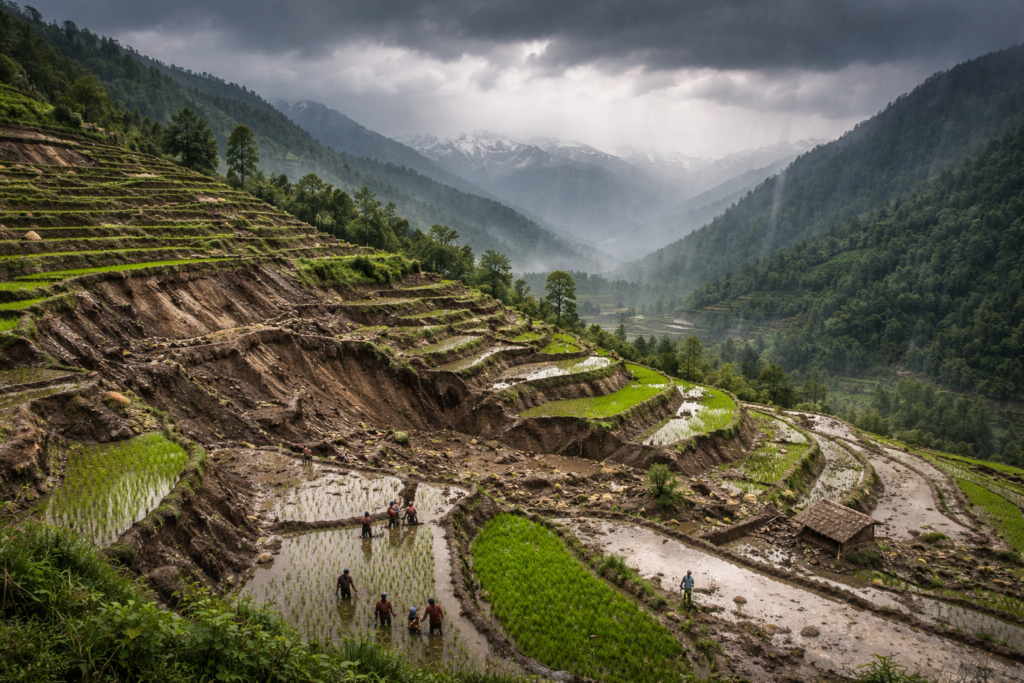
Himalayan glaciers have lost billions of tons of ice; equivalent to more than a vertical foot and a half of ice each year from 2000 to 2016. That’s double the amount of melting from 1975 to 2000, revealing that ice loss is accelerating.
Indigenous herders in Ladakh reported this acceleration decades ago. A study on Ladakh’s glaciers revealed that roughly 14% of the glacial mass has already been lost in the past four decades.
The human cost? Villages like Kumik, Kulum, and Shun have seen forced migrations. Families who lived for generations on ancestral land now scatter to urban slums, their traditional knowledge disappearing with them.
Warning #2: Water Sources Are Vanishing
Think about this: Almost 2 billion people rely on Asia’s Hindu Kush Himalayan glaciers for agriculture, industry, and drinking water. When indigenous communities warned that springs were drying up, they weren’t just talking about their villages; they were warning about the water security of one-third of humanity.
Results indicate between 34 and 90% of water comes from glacial melt during the dry, pre-monsoon season, with an average contribution of 65%. With two-thirds of the dry-season water supply at risk, communities face existential threats.
Warning #3: Traditional Agriculture Is Collapsing
In Upper Mustang, the vegetation cover in rangelands decreased by 4.3% over 30 years, leading to a decline in pastoral livelihoods. Pastures are shifting higher, forcing herders to walk from valleys to mountaintops to find grass.
Indigenous farmers adapted for millennia to harsh conditions. But climate change is outpacing their traditional coping mechanisms. Respondents cited declines in yields of traditional crop varieties, changes in sowing and harvesting times, and shifts in main crops cultivated.
Warning #4: Sacred Knowledge Systems Are Being Lost
Here’s what breaks my heart: the elders hold most of the wisdom, and younger generations are migrating for education or work. This creates a potential knowledge gap that threatens the transmission of traditional ecological knowledge.
When a Himalayan elder dies, it’s like a library burning down. Their knowledge of medicinal plants, water management, sustainable grazing, and disaster prediction disappears.
Warning #5: Extreme Weather Events Are Intensifying
In 2022, Pakistan suffered triple the usual amount of glacial lake outbursts. Glacial melt contributed to catastrophic floods that submerged one-third of the entire nation, impacting 33 million people and killing more than 1,200.
Indigenous communities saw this coming. They’d been reporting increasingly erratic monsoons, unexpected snowfall patterns, and dangerous glacial lake formations for years.
Warning #6: Biodiversity Is Shifting Unpredictably
Thanks to changing climate, farmers can now grow vegetables like cauliflower, cabbage, and cucumber at high altitudes, which was previously impossible due to extreme cold. The district is greener than it was decades ago.
Sounds positive, right? Wrong. These changes are signs of environmental and ecological changes that could have long-term negative impacts, disrupting carefully balanced ecosystems.
Warning #7: The Marginalization of Indigenous Voices
Perhaps the most damaging warning we ignored was this: People who have lived in the region for generations, surviving glacial lake outburst floods one after another, are not treated as serious knowledge holders.
We dismissed their stories as superstition. We excluded them from policy dialogues. We created climate adaptation plans without consulting the people who know the mountains best.
Why Indigenous Knowledge Matters Now More Than Ever
Because of their ecological knowledge, which is intergenerational and community-based, Indigenous Peoples were among the first to notice the early signs of climate change.
This isn’t about romanticizing traditional cultures. It’s about recognizing that 90% of indigenous knowledge applications focus on weather prediction, early warning signals, and disaster preparedness; exactly what we desperately need for climate adaptation.
Practical Applications of Traditional Knowledge
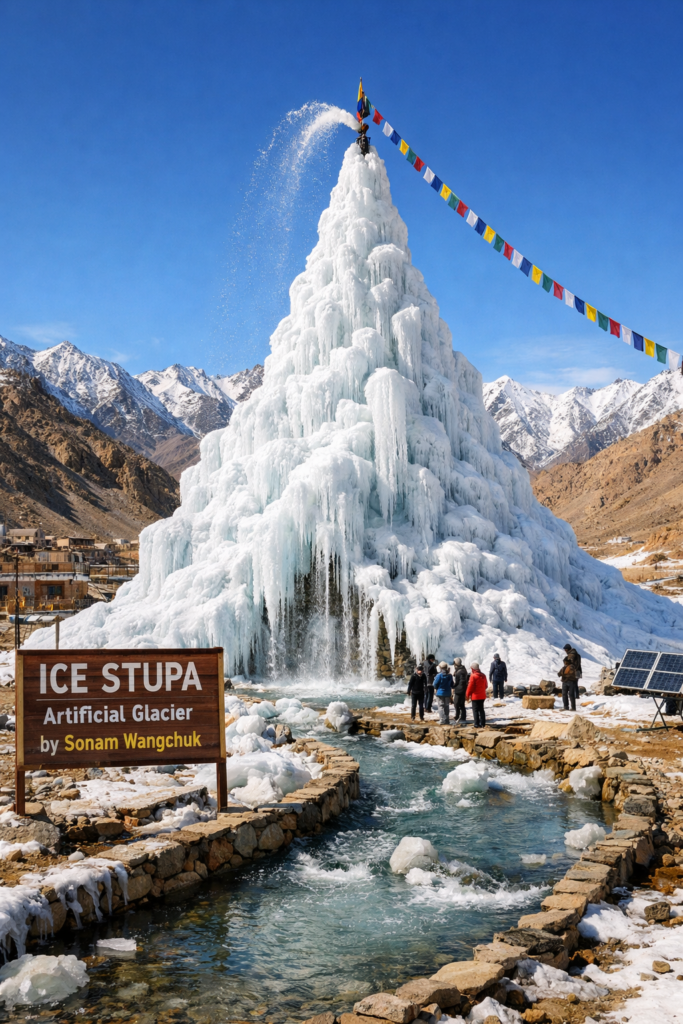
Water Conservation: Engineer Sonam Wangchuk designed a vertical ‘Ice Stupa’ that served as a dome-like artificial glacier, working with traditional Ladakhi knowledge of ice formation and water management. This innovation, rooted in indigenous understanding, provides water during critical spring planting seasons.
Sustainable Agriculture: Indigenous communities adapted to climate impacts by digging trenches and building water harvesting tanks upstream, changing sowing times, improving composting methods, shifting crop varieties, and promoting agroforestry.
Disaster Preparedness: Early warning systems now combine advanced automatic weather stations with traditional observation methods. Mock drills have prepared more than 5,326 people, including 2,204 women, to respond to disasters.
The Cost of Ignoring Indigenous Warnings
Let’s talk numbers. Floods in Nepal take at least 175 lives every year, with economic losses at $140 million and damage to assets at 1.4% of GDP.
But the real cost goes beyond economics. When we ignore indigenous warnings, we lose:
- Centuries of accumulated climate knowledge
- Proven adaptation strategies
- Early warning systems that could save thousands of lives
- Cultural diversity that enriches human resilience
- Sustainable practices that worked for generations
What Happens When Mountains Change?
The Himalayas aren’t just regional treasures; they’re global lifelines. Nearly two billion people depend on the ecosystem services these mountains provide. The region feeds ten major river systems affecting 1.65 billion people living downstream.
When glaciers melt in Nepal, farmers in Bangladesh lose irrigation water. When springs dry in Ladakh, cities in Pakistan face water scarcity. When traditional knowledge disappears in Uttarakhand, the entire world loses climate solutions.
This is the crucial truth indigenous communities have been shouting: when the Himalayas change, the world downstream changes with them.
Bridging Two Ways of Knowing
The Two-Eyed Seeing approach emphasizes weaving perspectives with both indigenous and scientific knowledge systems having equal importance, encouraging researchers to learn by moving between indigenous and Western methodologies.
This isn’t about choosing science OR traditional knowledge. It’s about AND.
Scientific instruments measure. Indigenous observation interprets. Satellites detect changes. Local communities understand impacts. Lab models predict. Traditional wisdom adapts.
Together, they create something more powerful than either alone.
Solutions Emerging from Indigenous Innovation
Community-Led Climate Monitoring: Villages across the Himalayas now combine traditional weather observation with simple measurement tools. Elders teach youth to read cloud patterns while recording data for climate scientists.
Adaptive Agriculture Programs: Local communities maintain approximately 80% of the world’s biodiversity through their inherited local knowledge and practices. Community forests store at least 24% of above-ground carbon emissions.
Cultural Knowledge Centers: Empowering local governance institutions, promoting intergenerational transmission of indigenous knowledge, and investing in Cultural Villages and Knowledge Centres are essential for developing effective and sustainable climate solutions.
What You Can Do Right Now
1. Amplify Indigenous Voices Share stories from Himalayan communities. When you read climate reports, ask: “Were local communities consulted? What do they observe?”
2. Support Community-Led Conservation Organizations working directly with indigenous groups need funding and advocacy. Your support helps preserve both ecosystems and knowledge systems.
3. Demand Inclusive Climate Policy While it is a global responsibility to safeguard crucial ecosystem services mountains provide, success hinges on engaging and empowering local communities, particularly Indigenous peoples, in collaborative adaptation action.
Contact your representatives. Demand that climate policies include indigenous perspectives.
4. Learn and Share Traditional Knowledge Watch documentaries like “Revealed: The Himalayan Meltdown” (available on Discovery Channel Asia). The film examines the human development impact of glacial ice melt on communities in Bangladesh, Bhutan, China, India, and Nepal, showing innovative fog-catching in Nepal and man-made glaciers in India.
5. Connect Climate Justice with Human Rights Climate change exacerbates difficulties already faced by indigenous communities including political marginalization, loss of land and resources, human rights violations, discrimination, and unemployment.
Support movements that recognize climate change as a human rights and inequality issue.
Listen Before It’s Too Late
Kancho Dolkar still lives near the ghost of Fuchhme Glacier. Most of her neighbors have left. But she stays, tending a small garden, teaching whoever will listen about the water cycles she’s observed for seven decades.
“The mountains always tell the truth,” she says. “The question is: will you listen before it’s too late?”
What if we see songs and stories from these communities as very important data points, as very important scientific pieces of knowledge? Instead of dismissing it as superstitious or backward or unscientific, we should start with some humility and willingness to learn from the indigenous caretakers of the land.
The science is clear. The satellites confirm what indigenous peoples have warned about for generations. The glaciers are melting. The waters are rising and falling unpredictably. Two billion lives hang in the balance.
But here’s the hope: Integrating indigenous, local, and traditional knowledge systems with existing practices increases the effectiveness of climate adaptation. We have solutions. We have knowledge. We have people who’ve survived in harsh mountain environments for millennia.
We just need to listen.
Comment from Nikhil Raj Sharma, Founder, Himalayan Geographic
“The indigenous communities of the Himalayas are not just stakeholders in climate adaptation; they are the original climate scientists. For too long, we’ve treated traditional ecological knowledge as supplementary rather than central to our understanding of mountain ecosystems. This must change.
At Himalayan Geographic Research Foundation, we’re committed to amplifying these voices, documenting their observations, and ensuring their knowledge informs policy at every level. The warnings these communities have sounded aren’t prophecies; they’re observations based on intimate, generational relationships with the land.
When we listen to the mountains through the voices of those who’ve lived there longest, we don’t just gain data; we gain wisdom. We owe it to these communities, and to future generations, to integrate their knowledge into every climate conversation, every policy decision, every adaptation strategy.
The mountains have been speaking. It’s time the world truly listened.”
Related Resources:
- Documentary: “Revealed: The Himalayan Meltdown” – UNDP, Discovery Asia, and Arrowhead Films.
- Research: “Climate Change Observations of Indigenous Communities in the Indian Himalaya” – Weather, Climate, and Society Journal.
- Report: “Understanding How Indigenous Knowledge Contributes to Climate Change Adaptation and Resilience” – PMC.
- UNESCO Resources: Local and Indigenous Knowledge Systems and Climate Change.
Disclaimer: The content and images published in this article are provided for general informational and educational purposes only. Some images may be generated or enhanced using artificial intelligence (AI) and are intended solely for illustrative use. The views, interpretations, and information expressed do not necessarily reflect the official position of Himalayan Geographic Research Foundation, nor do they constitute professional, legal, medical, or financial advice.
While efforts are made to ensure accuracy, no guarantees are given regarding completeness or reliability. Readers are encouraged to independently verify information and use their own judgment. By reading this article, you acknowledge that any reliance on the content is at your own risk, and Himalayan Geographic Research Foundation assumes no responsibility or liability for disagreements, interpretations, or outcomes arising from its use. If you do not agree with these terms, you are advised to discontinue reading.