
Half of the Himalayas’ 3 million springs have dried up, forcing women to walk miles for water and entire villages to migrate. This water crisis threatens 2 billion people downstream. Discover why the world must pay attention now.
At 4 AM, when most of the world sleeps, Shobha Devi was already walking. Not for exercise. Not by choice. For water.
Every morning for years, this Uttarakhand woman joined other women climbing mountain trails in freezing darkness, waiting three hours for a single bucket from a dying spring. One bucket. Three hours. Every single day.
Now her spring barely lasts through summer, forcing families to walk nearly two kilometers for water of questionable safety. And Shobha’s story is multiplying across the Himalayas at an alarming rate.
Here’s what no one is telling you: Half of South Asia’s water tower is running dry. And when the Himalayas change, 2 billion lives downstream change with them.
The Numbers That Should Terrify Us All
Let’s talk facts that governments aren’t shouting from rooftops.
Nearly half of India’s estimated 3 million springs have either dried up or are running dry. Think about that. We’re not talking about a few village wells. We’re talking about the lifeline of 100 million people in the Hindu Kush Himalaya.
In Kashmir alone, over half of the freshwater springs have dried up or shrunk in just the past 20 years. That’s not geological time. That’s within a single generation.
In Nepal, the situation is even more dire. Springs had dried up in 74% of local government units, with medium to severe problems across 44%. Read that again. Seventy-four percent.
But here’s the truly shocking part: Kashmir recorded a 70% rainfall deficit between December 2024 and February 2025; the lowest in eight years.
When Water Dies, Villages Follow
Remember Samjung? You probably don’t. It’s a village that doesn’t exist anymore.
Perched more than 13,000 feet above sea level in Nepal’s Upper Mustang, Samjung didn’t die in a day; it died slowly as snow-capped mountains turned brown and springs vanished. An entire Buddhist village, with 2,000 years of history, simply had to pack up and move.
They’re not alone.
In Nepal’s Khotang district, the population nearly halved between 2011 and 2021, dropping to 100,000 people. Villages that once housed 63 families now have just five. The reason? One word: Water.
In Purana Gaun, 52-year-old Sarita Rai watches her village die around her. Most of those with means to leave have already gone, driven out by rainfall that falters and springs that dry up.
This is climate migration. But it’s a migration nobody’s counting.
The Women Carrying Mountains on Their Backs
If you want to understand the true cost of this crisis, look at the women.
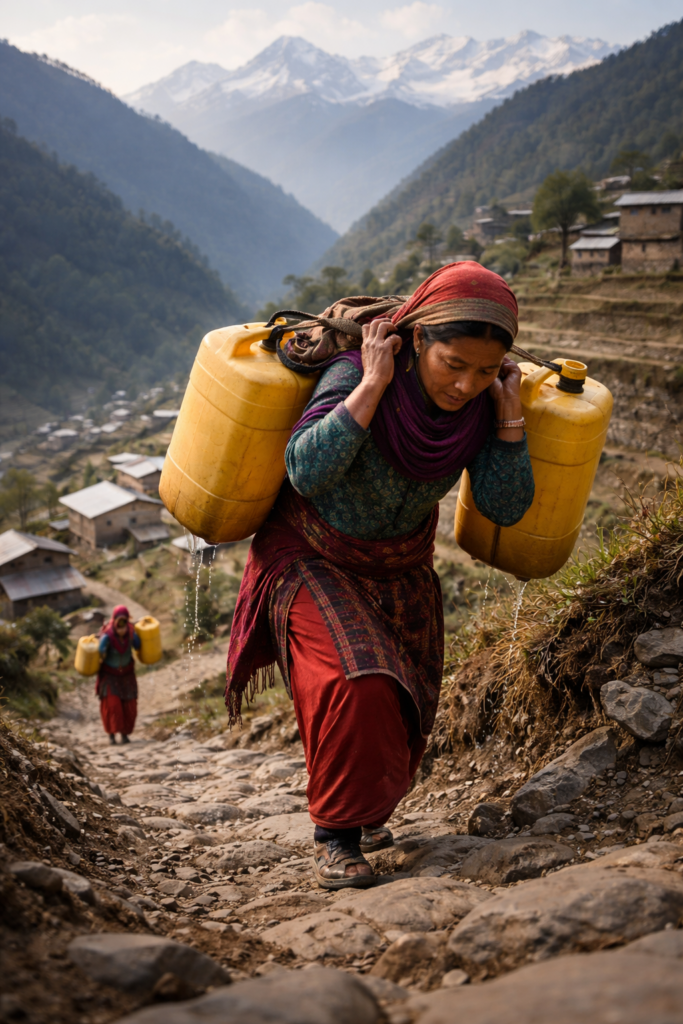
In Kumik village, Ladakh, 47-year-old Rigzin Chosdal makes a mile-long journey up Mountain Sultan La. Twice a day. Every day. Carrying 20-liter jerry cans on her back, she climbs to reach a rapidly receding glacier.
The pain in her joints is constant. She’s on medication. Other women in the village face similar back and posture problems from carrying water over long distances.
Twenty-six-year-old Nawang Dolma had to abandon her education. Her life is consumed by trekking four miles daily in freezing cold to fetch water, then doing household chores. In her own words: “Our life is wasted in fetching water.”
Think about that. An entire generation of mountain women, their potential, their dreams, their health; sacrificed at the altar of water scarcity.
And it’s not just physical. Migration has led to more tasks for women in staying communities. When men leave for cities, women inherit not just household work but farming, livestock, and the endless water collection.
Why Your Tap Water Depends on Himalayan Springs
“But I don’t live in the Himalayas,” you might think. “Why should I care?”
Here’s why: The Hindu Kush Himalayan region is home to 230 million people and provides water to one-fourth of the world’s population.
The Himalayas aren’t just mountains. They’re Asia’s water tower. Springs in the Indian Himalayan Region feed major rivers and account for up to 90% of their flow.
When Himalayan springs dry up, the Ganga dries up. The Brahmaputra weakens. The Indus struggles. These aren’t just Indian rivers; they cross borders, feed farmlands in Pakistan, Bangladesh, and beyond.
Farmers in Punjab depend on this water. Tech workers in Bangalore depend on this water. Textile factories in Dhaka depend on this water.
When the mountains stop giving water, half of South Asia stops working.
Why It’s Getting Worse
This isn’t just about less rain. It’s a convergence of catastrophes.
Climate Change Is Accelerating
Globally, Earth’s temperature has risen by 1.5°C in the past 50 years, but in the Himalayas, scientists warn it could rise by as much as 6°C in the coming decades.
Think about that multiplier effect. While the world warms by 1.5 degrees, the Himalayas might warm by 6.
Snow Is Vanishing
It hasn’t snowed in Upper Mustang for nearly three years; a dire blow for high-altitude villages where snowfall traditionally sets the seasonal calendar.
The average number of snow-covered days has declined by up to 15 days over two decades, even in traditionally heavy snow areas like the Ganga and Brahmaputra basins.
Rain Patterns Are Broken
Here’s the cruel irony: Intense rainfall over short periods causes water to run off instead of being absorbed into the ground, so the volume reaching underground aquifers that feed springs is low.
We’re getting more rain, but in the wrong way. Flash floods instead of gentle drizzles. Destruction instead of nourishment.
Human Actions Are Making It Worse
Road and infrastructure construction is identified as the main cause of springs drying up, followed by earthquakes and climate change.
Deforestation. Haphazard development. Tourism without planning. Each road cut through a mountain potentially severs underground water channels. Each hotel built without thought disrupts natural recharge zones.
The Contamination Crisis Within the Crisis
It’s not just that water is disappearing. What remains is often poisoned.
In January 2025, authorities tested spring water in Kashmir’s Ganderbal and Srinagar and found 37 out of 40 samples contaminated with bacteria.
So families face an impossible choice: walk farther for clean water they’re not sure exists, or drink contaminated water nearby and risk disease.
Ghost Villages; The Future That’s Already Here
Visit the Himalayas today, and you’ll see what tomorrow looks like.
Abandoned homes with crumbling walls. Terraced fields returning to wilderness. Schools with no children. Temples with no worshippers.
Villagers report that in coming generations, nobody will stay in mountain villages because of water problems, as springs have turned dry.
One village elder put it simply: “People are abandoning their homes now because there is no water left. If it were up to me, I would sell everything and live somewhere near water”.
This is what forced migration looks like before it makes headlines. This is what climate refugees look like before they become statistics.
Traditional Knowledge, Forgotten and Fading
For millennia, Himalayan communities managed water brilliantly. They built elaborate spring protection systems. They understood recharge zones. They knew which trees helped retain moisture.
Communal rainwater harvesting structures built by NGOs now lie wasted because migration has left villages with mostly elderly populations who cannot maintain them.
The knowledge keepers are leaving. The systems are collapsing. And with them goes centuries of accumulated wisdom about living in harmony with mountains.
When Springs Die, Conflicts Rise
Water scarcity doesn’t just cause migration. It causes tension.
As water sources dwindle, communities with greater power or closer proximity to springs tend to exclude or limit access for “outsiders”.
Historically marginalized groups like Dalits have been excluded from accessing water from springs located in upper caste settlements; discrimination that persists in many places.
Now, as scarcity intensifies, more springs are being enclosed on private land, turning what were once common pool resources into private commodities, with landowners selling spring water through tankers.
When water becomes a commodity rather than a commons, society fractures.
The Women Who Fought Back; And Won
But this isn’t just a story of loss. It’s also a story of extraordinary resilience.
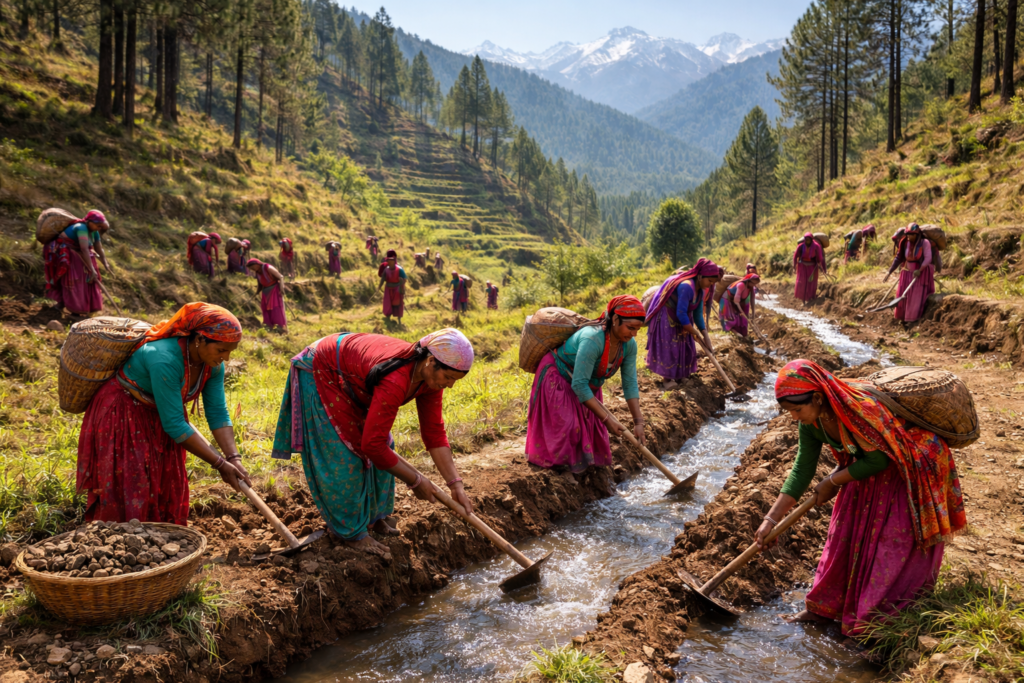
In Salga village, Uttarakhand, women refused to accept defeat. They picked up spades, hoes, and sickles and headed uphill to dig trenches in spring recharge zones. Day after day, under harsh sun, cutting through hard mountain soil.
When men in the village meeting refused to help, women of the Mahila Mangal Dal took matters into their own hands.
The result? Springs that had been dying started flowing again. Women who once woke at 4 AM and waited three hours for water now have access closer to home.
These aren’t just stories of survival. They’re blueprints for revival.
Solutions Exist; But Time Is Running Out
The science is clear. The technology exists. Community-led spring revival works.
Organizations like ICIMOD (International Centre for Integrated Mountain Development) have developed a six-step protocol for springshed management that demonstrates an inclusive and sustainable nature-based solution.
The approach includes:
Understanding the problem – Mapping spring locations and measuring flow rates
Identifying recharge zones – Finding the areas upslope where rainwater needs to infiltrate
Creating infiltration structures – Digging contour trenches, building check dams, installing percolation tanks
Protecting catchments – Planting native trees and vegetation that help retain moisture
Community ownership – Training local people, especially women, to monitor and maintain systems
Policy integration – Ensuring government programs support rather than undermine these efforts
This isn’t theoretical. Villagers working with organizations like CHIRAG in Uttarakhand have successfully revived springs, making noticeable improvements in their lives.
What Needs to Happen Now
For Governments
Stop treating this as a local issue. Water insecurity is attributed to poor water governance, lack of urban planning, poor tourism management, and climate-related challenges.
Governments must prioritize springshed management in climate adaptation plans. Fund community-led initiatives. Regulate development that destroys recharge zones. Create cross-border cooperation because water doesn’t respect political boundaries.
For International Community
The Himalayas aren’t just a South Asian problem. When glaciers retreat at 10 times the average rate. When 2 billion people’s water supply is at risk. When entire communities are forced to migrate; this demands global attention and funding.
For Researchers
We still don’t fully understand why springs are drying across such a wide Himalayan scale. More research is needed. Better monitoring systems. Real-time data. Predictive models.
For Communities
Traditional knowledge must be documented and revived before it’s lost forever. Young people need incentives to stay, training to manage springs, and hope for a viable mountain future.
For Each of Us
Share these stories. Demand accountability. Support organizations working on ground. Reduce our own carbon footprints. Because while you might not live in the Himalayas, your choices contribute to the warming that’s killing their springs.
The Choice Before Us
Every drought makes headlines when it hits cities. But the slow death of mountain springs happens in silence, witnessed only by women who walk farther each day and villages that empty one family at a time.
We’re at a crossroads. One path leads to continued neglect, more ghost villages, mass migration, and water wars. The other leads to urgent action, community-led solutions, and a future where mountains continue to give life.
The Himalayas have been humanity’s water tower for millennia. They’ve asked for nothing in return. Now they’re dying of thirst.
This is more than an environmental crisis. It’s a humanitarian catastrophe in slow motion. It’s a warning of what climate change looks like when it’s not dramatic floods or fires, but the quiet disappearance of the very sources of life.
The Hindu Kush Himalayan region faces increasing water crisis due to climate change with reduced snowfall, erratic rainfall, and glacial retreat. But this crisis is also an opportunity; for community leadership, for nature-based solutions, for a different relationship with our planet.
The question is simple: Will we listen to the mountains before it’s too late?
Take Action Now
What You Can Do:
- Share this article with your network; awareness is the first step
- Support organizations like ICIMOD, CHIRAG, and local Mahila Mangal Dals working on spring revival
- Contact your representatives demanding climate action and Himalayan water security in development agendas
- Reduce your carbon footprint; every degree of warming accelerates Himalayan spring loss
- If you’re in the Himalayas, join or start local spring conservation efforts
Watch and Learn More:
- Himalayan Waters Documentary – An overview of water problems and solutions in the Himalayas
- Songs of the Water Spirits – Award-winning documentary on Ladakh’s water crisis
Read More:
- India Water Portal: Comprehensive resource on Himalayan spring crisis
- ICIMOD Reports: Scientific research and community solutions
- Mongabay India: Ongoing coverage of mountain water issues
Comments from the Founder
Nikhil Raj Sharma, Founder, Himalayan Geographic:
“This water crisis represents the single greatest threat to Himalayan communities and downstream civilizations. We’re witnessing the collapse of ecosystems that have sustained humanity for thousands of years; not in centuries, but in decades. The resilience of women-led revival efforts gives me hope, but we need systemic change immediately. Every spring that dries is not just a loss of water; it’s a loss of culture, community, and countless futures. At Himalayan Geographic, we’re committed to documenting this crisis and amplifying solutions before it’s irreversible. The world cannot afford to ignore the mountains anymore.”
Disclaimer: The content and images published in this article are provided for general informational and educational purposes only. Some images may be generated or enhanced using artificial intelligence (AI) and are intended solely for illustrative use. The views, interpretations, and information expressed do not necessarily reflect the official position of Himalayan Geographic Research Foundation, nor do they constitute professional, legal, medical, or financial advice.
While efforts are made to ensure accuracy, no guarantees are given regarding completeness or reliability. Readers are encouraged to independently verify information and use their own judgment. By reading this article, you acknowledge that any reliance on the content is at your own risk, and Himalayan Geographic Research Foundation assumes no responsibility or liability for disagreements, interpretations, or outcomes arising from its use. If you do not agree with these terms, you are advised to discontinue reading.