
Tree cutting in the Himalayas triggers devastating landslides, biodiversity loss, and ecosystem collapse. Discover the shocking truth about deforestation destroying the world’s youngest mountains and threatening millions downstream.
The chainsaw roared to life at 6 AM on a cold October morning in Himachal Pradesh. Within minutes, a 200-year-old oak tree crashed to the ground. Nobody knew it then, but that single tree was holding together a slope that would, six months later, bury an entire bus carrying 25 people.
This isn’t just about trees. Tree cutting here doesn’t just remove vegetation; it destabilizes entire mountains.
When we talk about tree cutting in the Himalayas, we’re talking about pulling the stitches from a wound that will never heal.
The Mountain That Forgot How to Hold Itself Together
Picture this: You’re building a house of cards, but someone keeps removing the bottom cards while adding weight on top. That’s exactly what’s happening in the Himalayas right now.
The Himalayan mountain range is geologically young; just 60 million years old. These mountains look mighty, but up close, you can see they are disjointed, fractured, with fissures running through them. They’re still rising about 5 millimetres every year, still settling, still finding their balance.
And we’re cutting away the only thing holding them together: trees.
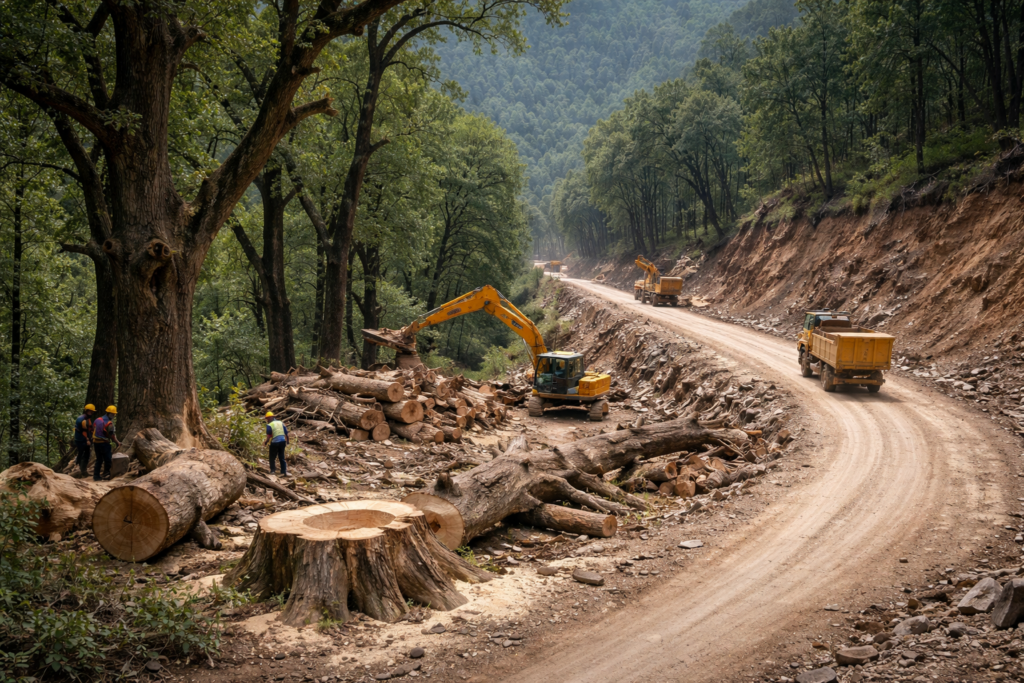
How One Chainsaw Unleashes a Catastrophe
Here’s what happens when a tree falls in the Himalayas; and everyone definitely hears it:
The Soil Loses Its Anchor
Tree roots bind soil to bedrock, and when trees are removed, sloped lands become far more susceptible to landslides. Think of roots as nature’s steel rebar, holding together thousands of tons of earth. Remove them, and gravity does the rest.
Water Becomes a Weapon
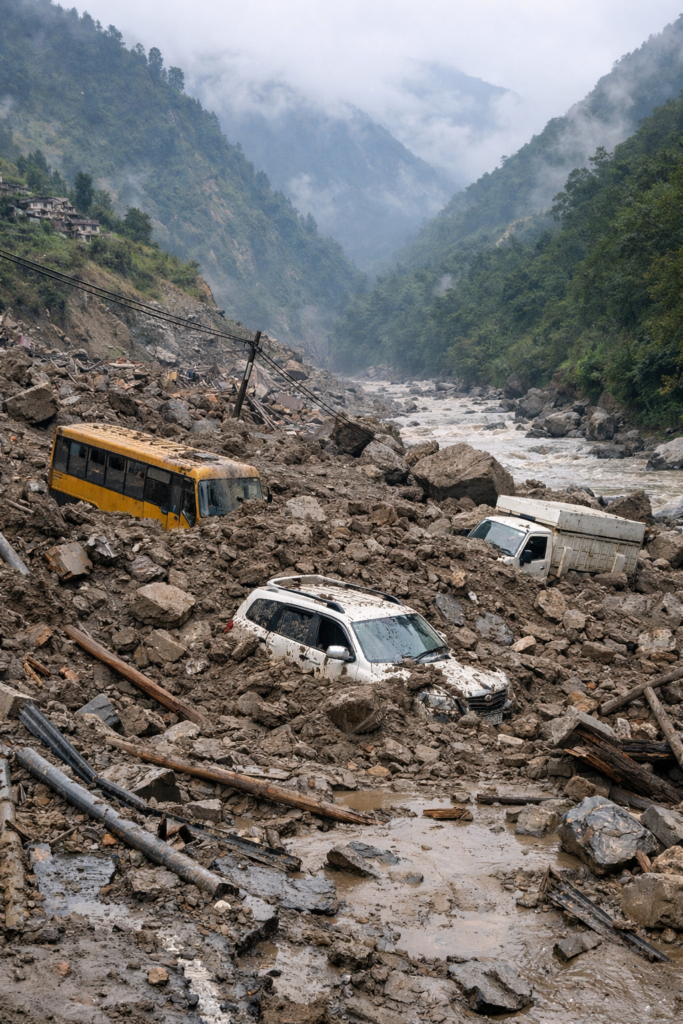
Trees act as giant sponges. They absorb excess monsoon rain and release it gradually; without them, water rushes down uncontrollably, triggering flash floods. During Himachal’s 2024 monsoon, this exact scenario played out. Roads became rivers. Entire hillsides melted into mudslides.
In October 2025, a bus near Bilaspur was buried under tons of earth, killing at least 15 people including women and children. Rescue teams dug through mud for days. The trigger? Torrential rains meeting deforested slopes.
The Temperature Rises
A shocking 2025 study found something terrifying: tropical deforestation between 2001 and 2020 exposed roughly 345 million people to local warming and was linked to about 28,330 additional heat-related deaths annually. When you remove forest cover, you remove the Earth’s air conditioning system.
The Numbers That Should Terrify You
Let’s talk facts that hit like falling boulders:
- The Indian Himalayan states lost 1,072 square kilometers of forest cover between 2019 and 2021
- By 2100, dense Himalayan forest cover could shrink to just 10% of the Indian Himalayan land area
- This could lead to the extinction of 366 endemic plant species and 35 endemic vertebrate species
- In Uttarakhand alone, 11,219 landslide incidents occurred between 1988 and 2022
- 72% of Uttarakhand (39,000 square kilometers) is prone to landslides
These aren’t just statistics. Each number represents a family displaced, a livelihood destroyed, a future erased.
Why Are We Cutting Down Our Own Lifeline?
The reasons read like a tragedy in three acts:
Act One; Roads to Nowhere (That End in Disaster)
The Char Dham highway project promised connectivity and economic growth. What it delivered was ecological chaos.
Experts recommended roads no wider than 5.5 meters in mountains, but the government pushed for 10-13 meter roads, requiring massive deforestation and slope cutting. The result? Mountains carved open like watermelons, their insides exposed to rain, wind, and gravity.
Geologist Ravi Chopra, who chaired a high-powered committee, discovered something shocking during field visits: geological investigations were inadequate, slopes were being cut at dangerous 60-70 degree angles, and roads were being built along river valleys; exactly where they should never be.
Before Independence, the British built mountain roads on ridges, not in valleys. They understood what we’ve forgotten: when floods come, valley roads get swept away.
Act Two; Dams That Promise Power, Deliver Catastrophe
The 2021 Chamoli disaster killed 200 people when a glacial burst sent a wall of debris crashing through a hydropower project. The 2013 Kedarnath tragedy killed thousands.
Deforestation is often compounded by monoculture plantations used for so-called “compensatory afforestation,” which lack the biodiversity and deep root structure of natural forests.
Translation: We’re replacing complex, evolved ecosystems with botanical window dressing.
Act Three; Tourism’s Dark Side
Every year, millions of pilgrims trek to sacred sites like Kedarnath, Badrinath, and Vaishno Devi. Hotels sprout like mushrooms. Trees fall like dominoes.
In August 2025, a cloudburst triggered a landslide on the Vaishno Devi pilgrimage route, killing 34 devotees despite clear weather warnings. The yatra continued anyway because economics trumped ecology.
The Compensatory Afforestation Lie
Here’s where it gets infuriating. Every time forest land is diverted for development, companies must pay for “compensatory afforestation”; planting trees elsewhere to make up for the loss.
Sounds great, right?
It’s a scam.
Research reveals the brutal truth:
- Large-scale tree planting in the Indian Himalayas has not led to increased forest canopy cover
- Plantations have shifted forest composition away from broadleaf varieties valued by local people, contributing to neither climate mitigation nor livelihood security
- In Himachal Pradesh, half the state’s tree planting budget is wasted on plantations unlikely to survive due to target-based approaches
Researchers found that compensatory afforestation plantations in the Himalayas were often sited in natural forests; meaning they weren’t compensating for anything; they were just converting one type of forest into another, less diverse one.
The fundamental problem? The policy doesn’t require ending the drivers of degradation before initiating afforestation, permits only uniform reconstructive approaches, and provides no guidance on selecting appropriate sites and species.
It’s like trying to fill a bathtub while the drain is wide open.
When Biodiversity Bleeds Out
The Himalayas are one of Earth’s 36 biodiversity hotspots. Over 75% of the original Himalayan habitat has already been degraded.
Let that sink in. Three-quarters. Gone.
What are we losing?
Species Vanishing Before Our Eyes
- The Himalayan tiger, now confined to shrinking corridors
- The red panda, whose bamboo forests are disappearing
- The snow leopard, killed in retaliation for livestock attacks as its natural prey vanishes
- As many as 87% of 124 endemic species have experienced warming-driven geographical range shifts in Sikkim Himalaya
The Cascade of Extinction
When a forest dies, everything connected to it starts dying too. Since 1970, there has been an average 69% decline in mammal, bird, reptile, fish, and amphibian populations.
Medicinal plants that local communities have used for thousands of years are vanishing. The traditional knowledge goes with them. Once a species is extinct, it’s gone forever; no second chances, no do-overs.
The Soil Erosion Apocalypse
Here’s something most people don’t realize: The northeastern Himalayas, with rainfall of 1,500-11,500 millimeters annually, face severe soil erosion affecting 22.3% of the area, compared to 12.6% in the northwestern hills.
In Himachal Pradesh, 34% of the state’s total geographical area falls under the severe erosion class.
Without tree roots to hold it, topsoil; built up over thousands of years; washes away in a single monsoon season. What’s left is barren, gravelly substrate where nothing can grow.
The cruel irony? The communities that depend on these forests for survival are watching their own livelihoods literally wash away.
The Human Cost Nobody Talks About
Every disaster has a face. Let’s talk about them.
The Bus Driver’s Last Ride
That October 2025 morning in Bilaspur started normally. A bus driver let’s call him Rajesh, because that could be anyone’s name; began his route through the mountains. Twenty-five passengers boarded. Mothers. Children. Workers heading to the city.
They never arrived. A landslide buried the bus under 75 feet of debris in seconds.
The Farmer Who Lost Everything
In Uttarkashi, a farmer named Sunita watched her family’s land slide into the river during the 2025 Dharali cloudburst. Three generations of work, gone in minutes. Dozens of homes were destroyed, people went missing.
She now lives in a temporary shelter, wondering if the government compensation will ever come.
The Widow of Vaishno Devi
Meera’s husband went on pilgrimage in August 2025. He was among the 34 who never returned. She’s raising two children alone now, in a village where widows are still blamed for their husband’s deaths.
These aren’t numbers. These are lives.
What Happens Downstream When Mountains Bleed
Here’s the terrifying truth: what happens in the Himalayas doesn’t stay in the Himalayas.
The mountains are the “water tower of Asia.” They feed ten major rivers including the Ganges, Indus, Brahmaputra, and Mekong. Approximately 120,000 million cubic meters of water flow down Himalayan rivers annually, nourishing millions living in the plains.
When you destabilize Himalayan slopes:
- Sediment chokes rivers downstream
- Flood patterns become erratic and deadly
- Hydroelectric dams silt up faster
- Agricultural lands lose irrigation
- Cities face water shortages
More than one billion people depend on Himalayan ecosystem services. When forests fall, a billion people suffer.
The Climate Change Multiplier Effect
If tree cutting was bad before, climate change has made it catastrophic.
Climate change is making storms more intense, glaciers less stable, and disasters more frequent. The Himalayas are warming faster than the global average.
What this means:
- More extreme rainfall events
- Faster glacial melting
- Increased landslide risk
- Longer dry seasons
- More forest fires
An ISRO report documented that between December 27, 2022 and January 8, 2023; just 13 days; Joshimath sank over 5 centimeters. The ground is literally giving way beneath people’s feet.
Can We Stop the Bleeding?
Here’s the good news: it’s not too late. Here’s the bad news: we need to act now.
What Needs to Happen Immediately
- Halt Destructive Projects: The Uttarakhand government’s decision to permanently seal the Loharinag-Pala hydroelectric project tunnels, though controversial, represents a recognition that some development is too dangerous
- Enforce Strict Road Width Limits: No more 13-meter cuts in fragile mountains. Stick to 5.5 meters or less
- Real Compensatory Afforestation: Not tree planting for show, but genuine ecosystem restoration with native species, community involvement, and long-term monitoring
- Listen to Local Communities: The 2022 Forest Conservation Rules removed the requirement to gain consent from village councils before clearing forests; this must be reversed
- Invest in Early Warning Systems: Technology exists to predict landslides. Use it
What You Can Do
- Share this article. Make people uncomfortable with the truth
- Support organizations working on Himalayan conservation
- Demand accountability from your elected representatives
- Choose sustainable tourism; stay in locally-owned, eco-friendly accommodations
- Reduce your carbon footprint; climate change is accelerating everything
The Reckoning
Here’s what keeps me up at night: we’re conducting an experiment with the Himalayas that we can’t reverse.
Every tree cut. Every slope blasted. Every road widened. We’re pulling threads from a tapestry that took 60 million years to weave.
Expert Ravi Chopra emphasizes that “the Himalayan mountains are geologically very young with fractured and fissured structures,” requiring extreme caution with any major engineering intervention.
The Kedarnath tragedy of 2013 should have been our wake-up call. The Chamoli disaster of 2021 should have been our last warning. The Joshimath crisis of 2023 should have forced us to stop.
But here we are in 2026, still cutting, still blasting, still pretending the mountains will forgive us.
A Witness. A Warning. A Record for the Future.
When your grandchildren ask what you did when the Himalayas were dying, what will you tell them?
Will you say you didn’t know? The evidence is overwhelming.
Will you say you couldn’t do anything? You can share this article right now.
Will you say it wasn’t your problem? Every river that flows from these mountains connects to you.
The Himalayas are not just mountains. They’re the lungs of South Asia, the water tower of a billion people, the climate stabilizer for the entire region.
When forests fall, mountains bleed. And when mountains bleed, the world downstream drowns.
The choice is ours. The time is now.
Comments from Nikhil Raj Sharma, Founder, Himalayan Geographic:
“This article captures the urgency of what we’re witnessing in real-time across the Himalayas. As someone who has trekked these mountains for over two decades, I’ve seen first-hand how rapidly the landscape is changing. The connection between tree cutting and landslides isn’t theoretical; it’s visible, measurable, and devastating.
What troubles me most is how we’ve normalized the destruction. A road project that would have been unthinkable 20 years ago is now fast-tracked without proper environmental assessment. We’ve confused development with destruction.
But I remain hopeful. The local communities I’ve worked with possess incredible traditional knowledge about sustainable mountain living. If we empower them, listen to them, and give them decision-making authority over their forests, we can still reverse course.
The Himalayas have stood for 60 million years. Let’s ensure they stand for 60 million more.”
Related Resources
Watch & Learn:
- NOVA: Killer Landslides – Documentary on landslide threats in the Himalayas and globally
- Children of the Snow Land – Award-winning film on Himalayan communities
- Michael Palin’s Himalaya Journey (2004) – Six-part series on Himalayan cultures and environment
Read More:
- Down to Earth: Himalayan Plunder
- Scroll.in: Expert Interview on Wide Roads Destroying Slopes
- Nature Sustainability: Limited Effects of Tree Planting in Northern India
Disclaimer: The content and images published in this article are provided for general informational and educational purposes only. Some images may be generated or enhanced using artificial intelligence (AI) and are intended solely for illustrative use. The views, interpretations, and information expressed do not necessarily reflect the official position of Himalayan Geographic Research Foundation, nor do they constitute professional, legal, medical, or financial advice.
While efforts are made to ensure accuracy, no guarantees are given regarding completeness or reliability. Readers are encouraged to independently verify information and use their own judgment. By reading this article, you acknowledge that any reliance on the content is at your own risk, and Himalayan Geographic Research Foundation assumes no responsibility or liability for disagreements, interpretations, or outcomes arising from its use. If you do not agree with these terms, you are advised to discontinue reading.