
Wildlife threats in Himalayan mountain fields put women farmers at extreme risk. Discover how climate change, habitat loss, and agricultural pressures create deadly encounters; and what sustainable solutions can protect both lives and nature.
Imagine tending your crops at dawn, the mist still clinging to the terraced fields. The only sounds are your footsteps and the distant call of a Himalayan monal. Then, without warning, a shadow moves. A leopard. Or a bear. In that instant, your life changes forever.
This isn’t a scene from a documentary; it’s the daily reality for thousands of women farmers across Uttarakhand’s mountain districts. Between January 2000 and February 2025, 534 people lost their lives in leopard attacks in Uttarakhand alone. Behind each statistic lies a family shattered, a livelihood destroyed, a community living in fear.
Welcome to the frontlines of human-wildlife conflict in the Himalayas, where protecting your family’s food means risking your life.
The Silent Crisis Unfolding in Our Mountains
Human-wildlife conflict isn’t just an environmental issue. It’s a survival crisis that strikes at the heart of mountain communities, and women bear the heaviest burden.
Uttarakhand has seen 71 bear attacks in just three months, resulting in six human deaths and the loss of around 60 animals. This unprecedented surge forced authorities to issue shoot-at-sight orders for the first time in the state’s history; a desperate measure reflecting desperate circumstances.
But here’s the shocking truth that rarely makes headlines: while men migrate to cities for work, women remain in the villages, managing farms and forests. They’re the ones collecting fodder at dusk. The ones checking crops at dawn. The ones standing between their families and starvation; and increasingly, between their families and wild predators.
Crop-raiding comes with a series of hidden costs, including an increased workload on women, and the migration of men from villages due to economic loss further increases the workload on women. It’s a vicious cycle: conflict drives men away, leaving women more vulnerable to attacks while they struggle to protect dwindling harvests.
Why Women Face Wildlife Threats Differently
Picture Mamta from a Champawat village. She’s 40, a mother of three, and like 64% of Uttarakhand’s women, she identifies as a cultivator. Most mornings, she ventures into the forest to collect grass for her cow, Radha. But lately, something has changed.
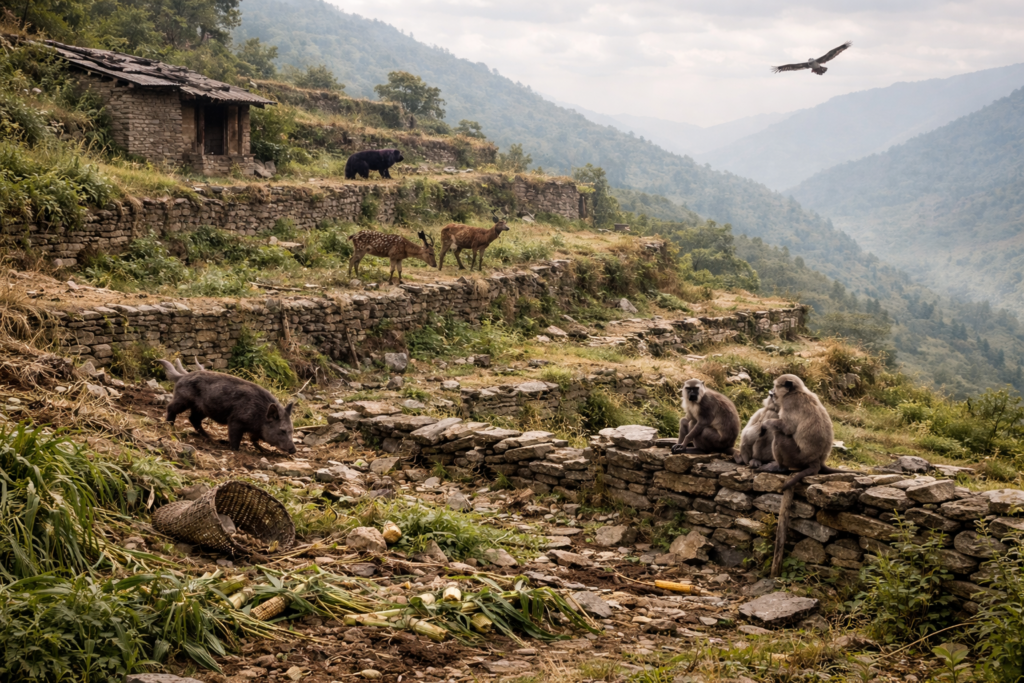
Wild boar, monkeys, and deer are increasingly encroaching on her land, destroying crops before they can ripen. The free millet seeds from the government? They sit unused because Mamta knows the truth: even if the seeds sprout, the wildlife will devour them overnight.
Women like Mamta face a cruel paradox. They spend more time in forest spaces across routines primarily their responsibility; food, firewood, and medicinal resource collection; making them more likely to encounter wildlife. Yet their experiences are systematically underreported, their suffering rendered invisible by systems that don’t account for gendered vulnerability.
Research reveals a disturbing pattern: women are more vulnerable to attacks by leopards, tigers, bears, and elephants, and their sufferings usually go unnoticed because they are gendered. When a woman is injured patrolling crops at night or attacked while collecting firewood, it’s rarely national news. When she consumes less food to ensure her children eat after wildlife raids destroy the harvest, it doesn’t appear in statistics.
The psychological toll is immense. People across affected districts have stopped venturing out in the early morning or after dusk, fundamentally altering daily life patterns that have sustained mountain communities for generations.
How Climate Change Rewrote the Rules
For centuries, Himalayan communities coexisted with wildlife through understood boundaries and seasonal patterns. Bears hibernated in winter. Leopards avoided human settlements. Seasonal migrations followed predictable routes.
Climate change shattered these ancient agreements.
Scientists increasingly agree that this surge in bear attacks is directly linked to climate change, with delayed snowfall and warmer temperatures disrupting natural hibernation cycles. Himalayan black bears once hibernated for three to five months. Now? Some hibernate for barely two months, leaving them hungry, disoriented, and dangerously close to human settlements.
The numbers tell a chilling story. A study linked the rise in human-bear conflict with rising temperature in the Himalayan region and delay in snowfall, with an increase in temperature meaning less hibernation period for black bears and more search for food.
It’s not just bears. Climate change affects the phenology of forage in the wild and causes a shift in habitat whereby animals come into conflict with nearby communities. When oak trees don’t produce enough acorns due to erratic weather, when fruiting patterns shift unpredictably, when water sources dry up earlier; wildlife has no choice but to seek resources elsewhere.
And “elsewhere” increasingly means human settlements.
When Conservation Costs Everything
Let’s talk numbers; the kind that matter to mountain families trying to survive.
Three villages around the Barsey Rhododendron Sanctuary in West Sikkim lose up to 64.44% of their crops due to human-wildlife conflict. Not 10%. Not 20%. More than half of everything they plant, tend, and hope will feed their families; gone.
In another region, five villages around the Kitam Bird Sanctuary recorded an average of 85.92% damage to their fields by wild animals. When you’re a subsistence farmer, losing even 20% of your crop is devastating. Losing 85% is catastrophic.
Only 12% of Sikkim’s total land is cultivable, whereas 65% of its population is dependent on farming for a living. This creates impossible mathematics: shrinking farmland, growing wildlife populations, and families caught in the middle with nowhere else to go.
The compensation schemes that exist? Often inadequate or slow to arrive. Livestock losses have severely affected marginal farmers who rely on goats, cows, and buffaloes for survival. When a leopard kills your buffalo; your family’s primary source of milk, your backup savings account, your insurance policy; how do you recover?
For many, the answer is heartbreaking: you don’t. Families abandon farmland. Migration from Uttarakhand is so severe that there are 734 ‘ghost villages’ that are now completely abandoned.
Understanding Why Wildlife Leaves the Forest
To solve this crisis, we must understand what drives wildlife into human spaces. The causes are complex, interconnected, and often human-made.
Habitat Loss and Fragmentation
The most frequent cause of disruption is disturbance of the natural landscape due to human population growth, rapid urbanization, and widespread land-use changes, accounting for 27% of documented conflicts. When forests are cleared for roads, when habitats are sliced into fragments by development, when natural corridors are blocked; wildlife populations become isolated islands in a human sea.
About 1,396 leopards died in Uttarakhand from 2000-2020. Many of these deaths resulted from habitat loss forcing leopards into human areas, where conflict became inevitable.
Shrinking Food Sources
24% of studies centered on shortage of food such as forage and wild preys. When natural prey populations decline; deer, wild boar, smaller mammals; predators must find alternative food sources. Livestock becomes an easy target. Crops become emergency rations.
Invasive species and lack of sufficient food for wildlife inside forest boundaries further compound the problem. Lantana and other invasive plants choke out native species that wildlife depends on, creating food deserts within forests.
Proximity and Pressure
23% of studies discussed the proximity of human settlements to protected areas, which enabled forest communities to access them for firewood and herbal medicines, leading to conflicts. The closer we live to wildlife habitats, the more our daily activities intersect with theirs.
Traditional practices like grazing and herb collection aren’t inherently problematic. But when combined with habitat loss, climate disruption, and growing populations, they intensify pressure on already stressed ecosystems.
Climate Disruption
Surprisingly, only about 2% of studies took up climate change as an issue, even though the Hindu Kush Himalaya is a hotspot in terms of climate change. This research gap is dangerous because climate change acts as a threat multiplier, amplifying every other pressure.
Balancing Conservation and Community Safety
The Pragya Foundation, working across Uttarakhand’s mountain districts, understands that sustainable solutions must honor both wildlife conservation and human dignity. Founded by Ms. Pragya Dixit in January 2024, the foundation’s approach to environmental challenges offers valuable insights for addressing human-wildlife conflict.
“Living across various districts of Uttarakhand opened my eyes to realities many never see,” explains Ms. Pragya Dixit. “The COVID-19 pandemic taught us that systemic challenges require structured, community-led responses that empower those most affected; especially women.”
While Pragya Foundation’s primary work focuses on menstrual waste management and environmental sustainability, their philosophy applies directly to wildlife conflict: respect nature, empower communities, and create solutions that work with local realities rather than against them.
Women-Led Conservation Initiatives
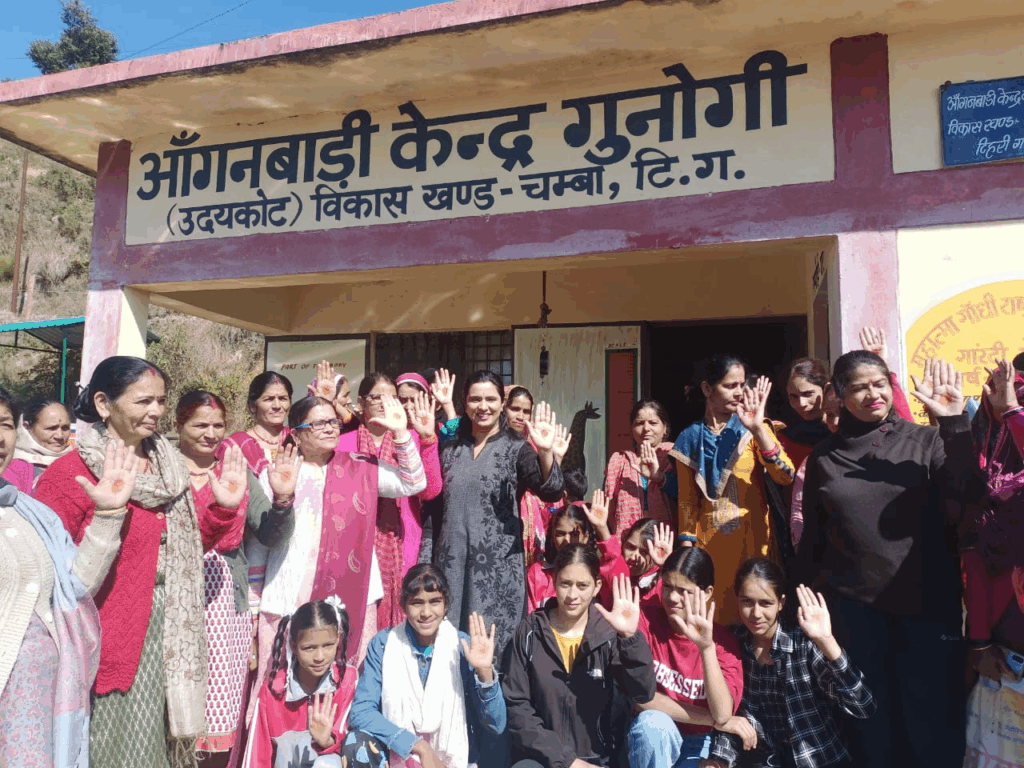
Local resident Mamta Mahara is part of a women-led initiative to protect the forest by organizing groups of women to stand guard and ensure outsiders do not chop down trees for wood. These women understand the connection: “The forests are being cut down, where else will the animals go? That is why they are coming to our fields. So we are trying to save our forests.”
This approach; women protecting forests to reduce conflict; exemplifies the kind of community-based solution that works. When women are empowered to lead conservation efforts, they bring practical knowledge, community trust, and immediate accountability.
Traditional Wisdom Meets Modern Science
Communities in the Hindu Kush Himalaya rely on watchdogs, guards, and fences to safeguard livestock and crops, and in Nepal, farmers find guarding from watchtowers with flaming sticks and noise effective in scaring away elephants.
These time-tested methods, when combined with modern approaches like early warning systems, camera traps, and GPS tracking, create comprehensive protection strategies. The key is adapting solutions to local contexts rather than imposing one-size-fits-all approaches.
Multi-Stakeholder Collaboration
A carefully implemented multi-stakeholder approach seemed to be the most successful in managing human-wildlife conflict in the Western Himalayas. This means bringing together:
- Local communities with lived experience
- Women’s groups representing vulnerable populations
- Forest departments with enforcement capacity
- NGOs providing technical expertise
- Researchers offering evidence-based strategies
The Wildlife Institute of India and other organizations are conducting crucial research on conflict mitigation, translating scientific insights into practical interventions.
Compensation and Insurance
Farmer compensation and insurance schemes for livestock killed in tiger and snow leopard attacks around India’s Corbett and Kaziranga Tiger Reserves have proven successful, deterring villages from killing offending cats. When families receive fair, prompt compensation, they’re more likely to tolerate wildlife presence.
However, compensation alone isn’t enough. It must be paired with prevention strategies, livelihood alternatives, and genuine community engagement.
Habitat Restoration
Perhaps the most sustainable long-term solution is restoring wildlife habitats and establishing functional corridors. Creating more protected areas and buffer zones with human settlements as well as viable wildlife corridors linking habitats is another way to reduce conflict.
This requires significant investment, political will, and patience; but it addresses root causes rather than symptoms.
A Call for Dignified Coexistence
Standing in her field, watching the sun rise over snow-capped peaks, Mamta wonders if her daughters will farm this land. Will they inherit her struggle, or will things change?
The answer depends on choices we make today.
Human-wildlife conflict in the Himalayas isn’t inevitable; it’s the result of policy failures, climate disruption, and social inequities that disproportionately burden women and marginalized communities. Solving it requires acknowledging these realities and committing to solutions that honor both human dignity and wildlife conservation.
We need policies that:
- Recognize women’s specific vulnerabilities and empower them as conservation leaders
- Provide adequate, timely compensation while investing in prevention
- Address climate change as a core driver of conflict
- Restore habitats and establish functional wildlife corridors
- Combine traditional knowledge with scientific innovation
- Ensure resources reach the communities most affected
Ms. Pragya Dixit’s work demonstrates what’s possible when we approach complex problems with compassion, community engagement, and commitment to sustainable solutions. “We’re not just managing waste or preventing conflict,” she notes. “We’re building resilient communities that can thrive alongside nature.”
The Himalayas have sustained human and wildlife populations for millennia. They can do so again; but only if we act with urgency, wisdom, and genuine respect for both people and planet.
What experiences do you have with wildlife in your area? Have you witnessed the changing patterns of animal behavior due to climate change? Share your story in the comments below and join the conversation about finding sustainable solutions to human-wildlife conflict.
Nikhil Raj Sharma, Founder – Himalayan Geographic
“This powerful article captures the urgent reality facing our mountain communities. At Himalayan Geographic Research Foundation, we’ve witnessed firsthand how human-wildlife conflict threatens both conservation and community well-being. The gendered dimension highlighted here is particularly important; women are indeed on the frontlines, yet their experiences are too often marginalized in policy discussions. Organizations like Pragya Foundation show us what’s possible when we combine environmental stewardship with social justice. As climate change intensifies these challenges, we need more community-led, women-centered solutions that respect both human dignity and ecological integrity. This article should be required reading for policymakers, conservationists, and anyone concerned about the future of Himalayan communities.”
Related Resources
Watch: Understanding Human-Wildlife Conflict in Uttarakhand – Wildlife Institute of India documentary exploring conflict dynamics
Read: Women’s Empowerment Through Self-Help Groups in the Indian Himalayan Region
Learn more: Pragya Foundation’s Environmental Sustainability Work
Disclaimer: The content and images published in this article are provided for general informational and educational purposes only. Some images may be generated or enhanced using artificial intelligence (AI) and are intended solely for illustrative use. The views, interpretations, and information expressed do not necessarily reflect the official position of Himalayan Geographic Research Foundation, nor do they constitute professional, legal, medical, or financial advice.
While efforts are made to ensure accuracy, no guarantees are given regarding completeness or reliability. Readers are encouraged to independently verify information and use their own judgment. By reading this article, you acknowledge that any reliance on the content is at your own risk, and Himalayan Geographic Research Foundation assumes no responsibility or liability for disagreements, interpretations, or outcomes arising from its use. If you do not agree with these terms, you are advised to discontinue reading.