
Why Himalayan deforestation threatens 2 billion people. From devastating landslides to water crises, learn how losing mountain forests impacts humanity’s survival and what we can do now.
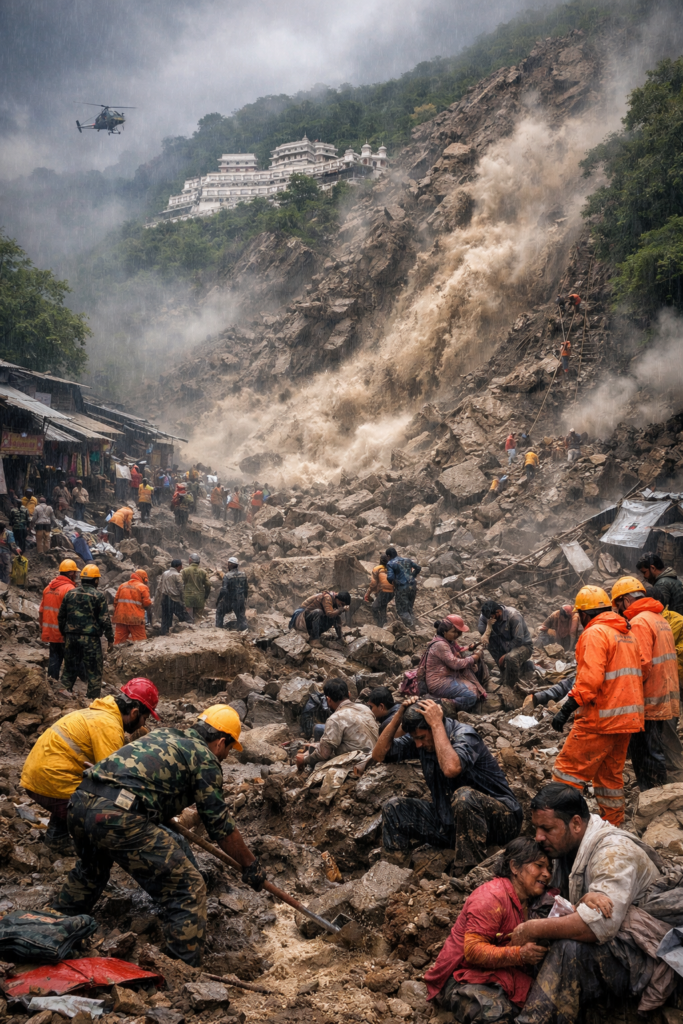
In August 2025, pilgrims walking toward the sacred Vaishno Devi shrine witnessed a nightmare unfold. A sudden cloudburst triggered a massive landslide that buried 34 devotees alive. The mountains themselves seemed to betray their faith. But was it the mountains; or what we’ve done to them?
The Himalayas are bleeding. Not slowly, but catastrophically. And when these mountains lose their trees, every person from Delhi to Dhaka feels the consequences.
Why the Himalayas Matter More Than You Think
Picture this: the Himalayas stretch across 2,000 miles, touching eight countries. They’re not just postcard-perfect peaks. They’re the lifeline for nearly two billion people; that’s one in every five humans on Earth.
These mountains are often called Asia’s “Water Tower.” The Ganges, Indus, Brahmaputra, Mekong, and Yangtze rivers all begin here. Every morning when you drink water, irrigate farmland, or generate electricity in South Asia, you’re depending on Himalayan forests working silently in the background.
Here’s the sobering reality: Himalayan glaciers are melting 65% faster since 2010 than the previous decade. At our current pace, the Eastern Himalayas could lose up to 75% of their ice by 2100.
But glacial melt is only part of the story.
The Silent Engineers Holding Mountains Together
Think of tree roots as nature’s stitches. They literally hold the soil together on steep mountain slopes.
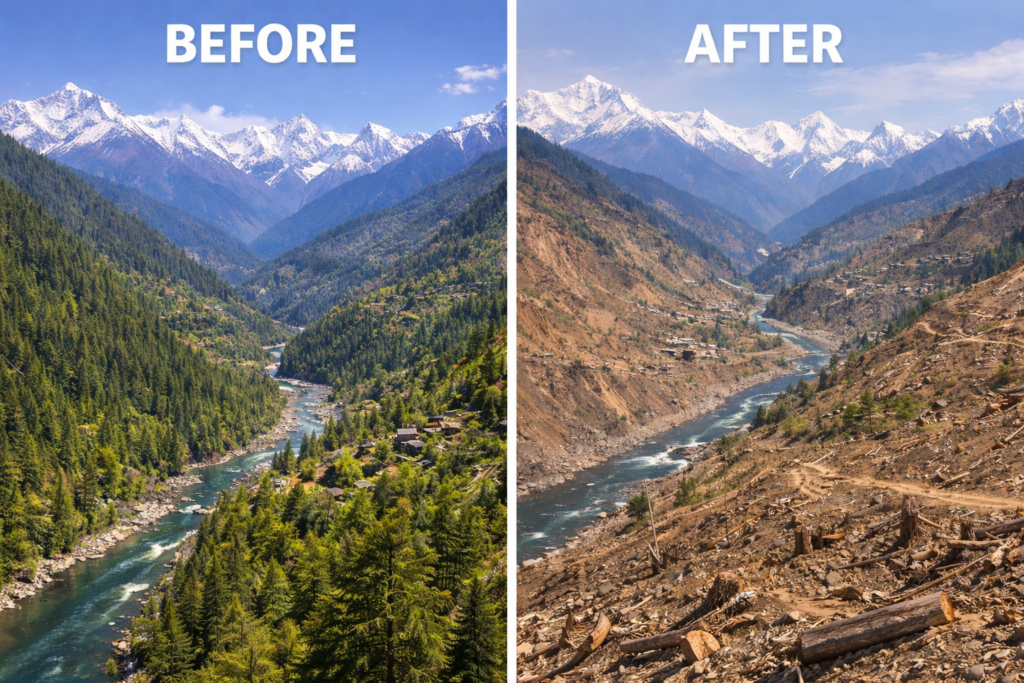
When forests disappear, those stitches come undone. Slopes lose their grip. And during monsoons, entire hillsides slide down like wet paper.
Between 1988 and 2022, Uttarakhand alone recorded 11,219 landslides. That’s not a number; that’s 11,219 moments of terror for mountain communities. In 2024, cloudbursts in Himachal Pradesh’s Dharamshala and Mandi regions killed over 50 people and destroyed countless homes.
Tree roots anchor soil, and when forests are cut, slopes lose their grip, causing landslides and erosion. Forests also act like giant sponges, absorbing heavy rainfall and releasing it slowly. Strip away the trees, and rainwater rushes downhill uncontrollably, triggering flash floods.
The 2013 Kedarnath disaster killed thousands. Scientists concluded that deforestation and reckless construction amplified the destruction. Nature didn’t fail us; : we failed nature.
When the Mountains Lose Their Trees
Here’s what most people don’t realize: when it rains hard in the mountains, cities hundreds of miles away pay the price.
In September 2024, Nepal’s Kathmandu valley received 240mm of rain; the heaviest since 2002. The resulting floods and landslides killed 228 people. One in every seven Bangladeshis is expected to be displaced by 2050 due to flooding linked to upstream changes.
But here’s where science complicates the narrative. Research shows that while local deforestation dramatically increases landslides and flash floods in mountain communities, its impact on massive downstream flooding in places like Bangladesh is more complex than once believed. The real villains? Climate change driving extreme rainfall, and unplanned construction choking river channels.
Still, mountains losing their forests means communities lose their first line of defense against disaster.
When Glaciers Melt Too Fast
Glaciers are like frozen savings accounts. For centuries, they’ve stored water and released it steadily during dry seasons.
But climate change is forcing an early withdrawal. Himalayan glaciers have lost 40% of their area since the Little Ice Age; shrinking from 28,000 km² to 19,600 km² today.
Initially, more melt means more water. Sounds good, right? Wrong.
Increased melt may trigger landslides or glacial lake outburst floods, with devastating consequences. In 2022, Pakistan’s Shisper Glacier burst through an ice dam, flooding valleys and washing away the Hassanabad bridge, cutting off food supplies for remote regions.
By the 2050s, meltwater flow will peak; then begin declining. Communities in places like Gilgit-Baltistan are already seeing unpredictable water patterns. Farmers who once knew exactly when snowmelt would arrive now face chaos. Some have abandoned their fields entirely.
The dry season could become bone-dry. Wells could run empty. And 65% of domestic water supply in places like Nepal’s Khumbu Valley depends on glacial melt.
Biodiversity in Free Fall
Over 75% of the original Himalayan habitat has been destroyed or degraded. Think about that; three-quarters gone.
The Eastern Himalayas host incredible biodiversity: snow leopards, red pandas, Himalayan tahrs, and over 300 bird species. But rapid habitat loss is pushing them toward extinction.
The Himalayan musk deer, hunted for traditional medicine, is losing forest cover at an alarming rate. Climate warming is shifting vegetation zones, forcing species like the Himalayan birch toward the east while rhododendron forests expand.
And it’s not just wildlife suffering. Over 675 edible plants and 1,743 medicinal species found in the Indian Himalayas are at risk. When forests vanish, mountain communities lose their traditional pharmacies and food sources.
Displacement and Lost Livelihoods
Numbers can numb us. Let’s talk about real people.
In Joshimath, homes literally sank into the ground in 2023. Entire families evacuated within days as their town became geologically unstable; a direct consequence of construction on fragile slopes.
In July 2023, Himachal Pradesh’s apple orchards; the economic backbone; were washed away by flash floods. Farmers who’d invested years of labor watched their livelihoods float downstream.
Mountain communities have lived sustainably for centuries. But modern “development”; four-lane highways through the Char Dham project, hydropower tunnels blasted through mountains, hotels on unstable slopes; has destabilized their world.
The irony? These projects are often justified as bringing progress. Instead, they bring disaster.
Progress or Destruction?
The Himalayas are geologically young and fragile. They’re still rising, still settling. Building massive infrastructure here is like constructing a house on quicksand.
Yet governments chase “development” aggressively:
- Explosive mountain blasting for tunnels
- Hotels in river basins that narrow natural water flow
- Roads without proper geological assessment
Between 2000 and 2024, Uttarakhand’s total road length increased tremendously. Environmental experts begged for geological assessments before construction. They were ignored.
Uttarakhand witnessed 11,219 landslides between 1988 and 2022, with 72% of the state prone to landslides, according to reports.
Construction doesn’t stop for monsoons. Tourists keep arriving. And when disaster strikes, we call it an “act of God.”
It’s not. It’s an act of greed.
What Happens When We Lose the Forests?
Let’s be clear: protecting Himalayan forests isn’t about hugging trees or saving cute animals (though that matters too). It’s about human survival.
Here’s what’s at stake:
Water Security: Nearly 2 billion people depend on rivers fed by these mountains. No forests = erratic water supply.
Food Security: Stable water means predictable agriculture. Lose the forests, lose the harvest.
Disaster Prevention: Forests buffer against landslides and floods. Without them, disasters multiply.
Climate Stability: Himalayan forests store massive amounts of carbon. Deforestation accelerates global warming.
Economic Stability: Tourism, agriculture, and hydropower depend on healthy ecosystems.
Lose the trees, and dominoes fall across continents.
Solutions That Actually Work
This isn’t a hopeless situation. But band-aid solutions won’t cut it.
1. Stop Pretending Development Means Destruction
Mountain roads should be 8-10 meters wide max, like in European Alps. Not four-lane highways carved with explosives.
Every project; every single one; must undergo rigorous geological and environmental assessment BEFORE construction begins. No exceptions.
2. Community-Led Afforestation Programs
Top-down tree-planting campaigns often fail. Trees planted without community buy-in don’t survive.
Successful models exist. Nepal’s community forest management has reduced deforestation in several regions. When locals own and benefit from forests, they protect them fiercely.
3. Eco-DRR: Ecosystem-Based Disaster Risk Reduction
Nature-based solutions work. Fodder banks reduce pressure on forests while supporting livestock. Terracing and contour farming prevent soil erosion. Traditional water harvesting systems manage monsoon excess.
These aren’t new ideas; they’re ancient wisdom we’ve forgotten.
4. Sustainable Tourism, Not Tourist Trampling
The Himalayas attract millions of tourists. That’s good for the economy. But unregulated tourism destroys the very beauty people come to see.
Bhutan limits tourist numbers and charges sustainability fees. It works. Other Himalayan regions should learn.
5. Youth and Student Leadership
Here’s where YOU come in.
Students and young people aren’t just the future; you’re the now. Organize local tree-planting drives. Pressure politicians for stricter environmental laws. Use social media to expose reckless construction.
When the Chipko Movement began in the 1970s, village women literally hugged trees to prevent logging. Their courage saved forests. We need that same energy today; just with smartphones and hashtags.
From Villages to Cities
Mountain conservation isn’t just a mountain problem.
City dwellers benefit from Himalayan water. Urban floods worsen when mountain forests disappear. Your electricity might come from Himalayan hydropower.
We’re all connected.
Support companies practicing sustainable forestry. Vote for politicians with strong environmental records. Donate to organizations doing real conservation work (not just photo-ops).
And talk about it. Make noise. Climate silence is complicity.
What You Can Do Right Now
Start small. Think big.
This week:
- Learn about your water source. Does it originate in mountains?
- Share this article. Start conversations.
- Reduce paper waste (fewer trees cut).
This month:
- Join or donate to organizations like WWF, ICIMOD, or local conservation groups
- Plant a tree (properly; native species in appropriate locations)
- Organize a campus or community awareness event
This year:
- Volunteer with reforestation projects
- Advocate for sustainable policies in your region
- Travel responsibly; choose eco-friendly tourism options
Small actions multiply. Individual ripples become waves.
Act Now or Pay Later
The Himalayas aren’t just scenery. They’re infrastructure. They’re pharmacy and supermarket and water treatment plant all rolled into one; built by nature over millions of years.
We’re dismantling them in decades.
Climate change is here. Glaciers are melting. But we can still reduce deforestation. We can still build sustainably. We can still protect what remains and restore what’s been lost.
Or we can keep building recklessly, extracting greedily, and pretending consequences won’t catch up.
Tree roots anchor soil; when forests are cut, slopes lose their grip. It’s that simple. And that urgent.
The mountains are speaking. Through landslides and floods, through droughts and disasters, they’re screaming a warning.
The question isn’t whether we’ll listen. It’s whether we’ll listen in time.
Resources to Learn More
Watch:
- The Himalayas (BBC Natural World, narrated by David Attenborough)
- Himalayan Waters: Problems and Solutions – Documentary exploring water crises
- 14 Peaks: Nothing Is Impossible (Netflix) – Shows Himalayan landscape and challenges
Read:
- Yale Environment 360: Himalayan Glaciers and Water Crisis
- National Geographic: Understanding Flash Flooding
Follow:
- International Centre for Integrated Mountain Development (ICIMOD)
- WWF Himalayas Program
- Himalayan Geographic Research Foundation
Your Turn: What Will You Do?
The mountains need allies. Trees need defenders. Future generations need us to act.
Will you plant a tree? Pressure a politician? Start a campus movement? Share this article?
Don’t just read and scroll. Do something. Anything. Today.
Because when the mountains lose their trees, humanity doesn’t just pay a price; we lose everything.
Comments from Nikhil Raj Sharma, Founder, Himalayan Geographic:
“For too long, we’ve treated mountains as mere tourist destinations or resources to exploit. The reality is stark; when mountain ecosystems collapse, the consequences ripple across continents. What strikes me most is how interconnected everything is. A tree cut in Uttarakhand affects water flow in Bangladesh. A glacier melting in Nepal impacts millions downstream. We’re all in this together, whether we realize it or not.
The youth uprising around climate action gives me hope. Young people in Himachal, Uttarakhand, and across the Himalayan belt are demanding better from their leaders. They’re organizing cleanups, planting trees, and most importantly, refusing to accept business as usual. This generation understands what’s at stake.
At Himalayan Geographic, we’re committed to amplifying these stories; not just the disasters, but the solutions, the heroes, the communities fighting back. Every article we publish, every documentary we support, every tree planted through our partnerships; these are acts of resistance against the destruction of our mountains.
I urge every reader: don’t be a bystander. Whether you live in the mountains or the plains, your choices matter. Support sustainable businesses. Demand accountability from politicians. Teach your children to love and protect nature. And if you visit the Himalayas, leave them better than you found them.
The mountains have given us everything. It’s time we gave back.”
“Disclaimer: The content and images published in this article are provided for general informational and educational purposes only. Some images may be generated or enhanced using artificial intelligence (AI) and are intended solely for illustrative use. The views, interpretations, and information expressed do not necessarily reflect the official position of Himalayan Geographic Research Foundation, nor do they constitute professional, legal, medical, or financial advice.
While efforts are made to ensure accuracy, no guarantees are given regarding completeness or reliability. Readers are encouraged to independently verify information and use their own judgment. By reading this article, you acknowledge that any reliance on the content is at your own risk, and Himalayan Geographic Research Foundation assumes no responsibility or liability for disagreements, interpretations, or outcomes arising from its use. If you do not agree with these terms, you are advised to discontinue reading.”